




JET Alum Helps Moss Point Mississippi High School Host Japanese Students for Cultural Exchange
 Article/Journalism, Events, Uncategorized
  Comments Off on JET Alum Helps Moss Point Mississippi High School Host Japanese Students for Cultural Exchange
Via WLOX.com. Posted by Kay Monroe (Miyazaki-shi, 1995 -97). Click here to join the JETwit Jobs Google Group and receive job listings even sooner by email.
————————————————————————————————————
Moss Point High School’s Japanese club hosted 30 Japanese students in Moss Point Mississippi for a unique experience through the Kizuna Project with JET Alum Megan Bernard.
WLOX.com – The News for South Mississippi
Isn’t Japan Supposed to be Polite?
Humor, Japan Local, Writers Comments Off on Isn’t Japan Supposed to be Polite?
Posted by Benjamin Martin, a 5th year JET in Okinawa, publisher of the blog MoreThingsJapanese.com and author of the YA fantasy novel Samurai Awakening (Tuttle).
For those of you who don’t know, I spent my first three years in Japan living on Kitadaito Island. Kitadaito is a small island 320km east of the mainland of Okinawa. While I was there, I experienced the close community of rural Japan, and started writing. A bit over a year ago, I moved to Kumejima which his far larger. Since this is my last year with the JET Programme, I decided to visit Kitadaito during their annual Daitogusai Festival. While I still stayed in contact with many people from Kitadaito, and even saw them occasionally on the mainland, it was the first time I had really seen everyone in over a year.
A year might not seem like a long time to you, but in Japan things can change a lot. Teachers, doctors, and other civil servants often change jobs every few years. On Kitadaito, Junior High graduates have to leave the island since there is no high school for them. So even though it had only been a year, some students and friends were gone, many students had gotten bigger or changed, and there were new people to meet.
Perhaps most surprising was the fact that I had changed too. When I came to Japan I weighed 80kg (that’s 176lbs for all you non-metric people). If you’ve read Samurai Awakening, you probably figured out I played a lot of sports while I was there, and with all the running and sports festivals, I kept in decent shape. Things change though
Back to Daito
So last month, I went back to Kitadaito for 5 days. Nearly the first thing, every single person said to me was “太った” (futotta). Now if you plug that into Google Translate, you’ll get a translation of “Fat” with alternatives of “Chubby” and “Plump.”
Why did literally at least 15 people say this to me on my first day back? Well because when I went I was about 91kg (200lbs). But aren’t Japanese people supposed to be polite? Don’t they ignore stuff so that they can live through dealing with stuffed subway cars and close quarters? Strangely enough, there’s a lot going on in that simple little phrase, and a lot of different meanings.
…Read the full article at MoreThingsJapanese.com
WIT Life #218: Hold These Truths
Events, Translating/Interpreting, WIT Life, Writers Comments Off on WIT Life #218: Hold These Truths
WIT Life is a periodic series written by professional Writer/Interpreter/Translator Stacy Smith (Kumamoto-ken CIR, 2000-03). She starts her day by watching Fujisankei’s newscast in Japanese, and here she shares some of the interesting tidbits and trends together with her own observations.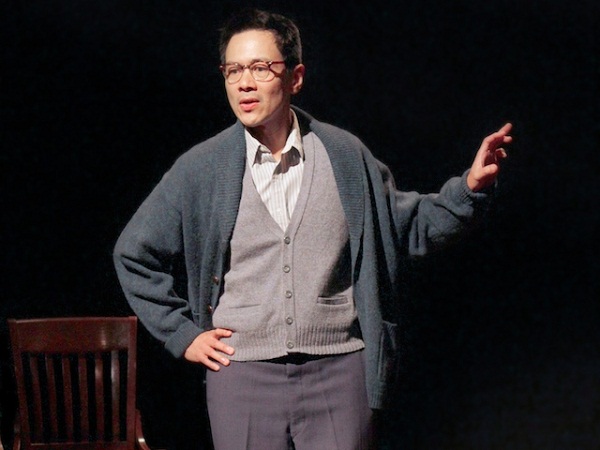
This weekend I went to see the heralded play Hold These Truths being shown at the 14th Street Y. It starts Joel de la Fuente as Gordon Hirabayashi, second generation Japanese-American who defied Executive Order 9066, which led to the forced interment of Japanese Americans in camps during World War II. De la Fuente (10-year veteran of Law and Order SVU) brings his proven acting chops to this one-man show, in which he plays not only the role of Hirabayashi himself, but also those of family, friends, law enforcement, lawyers, etc.
The play traces Hirabayashi’s journey as a boy growing up in Seattle to university student to imprisoned activist to the eventually taking of his case all the way to the Supreme Court. Unfortunately the Court unanimously rules against Hirabayashi and the other two Japanese-American resistors, but he is vindicated when Read More
JQ Magazine: JQ&A with Jenn Doane of the Hiroshima Ange Violet
Article/Journalism, Interview/Profile, JQ Magazine Comments Off on JQ Magazine: JQ&A with Jenn Doane of the Hiroshima Ange Violet
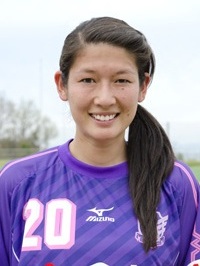
“On JET I was deeply involved in both my town and my prefecture, and in turn developed close relationships with both foreigners and Japanese people. Seattle is a diverse place, but I don’t think I would ever have had such a dynamic and interesting life outside of my day job!”
Seattle native Jenn Doane (Shimane-ken, 2010-12) has played soccer since she was eight years old. Having been a four-year starter on her high school varsity team, a three-year starter in college, and selected to play for the Olympic Development Program, she is now the first American to play professional soccer on a Japanese team, the Hiroshima Ange Violet. JQ learned all about her path to the team in this exclusive interview.
How did you become interested in Japan and the JET Program?
I have known about the JET Program since I was young, actually—my parents were both very involved in the Japanese community in Seattle: My mother was the executive director of the Japan America Society and the Japanese American Chamber of Commerce, and my dad served as president of the Society as well, and I think they have even been asked to be interviewers for prospective JET candidates. However, as any teenager would, I wasn’t interested in anything my parents were! I am three-fourths Japanese and one-fourth Caucasian (my mom is full, my dad is half, and both were born and raised in America).
I wasn’t necessarily ashamed of being Japanese, but I grew up in a mostly Caucasian suburb–and while I don’t think I was ever really picked on or anything, being Japanese wasn’t something I was overly proud of! You should have seen the reactions of my friends when I sometimes brought onigiri and kamaboko in my school lunch!
I was planning to be a Spanish major in college until my junior year when I decided to switch my focus to Japanese and study abroad in Osaka. I think I finally came around and got more curious about my heritage and the Japanese language. Many students from my college (Whitman) do the JET Program, and after a wonderful study abroad experience and hearing from all the raving alums, I thought it would be the perfect thing to do after graduating. So, here I am (or rather, there I was…).
I noticed you were a violinist for the Whitman Women’s Symphony. Any plans to continue with the violin in Japan?
Unfortunately, I have not touched a violin in a long time—however, I really have a passion for music and have found other ways to realize the musician in me! I joined a singing group in the countryside (we sing all the Glee hits) and have also been learning guitar. If I had easier access to a violin, I would definitely love to get back into it!
If you don’t mind sharing, what was it like to be on JET and teach at schools during the time of the disasters last year?
Compared to the JETs and teachers actually living in Tohoku, I can’t say that things were dramatically different. However, there was a kind of solemnness in the air after what happened— lots of moments of silence, and donations boxes all around school and town. One of my college friends is a JET in Miyagi Prefecture and we couldn’t get a hold of him for two weeks after the earthquake…it was terrifying. Thankfully, he had been at a relief shelter without Internet or phone access.
I also had the opportunity to volunteer in one of the hardest hit towns of Tohoku (Kesennuma) about six months after the tsunami, just helping sort debris and cleaning ruined houses, and it was such a moving experience—I met some incredibly strong and inspiring people, people who lost loves ones, everything they owned, or both.
Call for Artists for New Feature: JET Alum Artist Beat
Art, JET Alum Artist Beat Comments Off on Call for Artists for New Feature: JET Alum Artist Beat
JET Alum Artist Beat is a new feature organized by Jessica Sattell (Fukuoka-ken, 2007-2008) intending to share the wide scope of creative work that JET alumni are pursuing as artists, designers, and/or craftspeople, either professionally or for personal enjoyment. She is interested in interviewing and providing exposure for artists of all mediums, and welcomes links to online portfolios or stores.
The beauty (and the greatest strength) of the JET program is that is attracts such a wide variety of dedicated, talented people from all walks of life. We’re a wonderfully diverse bunch, and JET allows us to further explore and develop our interests, hobbies, and passions within new communities. Whether you’re an alum, a current JET or a prospective JET, we all have stories to tell about how Japan has inspired us, no matter our professional path.
As an aspiring fashion stylist living in Japan during my JET tenure, I saw my own creativity blossom exponentially. My community’s many galleries, museums, cafes and shops spoke to Japan’s inherent acceptance of a DIY mentality and curiosity about art. While I didn’t choose to pursue a path in fashion, I did follow my love of visual art and am crafting a career to help promote the work of artists and creative individuals.
JET Alum Artist Beat aims to profile JETs working as professional artists or who create art for personal enjoyment. There are many JET alums working as artists and in the art world, and many of them wear several different hats! Explore the Art Library here at JETwit to learn more about what some of them are up to, and check out the art category archives for a glimpse of some past projects involving the JET community. There’s also the JET Alum Creative Types LinkedIn group, which is open to new members.
Are you an artist, designer or craftsperson? We’d love to hear your story and share your creative work in a profile piece. Contact Jessica at hello.jessicasattell (at) gmail (dot) com to say hello and introduce yourself!
I’ll Make It Myself!: Halloween Taste-Testing: Koshiyama Kanseido Pumpkin Dorayaki
Blogs, Food & Drink, I'll Make It Myself, Writers Comments Off on I’ll Make It Myself!: Halloween Taste-Testing: Koshiyama Kanseido Pumpkin Dorayaki
L.M. Zoller (CIR Ishikawa-ken, Anamizu, 2009-11) is the editor of The Ishikawa JET Kitchen: Cooking in Japan Without a Fight. A writer and web administrator for The Art of Travel, ze also writes I’ll Make It Myself!, a blog about food culture in Japan, and curates The Rice Cooker Chronicles, a series of essays by JETs and JET alumni on the theme of cooking/eating and being alone in Japan.
New Rice Cooker Chronicles submissions always welcome. Just e-mail it to jetwit [at] jetwit.com.

Image from Koshiyama Kanseido. (http://www.koshiyamakanseido.jp/shopping/kisetsu/halloween.html)
This is a bit ぎりぎり since Halloween is right around the corner, but if you are in Kanazawa or will be there this weekend for Halloween festivities, be sure to try the pumpkin dorayaki at Koshiyama Kanseido.
Job: Employment Opportunity Administrative Assistant
Jobs Comments Off on Job: Employment Opportunity Administrative Assistant
Via JETAA-DC. Posted by Kay Monroe (Miyazaki-shi, 1995 -97). Click here to join the JETwit Jobs Google Group and receive job listings even sooner by email.
————————————————————————————————————
Position: Administrative Assistant
Posted by: Embassy of Japan
Type: Full-time
Location: Washington, DC
Salary: N/A
Start Date: N/A
Overview:
The Embassy of Japan is seeking an individual for the position of administrative assistant at the Political Desk. The Embassy offers group health insurance coverage, paid vacation and sick leave. Salary is commensurate with experience.
Requirements:
•Must be a U.S. Citizen or green card holder
•Fluent in English and Japanese preferred.
•Ability to use computer applications such as Microsoft Windows, Word, Excel, Outlook, and PowerPoint. Read More
Be a Host School for the Japanese Language Education Assistant Program (J-LEAP)
Academic, Uncategorized Comments Off on Be a Host School for the Japanese Language Education Assistant Program (J-LEAP)
Thanks to JET alum Stephen Smith for sharing this information. Posted by Kay Monroe (Miyazaki-shi, 1995 -97). Click here to join the JETwit Jobs Google Group and receive job listings even sooner by email.
————————————————————————————————————
Applications to be a host school for the Japanese Language Education Assistant Program (J-LEAP) are now available online. This program seeks K-12 Japanese language teachers to apply to become supervisors to young, native Japanese teaching assistants who have studied Japanese language pedagogy. In addition to receiving a teaching assistant for two years, selected schools will be provided with a $1,000 stipend to purchase teaching materials for the Japanese language classroom.
Please not that J-LEAP teaching assistants cannot serve as independent teachers in the classroom. They are not certified and need to be supervised by a certified teacher.
Please click on the link below and scroll down to the J-LEAP section. You will find links to downloadable program prospectus and application on the right. (Deadline: all application materials need to be submitted by January 31.)
http://www.laurasian.org/Programs.htm
JETAA USA National Conference in San Francisco this weekend
JETAA Chapters Comments Off on JETAA USA National Conference in San Francisco this weekend
I’m heading to San Francisco today to participate in the the JETAA USA Conference for the next four days hosted by JETAA Northern California. A great opportunity to meet and work with officers from the 19 US chapters to build and strengthen the JET alumni community and its goals and purposes.
Steven Horowitz (Aichi-ken, 1992-94)
Job: Postings from Idealist.org 10.24.12
Jobs Comments Off on Job: Postings from Idealist.org 10.24.12
Via Idealist.org. Posted by Geneva Marie (Niigata-ken 2008-09) Geneva is a contributor to both JETwit and JETAANY. Geneva is on a continuous (epic) search for Japanese-related jobs in the United States. Click here to join the JETwit Jobs Google Group and receive job listings even sooner by email.
Grants Associate with Give2Asia
Posted by: The Asia Foundation
Type: Full-time
Location: San Francisco, CA
Salary: Commensurate with experience
Application Deadline: November 2, 2012
Give2Asia is seeking a highly organized and motivated professional to become our new Grants Associate. The Grants Associate is responsible for supporting grant-making and donor stewardship activities. Bachelors degree with minimum 2-3 years of professional experience required. Interest in international philanthropy and international development preferred.
http://www.idealist.org/view/job/xPTGS3GhB7SP/
Au Pair Coordinator
Posted by: Cultural International Homestay (C.H.I)
Type: Part-time/Contract
Location: Milwaukee, WI
Salary: Approx 1000/placement per year
Application Deadline: Not Specified
The J1 Au Pair program is looking for a local coordinator ( APC – Au Pair Coordinator) for the Milwaukee area. The coordinator would be responsible for developing the area from the ground up and would be expected to spend between 2-5 hours a week assisting families and Au Pairs as well as marketing. This is a part time independent contractor position and coordinators are paid for each family they recruit who places with an Au Pair.
http://www.idealist.org/view/job/xPM2f5MP5gnp/
JQ Magazine Seeks Writers for Winter 2012!
Article/Journalism, JQ Magazine Comments Off on JQ Magazine Seeks Writers for Winter 2012!

Visit JQ magazine online at http://jetaany.org/magazine
As winter approaches, JETAA New York’s JQ magazine continues to provide content with an ever-expanding array of articles, interviews and features (see our recent stories here). We’re now looking for new writers, including recent returnees and JET vets, from all JETAA chapters worldwide for posting stories via our host at the global JET alumni resource site JETwit.com. (Scribes are also encouraged to join the JET Alumni Writers group on LinkedIn.)
Below are story ideas grouped by JET participants and alumni (JET World) and those more on Japanese culture (Japan World). And if you’re a JET or JETWit contributor from anywhere in the world with a story idea of your own, let us know!
Click “Read More” below for our winter 2012 ideas pitch package, and contact JQ editor Justin Tedaldi (magazine [at] jetaany [dot] org) to sign up for stories.
WIT Life #217: David Mitchell’s Japan connection
Books, Translating/Interpreting, WIT Life, Writers Comments Off on WIT Life #217: David Mitchell’s Japan connection
WIT Life is a periodic series written by professional Writer/Interpreter/Translator Stacy Smith (Kumamoto-ken CIR, 2000-03). She starts her day by watching Fujisankei’s newscast in Japanese, and here she shares some of the interesting tidbits and trends together with her own observations.
Last week I had the chance to see English author David Mitchell at Symphony Space. He appeared with several actors who read short stories he had selected as some of his favorites, and then Campbell Scott read a sample from his novel Cloud Atlas. Mitchell was alternatively humorous and self-deprecating, and he offered many insights into what had grabbed him about the short stories he had picked as well as the way he pursues his craft.
Cloud Atlas is actually composed of six interlocking novellas that span centuries and characters, and they are connected by the theme of souls being reborn in different places and times. Cloud Atlas is challenging to read at times, but really fascinating stuff so totally worth it. The movie version is being released later this week, and I’m very eager to see how much Read More
Justin’s Japan: New York Comic Con Welcomes ‘Sakuran’ Creator Moyoco Anno
Art, Article/Journalism, Books, Justin's Japan Comments Off on Justin’s Japan: New York Comic Con Welcomes ‘Sakuran’ Creator Moyoco Anno
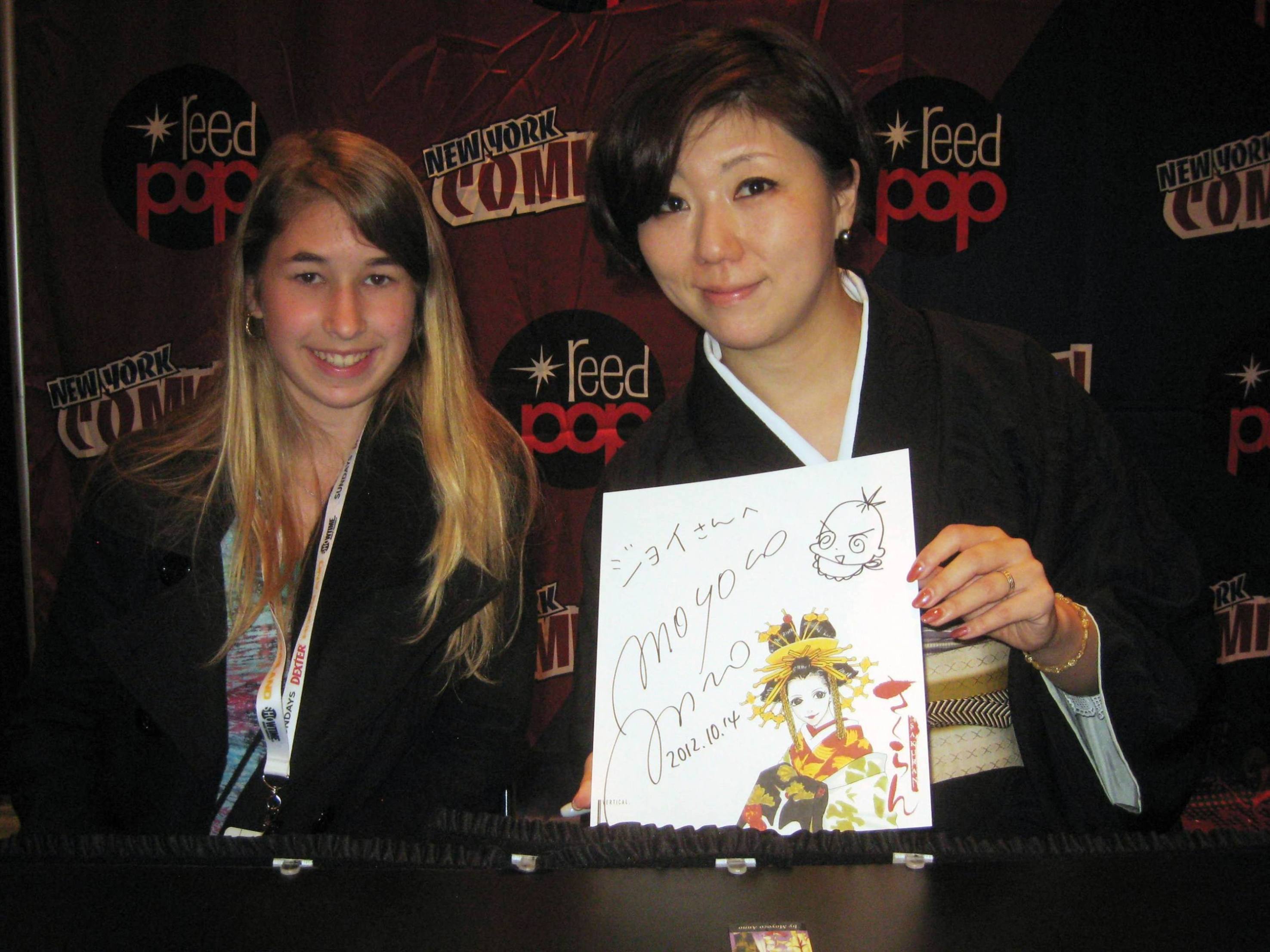
Manga author Moyoco Anno with New York Comic Con attendee Joy Charbonneau of Pacifica, CA, Oct. 14, 2012. (Justin Tedaldi)
By JQ magazine editor Justin Tedaldi (CIR Kobe-shi, 2001-02) for Examiner.com. Visit his Japanese culture page here for related stories.
Anime and manga fandom came out in full force at New York Comic Con last weekend, with a record 116,000 fans visiting the Jacob K. Javits Center for the annual event. Sunday (Oct. 14) hosted special guest artist Moyoco Anno of Sugar Sugar Rune and Sakuran fame.
A professional mangaka (manga artist and author) and one of the most respected names in Japanese comics today for her josei (ladies’) comics, Anno was in town to promote the recently released English-language edition of Sakuran, a starkly drawn tale of Japanese courtesans in the Edo period.
“We’d been thinking about publishing Sakuran for a few years now, and were finally able to convince [our] CEO to take the plunge,” said Ed Chavez, marketing director of Vertical Inc., the book’s North American publisher, which had its own booth at Comic Con. Based in New York, Vertical translates Japanese works of fiction and non-fiction that are considered good reads with universal themes from its vibrant book market.
Standouts of Vertical’s manga stable include Osamu Tezuka’s Buddha, Usamaru Furuya’s No Longer Human and Kanata Konami’s Chi’s Sweet Home.
For the complete story, click here.
I’ll Make It Myself!: Pumpkin Spice Latte with Kabocha Purée (Bonus: Pumpkin Pie Spice Recipe)
Blogs, Food & Drink, I'll Make It Myself, Writers Comments Off on I’ll Make It Myself!: Pumpkin Spice Latte with Kabocha Purée (Bonus: Pumpkin Pie Spice Recipe)
L.M. Zoller (CIR Ishikawa-ken, Anamizu, 2009-11) is the editor of The Ishikawa JET Kitchen: Cooking in Japan Without a Fight. A writer and web administrator for The Art of Travel (formerly The Art of Japan: Kanazawa & Discover Kanazawa), ze also writes I’ll Make It Myself!, a blog about food culture in Japan, and curates The Rice Cooker Chronicles, a series of essays by JETs and JET alumni on the theme of cooking/eating and being alone in Japan.
New Rice Cooker Chronicles submissions always welcome. Just e-mail it to L.M.at jetwit [at] jetwit.com.
If every Japan food blogger is required by law to cover okonomiyaki (twice), then every food blogger in the US and Canada is required to offer a homemade version of Starbucks pumpkin spice latte.

The most popular variety has pumpkin purée rather than syrup mixed into it. Whether you live in Japan or the US, you don’t have to worrying about buying canned pumpkin before the Thanksgiving hoarders get to it or even stocking up on the orange pumpkins that seem to disappear on November 1 to make your own purée. Where there is squash, there can be “pumpkin” spice latte. No import store required.
JQ Magazine: Book Review – ‘The Buddha in the Attic’
Article/Journalism, Books, JQ Magazine, Reviews Comments Off on JQ Magazine: Book Review – ‘The Buddha in the Attic’
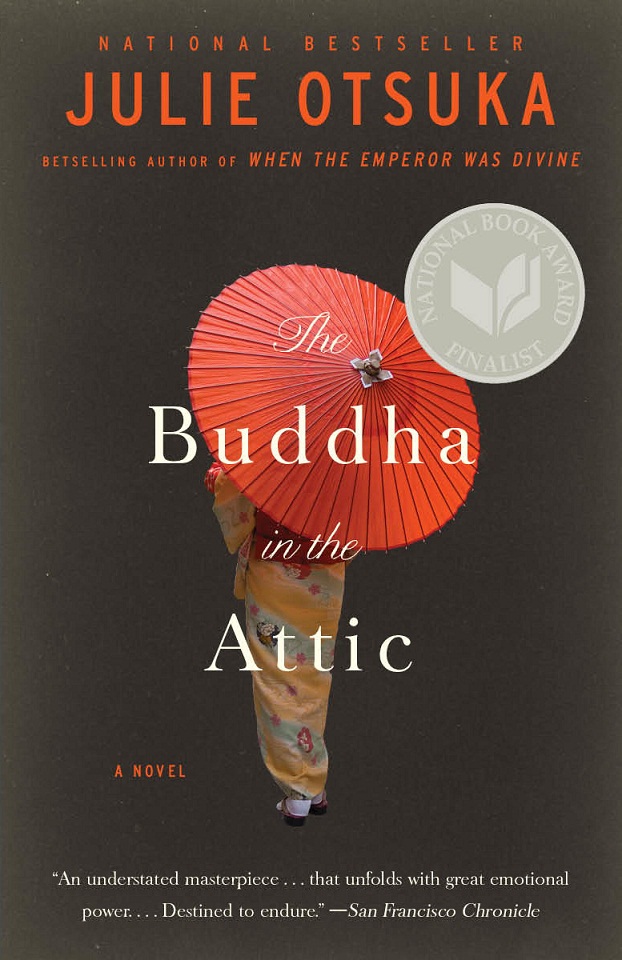
“Just the right length, the perfect amount of general and specific, and no solid story but yet the story that so many people in the United States—and elsewhere—can tell about hope, and heartbreak, and the ways in which lives change that most of us never intend or imagine.” (Knopf)
By Liz Mathews (Hiroshima-ken, 2005-06) for JQ magazine. Liz is the JETAA New York Book Club wrangler.
I would like to start by saying that the JETAANY Book Club discussed reading Julie Otsuka’s The Buddha in the Attic for at least five months before choosing it for our fall meeting. This is notable because 1) we were right in our primary reason for putting it off; and 2) we were even more right in finally selecting it to read. It’s easy to explain the first note: Over the summer we thought it best to opt for a lighter, more beachy read, and not a novel about Japanese “picture brides” and their distressing existences in the United States of the early 20th century.
As for the second point, autumn and its colder, shorter, darker days did turn out to be a much more appropriate setting to read Otsuka’s carefully composed novel. Otsuka wrote her book in eight sections, writing mostly from the perspective of the women—the women as a united “we”—who came across the ocean to a new life of false promises, how they endured meeting their husbands the first time, how they got along (or didn’t) with their employers and new fellow countrymen, and what happened as a new, Japanese American generation grew.
For all the suffering in those first five sections, there is hope written between the lines. Hope for a new life with a wonderful husband, hope that hard work will pay off in acceptance, and hope for their children in that, as one of the paragraphs ends, “Whatever you do, don’t end up like me.” But then, as one club member put it, “You come to this country, you work your ass off, you think you’re getting somewhere…and then you don’t” (referring to the war’s outbreak).
When we got together to discuss The Buddha in the Attic, we spent a fair amount of time talking about the perspective the story was written from—first person plural—and how initially we didn’t like it, but then either grew accustomed to it or could at least appreciate it as a tool. One attendee stated, “Everyone’s situation is different. You can’t even generalize the Japanese experience.” Another pointed out, “[Otsuka] has a new story in every sentence.” We laughed a little at this realization, probably as all our thoughts turned back to our own departure orientations, when we were constantly told those very same things.
