




JQ Magazine: JQ&A with Laurel Lukaszewski, JETAA Initiative Project Director
 Article/Journalism, Interview/Profile, JQ Magazine, Local Government, Notable JET Alums
  Comments Off on JQ Magazine: JQ&A with Laurel Lukaszewski, JETAA Initiative Project Director
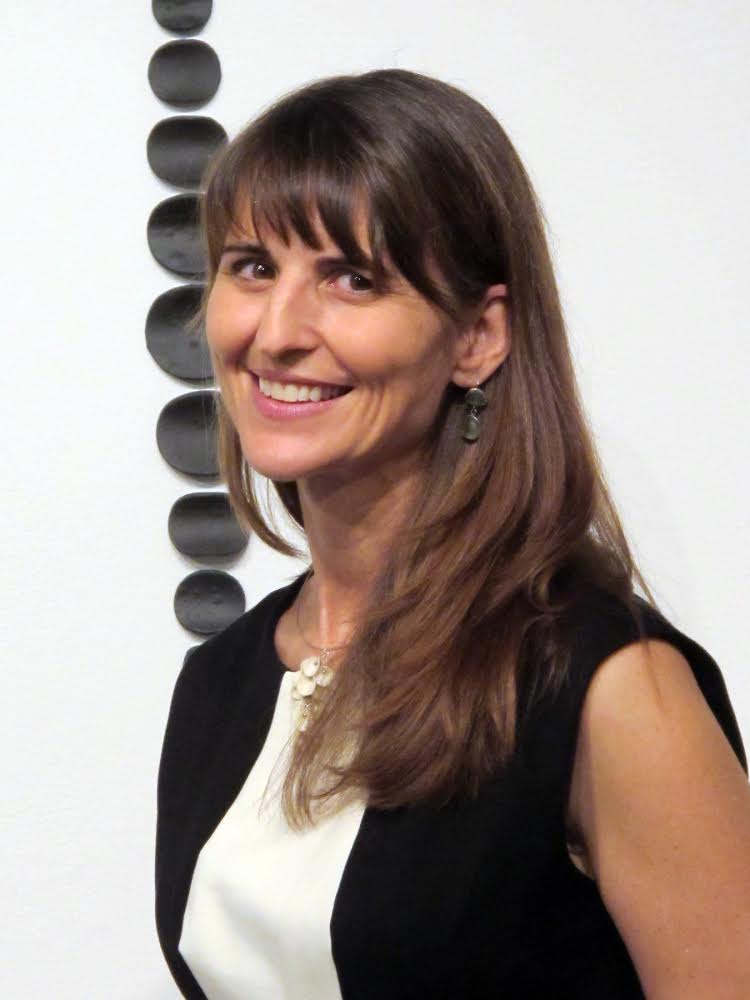
“I believe very strongly that a national organization will strengthen the network and relationships between both chapters and individual alumni, as well as elevate the status and recognition of the JET Programme and its alumni in the greater U.S.-Japan arena.” (Courtesy of Laurel Lukaszewski)
a
By Eden Law (Fukushima-ken, 2010-11) for JQ magazine. Eden currently serves on the JETAA New South Wales committee in Sydney, Australia as the online social media, webmaster and occasional editor. Got feedback? Leave a comment below.
In 2013, the JETAA Initiative project was launched by the United States-Japan Bridging Foundation (USJBF), with funding provided by the The Japan Foundation Center for Global Partnership (CGP). The first phase of the project was to assess the feasibility of a national JETAA organization, with the next phases dealing with the structure, duties and objectives of the new organization.
The first phase (feasibility study) has now wrapped up and its findings presented at the September 2014 National JETAA USA Conference, and the next phase is currently underway. JQ spoke with Laurel Lukaszewski (Kagoshima-ken, 1990-92), JETAA Initiative project director (who is also a highly noted, Washington D.C.-based ceramic artist in her own right), who kindly gave her time to discuss the JETAA Initiative, the findings and next steps for the project.
How did you come to be selected for the role of project director of the JETAA Initiative?
I applied for the position after I saw the job announcement posted in a number of different places. I work as an artist full-time, but my schedule is flexible and I thought this would be an exciting project. In my previous career, I was the executive director of the Japan-America Society of Washington, D.C. Before that, I worked for the Japan-America Society of the State of Washington in Seattle as their program director. I’ve also been part of the JET selection process for over 15 years (reviewing applications, interviewing, working at the embassy as the review committee liaison for two seasons). I have also been a board member of the National Cherry Blossom Festival since 2002 and have served on a number of arts-related nonprofit boards and committees over the years. I was also the secretary, then president, of the JETAA Pacific Northwest chapter in Seattle in the late ’90s, so JETAA is near and dear to my heart.
It’s been a year since your appointment. What were the main challenges you faced as a director?
While not exactly a challenge, it has been paramount to reach out to all 19 chapters in the U.S. to give them an understanding of what we are doing and why we think creating a national organization is necessary. To do this, both [JETAA co-founder] Paige Cottingham-Streater (Mie-ken, 1988-89) and I have attended national and regional conferences to give presentations and speak with alumni to garner their support. We have also made site visits to chapters in Kansas City, Atlanta and Denver to find out what challenges exist at the local level. It was also imperative to show the progress we made over the first year to our funder, The Japan Foundation Center for Global Partnership, so that we could continue.
Why was there a need to examine to conduct a feasibility study on whether a national organization was required?
The only way a national organization will be successful is if the JET alumni community wants it. This is being created for them. I believe very strongly that a national organization will strengthen the network and relationships between both chapters and individual alumni, as well as elevate the status and recognition of the JET Programme and its alumni in the greater U.S.-Japan arena, but the JET alumni community needs to believe this, too. We hope that the national organization will provide much needed support to smaller chapters and give alumni who live outside of large cities a way to connect to the broader JETAA community.
Leading U.S.-Japan Exchange in Northern California: JETAANC
JETAA Chapters, Local Government, Return on JET-vestment Comments Off on Leading U.S.-Japan Exchange in Northern California: JETAANC
The following was written by JETAA Northern California President Mark Frey (Kumamoto-ken, 2002-06) with contributions from Xander Peterson (Miyazaki, 2009-2012) and was originally published in Japanese in the most recent edition of the CLAIR Forum which is distributed to pretty much every prefecture and town government in Japan as well as every Japanese consulate and embassy. Below is the English version. Here’s a link to the CLAIR Forum (PDF) which has the article in Japanese.
Leading U.S.-Japan Exchange in Northern California: JETAANC
By Mark Frey, President, JETAANC, mark.frey@jetaanc.org
Many of you know participants of the JET Program (Japan Exchange and Teaching Program). They may be your co-workers or friends. But what happens to them when they return to their home countries? I hope to show you some of the exciting things that former JETs are doing on behalf of U.S.-Japan relations. I will also suggest some ways that you can engage JET alumni to further your own goals.
In 1989, two years after the start of the JET Program, former JETs gathered and established the JET Program Alumni Association (JETAA) with the aim of giving each other support and continuing the mission of the JET Program to foster grassroots international exchange.
Over the past 25 years, JETAA has grown into a vibrant worldwide organization. There are now over 57,000 JET alumni living across the globe. Over 28,000 of them live in America. That’s about 1 in every 8,000 American adults! You can see the positive impact that JET alumni can have in promoting Japan around the world.
This year I became President of JETAA’s Northern California chapter, JETAANC. With over 3,000 members, I am proud to say that we are one of the largest and most active chapters in the world. Next year we will celebrate our 25th Anniversary.
Our alumni are working at every level of every sector of the local economy, including for-profit, non-profit, education, and government. They are promoting exchange between the U.S. and Japan whenever and however they can.
Every year, our alumni provide substantial support to the JET Program. Read More
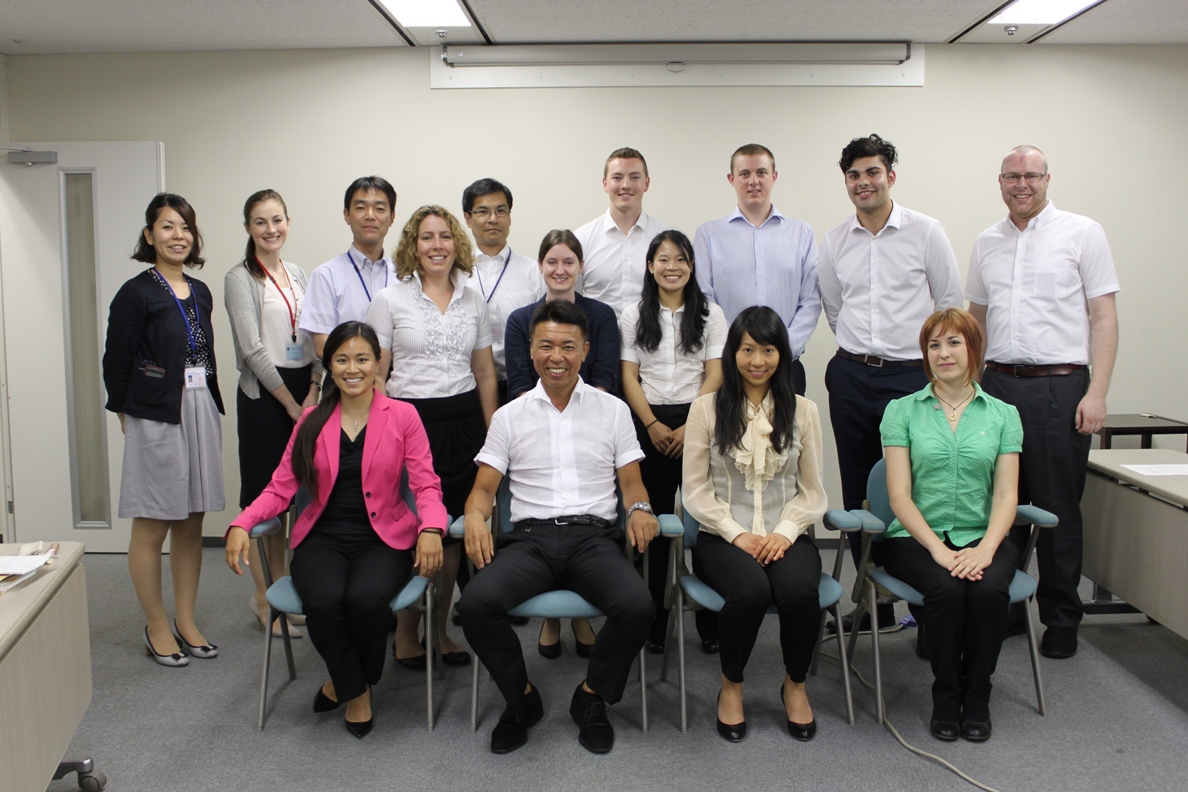
AJET Chair Kay Makishi (front row, left) at the Spring AJET Opinion Exchange Meeting in Tokyo, June 2014. (Courtesy of AJET)
By Eden Law (Fukushima-ken, 2010-11) for JQ magazine. Eden lived and worked in the core city of Iwaki on JET, and is JETAA New South Wales‘s webmaster, meaning he is the voice on all the online and social media for the Sydney-based chapter like Twitter, Instagram (both @jetaansw) and Facebook.
At the start of this year, dramatic changes took place as CLAIR (the Council of Local Authorities for International Relations) formally announced changes to its relationship with AJET (the Association for Japan Exchange and Teaching), with the full details made public by the latter on their Facebook page on a post dated January 27. The immediate outcome of this decision means that AJET’s participation and input at CLAIR-organised events such as the Tokyo Orientation and After JET conferences will be discontinued.
While AJET has had a low profile in the collective consciousness of many on the programme, these changes will inevitably impact all JET participants, most immediately in how conferences will be held and run, and how AJET will continue to represent and assist the needs of the JET community. Historically, the volunteer organisation has existed from the start of the JET Programme and is run by JETs to benefit and support participants in Japan. Now, it faces the biggest challenge of its 27-year history.
For those who may not have heard of or know about AJET, its constitution describes it as a volunteer organisation whose purpose is to foster a successful working relationship between JET Programme sponsors and participants, as well as to promote and support the JET community. In turn, it presents itself as a representative of the same community. Founded in 1987 right from the start of the JET Programme itself, AJET’s early work was very much focused on providing a support network for the first participants.
Kay Makishi (Fukuoka-ken CIR, 2011-14), 2014’s outgoing AJET chair who completed her one-year term on the AJET council, sums up her focus on the JET community: “I wanted to see more energy spent on starting projects like our Professional Development Conference Calls…[and] collaborating more with JETAA so JETs have more support finding jobs post-JET,” she explained.
JQ Magazine: From JET to the U.S. Department of State, Alumni Share Their Stories
Article/Journalism, JQ Magazine, Local Government Comments Off on JQ Magazine: From JET to the U.S. Department of State, Alumni Share Their Stories
By Sheila Burt (Toyama-ken, 2010-12) for JQ magazine. Sheila is a scientific writer at the Center for Bionic Medicine, a research group located within the Rehabilitation Institute of Chicago. She blogs about urban issues and Japan at www.sheilaburt.com, and writes the column “Letters from Japan” for Gapers Block. Follow her on Twitter @smburt.
Many of those who apply to the JET Program, and for several other teaching or translation positions in Japan, have a strong interest in international relations and diplomacy. But how does one transition from being eigo no sensei to a government career in the Foreign Service?
Via email, JQ reached out to three former ALTs who now work overseas for the U.S. Department of State to learn more about how they successfully made the big jump, and how their time in Japan influenced their respective careers.
Katrina Barnas, Consular Officer in Ecuador
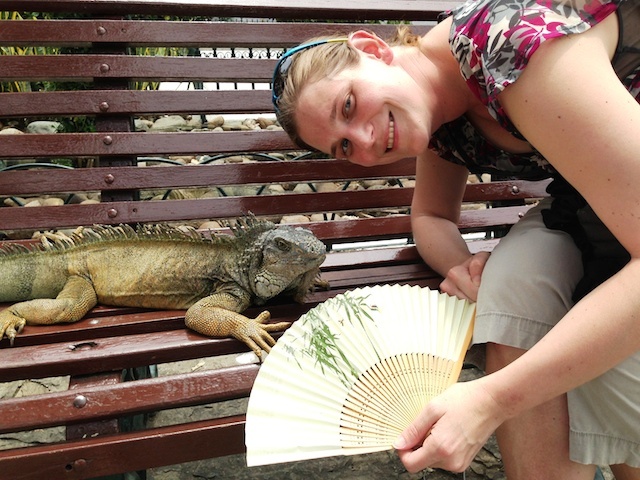
Katrina Barnas (Chiba-ken, 2001-02) holds a BS in journalism from Northwestern University and a Master’s in Public Administration from Columbia University’s School of International and Public Affairs. After working for nine years in higher education administration at Columbia, she joined the Foreign Service in 2013 and recently started her first tour as a Consular Officer in Ecuador, where she assists American citizens in Ecuador and interviews other nationalities interested in traveling to the U.S. for tourism, study and work. She has also been an active member of the JETAA community, serving as vice president of the JET Alumni Association of New York (JETAANY) from 2005 to 2007, and then as a founding member of its board of directors from 2006 to 2011. Here, Barnas discusses how she applied to the JET Program on a whim—and how that decision ultimately shaped her future career path.
I wasn’t sure what I wanted to do after college. I had studied journalism but in my senior year, I was no longer sure that was the path I wanted to pursue. I liked traveling and children, so when some of my friends applied for JET I decided to apply as well. It is interesting to look back on it now since at the time I did not have a strong interest in Japan, but now I can’t imagine my life without a Japanese influence.
JET helped make my choice of joining the Foreign Service less daunting because I knew that I had done this before and succeeded. Through JET, I had experienced working in another country—getting beyond just a visit and belonging someplace very different from my hometown, and I knew that although it was going to be different that I could do it.
JETs Carry on Taylor’s Legacy in Miyagi
Cultural Outreach, Japan Local, Local Government, Return on JET-vestment, Translating/Interpreting, Volunteer Comments Off on JETs Carry on Taylor’s Legacy in Miyagi
Originally posted on the JETAA USA website:
Donated Books from Ambassador Kennedy Translated into Japanese
Following Ambassador Kennedy’s donation last November of 110 books to the Taylor Anderson Reading Corner at Mangokuura Elementary School in Ishinomaki, the volunteer group that reads to the students there, Soyokaze no Ohanashi (The Gentle Breeze Talks), joined together with the Miyagi International Association (MIA) and current JETs in the prefecture to translate nine of these books into Japanese. The books chosen cover various topics such as the lives of children in the US and other countries around the world, science, and wildlife, and are simple enough to be accessible to younger students.
Ms. Kyoko Sasaki, from Soyokaze, reportedly first reached out to Mr. Andre Perez to ask for his support for the project. Andre, who is currently a Coordinator for International Relations with Miyagi Prefecture and MIA, took on the planning of the event, coordinating details between MIA and Ms. Sasaki. Once these were settled, he reached out to Miyagi JETs through his position as a Prefecture Advisor and tapped into the Miyagi AJET(MAJET) network through Ms. Tanya Zolotareva, another CIR and a MAJET officer. The various groups collaborated, with each taking responsibility for different steps of the process of selecting books, translating them, and affixing the translations. The whole undertaking reportedly went quite smoothly, thanks to MIA’s previous experience with translating books, the eight JETs and roughly 10 other people who volunteered their time and talent, and Mr. Perez’s connections to both MAJET and MIA.
The project was also profiled on Miyagi Prefecture’s Facebook page (https://www.facebook.com/visitmiyagi) and in the Asahi Shimbun and Kahoku Shimbun.
The books will now be available to students at Mangokuura E.S. to look at any time and they will be able to work on their understanding of the English texts by referring to the new Japanese translations. Having prepared translations at hand will also make it easier for the volunteers who read to the children.
As Ms. Sasaki, who is also a friend of the Andersons, having known Taylor, said in talking with one of the local newspapers that reported on the story, “This is a way to express our thanks to Taylor’s family. We want to show them that we are continuing Taylor’s legacy by carrying on her work.”
All the volunteer teams working to translate books for the Taylor Anderson Reading Corner.
AJET Professional Development Call with JET alum Anthony Bianchi
Audio, Career Update, Celebrity, Interview/Profile, Japan Local, LifeAfterJET, Local Government, Notable JET Alums, Return on JET-vestment Comments Off on AJET Professional Development Call with JET alum Anthony Bianchi
 Via the AJET website:
On May 7th, we held our fourth AJET Professional Development Conference Call. Our guest speaker was former JET, Mr. Anthony Bianchi (Aichi-ken, Kiyosu City, 1989-91) who now serves as a city council council member in Inuyama City, Aichi prefecture. Mr. Bianchi is often highlighted in the Japanese media and is well-known for being the first American-born elected official in Japan. Click here to read a short interview with him on AJET.net.
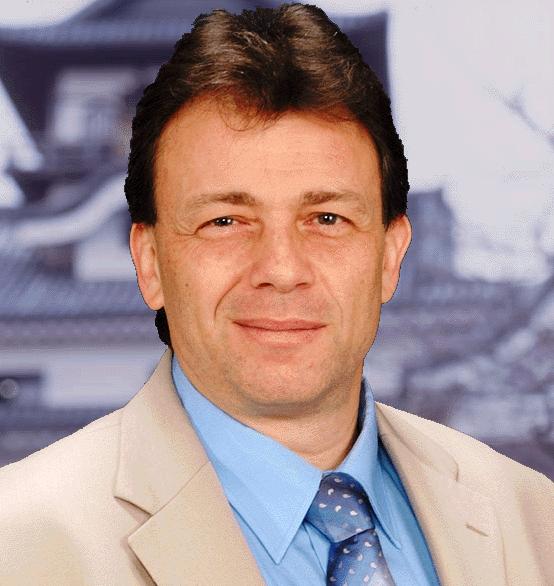
Anthony Bianchi (Aichi-ken, 1989-91)
Mr. Bianchi discussed the inner workings of his current position, various initiatives to improve English and international communication in his community and how JETs can potentially get involved with local politics in their communities.
Click here to listen to the recording of the call on the AJET website: http://ajet.net/2014/05/13/professional-development-call-anthony-bianchi/
JETs in the News: Matt Cook featured in hometown paper
Interview/Profile, JETs in the News, LifeAfterJET, Local Government, Notable JET Alums, Return on JET-vestment Comments Off on JETs in the News: Matt Cook featured in hometown paper
**************
Very nice article on JET alum and former AJET Chair Matthew Cook (Osaka-fu, 2007-12) that recently appeared in the newspaper of Matt’s hometown, Danville, Virginia and describes his path from the JET Program to becoming a key player in Osaka’s pioneering English education reform efforts.
Danville man appointed to Japanese board of education
By DENICE THIBODEAU
dthibodeau@registerbee.com
Thibodeau reports for the Danville Register & Bee.
May 10, 2014
When Danville native Matthew Cook headed to Osaka, Japan, in 2007 to take a job as an education specialist and trainer in the Japan Exchange and Teaching Program, little did he realize he would end up working for a Japanese government agency to completely reform how English is taught in the city.
CLICK HERE to read the rest of the article: http://m.godanriver.com/news/danville/danville-man-appointed-to-japanese-board-of-education/article_1b9620f2-d972-11e3-8adc-0017a43b2370.html?mode=jqm#.U3A0DN98uYw.facebook
CLAIR Sydney Newsletter No. 75
JETAA Chapters, Local Government Comments Off on CLAIR Sydney Newsletter No. 75
 Posted originally by Hiromi Hakuta to the JETAA Oceania FB page.
“In CLAIR monthly Newsletter No.75, we introduce JETAA South Island activities, a cycling festival in Hiroshima and Japanese schools that are seeking Sister School relationships with Australian or NZ schools. My business trip to New Zealand is also introduced on that!”
http://www.jlgc.org.au/wp-content/uploads/2014/05/CLAIR-newsletter-No.75.pdf
Japan Times: Osaka Embraces English Reformation
Japan Trends, JETs in the News, Language Study, Local Government, Notable JET Alums, Return on JET-vestment Comments Off on Japan Times: Osaka Embraces English Reformation
Former AJET Chair Matthew Cook (Osaka-fu, 2007-12) has been heavily involved in this cutting edge effort to improve Osaka’s English education system and is quoted in the article.
Osaka embraces English Reformation
BY TERU CLAVEL
While Osaka Mayor Toru Hashimoto’s controversial political antics have increasingly drawn criticism, little attention has been paid to how his leadership has prompted the most progressive reforms of English-language education in the nation. Hashimoto, who served as Osaka’s governor from 2008-11, made possible the appointment of fellow Waseda Law School graduate Toru Nakahara as superintendent of the Osaka Prefectural Board of Education, charging him with the task of empowering students to compete on a global stage.
Only in Osaka will students in the public school system have the opportunity to start preparing for the TOEFL iBT — an internationally recognized English-language proficiency exam for non-native speakers administered over the Internet that tests reading, writing, speaking and listening skills for entrance to English-speaking university overseas — in grade one of primary school.
With the urging of Mayor Hashimoto, Nakahara — who also graduated from the University of Michigan Law School and was a practicing attorney at a California firm for 10 years — left the private sector and took a substantial pay cut to become the principal of Izumi High School in Osaka in 2010. In 2013, Nakahara became Japan’s youngest-ever superintendent at age 42, overseeing 1,600-plus schools, and he formed what is known as the English Reformation Project Team.
Nakahara’s accomplishments in the United States and at Izumi High School have led him to be recognized as an education innovator.
“One thing I noticed when I was in Ann Arbor (Michigan) Read More
Japan Times features JET alum Matthew Cook and his work with Osaka’s English Reformation Project Team
Career, Interview/Profile, Japan Local, JETs in the News, LifeAfterJET, Local Government, Notable JET Alums, Return on JET-vestment Comments Off on Japan Times features JET alum Matthew Cook and his work with Osaka’s English Reformation Project Team
****************************
Very nice article on JET alum and former AJET Chair Matthew Cook (Osaka-fu, 2007-12) about his path from JET to becoming an agent of change for the Japanese English education system through is unique role with Osaka Prefecture’s Board of Education. Matt is also the founder of the Kansai JET Alumni group. FYI, you can also click here for a recent JQ profile of Matthew Cook by JETAA New South Wales‘ Eden Law (Fukushima-ken, 2010-11) .
Changing the system starts by challenging it
BY TERU CLAVEL
Just seven years after first participating in the JET program in Osaka, Matthew Cook from Danville, Virginia, is making great strides as a pioneer of English-language education reform in Japan. Having never previously been to an Asian country, Cook is now one of seven members of Osaka’s groundbreaking English Reformation Project Team, having been appointed by Osaka superintendent Toru Nakahara in 2013. With an unswerving commitment to English-language education and a little luck, Cook’s efforts may pave the path for Japan’s next generation of global leaders.
Cook applied to the JET (Japan Exchange and Teaching) program because it was “the most lucrative, stable and safe way to get to Japan.” Having run his own karate dojo in the United States, he felt the need to gain a deeper understanding of the Japanese culture behind it. However, Cook was waitlisted and needed to make a snap decision when he was offered a position within a month of the JET start date. “I had totally assumed that I wasn’t going to get in,” he says.
Cook’s initial placement was less than ideal, though. He was forewarned that the Osaka junior high school to which he was assigned might be challenging, but he was not prepared for the “few students who were stopping class altogether, violence in the classroom or kids getting up and leaving.” Read More
JQ Magazine: Tohoku Projects—The TOMODACHI Initiative
Article/Journalism, Earthquake Tsunami, JQ Magazine, Local Government Comments Off on JQ Magazine: Tohoku Projects—The TOMODACHI Initiative
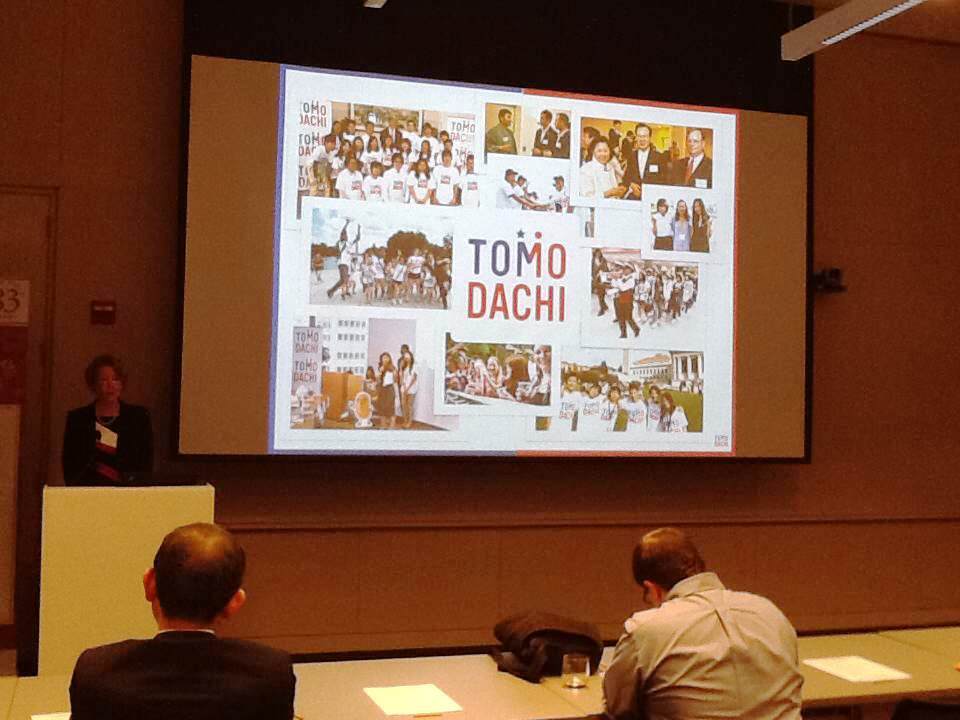
Suzanne Basalla, left, presents The TOMODACHI Generation: Investing in the NEXT Generation of U.S – Japan Relations, Chicago, Oct. 11, 2013. (Sheila Burt)
By Sheila Burt (Toyama-ken, 2010-12) for JQ magazine. As part of an occasional series, Sheila is profiling individuals who are or were in some way involved with rebuilding efforts in the Tohoku region. Her first post was on the writing project 3,000 Letters to Japan. After JET, Burt spent an additional year in Japan working at a private school and translation company. She recently returned to the Chicago area. Read more of her reporting at her blog, Stories from the Inaka.
Having been posted in Tokyo during the disastrous March 11 earthquake and tsunami of 2011, diplomat Suzanne Basalla saw firsthand how quickly Japan changed in a matter of seconds.
As senior advisor to former Ambassador John V. Roos in the Embassy of the United States in Tokyo, Basalla had been living in Japan since March 2010, advising Roos on several economic and foreign policy matters. A few months after 3/11, Basalla visited Tohoku and started thinking of ways to encourage redevelopment in the stricken area, “trying to do what we [could] to create hope and support,” she recalled. Although her post with the embassy ended in March 2012, she realized she wasn’t ready to go back to the Pentagon.
Instead, Basalla and a team of others pooled their efforts to create the TOMODACHI Initiative, a public-private partnership established in the wake of 3/11 with the U.S.-Japan Council in Washington. TOMODACHI helps coordinate educational, business and cultural exchange programs for Japanese youth, particularly students in Tohoku, where development opportunities are still few and far between. Presenting at a Japan American Society of Chicago event last October, Basalla referred to TOMODACHI as “an incredibly important initiative…with a path-breaking paradigm.”
“Part of leadership is getting to know yourself,” said Basalla, who now serves as executive vice president of the U.S.-Japan Council. “TOMODACHI’s initiative is to inspire and empower young Japanese and Americans by giving them experience, skills and confidence to achieve their dreams and contribute to a better world.”
JQ Magazine: 2013 JETAA Oceania National Conference Spotlights Sister City Relationships
Article/Journalism, Japan Local, JETAA Chapters, JQ Magazine, Local Government, Return on JET-vestment, Sister City Comments Off on JQ Magazine: 2013 JETAA Oceania National Conference Spotlights Sister City Relationships
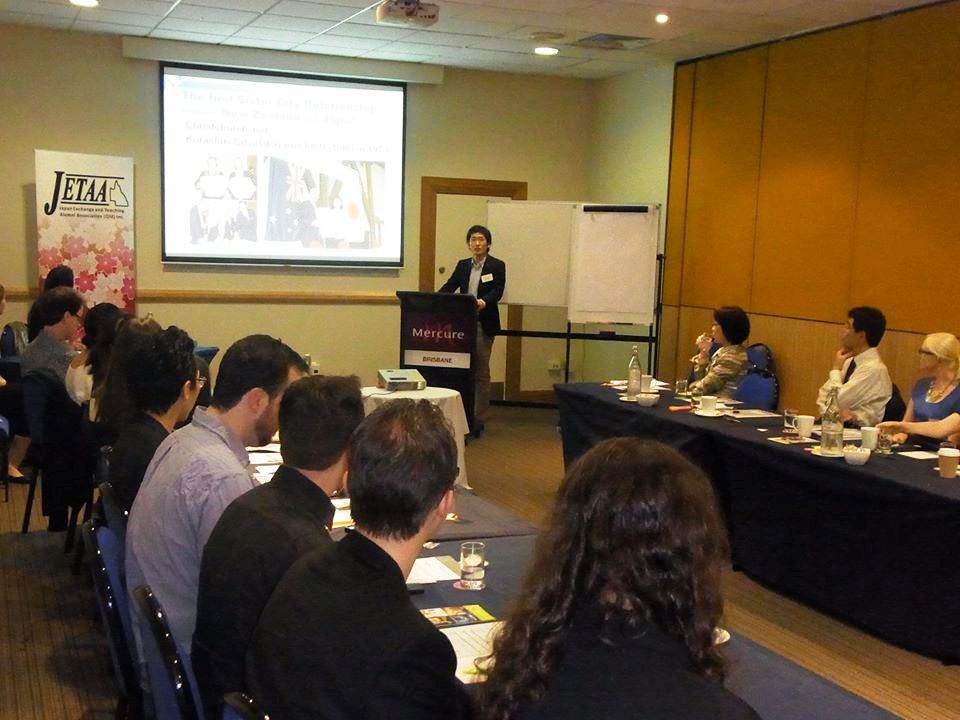
Hiromi Hakuta, assistant director of CLAIR Sydney, addresses alumni at the JETAA Oceania National Conference, Brisbane, Nov. 2013. (Courtesy of Hiromi Hakuta)
By Eden Law (Fukushima-ken, 2010-11). After the JET Programme more than fulfilled its promise of “an experience of a lifetime,” Eden returned to Sydney, Australia, where he joined the JETAA New South Wales chapter to take advantage of the network and connections available to undertake projects such as an uchiwa design competition for the Sydney Japan Festival. He also maintains the JETAANSW website and social media. Other than that, he’s a web designer and a poet, gentlemen and raconteur.
One of the best things about being a member of JETAA is the community, and over the weekend of 15-17 of November, the Oceania community of JETAA got together for our annual antipodean regional conference. For those of you up north who don’t know, JETAA Oceania comprises of five Australian chapters (the state chapters of Queensland, New South Wales, Canberra, the uber-chapter of South Australia-Victoria-Tasmania, Western Australia) and three New Zealand chapters (South Island, Auckland and Wellington). Representatives from Sydney’s CLAIR office (Tsuyoshi Ito, Hiromi Hakuta and Julien Ansart) attended as observers of the proceedings. This year, JETAA Queensland played host in Brisbane, the northern capital that looks to Asia and is close to the Gold Coast, a favoured destination for young Japanese looking for sun, surf and sand. Appropriately, we had our first lunch meet on Friday at MOS Burger, the famous Japanese fast food chain whose only non-Asian presence internationally is right in Brisbane.
JETAA Oceania was invited to attend the Welcome Back Reception for returning JETs at the Japanese Consul General’s home in Brisbane on the Friday night, a chance of course for us to network and hobnob with the cream of Brisbane’s Japanese cultural community. And after the reception finished (early, predictably), JETAA kicked on in town for a night out (hint: it’ll always involve karaoke—usually lots of obscure Japanese songs sung by that one quiet serious person who turns into a blurry, hip-thrusting maniac).
The first day of the conference began on Saturday, early (for some, too early) at our hotel and Laura Tasharofi, president of JETAA Qld, began proceedings by explaining the theme of this year: Australia-Japan sister-city relationships. As explained by Hakuta-san, of all countries, Japan has the most links in Oceania, with 108 sister city relationships in Australia and 44 in New Zealand. Therefore, the potential for JETAA to get involved is great, and the conference’s objective is to find ways to participate and be more prominent in our local communities. To start discussions and provide ideas and examples, two guest speakers, Ross Humphreys and Barry Hancock, were invited who are respected members of the Brisbane community and its influential sister city relationships.
JQ Magazine: JETAA USA Earthquake Relief Fund Aids Recovery
Article/Journalism, Earthquake Tsunami, Film, JQ Magazine, Local Government, Notable JET Alums, Return on JET-vestment Comments Off on JQ Magazine: JETAA USA Earthquake Relief Fund Aids Recovery

Taylor Anderson Memorial Fund founder Andy Anderson (center) with members of the JET Alumni Association of New York at Columbia University, Oct. 30, 2013. (Courtesy of JETAA New York)
By C-M Daeley (Saga-ken, 2008-2011) for JQ magazine. C-M is a poet, rap lyricist, and travel enthusiast currently working as an English teacher in Tokyo. For a look at some of his other writing, poetry and lyrics, check out his blog at http://spikedaeley.wordpress.com.
With today’s 24-hour global news cycle, it is sometimes difficult to keep even the most severe events in public memory. The Great East Japan Earthquake that struck on March 11, 2011 has not received much recent coverage in global news, but the issues faced by those still rebuilding remain monumental. Fortunately, there has been significant international aid from a number of sources, one of which is the JETAA USA Earthquake Relief Fund. This grant has raised almost USD $90,000 and has been used to provide seed funding to assist grassroots programs in areas severely impacted by the earthquake.
Due to the complex nature of fund allocation, this article will focus mainly on projects and programs directly supported through JETAA funds. However, it is significant to note that the Earthquake Relief Fund was only one of several avenues used to bring aid to the region and that, to date, roughly $500,000 has been raised through JET-affiliated groups and organizations worldwide. Jim Gannon (Ehime-Ken, 1992-94), current executive director at the Japan Center for International Exchange in New York, and Jessyca Livingston (Hokkaido, 2003-06), one of the three JETAA USA Country Representatives serving during the immediate aftermath and current JET Program coordinator at the Consulate-General of Japan in Denver, spoke about some of the initiatives the Earthquake Relief Fund has helped support.
“It is very difficult to give a concise yet comprehensive picture of what the JETAA funds have done,” Gannon explained. “The best way to describe it is that they have played a catalytic role in supporting some key projects in the early stage that have been supported by a range of others in more generous fashion once they proved their merits. JETAA cannot take full credit for all of the successes, but it did play an important role in getting things moving.” He also noted, “The real heroes are these incredible people from Tohoku who have championed these projects, the inspirational young people who have relocated to Tohoku to help operate them, and those who have been shuttling back and forth from Tokyo and elsewhere to help formulate and drive these initiatives.”
After a national discussion and several rounds of voting in each of JETAA USA’s 19 chapters, a final decision was made about how the fund should be allocated. “In the end, it was very obvious that chapters found it important to support education-related efforts in those areas most affected,” Livingston said.
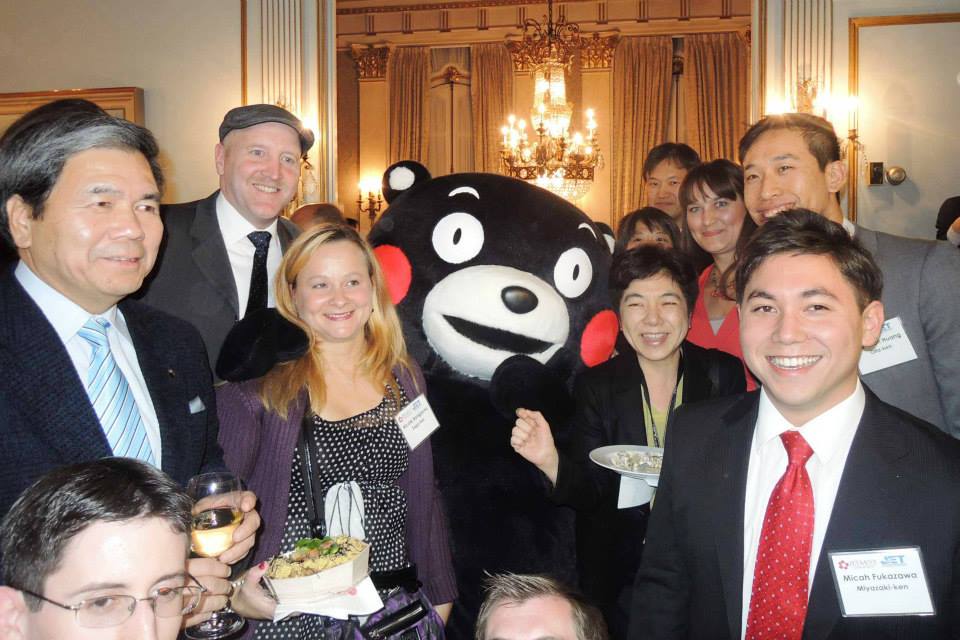
JET alumni from JETAANY meet Kumamon and Governor Kabashima at the Consul General’s residence
By Mark Frey (Kumamoto, 2002-2006), mark.frey@jetaanc.org
Updated with media coverage of the visit.
Boston and New York had the honor of hosting Kumamon’s North American debut last week! Who is Kumamon you may ask? The rosy-cheeked, sack-shaped bear is the official mascot of Kumamoto Prefecture in Kyushu. Voted the top “Yuru-kyara” (cuddly mascot character) in Japan, he has taken Japan by storm and sold more than $300 million worth of merchandise in 2012 alone.
Kumamon’s remarkable success in promoting his rural prefecture across Japan–there is even an exclusive “Kumamon Goods” store in Tokyo’s upscale Ginza neighborhood–is being studied in government offices and marketing departments across Japan. In fact, no less than the Wall Street Journal has published no fewer than three articles about the phenomenon.
If you’d like to learn more about Kumamon, including what he does every day, I recommend checking him out online:
Facebook page: https://www.facebook.com/kumamotodiary.en
Home page: http://kumamon-official.jp/
Kumamon accompanied Kumamoto Governor Kabashima during his visit to Boston on Novermber 12-13, which included giving a lecture at Harvard on “The Political Economy of Kumamon: A New Frontier in Japan’s Public Administration.”
Kumamon spent time with the Boston Red Sox’s mascot, Wally the Green Monster, for what was surely an important, high-level diplomatic meeting. The full itinerary of their Boston visit can be found here, here, and here. Media coverage of their visit includes:

Kumamon meets Boston Red Sox’s Wally the Green Monster at Fenway Park
The lovable bear and Governor Kabashima made their way down to New York on November 14, where they paid back the compliment with a visit the Wall Street Journal. Later they visited the Consul General’s residence, as part of a special reception to promote Kyushu. JET alumni from the New York Chapter of JETAA representing all of the prefectures of Kyushu were invited to the reception. In addition to presentations on Kyushu travel, tourism and shochu, Governor Kabashima introduced Kumamon. Guests dined on Kumamoto oysters and “ekiben” prepared by the chef from Hataka Tonton, and sipped shochu from the region. Kumamon and Governor Kabashima’s full New York itinerary can be found here. Media coverage of their visit includes:
Photos of JET alumni at Kyushu Promotion event at Consul General’s residence
Governor Kabashima is an interesting person. He was an “at-risk” student who grew up poor in Kumamoto. Against all odds, through hard work and dedication he ended up earning a PhD from Harvard and becoming a political science professor at University of Tokyo. His launch of the Kumamon public relations campaign is one of the great local promotion success stories of recent times.
Kabashima has also gotten a lot done in Kumamoto, including making some real headway in repairing Kumamoto’s troubled finances (he started by cutting his own salary), trying to resolve remaining issues related to Minamata disease, and blocking Tokyo’s plans to build a huge dam in the prefecture. A very good article about his life can be found here in the Asahi newspaper. The governor introduces himself and his views in two videos, here and here.
From the start, Kumamoto Prefecture and local communities have been dedicated supporters of the JET Program. Year after year, the prefecture has been near the top of the list in hosting the most JETs, hosting around 100 this year. I myself was a Kumamoto JET. I grew to love the prefecture while I lived there, and now consider it to be my “second home.”
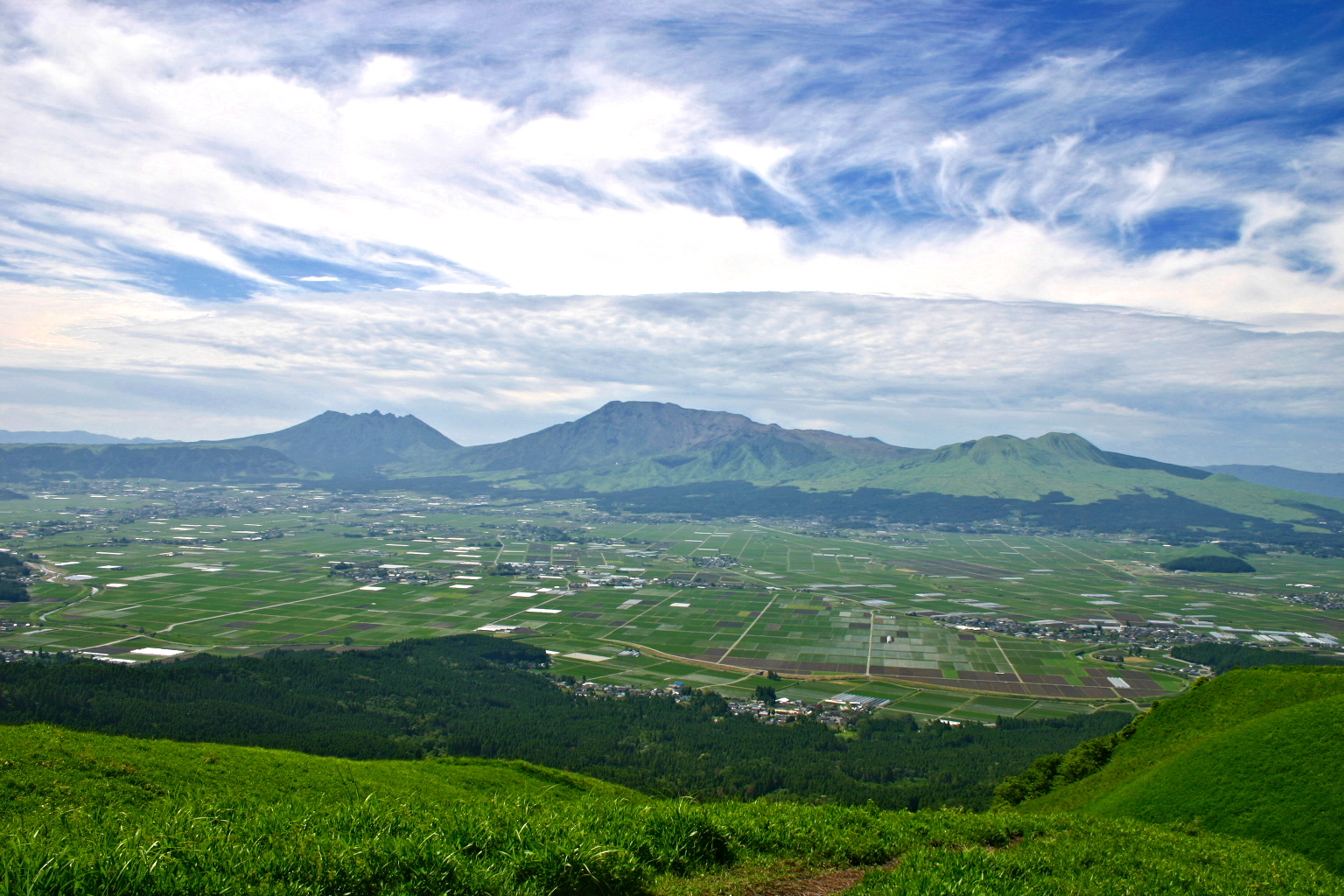
Aso-Kuju National Park, Kumamoto
I encourage everyone to take some time to visit Kumamoto while traveling in Japan. The prefecture boasts some of the best onsen hot springs in the country. Aso-Kuju National Park is one of the natural wonders of the world, with its giant ancient crater that is so large that an entire volcano and six towns exist inside of it (I lived in one of them!). Kumamoto Castle is one of the three finest castles in Japan. Beautiful parks and gardens, beaches and mountains, history and culture, Kumamoto has it all!
If you are a JET alum from Kumamoto, I encourage you to join the LinkedIn Group for Kumamoto JET alumni here. In fact, I encourage all alumni to join their prefecture’s LinkedIn Group. You can find yours here. It’s a great way to stay connected with other alumni from your prefecture.
I’m glad JET alumni had a chance to welcome Governor Kabashima and Kumamon to the U.S. Congratulations on the great success of their first U.S. tour together!
JLGC New York Newsletter – July 2013
Local Government Comments Off on JLGC New York Newsletter – July 2013
Via CLAIR-NY (aka Japan Local Government Center):
The newest JLGC Newsletter is has been published and can be viewed here: http://www.jlgc.org/files/newsletter76.pdf
This issue includes articles on Japan Day in Central Park (in which JETAA NY participated significantly) and a report on the JETAA Canada National Conference in Montreal.
JLGC publishes semi-annual newsletters featuring articles on JETAA activity, sister city and sister state relationships, exchange programs, and local government issues in the United States, Canada, and Japan. The newsletter enables local government officials, JLGC’s fellowship program participants, and other interested persons to stay abreast of JLGC activities and research efforts. At the same time, the newsletter provides those outside of the organization with the opportunity to share their ideas and opinions.
Click the following link to subscribe to the JLGC Newsletter: http://www.jlgc.org/NewsLetterEmailEntry.aspx
