




Justin’s Japan: ‘One Green Bottle’ at La MaMa
 Article/Journalism, Events, Justin's Japan
  Comments Off on Justin’s Japan: ‘One Green Bottle’ at La MaMa
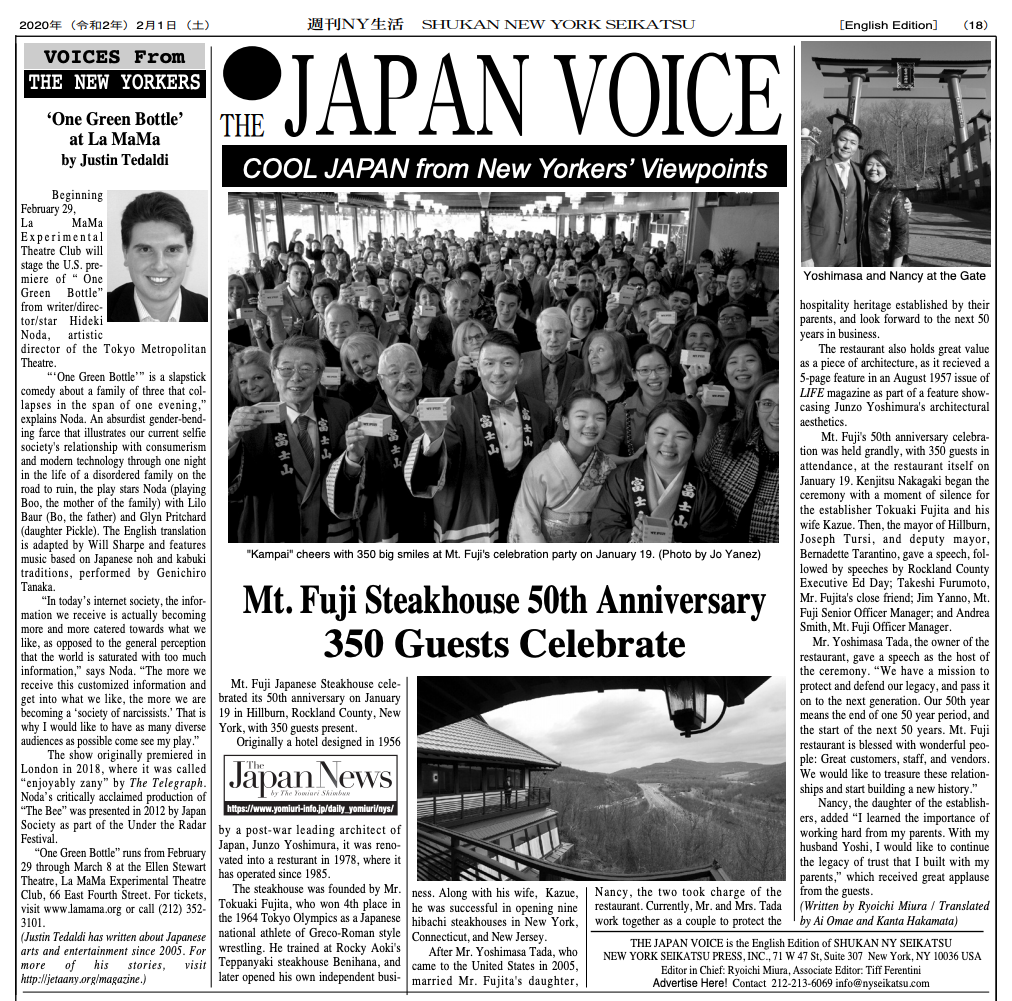
By JQ magazine editor Justin Tedaldi (CIR Kobe-shi, 2001-02) for Shukan NY Seikatsu. Justin has written about Japanese arts and entertainment for JETAA since 2005. For more of his articles, click here.
Beginning Feb. 29, La MaMa Experimental Theatre Clubwill stage the U.S. premiere of “One Green Bottle” from writer/director/star Hideki Noda, artistic director of the Tokyo Metropolitan Theatre.
“‘One Green Bottle’” is a slapstick comedy about a family of three that collapses in the span of one evening,” explains Noda. An absurdist gender-bending farce that illustrates our current selfie society’s relationship with consumerism and modern technology through one night in the life of a disordered family on the road to ruin, the play stars Noda (playing Boo, the mother of the family) with Lilo Baur (Bo, the father) and Glyn Pritchard (daughter Pickle). The English translation is adapted by Will Sharpe and features music based on Japanese noh and kabuki traditions, performed by Genichiro Tanaka.
“In today’s internet society, the information we receive is actually becoming more and more catered towards what we like, as opposed to the general perception that the world is saturated with too much information,” says Noda. “The more we receive this customized information and get into what we like, the more we are becoming like a ‘society of narcissists.’ That is why I would like to have as many diverse audiences as possible come to see my play.”
The show originally premiered in London in 2018, where it was called “enjoyably zany” by “The Telegraph.” Noda’s critically acclaimed production of “The Bee” was presented in 2012 by Japan Society as part of the Under the Radar Festival.
“One Green Bottle” runs from Feb. 29 through March 8 at the Ellen Stewart Theatre, La MaMa Experimental Theatre Club, 66 East Fourth Street. For tickets, visit www.lamama.org or call (212) 352-3101.
Justin’s Japan: ‘Weathering with You’ at Anime NYC
Art, Article/Journalism, Events, Film, Justin's Japan, Uncategorized Comments Off on Justin’s Japan: ‘Weathering with You’ at Anime NYC
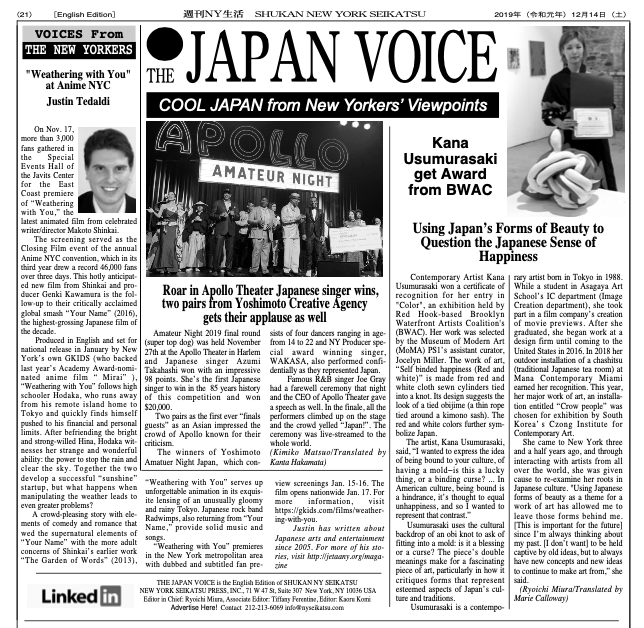
By JQ magazine editor Justin Tedaldi (CIR Kobe-shi, 2001-02) for Shukan NY Seikatsu. Justin has written about Japanese arts and entertainment for JETAA since 2005. For more of his articles, click here.
On Nov. 17, more than 3,000 fans gathered in the Special Events Hall of the Javits Center for the East Coast premiere of “Weathering with You,” the latest animated film from celebrated writer/director Makoto Shinkai.
The screening served as the Closing Film event of the annual Anime NYC convention, which in its third year drew a record 46,000 fans over three days. This hotly anticipated new film from Shinkai and producer Genki Kawamura is the follow-up to their critically acclaimed global smash “Your Name” (2016), the highest-grossing Japanese film of the decade.
Produced in English and set for national release in January by New York’s own GKIDS (who backed last year’s Academy Award-nominated anime film “Mirai”), “Weathering with You” follows high schooler Hodaka, who runs away from his remote island home to Tokyo and quickly finds himself pushed to his financial and personal limits. After befriending the bright and strong-willed Hina, Hodaka witnesses her strange and wonderful ability: the power to stop the rain and clear the sky. Together the two develop a successful “sunshine” startup, but what happens when manipulating the weather leads to even greater problems?
A crowd-pleasing story with elements of comedy and romance that wed the supernatural elements of “Your Name” with the more adult concerns of Shinkai’s earlier work “The Garden of Words” (2013), “Weathering with You” serves up unforgettable animation in its exquisite lensing of an unusually gloomy and rainy Tokyo. Japanese rock band Radwimps, also returning from “Your Name,” provide solid music and songs.
“Weathering with You” premieres in the New York metropolitan area with dubbed and subtitled fan preview screenings Jan. 15-16. The film opens nationwide Jan. 17. For more information, visit https://gkids.com/films/weathering-with-you.
Justin’s Japan: A Trip to Universal Studios Hollywood
Article/Journalism, Film, Justin's Japan Comments Off on Justin’s Japan: A Trip to Universal Studios Hollywood
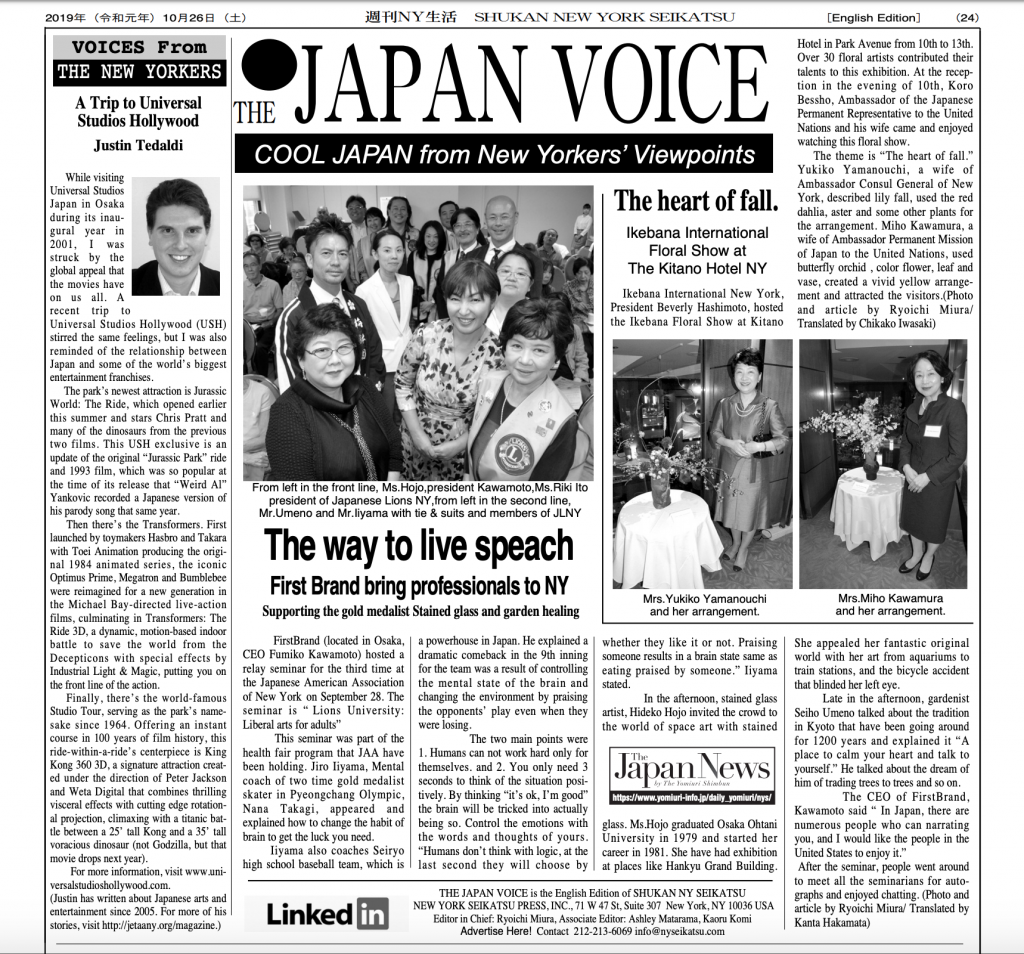
By JQ magazine editor Justin Tedaldi (CIR Kobe-shi, 2001-02) for Shukan NY Seikatsu. Justin has written about Japanese arts and entertainment for JETAA since 2005.For more of his articles, click here.
While visiting Universal Studios Japan in Osaka during its inaugural year in 2001, I was struck by the global appeal that the movies have on us all. A recent trip to Universal Studios Hollywood (USH) stirred the same feelings, but I was also reminded of the relationship between Japan and some of the world’s biggest entertainment franchises.
The park’s newest attraction is Jurassic World: The Ride, which opened earlier this summer and stars Chris Pratt and many of the dinosaurs from the previous two films. This USH exclusive is an update of the original “Jurassic Park” ride and 1993 film, which was so popular at the time of its release that “Weird Al” Yankovic recorded a Japanese version of his parody song that same year.
Then there’s the Transformers. First launched by toymakers Hasbro and Takara with Toei Animation producing the original 1984 animated series, the iconic Optimus Prime, Megatron and Bumblebee were reimagined for a new generation in the Michael Bay-directed live-action films, culminating in Transformers: The Ride 3D, a dynamic, motion-based indoor battle to save the world from the Decepticons with special effects by Industrial Light & Magic, putting you on the front line of the action.
Finally, there’s the world-famous Studio Tour, serving as the park’s namesake since 1964. Offering an instant course in 100 years of film history, this ride-within-a-ride’s centerpiece is King Kong 360 3D, a signature attraction created under the direction of Peter Jackson and Weta Digital that combines thrilling visceral effects with cutting edge rotational projection, climaxing with a titanic battle between a 25’ tall Kong and a 35’ tall voracious dinosaur (not Godzilla, but that movie drops next year).
For more information, visit www.universalstudioshollywood.com.
Justin has written about Japanese arts and entertainment since 2005. For more of his stories, visit http://jetaany.org/magazine.
Justin’s Japan: JAPAN CUTS at Japan Society
Art, Article/Journalism, Events, Film, Justin's Japan Comments Off on Justin’s Japan: JAPAN CUTS at Japan Society
Click image to view article
By JQ magazine editor Justin Tedaldi (CIR Kobe-shi, 2001-02) for Shukan NY Seikatsu. Justin has written about Japanese arts and entertainment for JETAA since 2005. For more of his articles, click here.
The largest festival of contemporary Japanese cinema in North America, this year’s JAPAN CUTS at Japan Society serves up 42 films from July 19-28, featuring more than 20 guest filmmakers and talent in person for daily post-screening Q&As.
“This 13th edition of JAPAN CUTS provides testament to the continued vitality of contemporary Japanese cinema with a wide array of films by emerging filmmakers who dare to take formal and thematic risks,” says Kazu Watanabe, Japan Society Deputy Director of Film.
“They are paired with a roster of veteran directors who similarly began their career in the spirit of creative innovation and who continue to expand their vision in new directions,” he continues. “Together, they tackle stories about existential ennui, class conflict and social discrimination through a range of filmmaking practices that continually subvert expectations and expand our notion of what Japanese cinema is.”
The Opening Film on July 19 is the U.S. premiere of Can’t Stop the Dancing, an office comedy-road trip-musical directed by Waterboys helmer Shinobu Yaguchi, featuring a breakout performance by star Ayaka Miyoshi. The festival’s Centerpiece Presentation on July 24 is the East Coast premiere of Killing, a subversive samurai drama and meditation on the nature of violence by internationally renowned cult director Shinya Tsukamoto (Tetsuo: The Iron Man), who will be presented with the 2019 CUT ABOVE Award for Outstanding Achievement in Film prior to the screening. Tsukamoto will also introduce a special 35mm presentation of his 1998 black-and-white classic Bullet Ballet on July 25.
The Closing Film on July 28 is the North American premiere of director Yuko Hakota’s remarkable debut feature Blue Hour, a comedic drama about rural homecoming and reinvention starring festival guests Kaho and Eun-kyung Shim.
For more information and tickets, visit www.japansociety.org/JAPANCUTS.
Justin’s Japan: The Joy of Sake
Article/Journalism, Food & Drink, Justin's Japan Comments Off on Justin’s Japan: The Joy of Sake
Click image to view article
By JQ magazine editor Justin Tedaldi (CIR Kobe-shi, 2001-02) for Shukan NY Seikatsu. Justin has written about Japanese arts and entertainment for JETAA since 2005. For more of his articles, click here.
Returning to New York in June for its 15th annual celebration, The Joy of Sake hosts the world’s largest sake tasting outside Japan, with a record 513 competition-level sakes and 19 top restaurants serving the best in traditional and contemporary Asian cuisine.
While statistics show that sake is losing ground to beer in Japan, it continues to make inroads in the U.S., especially among drink-savvy New Yorkers.
“The best showcase of this in the U.S. is The Joy of Sake,” said Joy of Sake board member Chris Johnson (Oita-ken, 1992-95), an experienced sommelier and restauranteur whose time in Japan began in the early ’90s as a participant of the Japan Exchange and Teaching (JET) Programme. Also known as the Sake Ninja, Johnson adds, “As a JET alum, having the opportunity to work with the national beverage of Japan is an honor and truly important.”
A beverage that can be paired with foods as diverse as sushi, chocolate and even pizza, sake lovers will also be able to sample exclusive appetizers at the event from some of New York’s most distinguished eateries, including Morimoto, Sakagura and Momofuku Ssäm Bar, enhancing the appreciation of the luster that fine sakes add to a meal.
A brewer’s technique and commitment help determine a great sake, and over 200 sakes not available in the U.S. are featured in this year’s lineup, including more than 100 gold award winners from the 2019 U.S. National Sake Appraisal.
“It’s safe to say,” said Joy of Sake founder Chris Pearce, “that New York has never seen a sake event like this.”
Experience The Joy of Sake Friday, June 21 from 6:30 p.m. to 9:30 p.m. at Metropolitan Pavilion, 125 West 18th Street. For more information and tickets, visit www.joyofsake.com.
Justin’s Japan: ‘Pretty Guardian Sailor Moon’ Makes Broadway Debut
Article/Journalism, Events, Justin's Japan, Reviews Comments Off on Justin’s Japan: ‘Pretty Guardian Sailor Moon’ Makes Broadway Debut
Click image to view article
By JQ magazine editor Justin Tedaldi (CIR Kobe-shi, 2001-02) for Shukan NY Seikatsu. Justin has written about Japanese arts and entertainment for JETAA since 2005. For more of his articles, click here.
On March 29-30, “Pretty Guardian Sailor Moon the Super Live” premiered with three sold-out performances at the PlayStation Theater. This dazzling musical adaptation of the megahit anime and manga franchise, which has generated $5 billion in merchandise sales to date, featured a talented all-female cast (including for the male roles) performing in Japanese.
“At its core, ‘Pretty Guardian Sailor Moon’ is about strong girlfriends banding together to fight for what they believe in…they are the ultimate example of ‘girl power,’” said show producer Takaharu Uera. This universal theme was reflected in the wide diversity of the audience, who were overjoyed to see their heroines come to life.
Innovatively directed and choreographed by TAKAHIRO (Madonna’s Sticky & Sweet Tour) with book by Akiko Kodama (Takarazuka Revue Company) and music by HYADAIN (pop groups Momoiro Clover Z and AKB48), these performances also marked the first time a 2.5D musical, a genre based on popular contemporary Japanese properties like manga, anime and video games, was performed on a New York stage.
First published by creator Naoko Takeuchi in 1991, the manga is now localized in more than 14 countries and released as an anime in more than 50 countries around the world, according to Naho Yamada, general manager of Kodansha USA Publishing, which ran a packed pop-up store at the theater displaying the newest volume of the “Sailor Moon Eternal Edition” collection and other exclusive goods that had thousands of fans eagerly lining up before and after the shows.
“We are happy that fans of all ages have the opportunity to experience ‘Sailor Moon’ in new ways, and that it continues to be a worldwide phenomenon,” said Yamada.
For more information, visit http://sailormoon-official.com/stage/superlive/us.
Justin’s Japan: ‘Alita: Battle Angel’
Article/Journalism, Film, Justin's Japan Comments Off on Justin’s Japan: ‘Alita: Battle Angel’
Click image to view article
By JQ magazine editor Justin Tedaldi (CIR Kobe-shi, 2001-02) for Shukan NY Seikatsu. Justin has written about Japanese arts and entertainment for JETAA since 2005. For more of his articles, click here.
Hollywood adaptations of famous anime and manga series have a history of troubled birth and indifferent reception. “Speed Racer,” “Dragonball: Evolution,” and “Ghost in the Shell” didn’t click with fans of the source material, nor did they gain new ones through the interpretations of directors who might not have grasped their appeal in the first place. “Alita: Battle Angel” looks to change that trend.
Produced and co-written by James Cameron and directed by Robert Rodriguez (the “Sin City” and “Spy Kids” films), “Alita” brings original creator Yukito Kishiro’s epic to the big screen. Rosa Salazar (“Maze Runner,” “Bird Box”) plays the titular heroine, a cyborg with saucer-like eyes and a combat-scarred past who is revived in the post-apocalyptic future world of Iron City. Using her newfound skills as a bounty hunter, Alita fights to rediscover her humanity and find a place in her new surroundings.
With a cast that includes Academy Award winners Christoph Waltz, Mahershala Ali and Jennifer Connelly, along with a reported $200 million production budget with Dolby Cinema and IMAX 3D screenings, “Alita” has received advance praise: “The A.V. Club” calls it Rodriguez’s “best movie in ages,” and “The Verge” calls it “a worldbuilding triumph.”
First published in 1990 under the title “Gunnm” and recently reissued here as deluxe hardcover editions by “Attack on Titan” publisher Kodansha Comics, the film adaptation was first considered by devotee Cameron as his feature follow-up to “Titanic.” Rodriguez came aboard in 2015 as the steward to his vision, which includes 1,500 CGI shots in native 3D, climaxing with Iron City’s motorball competition, which blends turbo racing with gladiatorial combat.
“Alita: Battle Angel” premieres in North America February 14. For more information, visit www.foxmovies.com/movies/alita-battle-angel.
Justin’s Japan: When the White House Came to Japan
Article/Journalism, Justin's Japan Comments Off on Justin’s Japan: When the White House Came to Japan
Click image to view article on page 25
By JQ magazine editor Justin Tedaldi (CIR Kobe-shi, 2001-02) for Shukan NY Seikatsu. Justin has written about Japanese arts and entertainment for JETAA since 2005. For more of his articles, click here.
About 30 minutes west of Orlando in Clermont, Florida is the Presidents Hall of Fame. This informative, family-friendly spot contains realistic wax figures, hundreds of pieces of political memorabilia, and a roadside replica of Mount Rushmore.
Its centerpiece is a 60-foot long scale reproduction of the White House with full interior, which has taken over 40 years to research, design and construct. The White House in Miniature was created by John and Jan Zweifel of Orlando, Florida, their family, and hundreds of artisans, creating what the Hall describes as “a gift to the people.”
“John Zweifel developed its concept in 1956,” said Tommy Candido, art director for the Hall. “In the 1960s, he started putting drawings together and doing the research. There’s one story where he found some blueprints in the basement of a library in Chicago. The Secret Service came because they were supposed to have it, but nobody knew about it.”
The miniature toured Japan in July 1995 at a Smithsonian Institute-sanctioned display in Chiba celebrating U.S.-Japan history on the 140th anniversary of the Treaty of Peace and Amity. Attending the opening event were Jimmy and Rosalynn Carter, Walter Mondale, and Prince and Princess Akishino.
Candido noted that Zweifel, who is also the Hall’s owner, “has plans for the U.S. Tricentennial in 2076. He has passion and wants this to reteach the people that the United States is more than politics; the replica and the museum transcends politics. If there’s anything that in existence is bipartisan, it’s here.”
The Presidents Hall of Fame is located at 123 N Hwy 27 in Clermont, and is open seven days a week. For more information call (352) 394-2836, email phofjz@gmail.com, or visit their homepage at www.thepresidentshalloffame.com.
Justin’s Japan: Anisong World Matsuri
Article/Journalism, Cartoon/Illustration, Events, Justin's Japan, Music Comments Off on Justin’s Japan: Anisong World Matsuri
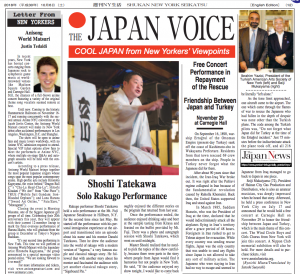
Click image to read article on page 12
By JQ magazine editor Justin Tedaldi (CIR Kobe-shi, 2001-02) for Shukan NY Seikatsu. Justin has written about Japanese arts and entertainment for JETAA since 2005. For more of his articles, click here.
In recent years, New York has hosted concerts ranging from Japanese rock to symphonic game music at world-renowned venues like Madison Square Garden and Carnegie Hall. Still, the chances of a full-blown anime concert featuring a variety of the original theme song vocalists seemed remote at best.
Until now. Coming to the historic Hammerstein Ballroom on November 16-17 and running concurrently with the second annual Anime NYC convention at the Jacob Javits Center, the Anisong World Matsuri concert event will make its New York debut after acclaimed performances in Los Angeles, Washington, D.C., and Shanghai.
The show will be open to anime fans and music lovers worldwide, with no Anime NYC admission required to attend. Special VIP ticket options allow fans to meet the performers at Anime NYC where multiple on-stage Q&As and autograph sessions will be held with the concert’s artists.
According to a press release, Anisong World Matsuri brings together the most popular Japanese singers whose songs span the most popular contemporary anime. High-profile acts include Hironobu Kageyama, the voice behind “Dragon Ball Z”’s “Cha-La Head-Cha-La”; Hiroshi Kitadani (“We Are!” from “One Piece”); TRUE (“Mobile Suit Gundam: Iron-Blooded Orphans”); and Luna Haruna (“Sword Art Online,” “Fate/Zero,” “Monogatari”).
Closing the event is Morning Musume, one of the biggest Japanese girl groups of all time. Celebrating their 20th anniversary this year, they will appear with their current 12-member lineup to mark the final overseas performance of Haruna Iikubo, who will graduate from the group in December at Tokyo’s Nippon Budokan.
“It’s our second time performing in New York. This time we will perform at Anisong World Matsuri with the legendary artist Hironobu Kageyama,” the group announced in a special message video posted online. “We are looking forward to it so much!”
For more information and tickets, visit www.anisongmatsuri.com and www.animenyc.com.
Justin’s Japan: SCANDAL from Japan
Article/Journalism, Events, Justin's Japan, Music Comments Off on Justin’s Japan: SCANDAL from Japan
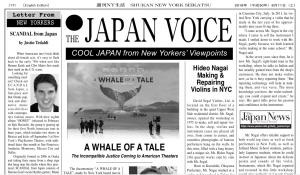
Click image to read article on page 17
By JQ magazine editor Justin Tedaldi (CIR Kobe-shi, 2001-02) for Shukan NY Seikatsu. Justin has written about Japanese arts and entertainment for JETAA since 2005. For more of his articles, click here.
When Americans into J-rock think about all-female acts, it’s easy to flash back to the early ’90s when acts like Shonen Knife and Cibo Matto first made their mark on the U.S. scene.
Looking for something modern? Check out SCANDAL from Japan, a four-piece unit that blends pop, rock and alternative music sensibilities with contemporary fashion smarts. With their eighth album HONEY (released in February on Epic Records), the group is gearing up for their first North American tour in three years, which includes two shows in Mexico, kicking off September 5th at New York’s PlayStation Theater, with additional dates that month in San Francisco, Anaheim, Monterrey, Mexico City and Dallas.
Originally formed in 2006 in Osaka and taking their name from a shop sign that hung near the studio where they practiced, SCANDAL from Japan consists of Haruna (lead vocals/rhythm guitar), Mami (lead guitar/backing vocals), Tomomi (bass/lead vocals) and Rina (drums/keyboards/guitar/backing vocals), who shared a love rock bands and artists ranging from Green Day, Foo Fighters and Paramore to the pop styling of Taylor Swift and Pink. Their own music has appeared in TV and anime series, and the band has its own original fashion brand – Feedback! – that is produced and designed by all of the members.
For the new album, Haruna explains, “We focused this album around what we individually like to do as well as what we like to do as a group. We wanted to make music that represents all of us and also songs and subjects told from the standpoint of a girls’ band. We also wanted to go all-in for the 10 -year anniversary of our debut. HONEY pays homage to that and also shows has we have continued to evolve as a group.”
For more information and tickets, visit www.scandal-4.com or the band’s Facebook page at /scandalofficial.
Justin’s Japan: The World Belongs to Hatsune Miku
Article/Journalism, Events, Justin's Japan, Music Comments Off on Justin’s Japan: The World Belongs to Hatsune Miku
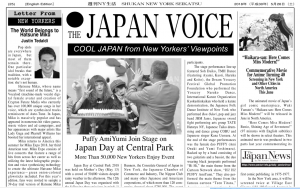
Click image to read article on page 25
By JQ magazine editor Justin Tedaldi (CIR Kobe-shi, 2001-02) for Shukan NY Seikatsu. Justin has written about Japanese arts and entertainment for JETAA since 2005. For more of his articles, click here.
Pop idols are everywhere in Japan, but most of them remain there. One particular idol breaks that tradition, with a notable exception: she’s not human.
Hatsune Miku, whose name means “first sound of the future,” is a Vocaloid (machine-made vocals) digital female avatar and creation of Crypton Future Media who currently has over 100,000 unique songs in her voice, which are synthesized tracks reminiscent of Auto-Tune. In Japan, Miku is massively popular and has appeared in numerous hit video games, music videos and ad campaigns, and her appearances with major artists like Lady Gaga and Pharrell Williams has boosted her international appeal.
Miku returns to the U.S. this summer for Miku Expo 2018, her third American tour. Miku Expo consists of live concerts that feature a range of hits from across her career as well as utilizing the latest holographic projection and voice synthesizing technology to create the ultimate Hatsune Miku experience—green onion-colored glowsticks included. For this year’s edition, fans were invited to sample a 39-day trial version of Hatsune Miku V4X software in English to create a new song, with the winning entry to be performed at every show on the North American tour.
True to its name, Miku Expo also presents an exhibition of Miku fan art by artists from Japan and local areas plus workshops and other events held to complement the concert.
The six-date U.S. tour wraps at New York’s legendary Hammerstein Ballroom on July 14th. After that comes Miku’s second appearance in Mexico City, then it’s off to Europe in December for Miku’s first-ever live concerts in Paris, Cologne, and London. The Paris date is set to coincide with the wider “Japonismes 2018” project celebrating Japanese and French relations throughout the year.
For more info and tickets, visit www.mikuexpo.com.
Justin’s Japan: JET Programme Alumni Gala Celebrates 30 Years
Article/Journalism, Events, JETs in the News, JQ Magazine, Justin's Japan, Return on JET-vestment Comments Off on Justin’s Japan: JET Programme Alumni Gala Celebrates 30 Years
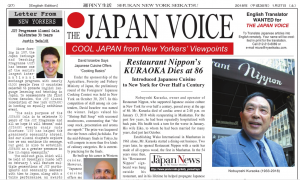
Click image to read article
By JQ magazine editor Justin Tedaldi (CIR Kobe-shi, 2001-02) for Shukan NY Seikatsu. Justin has written about Japanese arts and entertainment for JETAA since 2005. For more of his articles, click here.
Since forming in 1987, the Japan Exchange and Teaching Programme (JET) has become one of the world’s largest international exchange programs, with nearly 65,000 people from 65 countries selected to promote English language learning and teaching in Japan. To commemorate its first three decades, the JET Alumni Association of New York (JETAANY) is hosting an equally ambitious event.
“The main purpose of the JETAANY Gala is to celebrate 30 years of the JET Programme and all we hope it will become,” said JETAANY events chair Andy Shartzer. “JET has helped the grassroots community abroad, and our alumni chapters explore how we can continue its message. Our goal is also to establish JETAANY as a greater presence in the U.S.-Japan community.”
The sold-out gala, which will be held at Brooklyn’s Dumbo Loft on February 3rd, will feature multiple generations of JET participants and community members with ties to Japan, along with a taiko performance, an awards ceremony, and a prize drawing. Donations are from local companies and organizations including publisher Vertical, Inc., Kaoru Watanabe Taiko Center, and the venerable Japan Society of New York.
“Since its inception 30 years ago, the JET Programme has been a unique and outstanding facilitator of grassroots exchange between the U.S. and Japan,” said JETAANY president Wendy Ikemoto. “As one of the largest and most active alumni chapters in the U.S., we’re honored by the overwhelming response received.”
According to Shartzer, JETAANY plans to host similar events in the future, and is delighted to form new partnerships. For sponsorship and donation proposals, email Wendy at president@jetaany.org. For more information on JETAANY, visit http://jetaany.org.
Justin’s Japan: ‘Nourishing Japan’ Documentary Launches Kickstarter Campaign
Article/Journalism, Film, Justin's Japan Comments Off on Justin’s Japan: ‘Nourishing Japan’ Documentary Launches Kickstarter Campaign
Click image to view article
By JQ magazine editor Justin Tedaldi (CIR Kobe-shi, 2001-02) for Shukan NY Seikatsu. Justin has written about Japanese arts and entertainment for JETAA since 2005. For more of his articles, click here.
For Americans who have lived in Japan, some cultural experiences have a wonderful way of returning with us on the journey home.
Alexis Agliano Sanborn is a Harvard grad who spent two years teaching in rural Shimane Prefecture on the Japan Exchange and Teaching (JET) Program. As a Japan specialist, writer and filmmaker, her exposure to school lunch in Shimane served as the inspiration for a new project: “Nourishing Japan,” a documentary film currently in development about food education in Japan that aims to change how we look at what we eat.
“My specific goal is to create a documentary about how the food education workforce in Japan is changing the world for good,” Sanborn said. “We’re looking for supporters who believe learning about food is important, and are excited to support the creation of a film which has the power to change the world for the better.”
What’s so special about school lunches in Japan? Simple: The food is made from scratch. A 2013 Washington Post article explains: “Schools in Japan give their students the sort of food they’d get at home—not at a stadium, as in the United States….They’re balanced but hearty, heavy on rice and vegetables, fish and soups, and they haven’t changed much in four decades.”
Next year, Sanborn will return to Japan to begin a second round of filming. On January 5th, the “Nourishing Japan” project will launch a Kickstarter crowdfunding campaign to help share the project with the world. With more than 160 likes currently on Facebook, the team is looking to double that number in December. For more information and to view the Kickstarter teaser video, visit http://nourishingjapan.com.
Justin’s Japan: Manga! Manga! at New York Comic Con
Article/Journalism, Events, Film, Justin's Japan Comments Off on Justin’s Japan: Manga! Manga! at New York Comic Con
Click image to view article
By JQ magazine editor Justin Tedaldi (CIR Kobe-shi, 2001-02) for Shukan NY Seikatsu. Justin has written about Japanese arts and entertainment for JETAA since 2005. For more of his articles, click here.
New York Comic Con returned to the Jacob Javits Center October 5-8, selling a record-breaking 200,000 tickets (an 11% increase from last year) and featuring appearances from some of the contemporary manga world’s most renowned creators, including guest artists Akira Himekawa (The Legend of Zelda) and Hiro Mashima (Fairy Tail).
“New York Comic Con is always a great place to meet fans in person and talk about what titles they enjoy most,” said Tomo Tran, marketing director for New York-based Vertical, Inc., which publishes Japanese comics and novels in English. “We aim to bring titles that are not just mainstream in Japan, but that we feel can be impactful here in the U.S.”
Some of Vertical’s new fare was unveiled at a special panel, introducing the series Pop Team Epic, a comic-strip style parody of manga and pop culture, and the slapstick comedy The Delinquent Housewife!, both coming next year. In addition, Kodansha Comics celebrated its storied sci-fi library with a Q&A of the creators of a forthcoming Ghost in the Shell graphic novel, a new deluxe reissue of Battle Angel Alita, and a 35th anniversary boxed set of the classic “Akira,” which began life in print years before its release as a massively influential anime film.
As for memorable moments? “A female fan approached me and asked about volume seven of a backlisted title, Twin Spica, that we no longer printed,” Tran said. “I told her I would follow up about it, and fortunately we had a few copies at the office. When I gave her the copy at the con the next day, she was so happy with tears in her eyes, since this was one of her favorite series.”
Justin has written about Japanese arts and entertainment since 2005. For more of his stories, visit http://jetaany.org/magazine.
Justin’s Japan: LUCKYRICE and The Joy of Sake
Article/Journalism, Events, Food & Drink, Justin's Japan Comments Off on Justin’s Japan: LUCKYRICE and The Joy of Sake
Click image to view article
By JQ magazine editor Justin Tedaldi (CIR Kobe-shi, 2001-02) for Shukan NY Seikatsu. Justin has written about Japanese arts and entertainment for JETAA since 2005. For more of his articles, click here.
Autumn in New York is the season for delectable dishes, and this month has two unmissable events on the calendar.
First comes the annual LUCKYRICE New York Feast at Mandarin Oriental on September 22. Founded by Danielle Chang in 2010, this eagerly awaited event will once again showcase the city’s most enticing Asian food experiences, along with avant-garde spots, fine dining establishments and local superstar mom and pop shops. Tradition becomes progressive in this mash-up of culinary cuisines, with drinks provided by Asahi Beer and Suntory Whisky (for even more LUCKYRICE, check out their EPIC-urean Asian Feast hosted by BD Wong at Capitale on October 14).
Turning the spotlight to sake, returning for its 12th annual celebration in New York City is The Joy of Sake. The world’s largest sake tasting event outside of Japan comes to Metropolitan Pavilion in Chelsea on September 27, featuring a record 400 premium labels from every part of Japan and sake appetizers from 16 of New York’s finest restaurants, including Momofuku, Sakagura and SushiSamba.
While current statistics show that sake is losing ground to beer in Japan, it continues to make inroads in the U.S., especially among drink-savvy New Yorkers.
“In the last 10 years the amount of sake imported into New York has doubled as more and more people discover how good the premium labels can be,” says event organizer Chris Pearce. “The Joy of Sake is a celebration of the pleasures of the sake cup—and it’s also one of the best annual food and beverage events in New York.”
For more information and tickets, visit www.luckyrice.com and www.joyofsake.com.
