




WIT Life #142: Fair Play Committee
 Translating/Interpreting, WIT Life, Writers
  Comments Off on WIT Life #142: Fair Play Committee
WITLife is a periodic series written by professional Writer/Interpreter/Translator Stacy Smith (Kumamoto-ken CIR, 2000-03). She starts her day by watching Fujisankei’s newscast in Japanese, and here she shares some of the interesting tidbits and trends together with her own observations.
I don’t make a habit of reading the obituaries, but one in yesterday’s NYT caught my eye as it was entitled, “Frank Emi, Defiant World War II Internee, Dies at 94.” It told about the life of this Japanese- American who was imprisoned during the war and refused to serve when drafted in 1944. He was being held at the Heart Mountain Relocation Center in the northwest Wyoming desert, and he and six other internees there formed the Fair Play Committee in response to this order. Their rally cry was “No more shikata ga nai,” which had been the prevalent attitude until that point.
This committee stated that they would serve only when their rights as American citizens were fully restored. They tried to take their case to court, but these resisters were criticized by Read More
Jobs: Center for the Pacific Rim Teaching Fellowships (SF)
Jobs Comments Off on Jobs: Center for the Pacific Rim Teaching Fellowships (SF)

Via Shinpai Deshou, an online resource to help Japanese Studies majors figure out how to make a living doing what they love:
The Center for the Pacific Rim at the University of San Francisco is offering two teaching fellowships for the 2011-12 academic year: One Post-doctoral Teaching Fellow for applicants who have received their doctoral degrees within the past five years, and one Teaching Fellow for applicants of all stripes who are looking to spend a sabbatical semester or two at USF.
Deadlines are February 28, 2011. More details can be found here.
A recent article from Japan Times-McClatchy News Information Services about the Nitten braile library in Takadanobaba in Tokyo includes several paragraphs on a British JET alum named David Hathaway (Nagano-ken) who is blind and who is running the Information and Communication Technology (ICT) scholarship program — which is held in Malaysia, where he teaches basic and advanced computer skills to blind Asian leaders.
Here’s the link to the article: http://www.tmcnet.com/usubmit/2010/12/19/5203423.htm
(Thanks to Megan Miller-Yoo for alerting us to the article.)
Dialogue with an Affable Law School Dean, Part 1
Academic, Advice, Blogs, Career, Graduate School Comments Off on Dialogue with an Affable Law School Dean, Part 1
**********
Matt Leichter (matt [dot] leichter [at] gmail [dot] com) (Saitama-ken 2003-05) is a renegade attorney who plays by his own rules. He operates a think tank of one, The Law School Tuition Bubble, where he archives, chronicles, and analyzes the rising cost and declining value of legal education in the United States. He also maintains the “Bankruptcy Legal Topics,” and, “Bankruptcy Billables,” sections for Steven Horowitz’s Bankruptcy Bill. For further reading regarding JETs and the law, he recommends JETs with J.D.s.
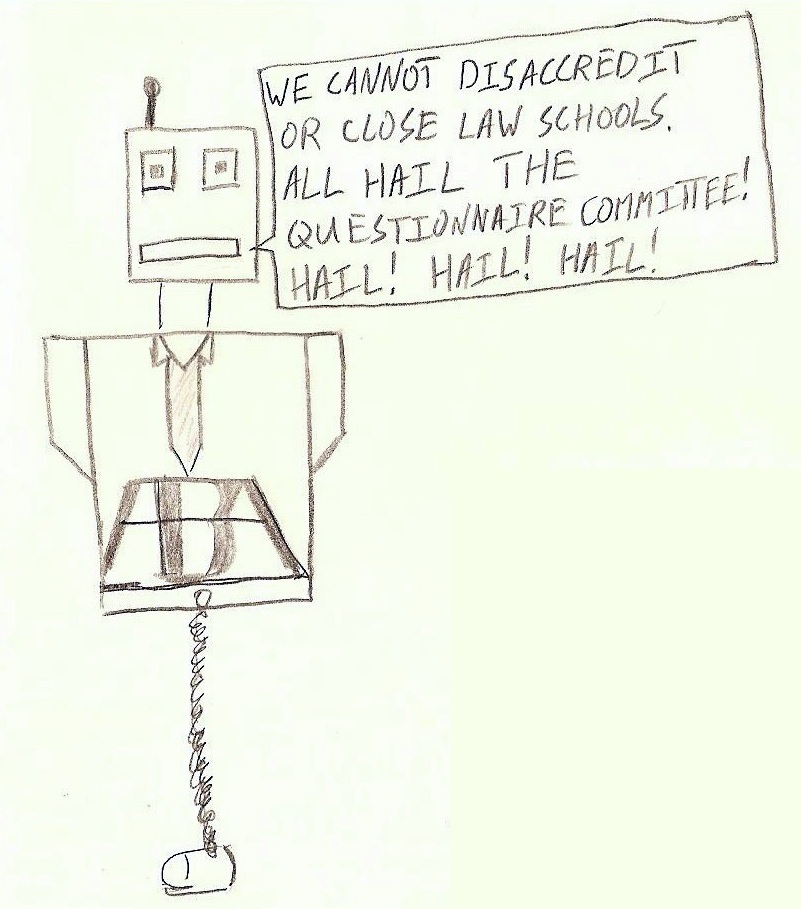
When you were on JET, did you ever have a refreshingly honest discussion about education with your kocho-sensei? I just had something similar. I received the distinct pleasure of discussing the state of legal education with the Devil’s advocate law school dean inhabiting my mind. A shrewd sparring partner, he’s surprisingly honest and appears to enjoy mandarin oranges. Find out why he doesn’t care that his law school isn’t transparent about its employment figures.
I just came across a vlog run by Jason, a JET alum who taught in Shimane-ken, which recommends JetWit as a good resource for JET alums and also contains a significant amount of videos, written content and links intended as a helpful resource for JETs.
Here’s a link to the video: http://www.youtube.com/watch?v=kWtIgFjWt2g (FYI, he talks about a few other things before mentioning JetWit, including the most bizarrely named snack I can remember hearing about.)
And here’s a link to his YouTube video channel for JET-related videos: http://www.youtube.com/user/myargonauts?feature=mhum#p/p
National AJET’s “Life After JET”: Teaching English in Japan – Lucas Clarkson
Advice, Career, Interview/Profile, Uncategorized Comments Off on National AJET’s “Life After JET”: Teaching English in Japan – Lucas Clarkson

Lucas poses as Honest Abe.
National AJET shares former JET participants’ experiences – and a little advice – with current JETs in their new monthly interview, Life After JET. Contact lifeafterjet [at] ajet.net to be featured in future posts.
*************
Lucas Clarkson spent five years on JET as an ALT at high schools and elementary schools and now teaches at a private school in Yokohama. He is currently a social studies instructor at the International Baccalaureate (IB) Middle Years Programme (MYP) at Chuo University Yokohama Yamate Girl’s School. Lucas told us a little more about his transition from JET to another teaching position in Japan for this month’s “Life After JET.”
National AJET: Why did you decide to continue teaching in Japan after JET? Was that always your plan?
Lucas Clarkson: I figured that I had so much invested in this country in terms of time spent, friendships made, and language (presumably) acquired, that to leave after JET would be a mistake. I always knew that I wanted to teach in some capacity, and I was lucky enough to find the position I did, when I did.
National AJET: Are there any resources you could recommend to someone looking for a teaching job in Japan?
Lucas: As far as resources go, there are the usual suspects: GaijinPot, Ohayo Sensei and Jobs in Japan. These are all helpful if you know exactly what you’re looking for. If you’re looking for International School positions there are a number of online headhunter-type sites where you pay a nominal fee to post your resume and other information online for prospective schools to see.
National AJET: Can you tell me a little bit about the logistics of staying on after JET – moving, getting a new visa, etc? Where there any difficulties that you didn’t expect?
Lucas: No major difficulties at all really, as long as you have a legitimate employer willing to sponsor you. If you decide to take the independent route however, you’re going to run into a host of difficulties. Just be sure to have (a) Japanese friend(s) on hand to help you with visa paperwork and the like.
Click here for the rest of the interview.
 Did you or your friends write or hear any songs about your JET experience, your town, your region, or anything JET-related?
We know a bunch of songs have been written by some number of the 50,000+ JET alumni over the 23 years of the JET Program. Now it’s time to try and gather them together in one place.
E-mail your songs to jetwit [at] jetwit.com or input them right into the comments section of this post. Whatever works for you. And if you have a recording or a video of the song being performed, then share that as well.
To start things off, here are some song lyrics about Saga-ken by a Japanese comedian translated into English by a JET.
New Spring Japanese Classes at Japan Society of New York
Japan Society Round-up, Language Study Comments Off on New Spring Japanese Classes at Japan Society of New York

| New Spring Classes at the Toyota Language Center
Spring 2011 Japanese Japanese Spring 2011 English Spring 2011 Shodō 2011 Spring Learn To Read Hiragana and Katakana LOCATION |

Calling all Kyushu JET alums and fans of Kyushu!
Events, Food & Drink Comments Off on Calling all Kyushu JET alums and fans of Kyushu!
People from different parts of Japan who reside here in NYC have r espective 県人会 (kenjinkai) or associations of people from a certain prefecture. Last year I decided to look for the Kumamoto Kenjinkai, and found out that we are part of the larger island-wide Battenkai for Kyushu-jin. I was hesitant to go since I wasn’t technically from Kyushu (even though I consider Kumamoto my home in Japan), but I was welcomed with open arms. The group is looking to get some new attendees, and would like to offer an open invitation to its upcoming shinnenkai (see below for details)! For those who want to read the original message in Japanese, please click here. Looking forward to seeing you all there!
We are beginning 2011 with a shinnenkai to mark the Year of the Rabbit! This exciting event will feature laughter yoga, a shamisen performance and a fabulous raffle. Please join us for this fun night!
★ Open to anyone born in or who has connections to Kyushu, as well as those interested in this region.
Date: January 5, 2011 (Tuesday)
Time: 7-9 pm
Location: Japanese American Association of New York (15 W. 44th Street (11th floor)
Cost: Adult = $35, Student = $20, 11 and younger free (includes food/drinks; pay in cash on day of)
☆Please click here to sign up! (This page is in Japanese, and it asks you to put your name in the first column, your phone number/email address in the next, and in the third column a password of your choice that will enable you to change your entry should you need to. When you are done with all that, click the gray button in the last column that says 登録する (touroku suru) or register. Please feel free to leave me a note below if you have any trouble! Stacy Smith, Kumamoto ’00-’03)
Justin’s Japan: Interview with ‘Fried Chicken and Sushi’ Cartoonist/JET Alum Khalid Birdsong: Part 2 of 2
Article/Journalism, Justin's Japan, Notable JET Alums Comments Off on Justin’s Japan: Interview with ‘Fried Chicken and Sushi’ Cartoonist/JET Alum Khalid Birdsong: Part 2 of 2
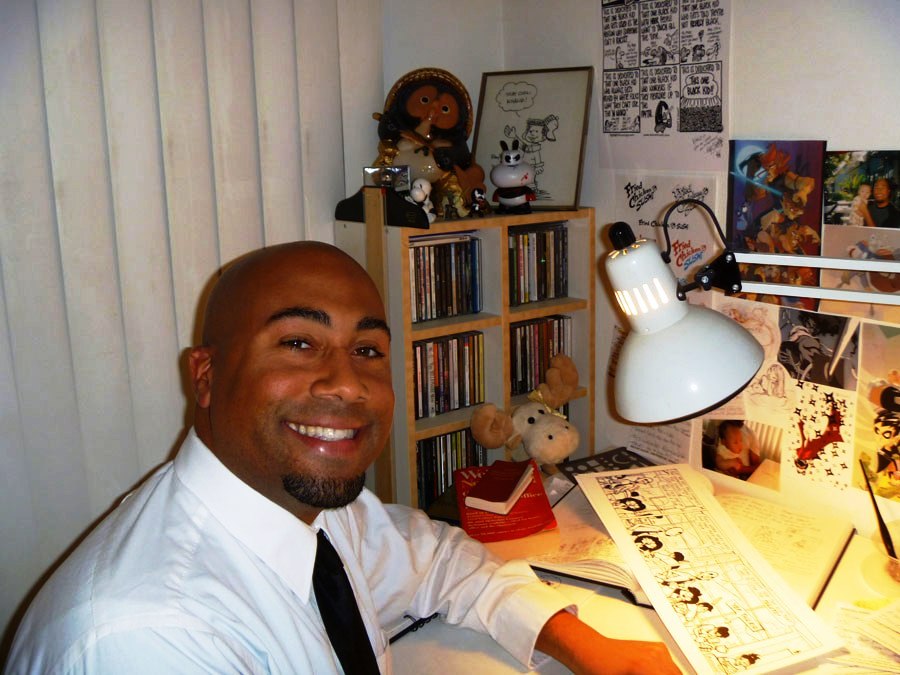
Khalid Birdsong at work. (Courtesy of K. Birdsong)
By
JQ magazine’s Justin Tedaldi (CIR Kobe-shi, 2001-02) for Examiner.com. Visit his NY Japanese Culture page here to subscribe for free alerts on newly published stories.
For Fried Chicken and Sushi, was it a conscious decision to make the lead character black?
Of course, definitely. I’m obviously an African American, and I think that I was concerned because I thought, is anybody going to want to read about this black guy going to Japan? I felt like I wanted to be true to who I am, and there’s a certain kind of way of being able to comment on race, the way that we perceive and look at people. When you go to Japan, they don’t really care who you are, you’re just a foreigner. So it’s a different kind of perception, and I really like that idea. If I keep Karl as black, I can have things that I think about that can be a whole lot easier to write, but I think it would be an interesting thing that you don’t see very often.
What kinds of crazy situations did you observe in Japan regarding Japanese people’s impression of you?
Where do I start? One thing in general is that everyone would ask me questions about America as if everyone in America does the same thing, you know? Since the Japanese people have a shared history and are all kind of the same race, they say, “Well, what is it like in America?” and “What do families eat for dinner in America?”, and it’s always so difficult to answer those questions because I have to say, well, it depends—we have a lot of cultures and so everybody’s different, and people celebrate different things. So that always would frustrate me because they want to generalize and put us all into one box, and it was hard to do. I always found that to be funny and I would start laughing when they would ask me those questions and look at me strangely: “Why are you laughing? This is a very serious question!”
What were some of the funnier or grossly inappropriate things that you experienced there that may or may not make the cut for future episodes of Fried Chicken and Sushi?
Maybe I’ll put this one in there—I don’t know if I’m the only one where this happened—but a lot of students always are asking if you have a girlfriend or something like that. But I would have several students come up to me and ask if I had a lover, like, “Do you have a lover?” And I always would say, “Uhh…well, no.” It was just the kind of English that they would use. I’m sure that you remember that there were just certain words that were always just a little different, and it would make me laugh all the time when they asked me that question, which I would always get.
Did you find yourself in the situation of having to educate your students on certain cultural things?
All the time. About America, and talking about holidays and what people do, just like the whole Christmas thing, like, “How do you celebrate Christmas?”, you know? “Christmas is not for lovers in America and we have family over.” That kind of explanation would go on and on. Certain things, even racial issues—they would learn about Martin Luther King and then they felt like there were no problems for black people in America anymore because of Martin Luther King, and everyone’s treated equally all the time in America. So there are a lot of cultural issues that I would try to discuss and help them to understand. Also, even though we have things that are different, there’s things that are the same, too. They always wanted to know what’s different, but I tried to say that things are still the same. We have families that we love and we like to celebrate and laugh and eat, and so I think that was allowed because they want to act like we’re so different and no one’s like Japanese people, but we actually do share things in common just as people.
How about race-related questions?
Just being tall and getting the students who were just shocked at how tall I was, I got that all the time: “Oh, dekai! Se ga takai!”, “you’re so tall,” and everything. They thought that I played basketball, and I really, really suck at basketball [laughs]; it’s really embarrassing. So I was leaving school one day and the kids were out playing basketball, so of course they called me over, “Oh, Birdsong-sensei, please shoot the basket.” So I thought, okay, sure—I knew I was going to miss, and they’ll see how much I suck, and it’ll be great. So of course I shoot it, and of course I make it, and they’re all like, “WOAH! You’re the greatest!” [laughs] Here we go, living up to the stereotype. Those things didn’t happen much, but they would happen on occasion, that’s for sure.
Click here for the rest of the interview.
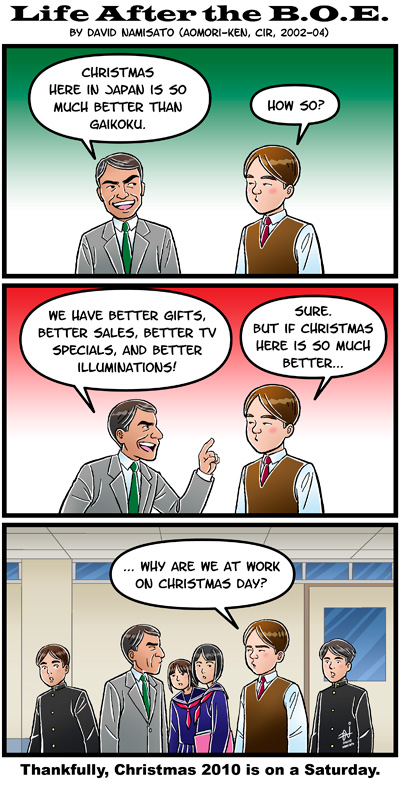
Life After the B.O.E.: Better Christmas
Cartoon/Illustration Comments Off on Life After the B.O.E.: Better Christmas
Life After the B.O.E. is a comic series about the JET experience by David Namisato (Aomori-ken, 2002-2004), a professional illustrator currently living in Toronto.
Visit David’s website at www.namisato.org.
JapanInfo e-Newsletter December 2010
Uncategorized Comments Off on JapanInfo e-Newsletter December 2010

The December 2010 edition of JapanInfo is now available online: http://editor.ne16.com/he/vo.aspx?FileID=569cab53-5818-4cc5-93c0-8d69ff4225b9&m=c084f6d45dcb1543a1f92db467644006&MailID=14668522 *(Click here to subscribe to JapanInfo by email.)
2010 Foreign Minister’s Commendation
Seiji Ozawa to Take the Conductor’s Podium at Carnegie Hall
New Yorkers Discover the Charms of Ishikawa
INSIDE THE ARMOR
The Art of Cut Paper in Philadelphia
VISIT JAPAN: Faster and Further on the Bullet Train
CULTURE CONNECTION: THE JAPANESE PROGRAM AT HUNTER COLLEGE
From the Ambassador’s Desk
JapanInfo is published by the Consulate General of Japan in New York/Japan Information Center and is a great source of info for Japan-related things going on in New York and the surrounding area.
Click here to subscribe to JapanInfo by email.
Boren Awards for International Language Study
Academic, Career, Language Study Comments Off on Boren Awards for International Language Study
 Stephanie Boegeman (ALT, Akita-ken, 2006-09) gets her kicks from finding fun crazy ways to see the world and getting paid to do it. She is constantly in search of job, internship, and travel ideas to add to her site Playing With Hire, in the hopes that more JET alumni and like-minded souls join her in her quest to find creative, inspiring, and unique ways to make ends meet.
Still honing your Japanese skills and looking for someone to subsidize your studies? American students who fit this description may want to look into the Boren award. There’s even a guaranteed government job waiting for you when you graduate. *Deadlines are in February*. More information on applicant criteria and other applicable languages is here.
Job: Educational Outreach Country Coordinator (US Embassy in Tokyo)
Jobs Comments Off on Job: Educational Outreach Country Coordinator (US Embassy in Tokyo)
via former JETAA DC Newsletter editor Gina Anderson. Posted by Dipika Soni (Ishikawa-ken, 2003-06). Dipika currently works as an in-house translator for PFU (a Fujitsu company) in Kahoku-shi, Ishikawa-ken. She is also the vocalist for the Japanese hardcore punk band DEGRADE.
*Note: If you apply for this position, please let them know you learned of it from JetWit. Thanks.
—————————————————————————————————————–
Job Position: Educational Outreach Country Coordinator (US Embassy in Tokyo)
Closing Date for Applications: January 10, 2011
Job Details:
U.S. Embassy Tokyo is looking for a Foreign Service National for the Educational Outreach Country Coordinator position. This person would be doing Education USA Outreach for all of Japan and would be collaborating with Fulbright Japan and working from inside the U.S. Embassy in Tokyo.
Under the direct supervision of the Assistant Cultural Affairs Officer (ACAO) and with support from the Regional Educational Advising Coordinator (REAC)/Northeast Asia, the Educational Outreach Country Coordinator is responsible for three core areas related to U.S./Japan student mobility:
1) providing U.S. higher education services to the Japanese public by organizing and administering thematic programs, seminars, workshops, and school presentations on how to study in the United States;
2) managing, strengthening, and expanding the network of Education USA advising centers throughout Japan by developing and implementing a sustainable marketing and outreach program and by training and guiding Education USA advisers in their goals for student outreach;
3) serving as the primary resource on Japanese education for U.S. educators, government agencies, and other interested parties. The country coordinator works with the ACAO and Cultural Affairs Officer (CAO) to design medium and long-term strategies, including annual work goals, to implement these objectives.
A copy of the complete position description listing all duties and responsibilities is available in the Human Resources Office. Please contact Minako Morimoto (MorimotoMX@state.gov / ext. 5629).
For further job and requirement details, and for how to apply, go to -> http://japan.usembassy.gov/e/info/tinfo-jobs.html
Job: English/Spanish Bilingual Sales/Marketing position at a Japanese Chemical Company (NYC)
Jobs Comments Off on Job: English/Spanish Bilingual Sales/Marketing position at a Japanese Chemical Company (NYC)
via Actus Consulting Group. Posted by Dipika Soni (Ishikawa-ken, 2003-06). Dipika currently works as an in-house translator for PFU (a Fujitsu company) in Kahoku-shi, Ishikawa-ken. She is also the vocalist for the Japanese hardcore punk band DEGRADE.
*Note: If you apply for this position, please let them know you learned of it from JetWit. Thanks.
—————————————————————————————————————–
Job Position: English/Spanish Bilingual Sales/Marketing position at a Japanese Chemical Company, New York City
Job Details:
The New York sales office of a Japanese Chemical manufacturing company is currently seeking candidates for their new Sales/Marketing position. This position will be responsible for marketing/business development and sales activities for chemical products such as Chloroprene, Thermal Functional Filler, Chlorinated Polyethylene, etc. Will report to the General Manager of the department who is a Japanese expatriate.
Main responsibilities are to manage overall sales/marketing functions of the above products and develop new business in North and South America. Job includes both domestic and international (Canada, Brazil, and Mexico, etc.) business trips visiting distributors, clients, attending trade shows, etc.
Requirements:
Regular business hours are from 9am to 5pm.
Some over time as needed.
Starting salary is 50~55K + possible bonus.
Full benefit after an initial 3-month of introductory period.
How to apply:
Please send your resume and cover letter as an MS Word attachment to moya@actus-usa.com to apply. Make sure to mention in your email to what position you are applying.
