




Return to Tohoku: Round-up 09.20.11
 Blogs, Earthquake Tsunami, Japan Local, Notable JET Alums, Return on JET-vestment, Travel/Tourism, Writers
  Comments Off on Return to Tohoku: Round-up 09.20.11
***************
Here are updates from a few more of the 20 Tohoku region JET alumni selected by the Ministry of Foreign Affairs (MOFA) to return to their town to both engage in volunteer efforts and also help document and share what’s going on there.
- Ben Erickson (Iwate-ken, Ninohe-shi) of Pacific Northwest JETAA left yesterday for Iwate. You can follow his experience on his blog at Tohokuben.com – One JET’s Return to Iwate. Here’s Ben’s current itinerary:
Day One: Tokyo, Ichinoseki, The Coast
My first official duty will be a meeting with the Japanese Ministry of Foreign Affairs (MOFA) in the Kasumigaseki area of Tokyo. After a brief meeting to discuss the goals of my program, there is no time to waste. I head from Tokyo to Ichinoseki to meet with Peace Winds America, and their staff member Mari Poorman who is overseeing their efforts in Japan. Time permitting, Mari and I may head south into Miyagi, and the town of Minamisanriku.
Day Two: The Coast
Mari and I are planning to head to the coastal cities of Ofunato and Rikuzen-Takata.
Day Three: Ninohe
After a late night train back to my second hometown, I’ll be back on familiar ground. In the morning, I’ll have a meeting with the good people of the Ninohe City Board of Education who have been working with me on this trip. I’ll also have a meeting with the Superintendent of Schools, and the Mayor. The real joy will be in the afternoon. A trip to the local High School and a chance to see my former Junior High School students now in High School.
Day Four: Ninohe
The schedule for this day is being determined.
Day Five: Ninohe, Northern Iwate and Hanamaki
The schedule for this day is being determined.
Day Six: Hiraizumi, Ichinoseki
Today I’ll visit the newly designate UNESCO World Heritage site in Hiraizumi. I’ll also be staying in a traditional Japanese Inn for my last night in Japan.
Day Seven: Return to Tokyo, Seattle.
My last day will be travel. A train to Tokyo and my flight home.
******************
- Brent Stirling (Fukushima-ken, Fukushima-shi, 2006-10) – “A Rough Guide to My Fukushima Trip – Return to Tohoku #1“ –Brent, based in Ottawa, shares his itinerary as he prepares to depart Canada for Fukushima.
Day 1: Wednesday September 21st – Depart from Ottawa for Japan
Day 2: Thursday, September 22nd – Arrive in Tokyo. Go straight to MOFA, then check into my hotel. (Spend the night in Tokyo)
Day 3: Friday, September 23rd – Tokyo to Koriyama city, then travel to Aizu-Wakamatsu to see Enzo-ji, Iimoriyama andTsuruga Castle. (Stay in Aizu-Wakamatsu)
Day 4: Saturday, September 24th – Take part in the Global Citizen’s Festival in Fukushima city that the Fukushima AJET Chapter will be taking part in. There will be facepainting, games and food from all different parts of the world and this is something that JETs in Fukushima do every year. (Stay in Fukushima)
Day 5: Sunday, September 25th (Tourist Destination) – Volunteer on the coast in Soma. Head to Soma to volunteer with Hearts for Haragama, a charity created by current Fukushima JETs, which provides funds and assistance to a kindergarten in Soma. (Stay in Fukushima)
Day 6: Monday, September 26th – In the morning, visit Fukushima Senior High School with Jason Ishida (Fukushima SHS ALT) to participate in classes and conversations with his students. (Stay in Fukushima)
Day 7: Tuesday, September 27th – Visit Nihonmatsu Adachi Senior High School to partake in their yearly bunkasai (oh ya, that’s right, who picked the best time to go? Oh this guy…BUNKASAI!!!!) (Stay in Fukushima)
Day 8: Wednesday, September 28th – Visit Nihonmatsu Technical Senior High School in the morning and then depart for Tokyo. (Stay in Tokyo)
Day 9: Thursday, September 29th – Depart from Tokyo for Ottawa
CLICK HERE to read the full post.
You can also check the JETAA USA website post (“JET Alums Return to Tohoku”) for additional information.
Return to Tohoku: Round-up 09.13.11
Blogs, Earthquake Tsunami, Japan Local, JETs in the News, Notable JET Alums, Return on JET-vestment, Travel/Tourism, Volunteer, Writers Comments Off on Return to Tohoku: Round-up 09.13.11
***************
Here are updates from a few more of the 20 Tohoku region JET alumni selected by the Ministry of Foreign Affairs (MOFA) to return to their town to both engage in volunteer efforts and also help document and share what’s going on there.
- Alan Mockridge (Iwate-ken, Ohtsuchi-shi), originally from the UK and now based in Santa Clara, CA, has started a blog in preparation for his upcoming trip to Tohoku. www.alanmockridge.com Alan reports that his town of Ohtsuchi “was completely destroyed by earthquake, tsunami & fire on 3/11. As you can imagine, after 17 years its been a bit of a challenge to reconnect with my old school but I’ve managed it & will depart on 19th Sep. until 27th.”
- James Foley will be blogging about his visit at jamesafoley.com.
- Brent Stirling (Fukushima-ken, Fukushima-shi, 2006-10) – “Still Alive, Just Really Busy” – Brent, based in Ottawa, writes about getting ready for his upcoming Tohoku visit and includes some of the recent media coverage about him.
You can also check the JETAA USA website post (“JET Alums Return to Tohoku”) for additional information.
CBC News Article on the MOFA/JET Alum “Return to Tohoku” Program
Earthquake Tsunami, Interview/Profile, Japan Local, JETs in the News, Notable JET Alums, Return on JET-vestment, Travel/Tourism, Volunteer, Writers Comments Off on CBC News Article on the MOFA/JET Alum “Return to Tohoku” Program
**********************
Here’s a link to a nice article on Canada’s CBC News website titled, “Repairing Japan’s image, one teacher at a time: 20 former teachers return to view progress in Japan six months after the earthquake and tsunami.” (By Amber Hildebrandt)
“Japan is employing an unusual method in its attempt to rejuvenate its faltering international image after a massive earthquake and tsunami devastated the country exactly six months ago on March 11.
It comes in the form of a petite, brunette teacher from Canada: Tanya Gardecky, 25, of Aurora, Ont.
Or rather in the form of 20 foreigners from around the world who once taught English in the devastated regions and now have gone back, on Japan’s dime, to view the progress for themselves.
Each was once a teacher with the government-funded JET Programme and taught in the public school system.”
CLICK HERE to read the rest of the article
Slate.com series: “Can Japan Recover?”
Article/Journalism, Earthquake Tsunami, Japan Local, Japan Trends, Travel/Tourism, Writers Comments Off on Slate.com series: “Can Japan Recover?”
There’s an excellent ongoing series on Slate.com titled “Can Japan Recover?” by Daisann McLane as she travels through various areas of Tohoku. McLane is traveling and writing about Japan as a guest of the Japan National Tourism Organization (JNTO).
“I’m exploring recovering Japan as a guest of the Japan National Tourism Organization. Tourism here dropped through the floor in the first three months after what’s now being called the “Triple Disaster”—earthquake, tsunami, Fukushima. The tourism board was so eager for upbeat stories they offered to send me anywhere I wanted over the course of a week. I emailed them a decidedly non-upbeat itinerary: Sendai, Fukushima, Tokyo. To my surprise, and to their credit, they said no problem. A few weeks later, in July, I was on a Shinkansenspeeding north from Tokyo to Sendai.”
To read more of McLane’s writing about Japan on her travel blog, go to www.therealtravelblog.com.
“A Perspective on Helping Japan Disaster Victims” by ex-JET Jeannie McKinney
Article/Journalism, Blogs, Earthquake Tsunami, Japan Local, Japan Trends, Notable JET Alums, Writers Comments Off on “A Perspective on Helping Japan Disaster Victims” by ex-JET Jeannie McKinney
This article titled “A Perspective on Helping Japan Disaster Victims“ recently appeared on the CleanEnergy.org website, written by Jeannie McKinney (Hokkaido, 2010-11) who is currently doing an internship for the Knoxville, TN office of the Southern Alliance for Clean Energy (SACE).
Link to original post: http://blog.cleanenergy.org/2011/08/30/helping-japan-disaster-victims/
Here’s an excerpt:
“Post-March 11th, the amount of willingness and enthusiasm, good will and generosity that came from abroad as well as at home, was honestly overwhelming. I was living in a small town in Hokkaido, the northernmost island and prefecture of Japan, at the time of the disaster, in an area that experienced nothing but a few tremors and shakes. But somehow, my community of 13,000 generated so many donation packages within the first few weeks after the disaster that our three little post offices had trouble handling the increased mail traffic. Instead, postal workers had to set out collection bins in their lobbies for the Japan Red Cross to come and pick up on their own.”
***********
“The problem is that there is only so much individuals can do on their own, without any direction or instruction from organized groups – especially without advice from the country’s government. Post-Katrina, the biggest complaints here in the U.S. were the slow reactions of the local and federal government to respond. Though nonprofits and volunteer groups were first on the scene, there was only so much they could do without bureaucratic support.”
“The same can be said for Japan right now, both in disaster areas as well as radiation areas.”
Return to Tohoku: WSJ article on ex-JET’s return
Blogs, Earthquake Tsunami, Japan Local, JETs in the News, Notable JET Alums, Return on JET-vestment, Travel/Tourism, Volunteer, Writers Comments Off on Return to Tohoku: WSJ article on ex-JET’s return
Nice article on the Wall Street Journal’s RealJapan blog titled “JET Calls in Favors in Tohoku“ about ex-JET Tanya Gardecky (Miyagi-ken, Shiogama-shi) and her return to Tohoku through the MOFA program. Follow JETwit updates on Tanya here and follow Tanya’s ongoing blog of her experience here.
Link to the article: http://blogs.wsj.com/japanrealtime/2011/09/01/jet-calls-in-favors-in-tohoku/
JQ Magazine: JQ&A with JET Alum Mike Maher-King of Smile Kids Japan
Earthquake Tsunami, Interview/Profile, JQ Magazine, Notable JET Alums, Return on JET-vestment, Volunteer, Writers Comments Off on JQ Magazine: JQ&A with JET Alum Mike Maher-King of Smile Kids Japan

"We are already talking to some universities and some private companies about Smile Kids Japan and soon I hope to have more volunteers than there are JETs in Japan! The JET network and support of AJET is at the very core of what we do."
By Renay Loper (Iwate-ken, 2006-07) for JQ magazine. Renay is a freelance writer and Associate Program Officer at the Japan Foundation Center for Global Partnership. Visit her blog at Atlas in Her Hand.
Mike Maher-King (Fukui-ken, 2006-11), originally from Shoreham-by-Sea, UK (near Brighton) and founder of Smile Kids Japan, which was created with the mission to have every orphanage in Japan visited regularly by a volunteer team in an effort to provide children with mentoring, cultural exchange and a newfound sense of trust.
Having making several Japanese friends while attending Royal Holloway, University of London, Mike eventually traveled to Japan and while there, fell in love with the people, the language, the culture, and most of all…the food! After working for a couple years in the UK, Mike returned to Japan as an ALT and eventually went on to create an organization that would touch the lives of thousands of Japanese children.
Recently, Mike took a few moments away from his hectic schedule to share with us a little about his organization, the emergence of volunteerism in Japan, and the impact the 3/11 earthquake and tsunami have had on his work.
When you first began Smile Kids Japan, did you realize you were introducing the concept of mentoring to the Japanese you were working with?
I didn’t actually realize that there are not as many opportunities for people to volunteer here in Japan as there are in the UK, USA, Canada. etc. until I started looking for a way to volunteer. I think with the cultural senpai-kohai (seniority based relationships) system here in Japan, the idea of mentoring isn’t at all new. However, this application of it is relatively new.
What challenges did you encounter doing volunteer work in Japan, where volunteerism isn’t as popular as it is in countries such as the UK or U.S.?
Setting up the very first meeting took a few months and lots of Japanese bureaucracy skills. But it was definitely worth the prodding! That and the initial 10 minutes of shyness, and walking into a room 1/4 of the size I expected with 10 more kids than we thought would choose to come meant all our planning wasn’t quite right! Further, it was also a little tricky to explain to some of the children’s homes what we wanted to do.
What do you think Smile Kids Japan has done for volunteerism in Japan?
There are so many people who do not realize the need for volunteers until they see it with their own eyes. I think that we are [now] approaching the tipping point. However, it is still a work in progress. We have provided an outlet for many people that want to help but didn’t have a channel for their energy. The [recent] earthquake initially transformed things with a huge amount of people volunteering. It will be interesting to see if this is carried back to people’s towns all around Japan.
Return to Tohoku: Tanya Gardecky “Hi ho! It’s off to school I go!”
Blogs, Cultural Outreach, Earthquake Tsunami, Japan Local, Notable JET Alums, Return on JET-vestment, Travel/Tourism, Volunteer, Writers Comments Off on Return to Tohoku: Tanya Gardecky “Hi ho! It’s off to school I go!”
******************
Tanya Gardecky (Miyagi-ken, Shiogama-shi) is one of the 20 Tohoku region JET alumni selected by the Ministry of Foreign Affairs (MOFA) to return to their town to both engage in volunteer efforts and also help document and share what’s going on there.
Here’s an excerpt from Tanya’s latest post: “Hi ho! It’s off to school I go!”
But when I went to the grade 3 classes the teachers changed it a bit and had some of the students mention their experience with the March 11th earthquake and tsunami. From what I understood, the students were very surprised by the earthquake and were confused about the tsunami. Some didn’t believe the tsunami was happening or that it was that big, others simply had no idea what was happening.
JETwit will continue to post updates from Tanya and other participating alums. You can also follow Tanya’s blog at http://www.travelblog.org/Bloggers/ShiogamaJET/.
Click here to read other “Return to Tohoku” posts.
If you are returning to Tohoku and would like to share your updates, please feel free to e-mail jetwit [at] jetwit.com.

AJET’s revamped website continues to impress. There’s now a section called AJET Voices that lists all the main JET online publications and also invites JETs to submit an article. The goal is to help JETs connect with their communities.
Here are the publications listed:
- The Wide Island View (Hiroshima)
- Yomoyama
- NagaZasshi (Nagasaki)
- Ganbatte Times: The Unofficial Kyoto JET Webzine
- The Refill (Fukuoka)
- The Hyogo Times
- HAJET (Hokkaido)
- The TRAM (Toyama)
- JETFuel
- Shimane Black Taxi
- Mie Life
- Ishikawa JET (Thanks to Leah Zoller for calling this one to our attention.)
For more about AJET Voices, here are AJET’s own words:
Have you done something you felt was special? Want to promote an event you are involved in? Just want to get published? AJET Voice is AJET’s way of connecting you with the rest of the JET community throughout Japan. All JETs are encouraged to submit and share their experiences with everyone.
The JET Programme is all about multicultural exchange and grassroots internationalization. If you have participated in something which you felt furthered these goals, please share it with the rest of us! Submit your articles of 200-300 words with any pictures to activities@ajet.net
Publications across Japan
Currently representing voices from Nagano, Hyogo, Toyama and many others, the site is growing in hopes of being a resources for all of Japan and those interested in the perspectives born from living here as a foreign resident.
By Prefecture
Many of the publications represented on the site are fundamentally newsletters, PDFs, or print magazines. If you are interested in or reside in the prefecture of a specific publication and wish to submit or regularly receive it, please don’t hesitate to contact us.
AJET
All of the publications on this site are in some way connected to the JET program and often each prefecture’s AJET (Association Japan Exchange and Teaching) branch. Submissions from guest writers and non-JET program teachers is extremely common and decided by each publication along with the content and editorial vision.
As a unified site, all content abides by the site’s editorial ethic not to publish any content felt to be uncritically prejudiced or offensive.
Return to Tohoku: JETAA Sydney’s Sharon Van Etten
Blogs, Earthquake Tsunami, Japan Local, Notable JET Alums, Return on JET-vestment, Travel/Tourism, Writers Comments Off on Return to Tohoku: JETAA Sydney’s Sharon Van Etten
******************
Sharon Van Etten (CIR Iwate-ken), President of JETAA Sydney, is another Tohoku region JET alumni selected by the Ministry of Foreign Affairs (MOFA) to return to their town to both engage in volunteer efforts and also help document and share what’s going on there.
You can follow Sharon’s blog Revisiting Iwate at: http://revisitingiwate.blogspot.com/
JETwit will continue to post updates from Sharon and other participating alums. Click here to see previous “Return to Tohoku” posts.
If you are returning to Tohoku and would like to share your updates, please feel free to e-mail jetwit [at] jetwit.com.
Return to Tohoku: JET alum Tanya Gardecky arrives in Shiogama
Blogs, Earthquake Tsunami, Japan Local, Notable JET Alums, Return on JET-vestment, Travel/Tourism, Volunteer, Writers Comments Off on Return to Tohoku: JET alum Tanya Gardecky arrives in Shiogama
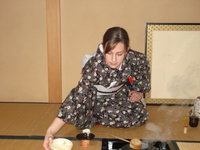 ******************
Tanya Gardecky (Miyagi-ken, Shiogama-shi) is one of the 20 Tohoku region JET alumni selected by the Ministry of Foreign Affairs (MOFA) to return to their town to both engage in volunteer efforts and also help document and share what’s going on there.
Here’s an excerpt from Tanya’s latest post:
I eventually made it Shiogama (and instantly noticed some damage around the train station) and went city hall. There I was greeted by the Mayor and vice-mayor, along with many staff from the Shiogama Board of Education, and they welcomed me back. We talked about the state of the city after the earthquake, and I was shown a book full of photos of the damage in Tohoku. Most I had seen in the news already but to see them all in one book was a bit of a shock. They said they had made much progress in the reconstruction, and this was something I wanted to see. From city hall I went to the Board of Education to meet the staff again and to discuss my week. It’s a very busy schedule but I know I can’t afford to get worn out because there are people, places, and things I want to and need to see.
JETwit will continue to post updates from Tanya and other participating alums. You can also follow Tanya’s blog at http://www.travelblog.org/Bloggers/ShiogamaJET/.
If you are returning to Tohoku and would like to share your updates, please feel free to e-mail jetwit [at] jetwit.com.
WIT Life #179: Japan in Transition, Yet Again
Earthquake Tsunami, Translating/Interpreting, WIT Life, Writers Comments Off on WIT Life #179: Japan in Transition, Yet Again
WITLife is a periodic series written by professional Writer/Interpreter/Translator Stacy Smith (Kumamoto-ken CIR, 2000-03). She starts her day by watching Fujisankei’s newscast in Japanese, and here she shares some of the interesting tidbits and trends together with her own observations.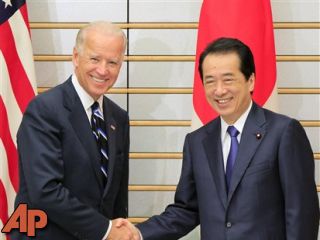
Yesterday’s NYT featured two articles relating to Japan’s financial and political situations. The first discusses how Moody’s lowered Japan’s credit rating by one step to Aa3, the fourth-highest grade (Standard & Poor’s had brought them down to AA back in January, putting them on par with the U.S.). The second recounts Vice President Biden’s recent trip to Japan, including a stop-off in of Tohoku. He served as a source of encouragement to some of the survivors he met in the disaster area.
Biden’s visit came at a time of great political turmoil, as it is forecast that Prime Minister Kan will be stepping down next week. A partywide ballot to decide a new party leader is expected on Monday, with the new leader being appointed prime minister on Tuesday. Kan indicated his desire to Read More
Latest Newsletter from Councilman Anthony Bianchi
Article/Journalism, Celebrity, Japan Local, Local Government, Notable JET Alums, Return on JET-vestment, Translating/Interpreting, Writers Comments Off on Latest Newsletter from Councilman Anthony Bianchi
************
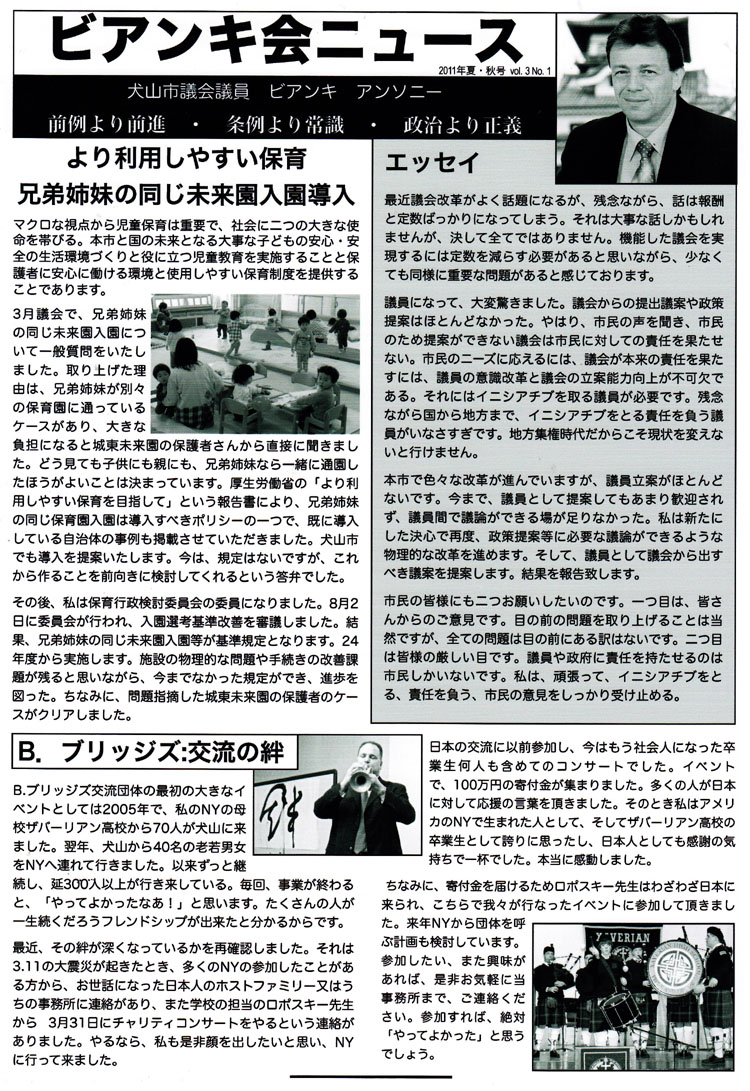
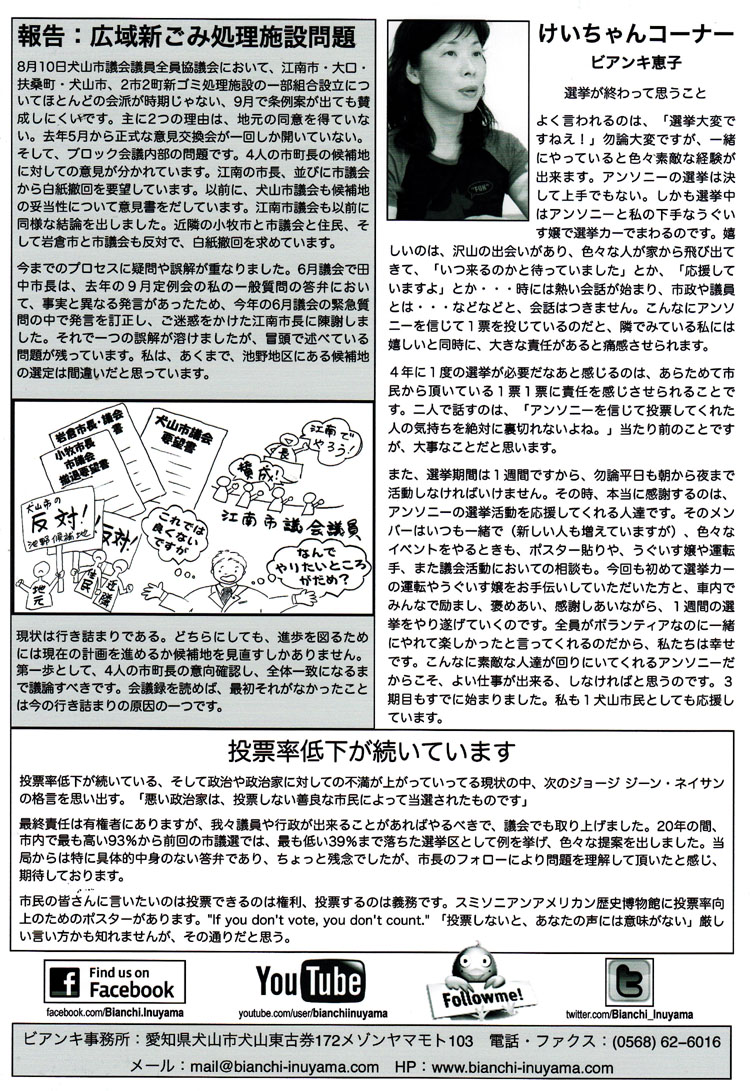
Here’s the newest newsletter from JET alum and Inuyama City Council Member Anthony Bianchi (Aichi-ken, Inuyama-shi, 1988-89):
***Page 1***
 ***Page 2***
CLICK HERE for more JETwit posts about Anthony Bianchi.
Show off your translating skills! An English translation or summary of some or all of the above would be great if any readers are up for it. Full credit will be given!
Return to Tohoku: JET alum Tanya Gradecky arrives in Japan
Blogs, Earthquake Tsunami, Japan Local, Notable JET Alums, Return on JET-vestment, Travel/Tourism, Volunteer, Writers Comments Off on Return to Tohoku: JET alum Tanya Gradecky arrives in Japan
******************
Tanya Gardecky (Miyagi-ken, Shiogama-shi) is one of the 20 Tohoku region JET alumni selected by the Ministry of Foreign Affairs (MOFA) to return to their town to both engage in volunteer efforts and also help document and share what’s going on there.
Here’s a quick excerpt from the first post on her travel blog:
“I’m about to head off to the Ministry of Foreign Affairs for a meeting and then I will be on my way to Sendai and Shiogama City in Miyagi Prefecture!!”
JETwit will continue to post updates from Tanya and other participating alums. You can also follow Tanya’s blog at http://www.travelblog.org/Bloggers/ShiogamaJET/.
If you are returning to Tohoku and would like to share your updates, please feel free to e-mail jetwit [at] jetwit.com.
JET Counselor: Roy Huggins (Hokkaido, Sapporo, 2007-10) is a counselor and therapist in both Portland, OR USA (Portland Counseling & Therapy) and Japan (All Japan Counseling) via the magic of Internet chat. He specializes in helping JETs in Japan, international folks and intercultural couples.
 How do you keep upbeat when your boss doesn’t speak English, your significant other is sixteen time zones away, the sweet little kids you work with keep diving at your backside and it takes an hour of driving to find the nearest person who understands all this? It’s a tough puzzle, and one that many JETs struggle with even now. Based on my conversations with JET alumni at the USA national conference last month, JET alumni both urban and rural can empathize even years after returning home.
Culture shock is a constant for nearly every JET. Beyond that, there’s discrimination (or the appearance of it), isolation, and other vicissitudes of international living. Most of us seem to have a good time anyways, though, or at least remember it all as a good experience.
At the USA national conference I got the chance to talk with the sempai about what worked for them. Going with the assumption that people who were motivated to volunteer for their local JET alumni chapter probably found ways to succeed on JET and value their Japan experiences, I asked everyone I could to tell me what they did to deal with culture shock, discrimination and anything else that came up during their time.
I expected a lot of what I think of as “good luck stories” — stories about Read More
