




JQ Magazine: JQ&A with Merry White on ‘Kissaten: Japanese Cafes Past and Present’
 Article/Journalism, Events, Food & Drink, JQ Magazine
  Comments Off on JQ Magazine: JQ&A with Merry White on ‘Kissaten: Japanese Cafes Past and Present’

“Japanese coffee standards are the highest—when there is a new varietal on the market, it is often sent to Japan for testing. If a bean can make it in Japan, it can make it anywhere. The quality tasters are very keen, and there are fewer defective beans permitted than anywhere in the world.” (Courtesy of Merry White)
Brewing Up Something at Japan Society
By Alexis Agliano Sanborn (Shimane-ken, 2009-11) for JQ magazine. Alexis is a graduate of Harvard University’s Regional Studies-East Asia (RSEA) program, and currently works as an executive associate at Asia Society in New York City.
When it comes to notable food and drink of Japan, for many “coffee” is not the first thing that comes to mind. Yet, on May 21, Merry (Corky) White, Professor of Anthropology at Boston University, will teach audiences at Japan Society in New York City just how robust their coffee culture is, and how exacting their measurements are. Get ready for something good at Kissaten: Japanese Cafes, Past and Present.
White’s no newbie to food and Japan—it’s been much of the foundation of her professional work. If you look her up on Amazon, you’ll see that she’s been publishing food-related books since the mid-1970s, and regularly offers contributions to publications the world over. Definitely a foodie—and someone who knows her stuff. When not researching coffee and cafes, she’s active teaching about Japanese society, women in Asia, food and culture, and the anthropology of travel and tourism. Check her out on Twitter, where she regularly posts food- and culture-related content.
To whet your appetite for this program, JQ recently caught up with White to learn more about the coffee world in Japan, and what we can expect to hear from this rich presentation.
At your lecture at Japan Society, what do you hope to teach the audience about Japanese coffee culture?
I hope to surprise at least a few people, who may not yet know that Japanese coffee is a well-rooted, well-developed cultural product with a deep history. The coffee experience is also about cafes, koohii hausu, and kissaten, places with a special meaning that have developed over time in Japan. These places have offered people various distinctive experiences, depending on the era. The first ones, in the Meiji period (1868-1912), gave people a window on Europe, decor, clothing, foods—which continued into the Taisho period (1912-1926) when the flappers and lounge lizards demonstrated a new modernity, and the urban cultures were changing to, for example, give women a place in public, too. It was fine for a young woman of good family in the daytime, anyway, to go to a cafe, though probably she might have a chaperone…
Can you describe an iconic Japanese-style kissaten?

Courtesy of Merry White
Kissaten are now places of memory, as well as ordinary community life. Brown kissa are the “sepia-toned” places where especially middle-aged people (I would say over 60s) like to go for a nice place to sit and get good service and maybe see friends. Young people like them, too, as they often share a love of the past (one they wouldn’t have had themselves) as a retro experience. Kissaten, though, also have more contemporary styles.
I’ll Make It Myself!: Add a Dash of Cultural Imperialism: Japanese Food and Cooking (1956), Part 5
Blogs, Food & Drink, I'll Make It Myself, Writers Comments Off on I’ll Make It Myself!: Add a Dash of Cultural Imperialism: Japanese Food and Cooking (1956), Part 5
L.M. (CIR Ishikawa-ken, Anamizu, 2009-11) is the editor of The Ishikawa JET Kitchen: Cooking in Japan Without a Fight. Ze works in international student exchange; writes I’ll Make It Myself!, a blog about food culture in Japan and the US; curates The Rice Cooker Chronicles, a series of essays by JETs and JET alumni on the theme of cooking/eating and being alone in Japan; and admins The JET Alumni Culinary Group on LinkedIn.

Part 5 on a series about Stuart Griffin’s Japanese Food and Cooking (1956).
If sushi is the engagement, sashimi, or raw fish, is the wedding. Now is the time to stop dabbling an plunge bolding into what may be regarded as the pièce de résistance, in the accepted French sense, and what some may regard as just the piece to resist, other will regard as the one they cannot resist.
Raw fish, to many foreigners, spells trouble.
“Raw fish!” one can hear them scream, “how could anyone think of eating such a thing?” (36)
I’ll Make It Myself!: Add a Dash of Cultural Imperialism: Japanese Food and Cooking (1956), Part 4
Blogs, Food & Drink, I'll Make It Myself, Writers Comments Off on I’ll Make It Myself!: Add a Dash of Cultural Imperialism: Japanese Food and Cooking (1956), Part 4
L.M. (CIR Ishikawa-ken, Anamizu, 2009-11) is the editor of The Ishikawa JET Kitchen: Cooking in Japan Without a Fight. Ze works in international student exchange; writes I’ll Make It Myself!, a blog about food culture in Japan and the US; curates The Rice Cooker Chronicles, a series of essays by JETs and JET alumni on the theme of cooking/eating and being alone in Japan; and admins The JET Alumni Culinary Group on LinkedIn.
Part 4 on a series about Stuart Griffin’s Japanese Food and Cooking (1956).
We’ve made it to the sushi chapter, readers!
I’ve spoken with several people about Griffin’s choice to describe sushi (well, nigiri sushi) as “rice sandwiches.” While I think most Americans in 2015 have some idea of what sushi is, in the 1950s, outside of Japanese-American communities, some explanation may have been required. Reactions to “rice sandwiches” have ranged from “no, that makes sense” to “aren’t they more like hors d’oeuvres?“* to (my favorite) “Do you know how sandwiches work?”
Justin’s Japan: Hello Hoppy
Article/Journalism, Events, Food & Drink, Justin's Japan Comments Off on Justin’s Japan: Hello Hoppy
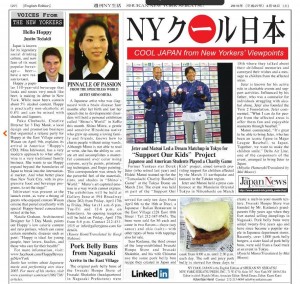
Click image to read story
By JQ magazine editor Justin Tedaldi (CIR Kobe-shi, 2001-02) for Shukan NY Seikatsu. Visit his Examiner.com Japanese culture page here for related stories.
Japan is legendary for its social drinking culture, and now fans of its most popular beverage—beer—have a new reason to toast.
Hoppy, a popular 110-year-old beverage that looks and tastes very much like beer, is making its debut in New York. While most beers contain about 5% alcohol content, Hoppy is practically non-alcoholic at 0.8%, and can be mixed with shochu and liqueurs.
Fuko Chubachi, creative director for 3 Day Monk, a local design and promotion business that organized a release party for Hoppy at East Village eatery Wasan on April 9, explains its arrival in America: “Hoppy’s CEO, Mina Ishiwatari, has a very modern approach to what otherwise is a very traditional family business. She wants to see Hoppy expand beyond the boundaries of Japan to break into the international market. And what better place than New York City, with its progressive food and beverage programs, to set the stage!”
Ishiwatari was present at the launch event, as were a throng of guests who enjoyed some custom Wasan cuisines that paired excellently with special Hoppy-based concoctions mixed at the bar.
Natalie Graham, architectural designer for 3 Day Monk, points out Hoppy’s low calorie content and zero purines, which can cause certain metabolic diseases such as gout: “Hoppy is ideal for young people, beer lovers, foodies, and those who care for their health!”
For more information, visit www.facebook.com/HoppyBeverageNewYork
WIT Life #286: 和食
Film, Food & Drink, Translating/Interpreting, WIT Life, Writers Comments Off on WIT Life #286: 和食
WIT Life is a periodic series written by professional Writer/Interpreter/Translator Stacy Smith (Kumamoto-ken CIR, 2000-03). She starts her day by watching Fujisankei’s newscast in Japanese, and here she shares some of the interesting tidbits and trends along with her own observations.
This weekend I had the chance to check out the documentary Washoku at Cinema Village, where it will be playing through the end of the month. It features interviews with sushi chefs and other Japanese food proprietors, and asks them about their philosophy, preparation and overall view of Japanese food. Many of them in talk in detail about the sacrifices they make for their craft, and how much pride they have in their work. This film is truly a must see for all washoku lovers.
One of the tidbits I found interesting was the discussion of “umami,” or the fifth taste. In one part, they were talking about the “aku” or scum that appears on the top of soup when it is being cooked, and how in Japan Read More
WIT Life #284: Durham’s Dashi Ramen & Izakaya
Food & Drink, Translating/Interpreting, WIT Life, Writers Comments Off on WIT Life #284: Durham’s Dashi Ramen & Izakaya
WIT Life is a periodic series written by professional Writer/Interpreter/Translator Stacy Smith (Kumamoto-ken CIR, 2000-03). She starts her day by watching Fujisankei’s newscast in Japanese, and here she shares some of the interesting tidbits and trends along with her own observations.
I was in Raleigh, NC this past weekend for an interpreting conference (hosted by the fabulous Carolina Association of Translators & Interpreters), and I wanted to check out the new Japanese influences as it had been a while since I had visited the area. After going to see a band in downtown Durham, I was looking for a place to grab a drink. I hoped to come across somewhere promising close to the venue, so was thrilled when I saw a sign for Dashi Ramen Shop & Izakay a.
a.
Unfortunately the downstairs ramen shop had closed at 10:30 (on Saturday night?!), but the upstairs izakaya was still open with a limited menu. I was happy to find a wide selection of Hitachino beers, including an Espresso Stout I had never tried before. Of course I needed some Read More
I’ll Make It Myself!: Recipe: Pear-Almond Cake [Dairy-Free]
Blogs, Food & Drink, I'll Make It Myself, Writers Comments Off on I’ll Make It Myself!: Recipe: Pear-Almond Cake [Dairy-Free]
L.M. (CIR Ishikawa-ken, Anamizu, 2009-11) is the editor of The Ishikawa JET Kitchen: Cooking in Japan Without a Fight. Ze works in international student exchange; writes I’ll Make It Myself!, a blog about food culture in Japan and the US; curates The Rice Cooker Chronicles, a series of essays by JETs and JET alumni on the theme of cooking/eating and being alone in Japan; and admins The JET Alumni Culinary Group on LinkedIn.
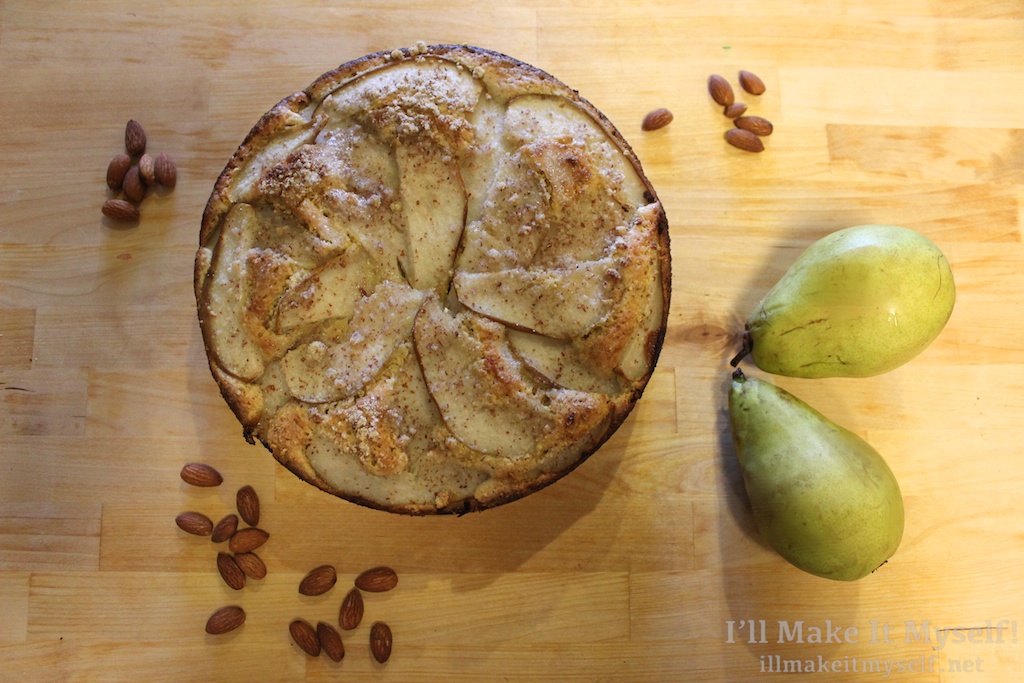
This “cake” occupies a nebulous area somewhere between dessert and cornbread. Almond meal, whole-wheat pastry flour, and cornmeal add a toothsome bite to the soft, sweet pears. I brought this to a potluck as dessert, but I liked it even better when I served it for brunch alongside a frittata and baked oatmeal.
Western pears (yônashi, 洋なし) can be a little tricky to find in certain regions and are not available year-round; the biggest producing regions are Tohoku and Koshinetsu, especially Niigata. Almond flour, whole-wheat pastry flour, corn meal are usually available in the baking section of supermarkets. (See notes for the translated ingredient list.)
I’ll Make It Myself!: Add a Dash of Cultural Imperialism: Japanese Food and Cooking (1956), Part 3
Blogs, Food & Drink, I'll Make It Myself, Writers Comments Off on I’ll Make It Myself!: Add a Dash of Cultural Imperialism: Japanese Food and Cooking (1956), Part 3
L.M. (CIR Ishikawa-ken, Anamizu, 2009-11) is the editor of The Ishikawa JET Kitchen: Cooking in Japan Without a Fight. Ze works in international student exchange; writes I’ll Make It Myself!, a blog about food culture in Japan and the US; curates The Rice Cooker Chronicles, a series of essays by JETs and JET alumni on the theme of cooking/eating and being alone in Japan; and admins The JET Alumni Culinary Group on LinkedIn.
Part 3 on a series about Stuart Griffin’s Japanese Food and Cooking (1956).
Ch. 2: Rice Dishes
Griffin’s writing style reminds me of culinary gaslighting. He bounces between extolling the deliciousness of Japanese food and calling it gross; he urges his fellow expats (or, rather, their wives) to keep an open mind and expand their palates while simultaneously telling them that foreigners don’t like this food or that food, implying that American cuisine is normal and Japanese cuisine is a curiosity.
I’ll Make It Myself!: Add a Dash of Cultural Imperialism: Japanese Food and Cooking (1956), Part 2
Blogs, Food & Drink, I'll Make It Myself, Writers Comments Off on I’ll Make It Myself!: Add a Dash of Cultural Imperialism: Japanese Food and Cooking (1956), Part 2
L.M. (CIR Ishikawa-ken, Anamizu, 2009-11) is the editor of The Ishikawa JET Kitchen: Cooking in Japan Without a Fight. Ze works in international student exchange; writes I’ll Make It Myself!, a blog about food culture in Japan and the US; curates The Rice Cooker Chronicles, a series of essays by JETs and JET alumni on the theme of cooking/eating and being alone in Japan; and admins The JET Alumni Culinary Group on LinkedIn.
Part 2 of a series on culinary cultural imperialism in Stuart Griffin’s Japanese Food and Cooking.
Yet, in the fifth paragraph, he goes right back into making the sort of judgments that put people off trying new foods:
Foreigners make wince at the first reading of the following paragraphs, but this a mistake correctable in the eating (1).
While he’s right that trying new foods prepared well is often the way to throw off squeamish assumptions about their perceived foreignness and potential unpleasantness, presenting these types of fish as “this is kinda gross but try it, you’ll like it!” a rather ineffectual way to go about it.
I’ll Make It Myself!: Add a Dash of Cultural Imperialism: Japanese Food and Cooking (1956), Part 1
Blogs, Food & Drink, I'll Make It Myself, Writers Comments Off on I’ll Make It Myself!: Add a Dash of Cultural Imperialism: Japanese Food and Cooking (1956), Part 1
L.M. (CIR Ishikawa-ken, Anamizu, 2009-11) is the editor of The Ishikawa JET Kitchen: Cooking in Japan Without a Fight. Ze works in international student exchange; writes I’ll Make It Myself!, a blog about food culture in Japan and the US; curates The Rice Cooker Chronicles, a series of essays by JETs and JET alumni on the theme of cooking/eating and being alone in Japan; and admins The JET Alumni Culinary Group on LinkedIn.
My friends, knowing I love food history, gave me a copy of an English-language Japanese cookbook as a parting gift. It’s been quite some time since I’ve written about SCAP (Supreme Commander of the Allied Powers), the US presence in Occupied Japan from 1945-52. In grad school, I wrote about SCAP decrees regarding film, and the micro-management of Japanese media to “promote democracy.” This is a bit of a different look–not a government decree from above but a cookbook created by and for the post-Occupation (1956) expat who wants to make Japanese food at home in Japan. Griffin’s cookbook is a very telling sociological text in that it captures the general colonialist attitudes of the expats toward Japan as an occupied nation and of gender norms (for both Japanese and American women). Additionally, the book provides insight into the introduction of Japanese cuisine to Americans and to the US through its explanations of ingredients and dishes as well as the translations of some of the terms used.
Join me on this multi-part descent into the bowels of cultural imperialism in the kitchen!
I’ll Make It Myself!: Pumpkin-Orange Scones with Candied Ginger
Blogs, Food & Drink, I'll Make It Myself, Writers Comments Off on I’ll Make It Myself!: Pumpkin-Orange Scones with Candied Ginger
L.M. (CIR Ishikawa-ken, Anamizu, 2009-11) is the editor of The Ishikawa JET Kitchen: Cooking in Japan Without a Fight. Ze works in international student exchange; writes I’ll Make It Myself!, a blog about food culture in Japan and the US; curates The Rice Cooker Chronicles, a series of essays by JETs and JET alumni on the theme of cooking/eating and being alone in Japan; and admins The JET Alumni Culinary Group on LinkedIn.
I’ve made the chocolate-chip version of this recipe before, but I liked the second batch I made with crystallized ginger even better. The orange really makes the ginger pop without overpowering the pumpkin, and the scones are tender on the inside. They’re best fresh out of the oven –no need for jam, although clotted cream might be nice.

I’ll Make It Myself!: Vegan “Unagi” with Shiitake
Blogs, Food & Drink, I'll Make It Myself, Writers Comments Off on I’ll Make It Myself!: Vegan “Unagi” with Shiitake
L.M. (CIR Ishikawa-ken, Anamizu, 2009-11) is the editor of The Ishikawa JET Kitchen: Cooking in Japan Without a Fight. Ze works in international student exchange; writes I’ll Make It Myself!, a blog about food culture in Japan and the US; curates The Rice Cooker Chronicles, a series of essays by JETs and JET alumni on the theme of cooking/eating and being alone in Japan; and admins The JET Alumni Culinary Group on LinkedIn.
I love unagi, but with the endangerment of the glass eel population (as well as the rising cost), it might be best to cool it with the eel. Although I’ve been following the eel news for several months, I hadn’t considered alternatives, but I saw this recipe for “Mock Eel” in the latest issue of Saveur and was intrigued.

I’ll Make It Myself!: Satsumaimo (Sweet-Potato) Pancakes
Blogs, Food & Drink, I'll Make It Myself, Writers Comments Off on I’ll Make It Myself!: Satsumaimo (Sweet-Potato) Pancakes
L.M. (CIR Ishikawa-ken, Anamizu, 2009-11) is the editor of The Ishikawa JET Kitchen: Cooking in Japan Without a Fight. Ze works in international student exchange; writes I’ll Make It Myself!, a blog about food culture in Japan and the US; curates The Rice Cooker Chronicles, a series of essays by JETs and JET alumni on the theme of cooking/eating and being alone in Japan; and admins The JET Alumni Culinary Group on LinkedIn.
I accidentally bought a white-fleshed sweet potato instead of an orange sweet potato, so I decided to make this old favorite from Japan. In the US, sweet potatoes with hard, orange flesh (annôimo, 安納芋) are more common, but in Japan, sweet potatoes with a softer, white/yellow flesh (satsumaimo, サツマイモ) are what you’ll find in the grocery store. This recipe is for satsumaimo, so make sure you have the right potato!

I’ll Make It Myself!: Slow-Cooker Vegetable Stock (from Vegetable Scraps)
Blogs, Food & Drink, I'll Make It Myself, Writers Comments Off on I’ll Make It Myself!: Slow-Cooker Vegetable Stock (from Vegetable Scraps)
L.M. (CIR Ishikawa-ken, Anamizu, 2009-11) is the editor of The Ishikawa JET Kitchen: Cooking in Japan Without a Fight. Ze works in international student exchange; writes I’ll Make It Myself!, a blog about food culture in Japan and the US; curates The Rice Cooker Chronicles, a series of essays by JETs and JET alumni on the theme of cooking/eating and being alone in Japan; and admins The JET Alumni Culinary Group on LinkedIn.
Save those vegetable scraps, readers! We’re making vegan stock, and it’s as easy as saving and freezing clean vegetable peels, food scraps, and herb stems.
Slow cookers (surô kukkâ, スロークッカー) are available in Japan, and are a good investment if you like to do sauces and soups that don’t work in rice cooker. Amazon.co.jp prices seem to be around 6000 yen (lower on sale); electronic / home goods stores tend to stock them, too.

Justin’s Japan: Nippon in New York — Takashi Murakami, Studio Ghibli Documentary, Japan Society Party
Article/Journalism, Events, Film, Food & Drink, Justin's Japan Comments Off on Justin’s Japan: Nippon in New York — Takashi Murakami, Studio Ghibli Documentary, Japan Society Party

See Takashi Murakami: In the Land of the Dead, Stepping on the Tail of a Rainbow at the Gagosian Gallery through Jan. 17. (Kaikai Kiki Co., Ltd. All Rights Reserved.)
By JQ magazine editor Justin Tedaldi (CIR Kobe-shi, 2001-02) for Examiner.com. Visit his Japanese culture page here for related stories.
With Thanksgiving (and the hopes of sensible eating) now just a memory, we turn to colder weather, falling snow, and the new year to come. Fortunately for Japanese culture fans, December is just as busy as the holiday season itself. Whether you’re hosting guests from out of town or looking to squeeze in an event or two in between parties, we’ve got you covered.
This month’s highlights include:
Now through Jan. 17
Takashi Murakami: In the Land of the Dead, Stepping on the Tail of a Rainbow
Gagosian Gallery, 555 West 24th Street
Free
Since the devastating Great Tōhoku Earthquake of 2011, prolific contemporary visual artist Takashi Murakami has explored Japanese art produced in response to historic natural disasters. Combining classical techniques with the latest technologies, he moves freely within an ever-expanding field of aesthetic issues and cultural inspirations. Mining religious and secular subjects favored by the so-called Japanese “eccentrics” or non-conformist artists of the Early Modern era commonly considered to be counterparts of the Western Romantic tradition, Murakami situates himself within their legacy of bold and lively individualism in a manner that is entirely his own and of his time.
Friday, Nov. 28
The Kingdom of Dreams and Madness
IFC Center, 323 Sixth Avenue
$14
New York premiere! Granted near-unfettered access to the notoriously insular Studio Ghibli, director Mami Sunada follows the three men who are the lifeblood of Ghibli—the eminent director Hayao Miyazaki, the producer Toshio Suzuki, and the elusive and influential “other director” Isao Takahata—over the course of a year as the studio rushes to complete two films, Miyazaki’s The Wind Rises and Takahata’s The Tale of The Princess Kaguya. The result is a rare “fly on the wall” glimpse of the inner workings of one of the world’s most celebrated animation studios, and an insight into the dreams, passion and singular dedication of these remarkable creators.
Wednesday, Dec. 3, 9:00 p.m.
Midnight in the Garden of Unearthy Delights Party
Japan Society, 333 47th Street
$25/$20 Japan Society members (until Dec. 2, $30/$25 afterward)
Japan Society Gallery serves up an exclusive after-dark soirée for patrons to escape into the wildly imaginative virtual gardens of its hit exhibition, Garden of Unearthly Delights: Works by Ikeda, Tenmyouya & teamLab. Sip some wine, beer, or a signature sake cocktail concocted just for Japan Society by JET alum Chris Johnson (Oita-ken, 1992-95), one of the country’s foremost experts on sake; enjoy the swinging sounds of jazz quartet The Red Birds + Francesco Ciniglio followed by the beats of DJ Aki til midnight; dig deep into the Garden with specially themed expert guided tours available all night; satisfy your sweet tooth at our dessert bar featuring tasty treats, fruits, and cheeses; and more! All food and drinks are covered by the cost of admission. Participants must be 21 years old or over.
For the complete story, click here.
