




JQ Magazine: JQ&A with Author/JET Alum David Namisato on ‘Life After the B.O.E. the Book’
 Article/Journalism, Books, Interview/Profile, JQ Magazine
  Comments Off on JQ Magazine: JQ&A with Author/JET Alum David Namisato on ‘Life After the B.O.E. the Book’

"The JET Programme mantra is “Every Situation is Different,” but so much of the frustrations and the joys that we encounter are very similar. I wanted a vehicle for us to laugh together." (Illustration courtesy of David Namisato)
By Rick Ambrosio (Ibaraki-ken, 2006-08) for JQ magazine. Rick manages the JET Alumni Association of New York (JETAANY)’s Twitter page and is the creator of the JETwit column Tadaima!
It’s probably happened to you over the last few years; you’re sitting at work, or maybe at home and an old buddy of yours from JET forwards you a link. You open it, and it’s a hilarious comic about life as a JET skillfully drawn with a mix of humor and nostalgia that pretty much makes your day. Life After the B.O.E. by David Namisato (Aomori-ken CIR, 2002-04) has given many a JET Alum a good laugh. If you’re anything like me, you’ve thought, “If this was a book, it would be a perfect Christmas present for those guys I still keep in contact with.” Well, David is happy to oblige.
David has now published a book of those comics, and we were lucky enough to catch up with him and pick his brain about it. With his comics popping up on other sites, it seems even a wider audience is getting into David’s work. In this exclusive interview, we ask him about his time on JET, his inspirations, and what he’s looking to do in the future.
What made you decide to publish this book?
I wasn’t planning to do a book initially, but a conversation with Lynn Miyauchi, JET Program Coordinator at the Consulate-General of Japan in Seattle, about the benefits of having a printed book (having something to read in your hands, something you can give as a gift) changed my mind.
So how did you get into art? Were you inspired at all by Japanese art/manga/etc.?
I drew a lot throughout childhood and dreamt of being a comic book artist. I grew up on a healthy diet of manga.
What brought you to Japan?
I was in the process of dropping out of animation school, and didn’t want to do anything art-related. I thought of some of the other skills I had, and I thought that the JET Programme would be an excellent way to transition myself in to a completely different career path.
JQ Magazine: Book Review – ‘Aftershock: Artists Respond to Disaster in Japan’
Article/Journalism, Books, JQ Magazine Comments Off on JQ Magazine: Book Review – ‘Aftershock: Artists Respond to Disaster in Japan’

“I assumed a response to the earthquake would be grim. I was, however, relieved to see that there is a nice dose of playfulness alongside the serious, an homage to resilience and the inimitable Japanese sense of humor.” (Big Ugly Robot Press)
By Sharona Moskowitz (Fukuoka-ken, 2000-01) for JQ magazine. Sharona works at a literary agency in New York City. She is interested in fresh, new voices in fiction and creative nonfiction.
Composed in the wake of the catastrophic events of 3/11, Aftershock is something of a series of love letters to Japan written in the object of affection’s own familiar dialect: manga. Edited and compiled by American-born and Nagoya-based cartoonist Adam Pasion (Sundogs), the range of over 35 artists/admirers runs the gamut from the seasoned foreign resident to the casual Japanophile, each with an individual style and tone. The pieces are as eclectic as the artists’ experiences and personal ties to Japan, and all proceeds from Aftershock will be donated to relief efforts in northeast Japan.
When I first approached the anthology I wasn’t sure what to expect though I braced myself for gravity. Even in the form of manga, I assumed a response to the earthquake would be grim. I was, however, relieved to see that there is a nice dose of playfulness alongside the serious, an homage to resilience and the inimitable Japanese sense of humor.
For example, “I Was a Teenage Otaku” by JET alum and Tohonharu cartoonist Lars Martinson (Fukuoka-ken, 2003-06) traces the trajectory of the author’s interest in manga and anime, a hobby which “provided the spark that made [him] want to get out there and really explore” and eventually led to his move to Japan as an exchange student. Though his passion for the art form eventually waned, it gave way to a much broader appreciation of the Japanese arts in general.
JET Alum Author Beat 10.05.11
Article/Journalism, Books, Cartoon/Illustration, JET Alum Author Beat, JQ Magazine, Notable JET Alums, Writers Comments Off on JET Alum Author Beat 10.05.11
JET Alum Author Beat is a new feature by Ling Tran (Saga-ken, 2009-11) intended to keep readers informed of what various JET alum authors are up to. Contact Ling at jetwit [at] jetwit.com if you’d like to see something included in upcoming posts. She is also interested in providing exposure for aspiring authors/writers among alumni and current JETs – excerpts and updates are all welcome.
- Suzanne Kamata (Tokushima-ken, 1998-90), author of Losing Kei and fiction editor for Literary Mama, reflects on the recent loss of a dear friend through a post about her first sushi experience on Gaijin Mama (a personal blog). Check it out and give some JET support.
- Sam Baldwin Ono (Fukui-ken, 2004-06) hails from the UK and made a life altering decision when he decided to move to Fukui-ken through the JET Program. The quiet facade of inaka Japan gradually revealed its colorful nature, eventually leading Sam to share stories and insights in For Fukui’s Sake: Two years in rural Japan. Whether for reference (newbie JETs, holla!), nostaliga, or reflection – ESID aside – this book is available electronically. If you want to be notified of its hard copy release, click here. Visit the website For Fukui’s Sake for details. (Fukui t-shirts are also available for purchase.)
- Author of The Order of Odd-Fish James Kennedy (Nara-ken, 2004-06) recently did a Q&A with JQ magazine as he will be curating the 90-Second Newbery Film Festival (Nov. 5 @New York Public Library | Nov. 16 @Harold Washington Library, Chicago). Read here.
- Robert Paul Weston’s (Nara-ken, 2002-04) Zorgamazoo will be honored at the Author Banquet of the California Library Association Conference for a California Young Reader Medal on Nov. 12. Details of the upcoming event are available on Weston’s blog. Congratulations!
- What is Japanamerica blogger Roland Kelts (Osaka-shi, 1998-99) reading these days?
- Cartoonist Lars Martinson (Fukuoka-ken, 2003-06) has been busily settling into his new home and schedule in Kameoka, Kyoto. He managed to fit in a brief post after a short hiatus. Eager followers can see how he is doing here – more substantial updates to come!
JQ Magazine: JQ&A with Author/JET Alum James Kennedy on the 90-Second Newbery Film Festival
Article/Journalism, Books, JQ Magazine Comments Off on JQ Magazine: JQ&A with Author/JET Alum James Kennedy on the 90-Second Newbery Film Festival

"As for how being on JET has influenced my writing—definitely, a lot of the fantastical world in my book 'The Order of Odd-Fish' is inspired by what I saw and experienced in Japan." (Courtesy of James Kennedy)
By Renay Loper (Iwate-ken, 2006-07) for JQ magazine. Renay is a freelance writer and Associate Program Officer at the Japan Foundation Center for Global Partnership. Visit her blog at Atlas in Her Hand.
James Kennedy (Nara-ken, 2004-06), author of the acclaimed young adult novel The Order of Odd-Fish, will be curating the 90-Second Newbery Film Festival at the New York Public Library on Nov. 5 and with the Harold Washington Library in Chicago on Nov. 16.
Named after John Newbery (thought to be the founding father of children’s literature), the Newbery Award is considered the highest regarded honor given to the author of the most distinguished contribution to American children’s literature, and the American Library Association has awarded it every year since 1922. James took a moment to tell us a little about the festival, curating, and his path as an author.
What is the premise of the festival?
[It is a contest, or challenge of sorts] open to anyone, to make a video that compresses the story of a Newbery Medal (or Honor)-winning book into 90 seconds or less. No book trailers! It has to be the entire story. For it turns out that any book, no matter how worthy and somber, becomes pleasingly ludicrous when compressed into 90 seconds. The goal is comedy.
In a previous JETwit posting, you mentioned three award winners who wrote about Japan and the Japanese that no one has tackled yet. Why do you think that is?
Only because the books aren’t as famous—people are naturally inspired to make movies of books they’ve already read and loved. Everyone has heard of Newbery Medal winners like A Wrinkle in Time by Madeleine L’Engle, The Graveyard Book by Neil Gaiman, or Bridge to Terabithia by Katherine Paterson.
The three Japan-related books that won Newbery Medals or Honors—Kira-Kira by Cynthia Kadohata, Heart of a Samurai by Margi Preus, and Commodore Perry in the Land of the Shogun by Rhoda Blumberg—are just not as well-known, and so it’s less likely someone would be moved to make a video. Their oversight is your opportunity! (To make it more interesting, you could even do it in Japanese and add subtitles!)
If you had to give one word of advice to entrants, what would it be?
Don’t merely recap the book. Transform the story! Either in style or substance. Some great examples of successful 90-Second Newbery entries are this full-scale musical version of The 21 Balloons, or this shadow puppet version of Where the Mountain Meets the Moon.
As I mention in the contest rules, it’s fun to switch up the genre style, like doing Charlotte’s Web in the nightmarish style of David Lynch’s Eraserhead. Or even cross two Newbery books: how about the rodents of Mrs. Frisby and the Rats of Nimh fight their counterparts in The Tale of Despereaux? Rat fights make for gripping cinema! Basically, make it funny. The deadline for entries is Oct. 17.
JET alum author Bruce Feiler’s latest NYTimes column
Article/Journalism, Books, Celebrity, Notable JET Alums, Writers Comments Off on JET alum author Bruce Feiler’s latest NYTimes column
September 23, 2011
By BRUCE FEILER
I RECENTLY attended a chaotic, kid-friendly gathering at the home of a friend. On my way to the bathroom to seek some solace, I decided to indulge in one of my favorite antisocial activities: scrutinizing someone else’s bookshelf. For a veteran sleuth, a bookshelf can offer a trove of insights worthy of any Freudian’s couch. Does a person alphabetize the books or clump them? Do they arrange their books by genre, order in which they were purchased, or color? Are these books unopened hardcovers or dog-eared paperbacks?
I was several minutes into my investigation (Bill Clinton’s memoir; “The DaVinci Code”), when I had a heart-sinking realization: Read More
Ishikawa AJET publishes digital cookbook for charity
AJET, Books, Earthquake Tsunami, Food & Drink, Fundraising, Japan Local, Notable JET Alums, Return on JET-vestment, Writers Comments Off on Ishikawa AJET publishes digital cookbook for charity
Thanks to Leah Zoller (CIR Ishikawa-ken, Anamizu, 2009-11) for sharing the below. Leah is currently a writer and translator for The Art of Japan: Kanazawa, an art-based tourism project via a METI grant to the Cooperative Association for the Promotion of Kanazawa-Kaga Maki-e in Kanazawa, Ishikawa.
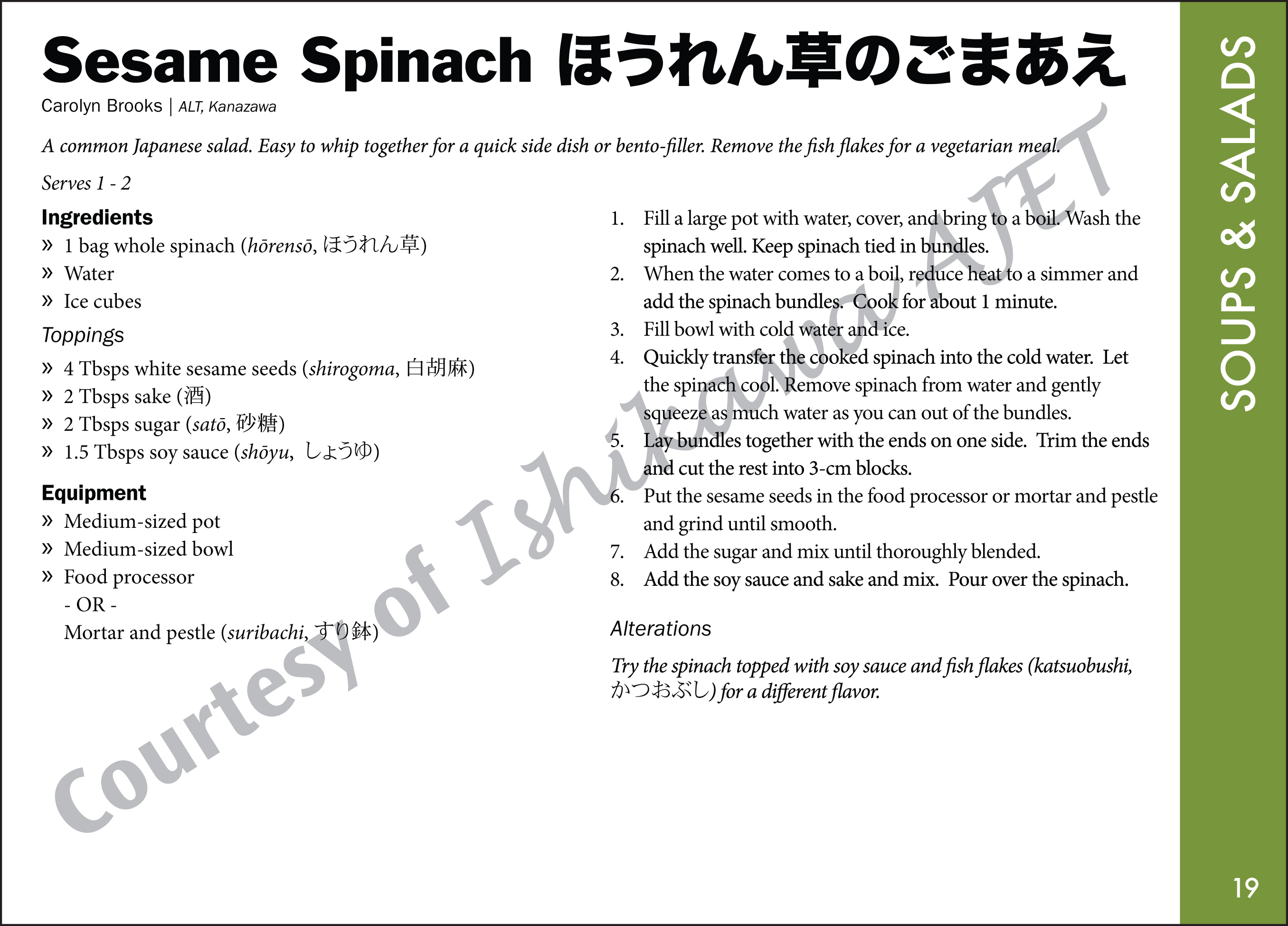
Ishikawa AJET has just published a digital cookbook for charity. The book is designed for the English-speaking expat in Japan.
CLICK HERE for details and to purchase the Ishikawa AJET Digital Cookbook.
When I moved to rural Ishikawa in 2009, I had to entirely revamp my philosophy on cooking: how to work with the ingredients I had available in my small town; how to cook without a full-size oven; how to deal with metric measurements; and how to cook for one. I started this project with the hope that any JET, regardless of cooking skill or Japanese language ability, could arrive in Japan and immediately have a guide to simple home-cooking and be able to make the food s/he wants to eat.
The recipes are written in English with the Japanese terms for the ingredients right on the page, along with helpful hints for navigating the grocery store. Measurements are in metrics, and the recipes are meant for Japanese kitchen equipment, so you never have to worry about recipes not fitting in the oven range or not cooking through. Furthermore, 30 JETs and friends and I did extensive testing on the recipes to make sure they all were easy to understand and actually worked correctly. The recipes are a mixture of Japanese, foreign, and fusion food, and include a large number vegetarian, vegan, and gluten-free recipes.
Because this is a pdf, we were able to save on printing costs and keep things more environmentally friendly. The pdf is interactive: there are hotlinks to recipes from the indices, and the document is searchable. Our design team did a fantastic job, and it’s a very useful friendly layout.
The cookbook costs 1000 yen, and all proceeds go to Second Harvest Japan, a charity that brings food and supplies to food banks, orphanages, single mothers, immigrants, et al. This charity has been critical in the relief efforts after the Tohoku Earthquake.
The original post on the Ishikawa JET Blog is here: http://ishikawajet.wordpress.com/2011/09/07/master-cooking-in-japan-with-the-ishikawa-kitchen/
Payment options include using paypal for a downloadable pdf (see link) or contacting AJET directly at ishikawaajet@gmail.com to pay via furikomi and receive the document by email.
****************
James Kennedy (Nara-ken, 2004-06), author of the acclaimed young adult novel The Order of Odd-Fish, will be curating the 90-Second Newbery Film Festival with the New York Public Library around November 5 and with the Harold Washington Library in Chicago around November 16. And he has a special request for JET alumni who are into film making:
There are some Newberry award winners that are about Japan and the Japanese, and nobody has done a 90-Second Newbery film of them yet!
Off the top of my head, I can think of:
(1) Heart of a Samurai by Margi Preus, which is about John Manjiro (2011 Honor Winner)
(2) Kira-Kira by Cynthia Kadohata, which is about WWII Japanese-American experience (2005 Medal Winner).
(3) Commodore Perry In the Land of the Shogun by Rhoda Blumberg. (1986 Honor Winner)
So, as for JET alumni:
(1) I’d love to put the call out to the JET alumni community, which surely must include filmmakers, to make 90-second films based on those books for the film festival. (It would be even better if they were totally in Japanese, with subtitles!)
(2) The film festival at the NYPL on November 5 will be not only films, but also live acts between the films — a kind of cabaret atmosphere — live 90-second Newbery reenactments, or songs, etc. So this is also a call out to any arts groups / comedy teams / bands / etc. who would be interested in doing something as a between-film live segment for the 90-Second Newbery film festival?
Here’s a little more info from James about the 90-Second Newbery Festival: Read More
JET alum James Kennedy reviews “Super Mario” for WSJ Book Review
Article/Journalism, Books, JETs in the News, Notable JET Alums, Return on JET-vestment, Reviews, Writers Comments Off on JET alum James Kennedy reviews “Super Mario” for WSJ Book Review
 James Kennedy (Nara-ken, 2004-06), author of the acclaimed young adult novel The Order of Odd-Fish, just did a Wall Street Journal book review of SUPER MARIO, Jeff Ryan’s history of Nintendo.
In the article, James apparently also had the chance to correct some bad Japanese in his book. (Who says the JET program doesn’t teach marketable skills?)
“Errors crop up. Speculating on the name of Mario’s evil twin, Wario, Mr. Ryan claims that “in Japanese, wariu means bad.” Actually, the Japanese is warui.”
The book review was in Friday’s print WSJ, and here it is online: http://on.wsj.com/paNu5f
JQ Magazine: Book Review – ‘The Beautiful One Has Come,’ short stories by JET alum author Suzanne Kamata
Article/Journalism, Books, JQ Magazine, Reviews Comments Off on JQ Magazine: Book Review – ‘The Beautiful One Has Come,’ short stories by JET alum author Suzanne Kamata

“The stories in The Beautiful One Has Come have a universal appeal but will strike a familiar note in particular with those who have spent considerable time outside their comfort zones.” (Wyatt-MacKenzie Publishing)
By Sharona Moskowitz (Fukuoka-ken, 2000-01) for JQ magazine. Sharona works at a literary agency in New York City. She is interested in fresh, new voices in fiction and creative nonfiction.
I began reading Suzanne Kamata (Tokushima-ken, 1988-1990)’s new collection of short stories with no idea what to expect and a sense of up-for-anything enthusiasm. Luckily, that feeling stayed with me throughout the collection and renewed itself automatically as I approached each new story.
There’s an enjoyably uncomfortable tension contained within the pages of The Beautiful One Has Come and it’s precisely that tension, paired with Kamata’s ability to glide between narrative points of view, that makes this collection so strong. The characters who inhabit the pages feel so true I could practically hear their pulses.
The physical settings of the stories vary from Cuba to Egypt to France to Japan among other countries, but the characters seem to inhabit spaces all their own: their minds are the true sites of conflict. The stories deal mostly with women in various states of transition; feeling like outsiders while negotiating their own identities, striving for something just out of reach, or trying to come to terms with loss. There is the foreign housewife who longs for the comforts of her native land, the elderly artist whose husband wrongfully gets the credit for the paintings she has created and the Japanese girl who is obsessed with studying abroad in Egypt.
Though these profiles might sound familiar, each story is buoyed by unique and unexpected details which keep the characters from sinking into stereotypes.
New Bruce Feiler column in the New York Times
Article/Journalism, Books, Celebrity, JETs in the News, Notable JET Alums, Writers Comments Off on New Bruce Feiler column in the New York Times
Attached is a new New York Times column (“The Life (and Death) of the Party: Mastering the Art of Dinner Party Conversation“) by JET alum Bruce Feiler (Tottori-ken, 1989-90), author of Learning to Bow, The Council of Dads, and several books on the Middle East including Walking the Bible, Abraham and Where God Was Born.
To read prior columns, please click here.
Bruce’s new book GENERATION FREEDOM: The Middle East Uprisings and the Remaking of the Modern World has just been published. You can see some of his recent media appearances by visiting www.brucefeiler.com.
***************
This Life
The Life (and Death) of the Party
By BRUCE FEILER
Published: July 8, 2011
I CALL it my insufferability test. It came about like this: A number of years ago, I was seated at a dinner party next to the celebrated C.E.O. of an American brewery. I was the lesser player here, so I began asking him questions about his beer. Fifteen minutes passed, then 30. He didn’t ask me a single question.
As dessert approached, I began slumping in my chair from trying to come up with query after query about organic hops and fluctuating wheat futures. Finally, I started dropping in teasers from the year I spent as a circus clown. “My friend the human cannonball …”; “That reminds me of the time I once got into a cage with nine tigers.” Surely these would pique his curiosity. Needless to say, I never told a story about the circus that night.
To me that encounter was a warning shot. I was like a rookie pitcher being plastered in his opening outing in the big leagues. If I hoped to avoid similar dinner party fiascoes in the future, I had to raise my game. So what is the best formula for handling a loudmouth, know-it-all, bore or clam?
With summer entertaining season upon us, it seemed like a good time to brush up on my techniques, and perhaps pick up some new tricks. So with the help of some veterans of the tablecloth trenches, here are some tips for navigating dinner party pitfalls.
EAT AND GREET In ancient Rome, senators hired nomenclatorsto follow them around and introduce them to people. These days, each of us has to be his own nomenclator. A good host often performs this role. “A lot of dinners I throw often have a specific point to them,” said Sunny Bates, a former Silicon Alley headhunter turned networking guru. “I make everyone go around and say who they are, where they’re from and what they most need.” Other starter questions I’ve seen work: “If you could change one thing about the human body, what would it be?” and “What about you, physically, is perfect?” Knowing something about all the other guests is more than good manners; it can also come in handy if you’re seated next to a dud and need to seek relief in someone a few seats away. If I’m at an event with no host at the table, I’ll go so far as to walk around and briefly introduce myself to the other guests. Think of a dinner party as being like a crime scene: plan your escape route. Read More
Video: “Tonoharu” explained in unique video by creator Lars Martinson
Books, Cartoon/Illustration, Cultural Outreach, Humor, Notable JET Alums, Uncategorized, Video, Writers Comments Off on Video: “Tonoharu” explained in unique video by creator Lars Martinson
****************
Lars Martinson (Fukuoka-ken 2003-2006), author of the graphic novels Tonoharu: Part Two and Tonoharu: Part 1, has put together a rather unique video that “explains” the Tonoharu series in a marvelously tongue-in-cheek way. (BTW, does anyone know if there’s a Japanese term for “tongue-in-cheek”?)
Anyway, have a look at the video. I think it’s fair to say that no one has captured the JET/living in Japan experience in as intricate a way as Lars has:
Harper Collins set to publish a new book by JET alum Bruce Feiler
Books, Celebrity, Notable JET Alums, Writers Comments Off on Harper Collins set to publish a new book by JET alum Bruce Feiler
JET alum Bruce Feiler (Tottori-ken, 1989-90), author of Learning to Bow, The Council of Dads, and several books on the Middle East including Walking the Bible, Abraham and Where God Was Born, has a new book to published by Harper Collins soon titled Generation Freedom: The Middle East Uprisings and the Remaking of the Modern World.
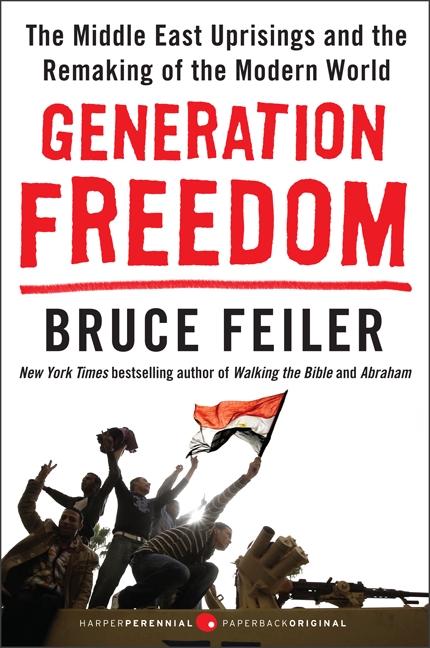
From the Harper Collins website:
At a time when the world is asking how the Arab Spring and the death of Osama bin Laden will reshape our times, Bruce Feiler, bestselling author of Walking the Bible and Abraham, offers a vivid behind-the-scenes portrait of history in the making. He marches with the daring young organizers in Liberation Square, confronts the head of the Muslim Brotherhood, and witnesses the dramatic rebuilding of a church at exactly the moment sectarian violence threatens the peaceful movement. Drawing on fifteen years of travels across the region, from Egypt to Israel, Iraq to Iran, Feiler brings his unprecedented experience to the most pressing questions: how the rise of freedom will affect terrorism; Middle East peace; and relations among Jews, Christians, and Muslims worldwide. Eloquent and thoughtful, Generation Freedom offers a hopeful vision of how this unrivaled upheaval will transform the world.
JQ Magazine: Book Review – Natsume Soseki’s ‘Kokoro’ Takes New Translation to Heart
Article/Journalism, Books, JQ Magazine Comments Off on JQ Magazine: Book Review – Natsume Soseki’s ‘Kokoro’ Takes New Translation to Heart

By Sharona Moskowitz (Fukuoka-ken, 2000-01) for JQ magazine. Sharona works at a literary agency in New York City. She is interested in fresh, new voices in fiction and creative nonfiction.
In a magazine article published earlier this year, crooked former banker Bernie Madoff told the public that despite his lies, despite the lives left ruined in the wake of his atrocious crimes, he is not a bad man.
Why do I bring this up here, in a book review of Japanese author Natsume Soseki’s seminal 1914 novel Kokoro? Because Madoff could have learned a thing or two from the book. As the saying goes, the classics aren’t about what happened, they’re about what happens. And Kokoro is no exception.
The novel peels back the layers of an unlikely friendship between a callow university student and a reclusive old man to reveal how experiences shape us and relationships define us, for better or worse. Admiration, greed, curiosity, jealousy; all these ingredients swirl together in the complex stew of the human psyche, the kokoro (“heart”). Only in the face of temptation are a person’s true colors revealed.
The new translation by Meredith McKinney offers readers a more modern version without compromising the impact of the work. The novel is both timeless and timely—it’s as relevant now as it ever was. Maybe cynicism weathers the ages better than unexamined optimism. Or, maybe human nature just doesn’t change that much.
MEF Bruce Rutledge’s Chin Music Press launches innovative “BooksRX”
Books, Cultural Outreach, Notable JET Alums, Writers Comments Off on MEF Bruce Rutledge’s Chin Music Press launches innovative “BooksRX”
MEF Bruce Rutledge, founder of Seattle-based independent book publisher Chin Music Press and editor of Ibuki magazine, has launched an innovative new approach to independent book publishing:
 Mail-Order Medicine For Your Mind!
Announcing BooksRX In 2010, small independent publisher Bellevue Literary Press won the Pulitzer Prize for fiction with Paul Harding’s Tinkers – the first time a small press had won the award since 1981! In 2011, the media bombards us with tales of Amazon’s digital books gobbling up demand for the printed page, and yet small presses continue to pop up all over the US and Canada.
With the book business in a state of flux, we here at Chin Music Press believe that independent publishers are poised to carry the banner of the publishing world far into the 21st century. We are fortunate to find ourselves in a literal consortium of visionary presses who refuse to believe the media’s Doomsday prophecies foretelling the slow demise of the printed book. In fact, we’re convinced that our fellow indie publishers offer the perfect elixirs for eager readers and despairing booksellers alike.
Beginning June 1, Chin Music Press will offer BooksRX, a quarterly curated collection of the best that North American independent publishers have to offer. We’re excited to prescribe publishers, writers and artists whom we think should be a part of any literary medicine cabinet. BooksRX ensures that you’re getting your recommended dose of vitamin READ.
“BooksRX is undoubtedly the gateway drug for unsuspecting readers into the world of independent book publishing!”
Dr. R. Max Sneezeworthy, Literary Division, US Department of Health and Human Services
Available as a single dosage (one issue) or as a full regimen (annual subscription), each installment of BooksRX is a limited edition of 100 and arranged around a loose theme. Our first issue is inspired by our passion for finding new ways to tell stories from and about Japan.
- Monkey Business: New Voices From Japan A bold new collection including short stories, poems, an interview with author Haruki Murakami and more curated by Motoyuki Shibata and Ted Goossen, and presented by A Public Space
- An exclusive hand-numbered, signed and limited edition giclee print from L.J.C. Shimoda, fine artist and illustrator of OH! a mystery of mono no aware
- Kuhaku and Other Accounts From Japan Our first book (and manifesto to holistic book design) featuring essays and art by Roland Kelts, Craig Mod, kozyndan, Sumie Kawakami and an irreverent but highly informative glossary of Japanese terms.
BooksRX is available exclusively through the Chin Music Press online store:
- Single dose (one issue): $40 including shipping to US and Canada ($10 extra for shipping to international destinations)
- Full prescription (four quarterly issues, save $20): $140 including shipping to US and Canada, ($35 extra for shipping to international destinations)
A carefully edited selection including two dynamic books featuring new voices from Japan paired with an exclusive hand-numbered and signed art print!
More: Chin Music Press · Online Store
600 North 36th Street, #212, Seattle, WA 98103
JETAA Chicago Author Panel: Experiences Teaching English in Japan
Books, Career, Events, JETAA Chapters Comments Off on JETAA Chicago Author Panel: Experiences Teaching English in Japan
Via JETAA Chicago May Webletter:
On Friday, June 10, 6:30-8pm, JETAA Chicago and the Japan America Society of Chicago will be hosting a panel featuring Lars Martinson and David Fernandez, two JET alumni authors.
Mr. Martinson, cartoonist and author of Tonoharu, and Mr. Fernandez, author of Rising Sunsets, will share their experiences teaching English in Japan, relive funny cultural stories, and mention how these experiences shaped the writing of their books Tonoharu and Rising Sunsets.
Please join us at Barnes & Thornburg LLP, 1 N Wacker Suite 4400, Chicago, IL 60606.
Tickets are $5 for JASC & JETAA members, $10 for general admission.
Space is limited so RSVP soon to Erika Kono at kono@jaschicago.org.
