




WIT Life #222: Japan’s Global Leadership
 Books, Events, Translating/Interpreting, WIT Life, Writers
  Comments Off on WIT Life #222: Japan’s Global Leadership
WIT Life is a periodic series written by professional Writer/Interpreter/Translator Stacy Smith (Kumamoto-ken CIR, 2000-03). She starts her day by watching Fujisankei’s newscast in Japanese, and here she shares some of the interesting tidbits and trends together with her own observations.
Earlier this week I went to a lunchtime 座談会 (zadankai, or round-table talk) at Columbia Business School’s Center on Japanese Economy and Business (CJEB) entitled “Global Leadership Challenges for Japanese Companies.” The discussion was led by Sheena Iyengar, the S.T. Lee Professor of Business at the school and moderated by Hugh Patrick, the Center’s Director. Some of the themes explored during the course of the hour and a half session were how to stimulate entrepreneurship, the issue of global leadership being thought of as equivalent to English ability, and the cultural fear of making mistakes as hindering innovation. There was an interesting characterization of America as being on the promotion side of the spectrum (risk-taking), and Japan falling on Read More
JQ Magazine: Book Review – Haruki Murakami’s ‘1Q84’
Article/Journalism, Books, JQ Magazine, Reviews, Roland Kelts Comments Off on JQ Magazine: Book Review – Haruki Murakami’s ‘1Q84’

“Murakami’s previous books were like delicious sandwiches that left you wanting more. 1Q84 is like a two-foot long sub that filled you to bursting, but you’re still not totally satisfied.” (Vintage International)
Roland Kelts, don’t kick me in the balls—
One man’s attempt to review a book honestly while still keeping friends
By Rick Ambrosio (Ibaraki-ken, 2006-08) for JQ magazine. A staple of the JET Alumni Association of New York (JETAANY) community, Rick manages their Twitter page and is an up-for-anything writer.
My girlfriend wouldn’t shut up about it.
“1Q84 is the best! Ah, when it comes out in English you need to read it!” Just talking about it made her rush to find her old copies (it was broken up into three books in Japan) and start reading them again. She was enthralled, to say the least. I’ve been a Murakami fan for a while: Norwegian Wood was emotional and sexually riveting; Dance Dance Dance was creepy as hell but lots of fun; Kafka on the Shore blew my mind. So I was hungry for 1Q84.
I picked it up shortly after it came out…and put it down for a while…then picked it up again…then down… then up…I think you get the idea. My feelings can kind of be summed up like this: Murakami’s previous books were like delicious sandwiches that left you wanting more. 1Q84 is like a two-foot long sub that filled you to bursting, but you’re still not totally satisfied.
The plot follows two people tied together by fate, love, and inter-dimensional happenstance. Tengo is an author and math teacher who finds himself embroiled in a shady plot to write an award-winning book. Aomame is a fitness instructor with a decidedly darker side job. Both find themselves in an altered version of 1984 called 1Q84 that deviates from the previous reality in specific ways. Those changes seem to revolve around a cult, a beautiful young girl, a book and mysterious “Little People.” Their battle to beat the odds and find each other, discover where they are, and who’s behind the changed world is an epic journey told through alternating perspectives.
1Q84 had all the things I love about Murakami: Super complex, interesting and engaging characters, crazy inter-dimensional sex, lots of mystery, and supernatural elements that bring it right on the cusp of reality, teetering between a fantasy realm and the real 1984. His ability to walk that line (like a cat walking a picket fence for those who love cats not only in Murakami novels, but also in reviews of Murakami novels) is astounding and he does it…for a really long time.
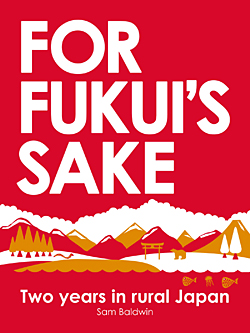
Now in Paperback: “For Fukui’s Sake: Two years in Rural Japan” by JET alum Sam Baldwin
Books, Cultural Outreach, Japan Local, Notable JET Alums, Return on JET-vestment, Travel/Tourism, Writers Comments Off on Now in Paperback: “For Fukui’s Sake: Two years in Rural Japan” by JET alum Sam Baldwin
|
JQ Magazine: Book Review – ‘Professor Risley and the Imperial Japanese Troupe: How an American Acrobat Introduced Circus to Japan—and Japan to the West’
Article/Journalism, Books, JQ Magazine, Reviews Comments Off on JQ Magazine: Book Review – ‘Professor Risley and the Imperial Japanese Troupe: How an American Acrobat Introduced Circus to Japan—and Japan to the West’

“Chock-full of illuminating illustrations and gorgeous printed ephemera that would make any contemporary typographer swoon, Professor Risley and the Imperial Japanese Troupe is a jet-set adventure in pop culture scholarship sure to appeal to anyone interested in Japan’s history on the world stage.” (Stone Bridge Press)
By Jessica Sattell (Fukuoka-ken, 2007-08) for JQ magazine. Jessica is a freelance writer, and was previously the publicist for Japan-focused publishers Stone Bridge Press and Chin Music Press. She is interested in the forgotten histories of culture, and has often considered running away and joining the circus.
We’re still riding the “Cool Japan” wave that crested at the turn of the millennium, but our fascination with the country and its culture didn’t quite stem from just anime, Harajuku fashions, or J-pop. In Professor Risley and the Imperial Japanese Troupe: How an American Acrobat Introduced Circus to Japan—and Japan to the West, award-winning author Frederik L. Schodt argues that contemporary interest in Japan’s popular culture has its roots in the travels and cross-cultural interactions of a band of 19th century Japanese circus performers and a colorful American impresario.
Published in November by Stone Bridge Press, Professor Risley explores a critical and exciting time in history, when an interest in foreign cultures was rapidly expanding beyond the privileged parlors of the upper class and Americans and Europeans were greatly fascinated by anything Japanese. Schodt offers an intriguing case study of both early Japanese conceptions of the West and the West’s first looks at modern Japan, but it is also a mystery of sorts: Why did a group of acrobats that were incredibly popular with international audiences in the 1860s fade from the annals of performing arts history? How was the life of “Professor” Richard Risley Carlisle, arguably one of the most extraordinarily talented and well-traveled performing artists in history, buried in the folds of time? Schodt suggests that we may never know the answers, but we can sit back and enjoy the show as their histories unfold.
This story begins, fittingly, with the question, “Where Is Risley?” Schodt artfully traces “Professor” Risley’s early travels and performance history like an elusive game of connect-the-dots, piecing together itineraries, publicity notices and press clippings until a clear pattern of a fascinating life emerges. Risley seemed to be everywhere and nowhere, and led a full life of jet-setting and adventure-seeking at a time where transcontinental travel was only beginning to open up to those outside of the diplomatic realm. We follow him on a decades-long journey across the United States, Europe, Australia, New Zealand, Southeast Asia, China…and finally to Japan.
Risley arrived in Yokohama in early 1864 and immediately went to work setting up a fantastic Western-style circus to delight foreign residents and Japanese locals alike. As the country had re-opened to the world just five years earlier, it was a risky time to be in Japan, and non-Japanese residents lived with underlying worries of Shogunate-dictated expulsion and violence from disgruntled ronin. That didn’t quite stop Risley’s entrepreneurial spirit, but he did eventually run into a series of difficulties with his shows—and a stint in dairy farming, which, in the process, led him to introduce ice cream to Japan. He hadn’t originally intended to stay in Japan for long, but most likely due to the Civil War raging back home in America, he bided his time and explored his options. Thankfully, his stay there—paired with an almost desperate talent for improvisation—would lead to the world’s first taste of Japanese popular culture.
Gemma Vidal (Okayama-ken, 2010-12) is a recently returned JET seeking work in licensing/merchandising (if it’s within the publishing industry, even better!). You can usually find her in her little web spaces Gem in the Rough and Peachy Keen (her JET adventures) or training with San Jose Taiko. If you know of any authors/aspiring writers you’d like to see featured in JET Alum Author Beat, just contact Gemma at gem.vidal [at] gmail.com
- Congratulations are in order to Will Ferguson (Nagasaki-ken, 1991-94), author of Hitching Rides With the Buddha (f/k/a The Hitchhiker’s Guide to Japan), who was awarded the esteemed 2012 Scotiabank Giller Prize for his novel 419. You can check out the announcement on the Scotiabank Giller Prize website and read more about his novel and other works on Will’s own website. Congratulations again, Will!
- What better way to warm up from the cold weather than a cup of sake! If you’re a fan of sake and live in Japan, check out John Gauntner’s (author of The Sake Handbook) annual Sake Professional Course 2013. It is a 5-day educational course which includes classroom sessions and visiting sake breweries in the Osaka/Kyoto/Kobe area. For more information about the schedule and registration, please visit the SPCJapan website. You can also download a free version of Sake: The Least You Need To Know, a quick start guide to sake here
- Suzanne Kamata (Tokushima-ken, 1998-90), author of Losing Kei and fiction editor of Literary Mama announced that her latest Young Adult novel, Gadget Girl: The Art of Being Invisible will be published by GemmaMedia (cool name) in May 2013! Gadget Girl follows the life of 14-year old Aiko Cassidy and her dream to become a manga artist. The story won the SCBWI Magazine Merit Award in Fiction. You can check out the book on her website or through Amazon, Powells, and Indiebound.

- Japanamerica’s Roland Kelts (Osaka-shi, 1998-99) will lead a presentation titled, “Japan’s New Anti-Piracy Law and the Online Media Debate” with media lawyer David B. Hoppe and music journalist Steve McClure on November 14th.
- Attention NY residents! James Kennedy (Nara-ken, 2004-06), author of The Order of Odd-Fish is holding a signing on November 27th at the Pittsford Barnes & Noble in Rochester at 7PM and presenting new material on November 28th at Writers and Books (also in Rochester with a $5 fee). Details can be found on James’ website and this site for the November 28th event. Go and show your support!
- Want a chance to win a free book written by one of our own? Benjamin Martin (Okinawa-ken, 2008-Present), publisher of the More Things Japanese blog is giving away two personalized copies of his new book, Samurai Awakenings which was just released last month! The giveaway ends on November 30th, so go to Goodreads and sign up! You can read JETwit’s own brief interview with Benjamin about his book.
- Mie-ken JET alumni Laura Popp’s fantasy novel, Treasure Traitor is out! Here’s the summary on Amazon’s website to give you a taste of the story:
“In a universe torn by war, two governments vie for power: the elemental Kingdom and the telepathic Hierarchy. Hierarchy women with animal bonds think nothing of sacrificing their beasts’ lives to protect themselves. Except sixteen-year-old Renagada. The bond with her carrion-eater bird Acha is two-sided, and she knows his mind as much as he knows hers. When Rena overhears her parents plotting to kill Acha because of superstition, she must leave her fiancé and home of sheltered luxury to flee with Acha into the desert. Peril awaits them at every turn, and someone is tracking them…”
And that’s all for this round of the Author Beat!
Justin’s Japan: Interview with ‘Manga! Manga! The World of Japanese Comics’ author Frederik L. Schodt
Article/Journalism, Books, Film, Interview/Profile, Justin's Japan, Writers Comments Off on Justin’s Japan: Interview with ‘Manga! Manga! The World of Japanese Comics’ author Frederik L. Schodt

“I grew up overseas in several different countries, and I’ve always enjoyed different cultures. And for me, that was exactly the way Japan appeared: it was always interesting, and it still is always interesting. There’s always things to learn.” (Courtesy of Stone Bridge Press)
By JQ magazine editor Justin Tedaldi (CIR Kobe-shi, 2001-02) for Examiner.com. Visit his Japanese culture page here for related stories.
Frederik L. Schodt first traveled to Japan in 1965 as a teenager, and since the early ’80s he has written numerous books about Japanese culture both popular and obscure, including the landmark Manga! Manga! The World of Japanese Comics, the first substantial English-language work on the art form. Schodt also has translated a wealth of books and manga series (many by his late friend, the “god of comics” Osamu Tezuka), and in 2009 he was awarded the Order of the Rising Sun, Gold Rays with Rosette for his contribution to the introduction and promotion of Japanese contemporary popular culture.
Out Nov. 13 is his newest book, Professor Risley and the Imperial Japanese Troupe, the true story of “Professor” Richard Risley Carlisle, an American who introduced the Western circus to Japan in 1864, and in turn gave many Americans their first glimpse of the East when he took his “Imperial Japanese Troupe” of acrobats and jugglers on a triumphant tour of North America and Europe, stirring a fascination with all things Japanese that, Schodt says, eventually led to today’s boom in manga and anime.
In part one of this exclusive, wide-ranging interview, I spoke with Schodt about his fascination with the late 19th century, his relationship with contemporary pop culture icons like George Lucas, and the story behind his middle initial, which is colorfully connected to the events of the film Argo.
It’s been more than five years since the release of your last book, The Astro Boy Essays. What else have you been up to since then?
I’ve actually gone through this and done some rough calculations, but it seems to take me about five years between books. I’ve been doing this same sort of thing that I always do, which is a mix of writing books and translating and then also working as a conference interpreter. For different periods, the weight and the ratio changes, but the mix is pretty much the same. And I’ve been working on the book of Professor Risley and the Imperial Japanese Troupe, I guess, for the last two or three years doing research. But it’s been a lot of fun, I have to say—it’s been one of the most fun books I’ve worked on in a long time.
What are some developments in manga/anime/Japanese pop culture in the U.S. that you feel has moved in a positive direction? At the same time, what things are you a bit critical of in the way they were handled?
I think it’s wonderful that a popular culture from another country such as Japan developed such a large fanbase in the United States, and that was a real surprise to me. I always hoped that people would take more notice in Japanese manga and anime, because I thought they were such an interesting manifestation of popular culture that had been long overlooked in the United States. But I never imagined that both of those entertainment media would become so big and so entrenched in the United States in terms of the fanbase, so that’s been wonderful to see.
It seems like the biggest development in recent years has been the cosplay phenomenon—that’s become a real part of the lingo here now.
That’s right. And I think cosplay in the United States is a little different, and in fact I think the whole fandom in the United States has assumed sort of American characteristics, so it’s developing on its own in new directions, and it’s kind of wonderful to see. I go to some of the larger cons every once in a while, and I really enjoy seeing how young people are interpreting this cultural phenomenon developed in Japan, although I have to say that cosplay is really indirectly inspired by the masquerades and the costume competitions that started in the United States in the sci-fi comic book community. So it’s very interesting. It’s this sort of cultural interchange that I’ve always been fascinated by where you have these two countries that are kind of reflecting each other and sending influences back and forth to each other, and interpreting a phenomenon in slightly different ways.
For the complete interview, click here.
JET Alum Will Ferguson Wins Canadian Lit Award
Article/Journalism, Books, JQ Magazine Comments Off on JET Alum Will Ferguson Wins Canadian Lit Award

Click image for JQ magazine’s 2010 feature story on Will Ferguson
From the Associated Press via the New York Times:
On Oct. 30, celebrated JET alum author Will Ferguson (Nagasaki-ken, 1991-94) won the Scotiabank Giller Prize, a $50,000 Canadian fiction award, for a his novel 419, about a family’s entanglement in a Nigerian email scam.
A kilt-wearing Ferguson pulled out a flask during his acceptance speech and raised a toast to the written word. Presenters included Sex and the City actress Kim Cattrall.
The Giller, which honors the best in Canadian fiction, was created in 1994 by businessman Jack Rabinovitch in memory of his late wife, literary journalist Doris Giller.
Tuesday’s ceremony was broadcast by the Canadian Broadcasting Corp. For a CBC video of Ferguson on writing 419 and being a Giller finalist, click here.
WIT Life #217: David Mitchell’s Japan connection
Books, Translating/Interpreting, WIT Life, Writers Comments Off on WIT Life #217: David Mitchell’s Japan connection
WIT Life is a periodic series written by professional Writer/Interpreter/Translator Stacy Smith (Kumamoto-ken CIR, 2000-03). She starts her day by watching Fujisankei’s newscast in Japanese, and here she shares some of the interesting tidbits and trends together with her own observations.
Last week I had the chance to see English author David Mitchell at Symphony Space. He appeared with several actors who read short stories he had selected as some of his favorites, and then Campbell Scott read a sample from his novel Cloud Atlas. Mitchell was alternatively humorous and self-deprecating, and he offered many insights into what had grabbed him about the short stories he had picked as well as the way he pursues his craft.
Cloud Atlas is actually composed of six interlocking novellas that span centuries and characters, and they are connected by the theme of souls being reborn in different places and times. Cloud Atlas is challenging to read at times, but really fascinating stuff so totally worth it. The movie version is being released later this week, and I’m very eager to see how much Read More
Justin’s Japan: New York Comic Con Welcomes ‘Sakuran’ Creator Moyoco Anno
Art, Article/Journalism, Books, Justin's Japan Comments Off on Justin’s Japan: New York Comic Con Welcomes ‘Sakuran’ Creator Moyoco Anno
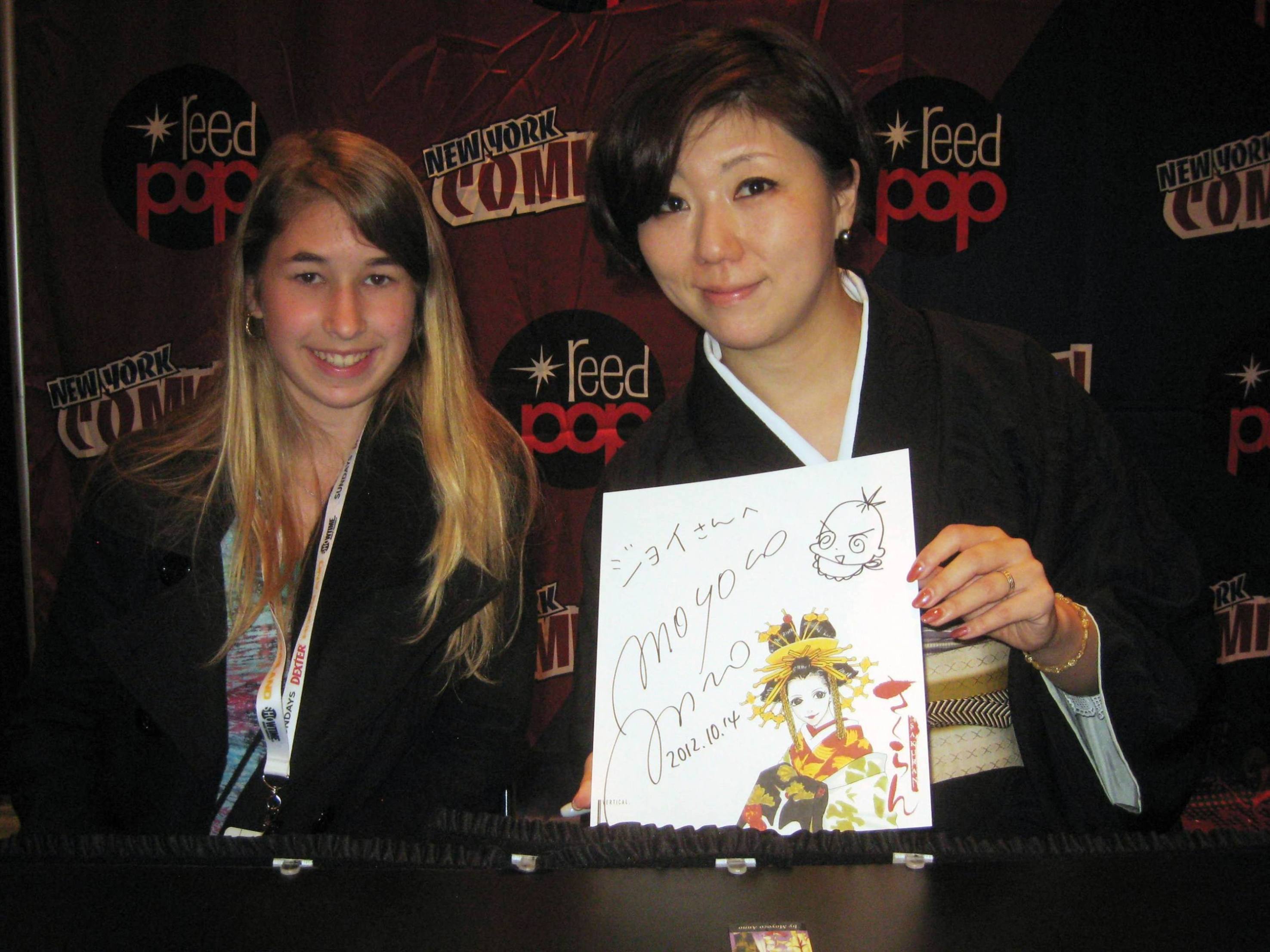
Manga author Moyoco Anno with New York Comic Con attendee Joy Charbonneau of Pacifica, CA, Oct. 14, 2012. (Justin Tedaldi)
By JQ magazine editor Justin Tedaldi (CIR Kobe-shi, 2001-02) for Examiner.com. Visit his Japanese culture page here for related stories.
Anime and manga fandom came out in full force at New York Comic Con last weekend, with a record 116,000 fans visiting the Jacob K. Javits Center for the annual event. Sunday (Oct. 14) hosted special guest artist Moyoco Anno of Sugar Sugar Rune and Sakuran fame.
A professional mangaka (manga artist and author) and one of the most respected names in Japanese comics today for her josei (ladies’) comics, Anno was in town to promote the recently released English-language edition of Sakuran, a starkly drawn tale of Japanese courtesans in the Edo period.
“We’d been thinking about publishing Sakuran for a few years now, and were finally able to convince [our] CEO to take the plunge,” said Ed Chavez, marketing director of Vertical Inc., the book’s North American publisher, which had its own booth at Comic Con. Based in New York, Vertical translates Japanese works of fiction and non-fiction that are considered good reads with universal themes from its vibrant book market.
Standouts of Vertical’s manga stable include Osamu Tezuka’s Buddha, Usamaru Furuya’s No Longer Human and Kanata Konami’s Chi’s Sweet Home.
For the complete story, click here.
JQ Magazine: Book Review – ‘The Buddha in the Attic’
Article/Journalism, Books, JQ Magazine, Reviews Comments Off on JQ Magazine: Book Review – ‘The Buddha in the Attic’
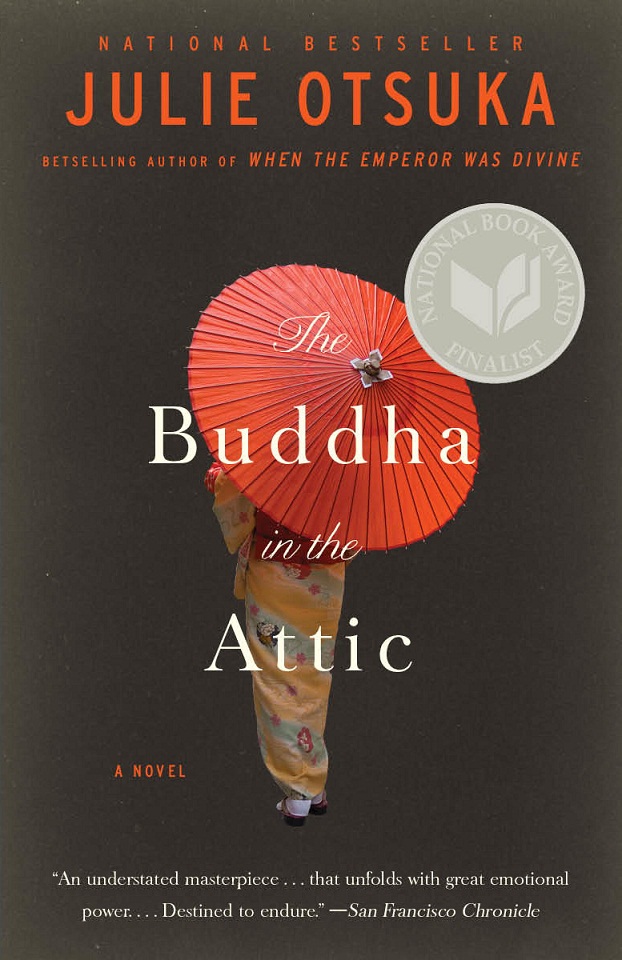
“Just the right length, the perfect amount of general and specific, and no solid story but yet the story that so many people in the United States—and elsewhere—can tell about hope, and heartbreak, and the ways in which lives change that most of us never intend or imagine.” (Knopf)
By Liz Mathews (Hiroshima-ken, 2005-06) for JQ magazine. Liz is the JETAA New York Book Club wrangler.
I would like to start by saying that the JETAANY Book Club discussed reading Julie Otsuka’s The Buddha in the Attic for at least five months before choosing it for our fall meeting. This is notable because 1) we were right in our primary reason for putting it off; and 2) we were even more right in finally selecting it to read. It’s easy to explain the first note: Over the summer we thought it best to opt for a lighter, more beachy read, and not a novel about Japanese “picture brides” and their distressing existences in the United States of the early 20th century.
As for the second point, autumn and its colder, shorter, darker days did turn out to be a much more appropriate setting to read Otsuka’s carefully composed novel. Otsuka wrote her book in eight sections, writing mostly from the perspective of the women—the women as a united “we”—who came across the ocean to a new life of false promises, how they endured meeting their husbands the first time, how they got along (or didn’t) with their employers and new fellow countrymen, and what happened as a new, Japanese American generation grew.
For all the suffering in those first five sections, there is hope written between the lines. Hope for a new life with a wonderful husband, hope that hard work will pay off in acceptance, and hope for their children in that, as one of the paragraphs ends, “Whatever you do, don’t end up like me.” But then, as one club member put it, “You come to this country, you work your ass off, you think you’re getting somewhere…and then you don’t” (referring to the war’s outbreak).
When we got together to discuss The Buddha in the Attic, we spent a fair amount of time talking about the perspective the story was written from—first person plural—and how initially we didn’t like it, but then either grew accustomed to it or could at least appreciate it as a tool. One attendee stated, “Everyone’s situation is different. You can’t even generalize the Japanese experience.” Another pointed out, “[Otsuka] has a new story in every sentence.” We laughed a little at this realization, probably as all our thoughts turned back to our own departure orientations, when we were constantly told those very same things.
Roland Kelts Praises the Who’s Pete Townshend in ‘The New Yorker’
Article/Journalism, Books, Music, Roland Kelts Comments Off on Roland Kelts Praises the Who’s Pete Townshend in ‘The New Yorker’

Roland Kelts, left: “When I published my first book, Japanamerica, about the odd synchronicity between two societies, Japanese and American, at once at great odds and suddenly allies, my publisher asked me to send the book to Pete Townshend. He had asked for it, why not give it to him?”
Courtesy of JETAA Northern California’s Mark Frey (Kumamoto-ken, 2002-06):
In a new article by JET alum Roland Kelts (Osaka-shi, 1998-99) on Pete Townshend in The New Yorker, Kelts references his book Japanamerica—of which Townshend said “I love that book!” to JQ magazine editor Justin Tedaldi at an NYC signing yesterday for his new memoir Who I Am—at the end of the article and offers some thoughts contrasting the experience of artists in the U.K. and Japan after World War II.
I first met Pete Townshend fifteen years ago in a modest London hotel suite. I was there with my friend Larry David Smith to interview Townshend for Smith’s book, “The Minstrel’s Dilemma.” We were already seated inside when I looked out the first-floor window and saw Townshend pulling into the parking lot.
He arrived alone, sans entourage or fanfare, driving himself in a gray Mercedes station wagon. Minutes later, the knob on the suite door rattled and shook. I stood, thinking that it might be a member of the hotel staff and wondering if I should turn the knob from our side. There was a pause, then more rattling, then the door swung open and Townshend burst through, eyes wide with exertion. He had apparently been trying to pull when he should have pushed.
We were scheduled to meet for two hours, but Townshend was unstoppable, regaling us not with stories of rock debauchery, but a stream of complex, sometimes half-formed ideas about popular culture, history, and human psychology. We were told not to ask him about his failing marriage; he immediately addressed it, confessing to a jolt of sadness while shaving that morning. “Don’t mention Keith Moon,” wrote his personal assistant via fax. “I never properly mourned for Keith,” he soon said, unprompted, and through tears.
For the complete story, click here.
JQ Magazine: Book Review – ‘Salvation of a Saint’
Article/Journalism, Books, JQ Magazine Comments Off on JQ Magazine: Book Review – ‘Salvation of a Saint’
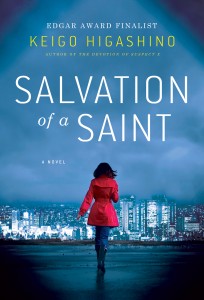
“The detectives in ‘Salvation’ are in constant motion, interrogating suspects, racking their brains for a break in the case. Insomniacs, they observe, question and theorize with an obsessive resolve, as good fictional crime detectives are apt to do.” (St. Martin’s Press)
By Sharona Moskowitz (Fukuoka-ken, 2000-01) for JQ magazine. Sharona is interested in fresh, new voices in fiction and creative nonfiction.
(Click image for an exclusive sample from the audiobook)
With more twists and turns than a mountain route through the Japanese Alps, Keigo Higashino’s latest murder mystery Salvation of a Saint is a seamless, well-constructed suspense novel with all the elements of a classic murder mystery, though he adds considerable fizz to the formula with a few unconventional characters and a very unlikely murder technique.
Yoshitaka is the unfortunate victim, poisoned early on in the story by arsenic laced coffee which he drinks with tepid oblivion. Despite being offed so soon, throughout the novel we learn quite a bit about him as his character is constructed in fragments that piece together to tell the story of his life.
And what an unsavory fellow indeed.
Narcissistic, duplicitous and with a chauvinistic tendency to view women solely in terms of their reproductive potential, Yoshitaka is not terribly likeable, to put it mildly. During the time of his murder he was in the process of leaving his wife Ayane because of her inability to bear him a child, a fact which he states openly with unabashed grandiosity. He was also, conveniently for the plot, in the midst of an affair with Ayane’s trusted confidant and apprentice Hiromi.
So whodunit? Was it a crime of passion committed by one of Yoshitaka’s jilted lovers past or present? Perhaps a jealous colleague? Or were Ayane and Hiromi secretly in cahoots?
JET Author Beat: Current Okinawa JET debuts with new book “Samurai Awakening”
Books, JET Alum Author Beat, Return on JET-vestment, Writers Comments Off on JET Author Beat: Current Okinawa JET debuts with new book “Samurai Awakening”
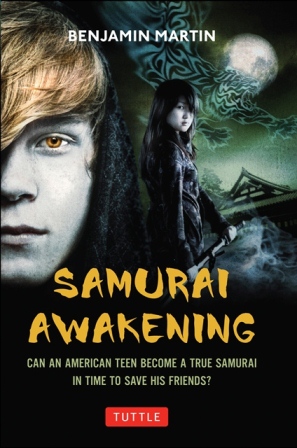 ********************
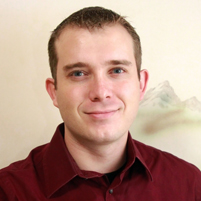
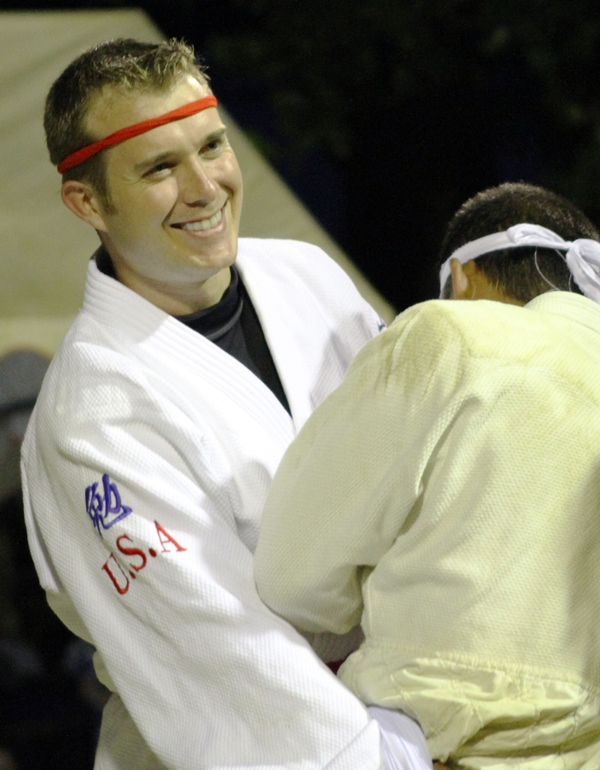
Benjamin Martin is a fifth-year JET ALT in Okinawa Prefecture. He spent three years on Kitadaito Island, a place of 12 sq km and 550 people before moving across the prefecture to another island called Kumejima. His debut novel Samurai Awakening is out now on online retailers and hits bookstores October 10, 2012. Benjamin competes in Okinawan Sumo, is co-host of FM Kumejima’s weekly Haisai English radio program, writes the blog More Things Japanese and serves as an occasional plaything for elementary school students.
About Samurai Awakening and Benjamin Martin
Samurai Awakening is a Young Adult fantasy that takes place in Japan. I began writing it as a way to bring aspects of Japanese culture to young westernersas a compliment to what we do on JET. Overall, it’s a fun read with aspects of Japanese mythology derived from The Kojiki and a healthy dose of real Japan as seen during my time teaching kindergarten through junior high. Here’s the official description:
Benjamin Martin (Okinawa-ken), author of Samurai Awakening
David Matthews is having a particularly bad day, after an especially bad month. His first weeks as an exchange student in Japan have left him homesick and misunderstood by nearly everyone around him, even his host family! Beaten down by a month of loneliness and bullies at school, a fateful invitation to the local Shinto shrine sends David on a path no foreigner has experienced before.
After awakening with a newfound ability to speak Japanese, David learns the members of the Matsumoto family are far more than just traditional sword smiths. They are the keepers of ancient secrets, and a task set upon them by the first Emperor- to train new Jitsugen Samurai, protectors of Japan.
When more strange things begin happening to David, he discovers his future is tied to a Japanese god within him, and that to be a Jitsugen Samurai holds consequences he may not survive. With his new family, friends, and a reluctant ally, David must fight against dangers far closer than any of them realize. As students disappear, David must overcome his past, and accept a new and uncertain future in time to stop the lurking darkness threatening Japan.Why Write?
I started writing as a way to share my experience on JET. My photography and writing skills have grown in tandem since I began my blog More Things Japanese in 2010. I had read Sir Basil Hall Chamberlain’s Things Japanese at the University of Arizona, and wanted to recreate it for today. It became a way to share the unique aspects of Japan I see every day with the world.
The two projects complement each other. The blog lets me focus on non-fiction without having to worry about huge amounts of research. I can simply share what I see, while my novels provide a chance to explore the question, “What if The Kojiki is more than mythology?”
JET has been an amazing experience, and writing gives me a chance to give back and continue to promote the ideals of cultural exchange. I left the US for Japan with a degree in Business and an interest in Japan. Now I have found just how amazing this country can be, and learned a lot about myself I had not known before.
Join the Awakening.
Enter to win a free copy of Samurai Awakening. http://morethingsjapanese.com/samurai-awakening-is-here/ Contest ends 10/10/2012. Alternately you can support my blog and novel by purchasing a copy from your favorite bookstore or online vendor. Thank you!
JET Alum Author Beat: Nicholas Klar’s “My Mother is a Tractor” now free on Kindle for a limited time
Books, Japan Local, JET Alum Author Beat, Return on JET-vestment, Travel/Tourism, Writers Comments Off on JET Alum Author Beat: Nicholas Klar’s “My Mother is a Tractor” now free on Kindle for a limited time
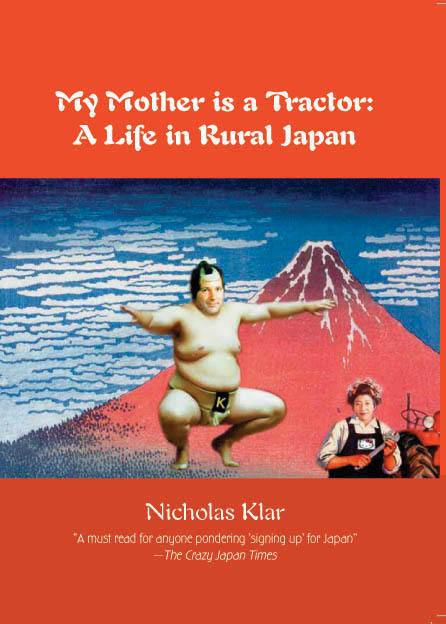 *************
JET alum Nicholas Klar’s (Niigata-ken, Omi-machi (now Itoigawa-shi), 1995-97) My Mother is a Tractor: A Life in Rural Japan, originally published in 2006, is now available for free on Kindle for the next couple days. Click here for more details.
Here’s some more info about the book:
Less than six months after chucking in his management job to take up teaching Nicholas Klar finds himself on the JET Program and a plane to Japan – ending up as an ALT teaching English in Omi (now Itoigawa City) in the far reaches of rural Niigata prefecture.
Never one to be taken too seriously he spends two years far beyond the beaten tourist path in often carousing encounters with Elvis impersonators, love hotels, toilets, train schedules, cults, hostess girls, freezing weather, the local garbage-man and postal workers, plus the recording of a bizarre incident where a cow apparently falls out of the sky.
Combining humour, wonder and a good deal of eclectic research the author veritably crams his pages chock-full of tales of culture shock, humorous anecdotes and insights, reflections upon his own life and cultural baggage, strange facts, plus cultural incongruities and marvels. He inevitably falls in with a motley crew of acquaintances along the way and revealed are many of the personalities he encounters – both Japanese and foreigners.
My Mother is a Tractor is rollicking, fact-filled ride through the Land of the Rising Sun that will both amuse and inform.
JQ Magazine: Inside the JETAA New York Book Club
Article/Journalism, Books, JQ Magazine Comments Off on JQ Magazine: Inside the JETAA New York Book Club

The JETAA New York Book Club with August’s selection, “The Thousand Autumns of Jacob de Zoet” by David Mitchell.
By Greg Anderson, (Fukuoka-ken, 1990-92) for JQ magazine. Greg is part of the fourth class of the JET Program, which began in 1987. He is currently employed as an auditor with the U.S. Treasury Department and is a new member of the JETAA New York Book Club.
Gone are the amazing, fascinating, fast-paced days of life in Japan filled with culture shock. As JET alums, most of us are employed in vocations that have no connection to Nippon at all. Ask yourself this question: After you have successfully completed another week or day at work, what do you have to look forward to? If you’re job hunting, then you have experienced another week of success/failure, but next week holds new opportunities. If you have children, you can look forward to screaming demanding creatures that we all love but sometimes drive us crazy. If you don’t have children, you may have an annoying spouse, boyfriend or girlfriend who has never been to Japan, has no interest in Japan, and wishes that you would get over your preoccupation with it and grow up. Once a JET, always a JET!
The JET experience transforms all who participate in the program; you will never be the same again. What can you do when you miss the connection to Japan? Besides going to Sapporo Ramen (located on 152 West 49th Street), you can attend a JET book club meeting. Every other month, JET alumni and others interested in Japan get together to discuss a Japan-related book over a nice relaxing glass of wine, soda, or water (but feel free to bring your choice of beverage). It does not end there! The hors d’oeuvres provided are smashing, and at a mere two to three dollars are a better bargain than McDonald’s. Participants also have the option of bringing goodies to supplement the menu, and you never know what surprises to expect.
The book club was started about three years ago, by two enterprising JET alums, Jessica Langbein and Michael Glazer, who suggested that JETAANY should have a book club. In fact, when the club first started, the meetings were held at the home of another JET, Katrina Barnas. The genesis of the book club was neither Japan nor the JET Program, but began as a college major. Jessica was a Japanese literature major in college and as a JET alumna was seeking some literature that would pique her interest. It was suggested to her that she speak to fellow alumnus Michael, and over a cup of coffee the JETAANY Book Club was born. Facebook was used to recruit new members.
