




Ex-Hot Dog Eating Champ Takeru Kobayashi arrested in New York on Independence Day
 Uncategorized
  Comments Off on Ex-Hot Dog Eating Champ Takeru Kobayashi arrested in New York on Independence Day
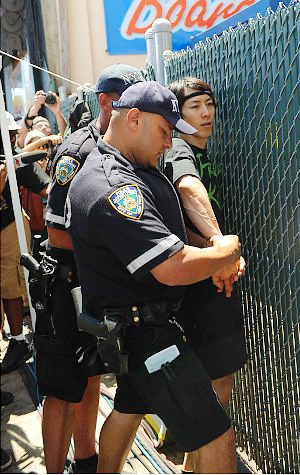 By JQ Magazine’s Justin Tedaldi (CIR Kobe-shi, 2001-02) for Examiner.com. Visit his NY Japanese Culture page here to subscribe for free alerts on newly published stories.
Say what you will about former hot dog eating champ Takeru Kobayashi, he’s no chicken.
The six-time winner of the Nathan’s Famous Fourth of July International Hot Dog Eating Contest was busted at the 95th edition of the annual event Sunday after attempting to storm the stage following the fourth win in a row by his American archrival Joey Chestnut. In an AP video, the Japan-born Kobayashi, clad in a “Free Kobi” T-shirt, is dragged away and handcuffed by multiple NYPD officers to the shouts in the crowd of “U.S.A.! U.S.A.!” while his interpreter Maggie James, wearing the same T-shirt, says frantically, “They weren’t giving him his freedom. It was unfair.”
As reported yesterday, Kobayashi officially blogged his intent to drop out of the competition after reaching an impasse over an exclusivity contract with Major League Eating, the sanctioning body of the Nathan’s event and other food-related contests. Public opinion Kobayashi, nicknamed “The Tsunami,” was divided between his announcement and the event, with some dubbing him a sore loser and coward (he had previously groused over an arthritic jaw before losing to Chestnut for the first time in 2007), and others applauding his decision to remain a free agent.
Read the full article here.
Japan Society kicks off annual JAPAN CUTS film fest
Events, Film, Japan Society Round-up Comments Off on Japan Society kicks off annual JAPAN CUTS film fest
 By JQ Magazine’s Justin Tedaldi (CIR Kobe-shi, 2001-02) for Examiner.com. Visit his NY Japanese Culture page here to subscribe for free alerts on newly published stories.
July is here, and that means hot dogs, fireworks, and a horde of Japanese films served up by New York’s Japan Society for their annual JAPAN CUTS contemporary Japanese cinema festival. Launched at the tail end of the New York Asian Film Festival, Japan Society and NYAFF have teamed to co-present a whopping 24 films from July 1-16.
“JAPAN CUTS presents the roughest, sharpest, and smoothest of today’s cutting-edge Japanese film scene,” notes Japan Society’s chief film curator Samuel Jamier. “This year the lineup includes psycho dramas, thrillers, period pieces, bizarre comedies, refined melodramas, artistically adventurous indies, j-horror, and even anime. But when the lineup came together, I realized a number of these great films were made by female directors or featured a large number of prominent women’s roles and powerful performances by women–a reflection of industry trends in the last ten years, and the impact women have been making in Japan’s film industry. Overall, I like to think this year’s festival is exemplary of where Japanese cinema is today.”
For this week’s list, see the full article here.
Samurai in New York Exhibition Opens in NYC
Academic, Japan Fix, Photography Comments Off on Samurai in New York Exhibition Opens in NYC
 By JQ Magazine’s Justin Tedaldi (CIR Kobe-shi, 2001-02) for Examiner.com. Visit his NY Japanese Culture page here to subscribe for free alerts on newly published stories.
The year 2010 is an auspicious one for New York and Japan. Fifty years ago, Gotham became Tokyo’s first sister city, and 150 years ago this month, a samurai envoy paraded down Broadway after clinching diplomatic ties between the U.S. and Nippon.
To celebrate that distinguished day, tributary events here in New York have included the annual Japan Day @ Central Park on June 6 which recreated the original samurai procession, a special lighting of the Empire State Building on June 16 to commemorate the actual anniversary date, and now, the Museum of the City of New York’s exhibition Samurai in New York: The First Japanese Delegation, 1860, on view from June 25 through October 11, with a special gallery tour on Saturday, June 26 hosted by project director Kathleen Benson, Yuko Suzuki of the Consulate General of Japan and Eric Campbell of the consulate’s Japan Information Center.
Read the rest of the article here.

By JQ Magazine’s Justin Tedaldi (CIR Kobe-shi, 2001-02) for Examiner.com. Visit his NY Japanese Culture page here to subscribe for free alerts on newly published stories.
It’s the return of a modern tradition as Japan Day @ Central Park 2010 hits the East Meadow Sunday. With an array of free family-friendly and traditional activities, samplings of popular cuisine and powerful stage performances featuring entertainers from Tokyo and New York, this year’s festivities are expected to top the estimated 45,000 New Yorkers drawn to last year’s Japan Day.
Continuing in the custom of previous years, the day kicks off with the four-mile Japan Run mini-marathon at 8 a.m., followed by the Japanese Day Festival in the East Meadow at 10 a.m. with the unveiling of all activity tents and the main stage show. The year 2010 is especially promising—it marks the 150th anniversary of the first Japanese diplomatic mission to New York—and there will be special activities to celebrate this historic milestone.
Click here to read the rest of the article.
Interview with Richie Kotzen on Mr. Big, touring Japan
Interview/Profile, Music Comments Off on Interview with Richie Kotzen on Mr. Big, touring Japan

For over twenty years, Richie Kotzen has waxed nearly as many albums under his own name, as well as high-profile discs as a former member of platinum-selling rock bands Poison and Mr. Big, the latter of which enjoyed massive popularity in Japan. Kotzen recorded two albums with them—1999’s Get Over It and 2001’s Actual Size—before the group called it quits with a Japanese farewell tour the following year. (In 2008 they reformed their original lineup, and is rumored to hit the road in the U.S. next year.)
Kotzen’s most recent release is 2009’s Peace Sign. JQ Magazine’s Justin Tedaldi (CIR Kobe-shi, 2001-02) spoke with him for Examiner.com while he was en route to the next stop of his current tour, which comes to New York’s Highline Ballroom on May 25. Visit his NY Japanese Culture page here to read the interview and subscribe for free alerts on newly published stories, including parts II and III of this interview.
Examiner.com NY Japanese culture roundup: 5/19
Japan Society Round-up, Networking Comments Off on Examiner.com NY Japanese culture roundup: 5/19

By JQ Magazine’s Justin Tedaldi (CIR Kobe-shi, 2001-02) for Examiner.com. Visit his NY Japanese Culture page here to subscribe for free alerts on newly published stories.
Japan Society serves up annual sake lecture/tasting Wednesday (5/19)
Japan U.S. Media Professionals launch networking debut Thursday (5/20)
Salon Series offers Joy of Okinawan Music and Dance Sunday (5/23)


JQ Magazine’s May/June 2010 “JET Author Issue” Out Now!
Article/Journalism, Celebrity, Interview/Profile, JQ Magazine, Notable JET Alums, Writers Comments Off on JQ Magazine’s May/June 2010 “JET Author Issue” Out Now!
 It’s a veritable JET literary review in the new issue of JQ, featuring an interview with bestselling Learning to Bow author Bruce Feiler and three-time Stephen Leacock Medal winner Will Ferguson! Click here to view.
Additional contents below. Thanks to JQ editor Justin Tedaldi (Kobe-shi CIR, 2001-02) for another solid issue. Contact Justin if you’d like to pitch or write a story for the next issue.
CONTENTS
- Page 3….From the Editor, New Country Reps
- Page 4….Nippon News Blotter / Wynne Memorial
- Page 5….JETAANY Election Recap
- Page 5….Gorgeous Entertainment by Anthony Waldman
- Page 6….Int’l Center of New York by Pamela Kavalam
- Page 6….Yoko Shioya of Japan Society by Lyle Sylvander
- Page 7….JETlog Feauturing Gail Cetnar Meadows
- Page 8….Bruce Feiler: The JQ Interview by Justin Tedaldi
- Page 9….JETAANY Society Page Photos
- Page 10…Nihonjin in NY: Nobuya Nagahama by Stacy Smith
- Page 11….Echostream Rocks the Anime Circuit by Earth Bennett
- Page 13.…Robataya Restaurant Review by Nancy Ikehara
- Page 13….The Niigata Sake Book by Yukari Sakamoto
- Page 14.…Will Ferguson: Canadian Cousin by Joshua Graubart
- Page 15….The Funny Page
Yes, New York has Japanese belly dancers, too
Art, Events, Interview/Profile Comments Off on Yes, New York has Japanese belly dancers, too

By JQ Magazine’s Justin Tedaldi (CIR Kobe-shi, 2001-02) for Examiner.com. Visit his NY Japanese Culture page here to subscribe for free alerts on newly published stories.
Nahoko Sugiyama discovered her niche at an early age. As a little girl growing up in Tokyo, she imitated the moves of the Japanese idols she saw on TV. As a teenager, a penchant for clubbing set the foundation to become a dancer, and in her twenties she took up Oriental (belly) dance, Quickly becoming a popular draw through professional appearances, she decided to make a career out of this exotic form of expression.
Moving to New York in 2006 for more in-depth training, Sugiyama joined the Mosaic Dance Theater Company a year later. “One of my teachers in here is a choreographer for this company, therefore I joined it,” she explains. “We have a wide range of Middle Eastern dance numbers, not only Oriental dance, which makes us unique. We focus on theater shows, [and] have big theater shows both in New Jersey and New York every year.”
This Friday, she will perform at Manhattan’s Arena Event Space with six other dancers as part of the Alternative Belly Dance Show.
 By JQ Magazine’s Justin Tedaldi (CIR Kobe-shi, 2001-02) for Examiner.com. Visit his NY Japanese Culture page here to subscribe for free alerts on newly published stories.
As reported at Sakura Matsuri earlier this month, cosplay (costume play) is a growing trend among youthful patrons of public Japan-related gatherings. Last year, New York’s Japan Society hosted its first-ever cosplay party as part of its KRAZY! exhibition dedicated to anime, manga and video games. The event was a sold-out success, drawing nearly 500 fans who expressed their visual zeal (not to mention their tailoring abilities) for the more contemporary facets of Japanese culture. This year’s edition, fittingly titled Cosplay Party 2.0, kicks off Saturday, May 15, and is expected to top last year’s inaugural event.
The day promises a chance to meet and mingle with other cosplayers, nonstop musical entertainment by cosplay DJ Ruby Red, a photo booth, free admission to Japan Society’s current exhibition Graphic Heroes, Magic Monsters and a full-tilt costume competition, hosted by Uncle Yo and judged by World Cosplay Summit 2009 Team USA along with guest judge and Japan Society artist-in-residence Hiroki Otsuka. During the party, Japan Society’s theater will host New York’s big screen premiere of the anime film Evangelion 1.11: You Are (Not) Alone.
Interview with ‘Beetle Queen Conquers Tokyo’ Director Jessica Oreck
Article/Journalism, Film, Interview/Profile, Uncategorized Comments Off on Interview with ‘Beetle Queen Conquers Tokyo’ Director Jessica Oreck
 The film Beetle Queen Conquers Tokyo explores the history and mystery of the development of Japan’s love affair with bugs, underscoring ancient philosophies that will shift Westerners’ perspectives. JQ Magazine’s Justin Tedaldi (CIR Kobe-shi, 2001-02) talked with producer/writer/director Jessica Oreck on the eve of the film’s New York premiere for Examiner.com. Visit his NY Japanese Culture page here to subscribe for free alerts on newly published stories.
Would you describe this film as a documentary, or something else?
I try not to label films too methodically. Some of my favorite “narrative” films are not “documentary” but certainly seem more honest than films based on facts. So I guess I’ll just keep it simple and call it a movie.
Have you always had an interest in insects and Japan? What made you want to go there to capture these images personally?
I have loved insects since I was a little girl, so when I stumbled onto the Japanese enthusiasm for the same ostracized order, it felt like it was meant to be. I studied filmmaking, biology and ecology in university; I knew I wanted to make films about ethnobiology, so this was the perfect film with which to start.
The Japanese concept of mono no aware (which describes the awareness in the transience of things) is invoked early on in the film. Was this the original thesis before filming, or did this thread to traditional concepts develop later in the process?
I did extensive research before traveling to Japan, and I laid out a 17-page essay that included pieces of Japanese history and philosophy I hoped to incorporate into the film. Mono no aware was just one of the many ideas that were intricately tied together within the architecture of the film as I initially envisioned it. I knew it would be part of the film’s foundation, but as the editing process progressed and I continued to refine the essay and skim off outer details, the concept of mono no aware became more and more pronounced. In this way, editing the footage and writing and editing the narration was a very organic process.
Were there any older Japanese-made films tackling this subject that you watched for reference?
As far as I know there are no other films that address this subject in particular. There are some fantastic Japanese films that have a lot of bugs in them—one of my favorites being Woman in the Dunes. But I think the Japanese film that I watched most often while making Beetle Queen was Kon Ichikawa’s Tokyo Olympiad. That movie is infinitely perfect to me.
Several scenes in the film depict Japanese children’s love of insects. Were the ones you filmed typical of that kind of interest, or were they more passionate than most about this? How would you define Japanese kids’ relationship with the insect world compared to American kids’?
A Japanese child’s relation to insects isn’t that different from an American’s child connection—if you catch them young enough. Most young children don’t have an innate fear of bugs (from my experience watching thousands of them pass through the butterfly vivarium at the American Museum of Natural History). It isn’t until they see dad flinch or mom scream that they learn disgust or fear. What’s different with a Japanese child is that they are encouraged to explore the insect world. They keep them as pets, their dads take them on insect collecting trips, and they travel halfway across the country to watch the fireflies emerge at dusk. I am generalizing, of course, but the phenomenon is, by and large, quite widespread.
In comparison, I believe that a Westerner’s view of the natural world is, in part, dictated by the cultural heritage of what I call the Judeo-Christian syndrome, through which we see the world as a linear chain of progress that culminates in the human form and bestows the power of control to the animals with the least sense of balance. However, I think an individual’s understanding of the natural world is still mostly directly absorbed through the behavior of the people they admire, and that that is why this connection to insects continues to thrive in Japanese culture.
The author and anatomist Dr. Takeshi Yoro is the only person interviewed on-camera for this film. How did you discover him, and were there any other experts or authorities whom you considered speaking with?
Dr. Yoro is a famous guy in Japan, so everywhere we went people asked if we had plans to interview him. Eventually we just decided to call him and, miraculously, he said he would be happy to be interviewed. It was never my intent to have talking heads, but so many of the things that Dr. Yoro said felt like pure poetry—he ended up being the key to some of my favorite parts in the movie.
Generally, what kind of support did you receive from the Japanese people you worked with and filmed? What was their reaction to an American filmmaker exploring what seems to be a uniquely Japanese interest?
Everyone was happy to have us, though they were often confused about why we were making this film. We got a lot of, “What? They don’t sell beetles in America?”
What should more Americans be aware of with respect to the insect world?
Well, I hate to limit the film’s impact to the insect world. To me, the film is about much more than bugs. I have had the opportunity to observe a myriad of reactions. Plenty of people have been surprised by the loss of their fear, or by newfound knowledge, or a novel appreciation for beauty in unanticipated facets of their life. But my favorite story is of a World War II veteran who approached me after a screening of Beetle Queen. He said something to the effect of, “For fifty years I have thought of the Japanese as my enemy. And in the past hour and a half, you have changed that.”
Are there any plans to screen the film in Japan?
Not yet! But we are always looking for opportunities!
Beetle Queen Conquers Tokyo runs from May 12-18 at New York’s Film Forum, with Jessica appearing at screenings on May 12, 14 and 16. Visit www.beetlequeen.com for more info, and sign up for the mailing list at info@beetlequeen.com.
MEGU Chefs Teach Secrets of Miso This Tuesday
Events, Food & Drink, Japan Trends Comments Off on MEGU Chefs Teach Secrets of Miso This Tuesday

By JQ Magazine’s Justin Tedaldi (CIR Kobe-shi, 2001-02) for Examiner.com. Visit his NY Japanese Culture page here to subscribe for free alerts on newly published stories.
Contrary to its most popular form, miso is not a soup, but a seasoning (usually resembling a paste) made with soybeans and rice or barley fermented for a period of time. It’s also right up there with rice as a Japanese diet staple—in Nippon’s olden days, miso was the fundamental currency exchanged in the market. Now, New Yorkers can treat themselves to a free cooking demonstration and tasting courtesy of Marukome Miso (one of the oldest miso manufactures in Japan) at the French Culinary Institute on Tuesday, May 11.
Presented as part of the Gohan Society and FCI Lecture series with Marukome USA, the demo and tasting is hosted by Chef Noriyuki Kobayashi of MEGU Midtown and Chef Katsuhisa Inoue of MEGU Downtown. The Zagat rated restaurant maestros will apply their Japanese cooking techniques to prepare Western-style dishes, all featuring Marukome Miso. (Insert your own Iron Chef zinger here.)
On the menu for the two-hour showcase: traditional grilled miso onigiri (rice ball); thickly sliced toasted white bread with miso garlic butter; cream cheese and miso egg roll; miso bagna cauda blue cheese and miso paste on baguette with honey; miso minestrone; and washu-gyu steak with miso fond de veau sauce.
Participants will learn how miso enhances foods and flavors, gleaning tips and creative ways to boost its versatility and umami (deliciousness) appeal. And just to be clear: this is good-for-you deliciousness, since miso is made from protein-rich soybeans containing amino acids, boasts a surprisingly low salt content, contains fiber, can aid in lowering cholesterol and preventing arterial blockage, and (smokers take note) is renowned for its mouth-cleansing properties.
Learn the secrets of miso at the French Culinary Institute, 462 Broadway (at Grand Street), on Tuesday, May 11, 3:30 p.m.-5:30 p.m. Admission is free. To RSVP, contact Sarah Marino or Amy Krakow at (212) 710-0529, or by e-mail at sarah.marino@agitproppr.com or amy.krakow@agitproppr.com.
This Weekend at Japan Society: STEIM Electronic Music Lab
Art, Japan Society Round-up, Music Comments Off on This Weekend at Japan Society: STEIM Electronic Music Lab

By JQ Magazine‘s Justin Tedaldi (CIR Kobe-shi, 2001-02) for Examiner.com. Visit his NY Japanese Culture page here to subscribe for free alerts on newly published stories.
From Yellow Magic Orchestra to Cornelius to the current wave of chiptune artists inspired by classic 8-bit video games, Japan has a rich legacy of electronic music whose influence continues to grow in the age of globalization. Seizing this trend, New York’s Japan Society will close out its spring 2010 performing arts season with a concert by STEIM (Studio of Electro-Instrumental Music) and related events on May 7 and 8.
Based in Amsterdam, STEIM is “the natural course of what we have presented under the category of ‘music,’” said Yoko Shioya, Japan Society’s artistic director. “In fact, there are many internationally active and acclaimed Japanese musicians and composers in this area, and that is why I started to make the program of this genre several years ago.”
The envoys of this sonic summit are Takuro Mizuta Lippit, STEIM’s artistic director, originally from Japan; Yutaka Makino (Japan/Germany), a musician and artist who works in the convergence of sound, science and architecture; ABATTOIR (U.S./Netherlands), a duo comprised of American cellist/vocalist Audrey Chen and Dutch musician/composer Robert van Heumen; digital media composer Yannis Kyriakides (Netherlands) and guitarist Andy Moor (U.K./ Netherlands) of the legendary Dutch punk band The Ex; and dj sniff (Japan/Netherlands), the performer alter ego of Takuro Mizuta Lippit.
“Put it this way,” said Shioya, “the layer of the musicians and composers in electric music in Japan is very thick—therefore, many types of musicians emerge…Japanese musicians in this genre have been quite influential in the international music scene.”
The program kicks off the night of Friday, May 7 with the Artist Talk + Demo, with STEIM artists Yutaka Makino and dj sniff discussing the process of crafting their sounds and sharing their perspectives on the latest international collaborations in electronic music. Japanese sound poet Tomomi Adachi rounds out the panel. Also, a free STEIM Mobile Touch Exhibition on May 7 and 8 will allow visitors the opportunity to make music on some of the artists’ instruments.
Saturday, May 8 showcases STEIM’s Workshop for Youth for ages 10 to 18, giving them a chance to learn more about their methods and test drive some of the instruments themselves. The night’s centerpiece is the Electronic Music Lab concert, a one-time only performance.
What will it all sound like? According to Shioya, “The music you will hear in STEIM’s concert is music which may make some people wonder, ‘Do you call it “music”’…? But…the definition of ‘music’ can be varied, and many Japanese musicians are not intimidated by the conventional perception of ‘music.’
This program shows that this genre of music—improvisational and experimental—is truly borderless.”
STEIM: Electronic Music Lab takes place Friday, May 7 and Saturday, May 8, with complete schedule and ticket information here. Japan Society is located at 333 East 47th Street between First & Second Avenues. Tickets may be purchased by calling the Box Office at (212) 715-1258 or in person at Japan Society (M–F / 10 AM–4:45 PM). For more info, call (212) 832 -1155 or visit www.japansociety.org.
Interview with Author Bruce Feiler
Uncategorized Comments Off on Interview with Author Bruce Feiler
 JQ Magazine editor Justin Tedaldi (Kobe-shi CIR, 2001-02) spoke with JET alum and Learning to Bow author Bruce Feiler (Tochigi-ken, 1987-88), who will be appearing tonight at Barnes & Noble on the Upper East Side to promote his new book The Council of Dads. (Visit Examiner.com for complete details.) The full-length interview will appear in the next issue of JQ, out later this month.
What made you want to write Learning to Bow?
It kind of grew out of a series of letters I wrote home of the “you’re not gonna believe what happened to me” variety. And when I went back to Savannah six months later, everywhere I went, people said, “I just loved your letters,” and I said, “Have we met?” It turned out that my grandmother had copied them, and they got passed from person to person—they went viral in the 1980s, if that’s the word—and I thought, wow, if that’s interesting to me and to these other people, I should write a book about it. It really was the sense that this story from this point of view wasn’t being told. In the 1980s, you couldn’t pick up a newspaper without reading an article about Japan or education, and the fact that here was a book that combined both, but had some sense of humor, I just think it was the right book at the right time, and I’m amazed and touched that, so many years later, for a lot of people, it’s the first book they read when they go to Japan…This was before the Internet, before e-mail, before blogs. The world seemed much bigger than it is today.
Have you returned to Japan since your time there as a teacher?
That’s a really good question, and the answer is no. I’ve kind of been to every place around it, but I’ve never been back to Japan. I keep looking for the right assignment, because I really want to go back and kind of write something, but I haven’t been back.
What kind of outlook did you take back home with you from your time in Japan?
People go to Japan today and they call me up, which still happens from time to time. I say the same thing that I’ve said for decades now, which is: don’t go over to Japan trying to change it, thinking that you know better. Go there trying to understand. I think that that essential way of experiencing another culture is by not going in as a sort of a haughty Westerner, looking down on it, but actually jumping into the deep end, completely immersed in yourself, befriending the people, and opening yourself up to the culture. That way of living is the thing that I would take from my experience, and pass on to my daughters today.
Have you thought about writing another book about Japan?
Sure, I would like in my life to go back and revisit that. I mean, we’re coming up on 25 years since I was living and working in Tochigi, and I would love the opportunity to go back, walk those streets, seek out friends, maybe some of those students, and use that as a prism to talk about how Japan has changed in the last quarter-century. I think that would be a great privilege, and if anybody reading this wants to send me on assignment, I’m ready to accept.
What was your best and worst memory of Japan?
I’d say my best memory was climbing Mt. Fuji, and the worst memory was…trying to fit my feet into the free giveaway slippers at Japanese schools.
Yeah, those are tough.
[Laughs] I haven’t thought about that in a long time.
 JQ Magazine editor Justin Tedaldi (Kobe-shi CIR, 2001-02) sums up the weekend-long annual event in Brooklyn. Originally published for Examiner.com.
“Today is a perfect kickoff for the historic months to come,” said New York’s Ambassador and Consul General of Japan Shinichi Nishimiya at the top of the 29th annual Sakura Matsuri Cherry Blossom Festival at Brooklyn Botanic Garden held the weekend of May 1 and 2. The historic months the ambassador referred to reach back 150 years, when a samurai envoy marched down Broadway in 1860 as part of the first Japanese diplomatic mission to the U.S. and Japan, which will be reenacted in June to celebrate the occasion.
For Japanese, springtime means hanami, a custom associated with enjoying the beauty of sakura (cherry blossoms), typically as part of an outdoor party in flower-viewing spots across Japan. While BBG’s sakura were already past their peak bloom before the event due to unseasonably warm weather, tens of thousands of people were still expected to attend over the weekend, according to Kate Blumm, BBG’s communications manager.
The dozens of performances, cultural exhibitions, art displays, and foods on tap at Sakura Matsuri—not to mention the brilliantly sunny weather—more than compensated for the lack of pink on the trees. After remarks from other speakers including Brooklyn Borough President Marty Markowitz, New York’s own Soh Daiko taiko drum ensemble hit the Cherry Esplanade Stage for a surging performance, followed later by classical and Okinawan dance, a martial arts demonstration by World Seido Karate, and a samurai drama representing the more traditional facets of Japan.
But Sakura Matsuri sported more than just time-honored acts. “We’ve ramped up the anime, J-pop, and manga sort of things,” said Blumm, noting that organizers have “been drawing a completely new crowd since we started J-Lounge. It’s been a big hit.” Located in BBG’s Osborne Garden, J-Lounge became a Mecca for young people with an interest in more contemporary Japanese pop culture. In addition to its manga and anime artist alley, other showcases included anime stand-up comedy, music and dance performances, and a guest appearance by Pokémon voice actress Veronica Taylor, who gave voice to characters created by Brooklyn-based graphic novel artist Misato Rocks!
“For me, it’s all about the contrasts,” explained Blumm, observing Sakura Matsuri’s blend of old and new. “Being immersed in a spectrum of cultural elements, the patrons become part of the festivities.” The most obvious example of this was the multitude of visitors engaging in cosplay, or costume play, a performance art of dressing in elaborate costumes (typically designed by the cosplayer) inspired by characters in Japanese popular fiction.
Cosplay began in Japan, but now enjoys a devoted following among young Americans, usually at anime and comic book conventions. The fact that more cosplayers have been popping up at Japan-themed gatherings like Sakura Matsuri was not lost on BBG: some of J-Lounge’s top attractions included “high tea” for lady cosplayers, a performance by artist/singer Mario Bueno, and the “Iron Cosplay” competition.
“We do this about two to three times a year,” said attendee Michelle Kwon, who with her two friends resembled characters from the anime and manga series Lucky Star, about a group of pastel-haired schoolgirls. “It’s great being able to recognize other characters that we like from animation. We’ve taken probably hundreds of pictures today.”
Some cosplayers were able to draw crowds of their own based on their costumes. Attendee Ferdinand Garcia and his three friends went as a Naruto-inspired ninja warrior clan, and received an unusual photo request from a patron: “We posed for a lady from Albania who was carrying this fish around with her,” Garcia said. “She wanted to take pictures of this fish in all these different places.”
Some criticized the cultural mash-up, Attendee Natsumi Onodera from Tokyo said the event was “not traditional, so I’m afraid non-Japanese people might misunderstand the culture.” Her friend Sachie Hayashida from Fukuoka was blunter: “There’s no Japanese people here,” she said. Both of them are currently studying abroad in New York, and were invited to Sakura Matsuri by one of the performers.
Brooklyn resident Kate Russell, a first-time visitor, enjoyed the variety between kimono and cosplay.
“It was great. I liked the classic cultural events and ceremonies, but also the modern, like seeing all the characters,” she said. “I will come again next year, because I want to see the cherry blossoms.”
For a full schedule and list of performers and events, visit Brooklyn Botanic Garden’s website.
JQ Magazine’s March/April 2010 “Go East Issue” Online Now!
Article/Journalism, Interview/Profile, JQ Magazine, Writers Comments Off on JQ Magazine’s March/April 2010 “Go East Issue” Online Now!


