




JET alum George Rose quoted in NYT feature on Hideki Irabu
 Article/Journalism, Celebrity, JETs in the News, Notable JET Alums, Translating/Interpreting
  Comments Off on JET alum George Rose quoted in NYT feature on Hideki Irabu
George Rose with Hideki Irabu
JET alum George Rose (Fukushima-ken, 1989-91), former interpreter for Hideki Irabu as well as former JETAA NY President, is quoted in a Sunday, October 9 feature article “Irabu Got Lost on the Way Back“) in the New York Times about Japanese pitcher Hideki Irabu who recently committed suicide. The article gives the impression that George was one of the few U.S. baseball colleagues who actually got to know Irabu personally.
Below is a link to the full article along with the quotes by George:
“When I saw him last summer, he told me he was having a midlife crisis,” said George Rose, who befriended Irabu when he worked for two years as his interpreter on the Yankees. Rose then repeated what had been a kind of conventional wisdom about the Irabu: he had a big heart, but could be his own worst enemy.
**********
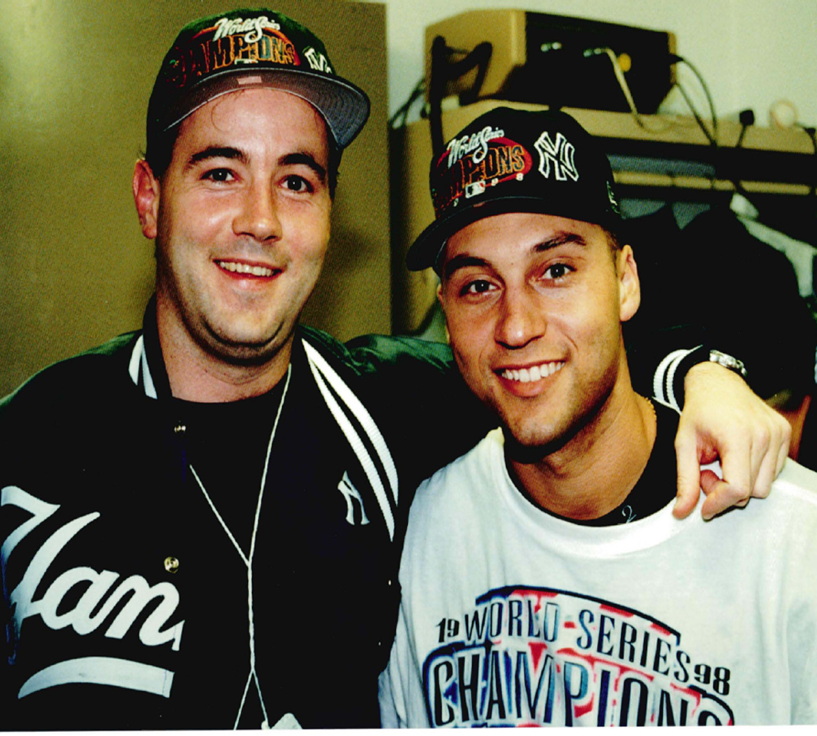
JET alum George Rose with Derek Jeter at the 1998 World Series.
“He was kind of searching for what to do next,” said George Rose, his old interpreter, “and he never did.”
For additional background on George, here’s a link to a 2008 JETAANY Newsletter interview with George Rose (“Pride of the Yankees: Far East Edition“) by Stacy Smith (Kumamoto-ken CIR, 2002-03).
 *****************
In a speech on October 7 at the U.S.-Japan Council Annual Conference, U.S. Secretary of State Hillary Clinton lauded the JET Programme for its vital grassroots relationship building, cited the JET alumni community’s role in raising money for earthquake/tsunami relief and cited Monty Dickson and Taylor Anderson as models of the kind of cross-cultural exchange that is so important to successful relationships between countries and cultures.
Here is a link to Secretary of State Clinton’s speech on the State Department’s website along with a video. http://www.state.gov/secretary/rm/2011/10/175151.htm
Below are a few excerpts followed by the full text of the speech.
“More than 35,000 people have participated in exchange programs sponsored by our two governments, programs like the Fulbright and the Japan Exchange and Teaching Program, known as JET.”
***********
“[A]lthough these ties have already benefited both of our nations, they are not self-sustaining. We have to continue to invest in them.”
***********
“The American people are proud to count Japan among our closest friends. I recently heard the story of an Alaskan named Monty Dickson who taught English at Yonesaki Elementary School as part of the JET program. While in Japan, Monty came to love Japanese poetry, and on the morning of March 11th, he had translated a poem by Shiba Ryotaro into English, and it read: “There’s nothing as beautiful as dedicating one’s life for a cause.” And just a few hours after writing those words, Monty Dickson was swept away in the tsunami. In fact, both of the Americans who died that day, Monty and Taylor Anderson, were teachers in the JET program. Their lives and their cause are part of the fabric of the friendship that we now share. The Dicksons, the Andersons, and the entire extended family of JET alumni have been working to help the communities that both Monty and Taylor lived in and grew to love.”
***********
“The U.S.-Japan alliance is the cornerstone of a system in the Asia Pacific that has underwritten peace, stability, and prosperity for decades. And the close connections built by the Monty Dicksons and the Taylor Andersons and the U.S.-Japan Councils, those are the foundations that not only keep the cornerstones strong but keep building higher and higher.”
***********
Remarks at the U.S.-Japan Council Annual Conference
Remarks
Secretary of State
Return on JET-vestment: AJET Chair Matthew Cook on the recent 25th Anniversary JET Programme Symposium
AJET, Article/Journalism, Notable JET Alums, Return on JET-vestment Comments Off on Return on JET-vestment: AJET Chair Matthew Cook on the recent 25th Anniversary JET Programme Symposium
*****************
Originally posted to the AJET website by National AJET Chair Matthew Cook (Osaka) who was an attendee of the 25th Anniversary JETProgramme Symposium, where, notably, JET alum Jim Gannon (Ehime-ken, 1992-94), Executive Director of the Japan Center for International Exchange (JCIE/USA), was invited to speak about the JET Programme and the JET Alumni Association.
It’s been a significant month in the world of the JET Programme.
On September 8th, the ministries hosted a commemorative symposium at the University of Tokyo to discuss 25 years of the JET Programme; what it has accomplished, and what challenges it faces today. The symposium featured many notable
speakers, such as United States ambassador to Japan, John Roos, and Ms. Yoko Kimura, the Chair of the Board of Directors of CLAIR.
On behalf of AJET, myself and AJET council members Mark Noizumi (treasurer) and Amelia Hagen (Block 10 rep) attended. After brief opening statements by the ministry heads, many speakers were given the chance to spotlight JETs’ achievements, and voice issues pertinent to the program.
One issue, for Japan as a country, that repeatedly came up was the fact that the number of Japanese students who study abroad or attend universities in foreign countries has been on a steady decline for years. This is particularly troubling in light of Japan’s efforts to globalize as more and more businesses are enforcing English as a required standard.
A highlighted concern for the JET Programme itself was the increasing number of Boards of Education who hire ALTs privately, or through recruiting companies other than JET. One of the many challenges the programme faces is how to best promote the value of what we do, and the return on investment that we can provide to the communities we serve.
As the Chair of AJET, I am fortunate enough to work with many people who have done amazing things with their time on JET. As such, I am aware of the many benefits of the JET programme that are sometimes overlooked. However, this made me question…. is everyone else?
How do we as JETs promote the value of what we do and the return on investment that we provide to the communities we serve?
For example, did you know that over 20 of the employees at the U.S. Embassy in Tokyo are former JETs? Did you know that after the March 11th disasters, current JETs raised an estimated ¥140,000,000 yen towards the relief efforts? These are only two examples of ways that JETs have given back to Japan. The benefits of JET are vast, and the elimination of the program would have far reaching consequences.
Toward the end of the day, the governor of Kyoto made an interesting point that stuck in my mind. He said that he believes the competition of privately hired JETs and the decrease of requests for JETs is actually a good thing! He reasoned that this competition would serve as a stimulus for positive change in our programme to become better and to show more quality than it ever has in the past.
That’s when I realized…. We ARE the positive change in the system now. As we speak, AJET has been working on more ways to provide resources to make JETs better teachers. Ways to learn Japanese more fluently. Opportunities to develop ourselves professionally in the field of education.
Not only that, but we’re finding better ways to connect to each other online and in person via social media and larger scale, better planned volunteer efforts! We’re finding better ways to let JETs VOICE their opinions and concerns to the not only the ministries, but to the people we interact with in our communities and workplaces everyday!
So, do we need to wait for the ministries to “save JET”? Should we wait for JET Alumni to prove that the Programme is a world-renowned program, that should be held in the highest regard so that we have luck with future employers?
No.
We need look no farther than to ourselves for this. We ARE the future of JET. Current JETs lay the ground-work for our successors who come next to fill our shoes.
I feel honored to have attended a symposium of so many people who have made amazing contributions to the JET Programme, and who all have a stake in its survival. I think we should take this symposium as a reminder that now
is the time for us to make more of this experience. The time is now for us to work together to be something MORE. I personally can’t wait to get started making that happen. I hope you’ll join us.
Matthew Cook
National AJET Chair
Symposium Speakers
Jim Gannon
Former JET and Executive
Director of the U.S.
based Japan Center for
International Exchange.
Keiji Yamada
Governor of Kyoto
Prefecture, President of
the National Governors
Association
Masao Niisato
Professor at Tokyo
International University
Angus Lockyer
Chair of Japan’s Research
Centre, University of
London
Jin Ah Kim
Director of International
Cooperation Department,
Governors Association of
Korea
Yoko Kimura
The Chair of the Board of
Directors, CLAIR
Akira Nakamura
Emeritus Professor
*****************
With increased potential for budget cuts to the JET Programme and to JETAA and additional prefectures opting to use private ALTs rather than JETs, it’s good to see an example of a prefecture making effective use of JETs to provide significant Return on JET-vestment.
Toyama Prefecture has for the past two years been using its CIRs & ALTs to promote tourism through their Twitter and FB accounts or other means. More explanation is available in Japanese at: http://www.pref.toyama.jp/cms_press/2011/20110915/00007707.pdf
This year, according to this notice, they were planning to take their six ALTs (4 Americans) and two CIRs (both Americans) around to the big tourist attractions and then have them put out word-of-mouth to promote them, through Facebook, Twitter, blogs, or actual word-of-mouth after they go home.
There’s no reason other prefectures can’t adopt similar programs with their JETs and CIRs and why JETs and JET alums themselves can’t initiate this kind of activity.
While it’s relatively easy for local governments to find native English speakers to teach in their schools, it’s much harder to bring in teachers who will feel a connection to the community that lasts a lifetime and continues to provide tangible and intangible benefits over the long term. And that is the power of the JET Programme.
*************
Thanks to Matt Gillam, Senior Researcher at CLAIR-NY (aka Japan Local Government Center), who attended the recent Sister Cities International Conference in Riverside, CA, for writing up a little something about the conference and noting how JETs were present in several ways.
A little context: Back in July, several JET alum reps including Mike Shu, Jessyca Wilcox and myself along with Matt met up with Sister Cities International when we were in D.C. for the JETAA USA National Conference to talk about potential collaboration. The topic was subsequently discussed with JETAA chapter reps in a session at the JETAA USA National Conference.
“I just got back from the Sister Cities Pan-Pacific conference in Riverside, where we had a chance to gauge interest in the idea of making alumni available to cities to help out with their sister city relationships. The reaction I got was that there is definitely interest, and not just limited to sister cities matters. There seems to be quite a need for help with other visitors from Japan as well, where cities lack people with knowledge of not just language, but also cultural and social norms.
Mark Juloya and Russell Iriye, from JETAA Southern California, came for the conference and Russell participated in a session on “Best Practices in Youth Programming”, where he talked about JET & JETAA. In the Q&A after his presentation, I had a chance to mention the alumni as an available resource for cities and a couple of people were quite interested. Overall, as I said, the response was positive, and Mark and Russell were also great exemplars of the kind of talent JETAA has to offer.
On Sunday, Sendai City put on a display at the most popular spot in town (the Mission Inn) to talk about how the city is recovering and to thank Riverside for all its support ($584,000 in donations, plus the area dispatched USAR (Urban Search and Rescue) teams etc. to the region immediately following the disasters). Audrey Shiomi, a former CIR in Sendai City, also came out to help for the day. Audrey is one of those former JETs who have taken advantage of the program to revisit their former communities in Tohoku, and another great example of how valuable alumni can be to their former employers.
And one more person to mention is Renay Loper, who’s with the Japan Foundation’s Center for Global Partnership now. She was there with a Japanese colleague to attend the conference, since CGP was helping to fund it.
JETs are everywhere.”
Matt Gillam
JLGC, New York
New New Jersey JETAA Subchapter
JETAA Chapters Comments Off on New New Jersey JETAA Subchapter
 Via JETAA NY:
JETAA NY is excited to kickstart a new subchapter on the other side of the river – in New Jersey!
Those interested can join the Facebook group and read about our NJ Subchapter Representative, Rachelle de Leon, at http://jetaany.org/about/contacts/ (scroll to the bottom).
Rachelle can be contacted via the Facebook group and/or email at njrep [at] jetaany.org.
Return on JET-vestment: JETAA NY joins Kyushu Battenkai for Fall Gathering
Cultural Outreach, Events, Japan Local, JETAA Chapters, Return on JET-vestment Comments Off on Return on JET-vestment: JETAA NY joins Kyushu Battenkai for Fall Gathering
 Via JETAA New York. A great example of JETAA providing Return on JET-vestment at the local government level:
Terrific Turnout for Kyushu Battenkai’s Fall Gathering
“With over 60 people in attendance from both JETAANY and the Kyushu BattenKai, we enjoyed another successful joint event with the Kyushu expat organization (see the picture from the end of the evening above). We look forward to working with them again.”

Return to Tohoku: “Don’t Speak, Just Move On” by Audrey Shiomi
Article/Journalism, Earthquake Tsunami, Japan Local, Notable JET Alums, Return on JET-vestment, Travel/Tourism, Volunteer, Writers Comments Off on Return to Tohoku: “Don’t Speak, Just Move On” by Audrey Shiomi
*******************
The following is a personal essay by Audrey Shiomi (CIR Miyagi-ken, Sendai-shi, 1999-2001). Through generous sponsorship by Japan’s Ministry of Foreign Affairs, she spent a week in September visiting her former residence in Sendai City, one of the areas affected by the March 11 earthquake. In lieu of volunteering in disaster-stricken regions, she spent each day meeting with friends and former coworkers to listen to their stories.
Click here to read other Return To Tohoku updates on JETwit. You can also check the JETAA USA website post (“JET Alums Return to Tohoku”) for additional information.
Don’t Speak, Just Move On
By Audrey Shiomi (CIR Miyagi-ken, Sendai-shi, 1999-2001)
I couldn’t believe how normal it all felt to spend each day hanging out with old friends in Sendai. They hardly talked about what had happened six months ago, and if they did, they were calm, reflective and grateful. They didn’t suffer the way they did in the north, along the Pacific coast.
Within city limits, homes were damaged and people were left without running water, electricity and heat soon after the earthquake. It was late winter, and they had no clue when things they’d taken for granted—warmth, hot food and information—would be readily available. The minute it looked like a market was about to re-open, people formed long lines out the door. Luckily, by Day 5, water and electricity had been restored.
Now, six months later, my friends are with me, laughing, drinking and eating like there’s no tomorrow. We were doing everything but dwelling on March 11 and for good reasons. For one, it was simply time to more forward. For another, talking about your own situation made it seem like you were complaining about it, and—as my friend explained—the only people who are socially allowed to lament are those whose loved ones died in the tsunami.
Another reason few people talk about the events of March is that if someone were to mention they temporarily fled the prefecture after the nuclear reactor meltdown, they’d face the silent scorn of their peers. For some, leaving town was a logical safety measure. For others, leaving town was the moral equivalent of abandoning your family. It’s these opposing schools of thought that make it difficult to openly talk to one another. “It’s like in the U.S. where people don’t bring up religion,” said one Japanese friend. “People don’t talk about certain parts of their experiences after the disaster.”
So instead of dwelling in the past, my friends have no option but to move forward. For many of them, March 11 instilled a newfound reason for living. Many have taken up new hobbies and started traveling more. My friend, Nanae, has been making a living by holding private cooking classes at her home. March 11 fueled her to hold more classes. The way she sees it, she’s lucky to be alive, so not living life would be like besmirching the memory of all those who’d died.
I’m glad my friends have emerged from this tragedy with their heads held high. It would have been a sad reunion if they’d greeted me with distressed tears. If they’d told me, “Take me back to the U.S. with you!” I would have stowed them all away in my suitcase. But, no, instead we’re able to share a drink, enjoy great izakaya food and laugh about old times.
That’s the Japan I know.
Les Pumps: Japan-inspired Shoe Art
Art, Art & Design Observer Comments Off on Les Pumps: Japan-inspired Shoe Art
by Lee-Sean Huang (ALT, Oita-ken, 2003-06). Lee-Sean is an artist, designer and educator based in New York City. He is the webmaster of JetWit and JETAANY. His new Art & Design Observer series features profiles art, design, and culture with a Japanese flavor.

Les Pumps is a collection of handmade art by the Barcelona-based Brazilian artist Caio de Paula Marques that uses vintage women’s shoes as 3D canvases. Caio decorates the shoes with hand-painted details and applies old manga art as a collage. The first Les Pumps collection is called “Sakura Vintage,” and Caio cites Japan as a major influence for his creative work. Are there any JET visual artists out there whose work has been influenced by Japan? Let us know in the comments, and we can feature your work here on JetWit.
According to the artist:
Les Pumps was born out of the need of creating an artistic project, in a more old fashion way, that involved manual crafts and to have a little break from using mainly digital tools as I have done as a graphic designer in the past years.
So in the search for interesting structures, aiming to work in a three dimensional way, and being a shoe lover myself, such fetishistic object of the feminine world seemed the perfect canvas for my art work.
Many hours have been put into each pair, from the investigation and purchase of the shoes, through which I´ve learned a great deal (now I can tell the difference between a pair of pumps from a pair of stilettos) and the many steps of execution till the final piece is ready, an average of 15 hours is needed.
For my first collection, the main motif has been SAKURA (meaning cherry blossom) so full of symbolism in Japan, reflecting the great interest I’ve always had towards this country and its culture ever since I can remember.
Perhaps the most innovating about this collection has been the use of COLLAGE, technique that allows the creations of different contexts and in this case, also recycles other artist’s works, which also relates to the concept of Vintage. Once more, the Nipponic culture is present as the paper I use is actually from 80’s manga.
VINTAGE SHOES have been my choice, as they convey history and strengthen the artistic value and the concept of uniqueness.
JETAA Music City to host it’s first Nihongo Dake Dinner!
Cultural Outreach, Events, Food & Drink, JETAA Chapters, Language Study, Networking, Translating/Interpreting Comments Off on JETAA Music City to host it’s first Nihongo Dake Dinner!
**************
Thanks to JETAA Music City President (and Arkansas Cherry Blossom Princess) Terry Vo (Kumamoto-ken, 2007-09) for the heads up:
Join us for a Japanese-Style Potluck on October 4, 2011. Come mingle, eat, drink, and be merry! This event is open to our Friends of JET Alum as well so please feel free to invite your family and friends! Please bring either your favorite Dish, Dessert or Beverage!
RSVP DEADLINE: September 30 to Leah atvp@jetaamc.org
Location: 1812 Cahal Avenue, Nashville TN 37206″
Job searching advice from JETAA Tokyo
Career, JETAA Chapters, Jobs Comments Off on Job searching advice from JETAA Tokyo
Via JETAA Tokyo’s Career Digest:
- “A Recruiter’s Guide to Finding Work in Tokyo” – by JETAA Tokyo President and former recruiter Byron Nagy
- “Getting That Perfect Job” – by JET alum and former CLAIR staffer Christian Tsuji
Return to Tohoku Update 10.04.11
Article/Journalism, Blogs, Earthquake Tsunami, Japan Local, Notable JET Alums, Return on JET-vestment, Travel/Tourism, Writers Comments Off on Return to Tohoku Update 10.04.11
***************
Here are updates from a few more of the 20 Tohoku region JET alumni selected by the Ministry of Foreign Affairs (MOFA) to return to their town to both engage in volunteer efforts and also help document and share what’s going on there.
- Audrey Shiomi (CIR Miyagi-ken, Sendai-shi, 1999-2001) has had some of her excellent writing and observations published in a series titled Tohoku Travelogue (http://rafu.com/news/tag/tohoku-travelogue/) including:
- “Moving On From Tragedy” (Oct 1)
- “Scenes from an Izakaya” (Sept 15)
- “Nearly Swept Away” (Sept 14)
- “Ah Matsushima!” (Sept 11)
- “Signs, Signs, Everywhere!” (Sept 10)
- “Gambarimasu” (Sept 9)
- “The Telephone Booth” (Sept 8)
- “Letters to Sendai” (Sept 8)
- “Ganbarou Nihon!” (Sept 7)
- “Omiyage 101” (Sept 6)
- “To Be Afraid or Not To Be Afraid….” (Sept 2)
- Brent Stirling (Fukushima-ken, Fukushima-shi, 2006-10) – “Why This is Only Blog #3.5” – Brent tries to explain the overwhelmingness of visiting Soma and how it has affected his approach to blogging about his trip. He shares photos and questions why he has taken them.
- Sharon Van Etten (CIR Iwate-ken), President of JETAA Sydney, has blogged about her trip here: Revisiting Iwate: http://revisitingiwate.blogspot.com/ Here are some recent posts:
Click here to read other Return To Tohoku updates on JETwit. You can also check the JETAA USA website post (“JET Alums Return to Tohoku”) for additional information.
JET alum Lee-Sean Huang in Fast Company, recruiting alumni interested in design for social innovation for new MFA program
Academic, Article/Journalism, Career, Graduate School, Notable JET Alums Comments Off on JET alum Lee-Sean Huang in Fast Company, recruiting alumni interested in design for social innovation for new MFA program

JET alum and JETwit webmaster Lee-Sean Huang (Oita-ken, Nakatsu-shi, 2003-2006) recently appeared in the Fast Company article “An MFA Degree For Designers Who Want To Change The World” by Michael J. Coren.
So you want to change the world? Cynics may send you off to Wall Street or a white-shoe law firm. Those with gumption will look for another way. The new Master’s of Fine Arts in Design for Social Innovation has opened its doors just for them.
“We’re adamant this not be a program where people sit in a classroom and talk about how great it’s going to be when they go out and change the world,” says program chair Cheryl Heller at the School of Visual Arts (SVA) in New York, and a board member of PopTech. “It is helping designers go beyond self-expression, which is how most designers are taught, and how to put [design] into practice to create a change.”
Read the full Fast Company article here.
Lee-Sean, a faculty member in the department, is reaching out to the JET community and encouraging returning JETs and alumni to apply to the MFA Design for Social Innovation program. The program is for applicants from a broad range of backgrounds with an interest in design and social innovation, and not just those with college degrees or prior professional experience in design. Email leesean@purpose.com with inquiries, and apply here. The deadline for applications is January 15, 2015 for Fall 2012 enrollment.
Photo: Lee-Sean with fellow MFA Design for Social Innovation faculty member Alessandra Orofino.
JET alum author Bruce Feiler’s latest NYTimes column
Article/Journalism, Books, Celebrity, Notable JET Alums, Writers Comments Off on JET alum author Bruce Feiler’s latest NYTimes column
September 23, 2011
By BRUCE FEILER
I RECENTLY attended a chaotic, kid-friendly gathering at the home of a friend. On my way to the bathroom to seek some solace, I decided to indulge in one of my favorite antisocial activities: scrutinizing someone else’s bookshelf. For a veteran sleuth, a bookshelf can offer a trove of insights worthy of any Freudian’s couch. Does a person alphabetize the books or clump them? Do they arrange their books by genre, order in which they were purchased, or color? Are these books unopened hardcovers or dog-eared paperbacks?
I was several minutes into my investigation (Bill Clinton’s memoir; “The DaVinci Code”), when I had a heart-sinking realization: Read More
New version of LinkedIn group for Monbusho English Fellows (MEFs) and other pre-JETs
Networking, Notable JET Alums, Return on JET-vestment Comments Off on New version of LinkedIn group for Monbusho English Fellows (MEFs) and other pre-JETs
A few months ago I set up a LinkedIn group for Monbusho English Fellows (MEFs) and other pre-JETs such as British English Teachers (BETs). However, it turns out that an MEF named Thomas Schalow, now a professor living in Kobe, had already set up an MEF group on Linkedin.
Here’s the link for anyone who would like to join: http://www.linkedin.com/groups?about=&gid=3757582
I believe there are a few hundred or so MEFs in existence and would love to track you guys down and bring you into the JET alum orbit to the extent possible. So if you are an MEF or BET or other pre-JET, please identify yourself by joining the group.
FYI, two prominent MEFs I’m aware of are Michael Green, former top Japan guy at the State Department during the Bush administration and Bruce Rutledge, founder of Seattle-based Chin Music Press.
