




Beyond the Human Tape Recorder: What JET Taught Me About Reclaiming My Voice
 Career
  Comments Off on Beyond the Human Tape Recorder: What JET Taught Me About Reclaiming My Voice
****************
By Valerie Hwang Beck (ALT, Hyogo, 2009-2012)
Almost every ALT on JET has some version of this story. Being used as a human tape recorder. Being put in a position where your input on how the English lessons should go was dismissed, or just ignored.
I remember one curriculum meeting for my town’s elementary and junior high English teachers. Typical Japanese school meeting room: fold-out tables arranged in a makeshift U so everyone could see each other, stacks of lesson plans on the tables, a whiteboard behind us. I’d already been there over a year by then. I’d worked hard on my lessons, coming up with the content, the activities, making sure they were fun and interesting for the kids, who looked forward to me coming every month.
In my town, I had a co-ALT. We never worked in the same school; he covered one side of the river, I covered the other, and we’d switch. He had a year of seniority on me, but we never competed, never tried to teach each other’s content. In fact, the whole point of the town hiring the two of us was so the kids could have two different perspectives, two different flavors of foreigner, not just one version of what a foreign teacher looked like.
In that meeting, with both of us sitting at the same table, in front of the entire town’s English teachers, one of the supervisors, anxious about managing two different foreign teachers, said dismissively, in Japanese: “Maybe we can just have Valerie teach everything Philip-sensei’s way.”
Have you ever had someone cut you so deep, everything just goes black for a second?
I don’t remember what happened in the room after that. I don’t remember if it went quiet, or if anyone shifted, or how long the pause was. That’s the thing about a moment like that; everything goes black except the gut-punch of it. I don’t think it even hit me consciously that I’d been insulted. I felt it at a visceral level. I could feel myself shrink. The tears came before I understood why.
As someone who didn’t grow up with a lot of self-esteem, that moment could have destroyed something in me. It almost did.
Here’s the thing though. I probably wouldn’t have advocated for myself that day. I didn’t know how yet. But I didn’t have to. My main supervisor, the meeting leaders, Philip himself, they all knew exactly what had just happened, and they defended me. Right after the meeting ended, the man who’d said those words came and sat down next to me and apologized.
That moment planted something. The seeds of the work I do today: deep, introspective coaching on mindset, self-esteem, learning to stand up for yourself and advocate for yourself in environments that were never built for you to be heard.
I think that’s actually the real inheritance of JET, more than any single skill on a resume. We moved to a foreign country, most of us right at the start of adulthood. We were handed jobs with loosely defined responsibilities and told, essentially, every situation is different, figure it out. Some of us also learned, the hard way, what it costs to not be heard, and what it takes to find your voice anyway, or to be lucky enough to have people around you who defend it before you know how to defend it yourself.
That’s real training. And yet look at most of the programming built for JET alumni. It’s aimed almost entirely at traditional paths: corporate, government, education, economics. We’re still shaped by a culture where the people who get honored are the ones in suits, the ones in government positions, not the ones doing something creative, something harder to categorize.
I’ve had the honor of meeting JETs across a huge range of paths since. Movie directors. Writers. Community organizers. Lawyers. Coaches. People building things that don’t fit neatly into a program pamphlet. Every time, I notice the same thing: they’re not succeeding despite what JET gave them. They’re succeeding because of it. The willingness to sit in ambiguity. The muscle of figuring out your own value in a system that didn’t hand it to you.
What actually binds this community isn’t the job title anyone picked afterward. It’s something harder to name and worth naming anyway. A shared 懐かしさ, a nostalgia, for something deeper than the two years abroad. Cross-cultural connection. Real community bonds. An appreciation for difference most people never get handed so early in life. A compassion that comes from being the outsider and the teacher at once. A sense of belonging that doesn’t respect borders.
I’ve built my career around one core belief: that people’s unique voices, their gifts, their own way of doing things, matter. The unique energy you brought into your classroom, whatever town or village you were teaching in, the thing that lit up your students’ eyes when you walked in, that same light is still in you today.
What a blessing it would be if we kept cultivating it, long after the program ends.
******************************
Valerie Hwang Beck (Hyogo, 2009-2012) is the founder of The Vibrant Visionary, where she works as a Vitality and Vision Mentor using her background as a holistic health professional, educator and movement artist to help people reclaim the parts of themselves they learned to hide in order to be acceptable. Her work centers on restoration, not reinvention: uncovering who you already are beneath the years of conditioning, and building a life that actually reflects your passion, values, and unique self-expression. If any of this resonated and you’d like to connect as fellow JET alumni, she’d love to hear from you: book a peer connect chat or find her at thevibrantvisionary.com. For more reflections on the JET Program, check out Valerie’s interview with fellow alumni Rikio Inouye on her podcast From the Ashes.
Mobal: How a Love of Japan Created a Company JETs Know Well
Career, Networking, Travel/Tourism Comments Off on Mobal: How a Love of Japan Created a Company JETs Know Well
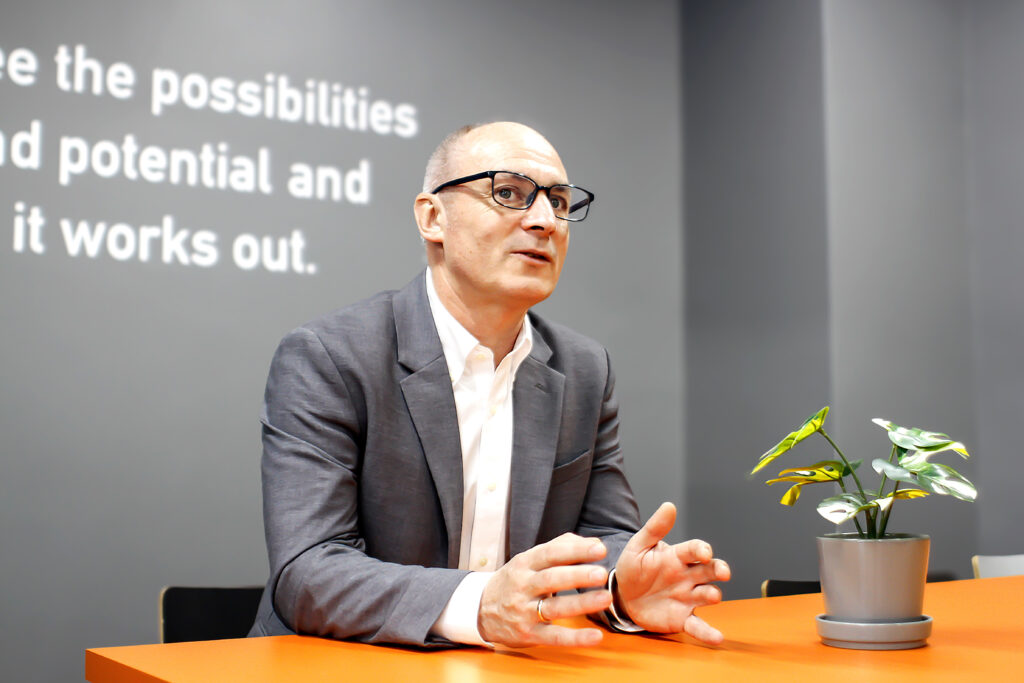
By Declan Somers, CEO of Mobal, and an Irish expat who has been living in Japan for a number of years. (Note: Mobal offers a discount to JETs and JET alumni. 50% off a voice product and 10% off any data product.)
Most former JETs will tell you the same thing:
Japan never quite lets go of you.
You might leave your contracting organisation, your apartment key, and your bike behind-but the country stays with you. In the food you miss. In the language you half-dream in. In the quiet pull to go back, even years later.
For Tony Smith, founder of Mobal, that pull never disappeared either. But the story of Mobal- one of the most familiar mobile providers to JETs didn’t begin in Japan.
It began in Malawi.
A Holiday That Changed Everything

Tony didn’t travel to Malawi on a mission.
There was no grand plan. No charity proposal. No business model.
He was on holiday.
What he saw there, though, stayed with him. Not statistics or policy failures-but people. Families. Children. Communities living with a level of poverty that was impossible to unsee once you had seen it up close. Tony returned home and did something quietly radical.
Without telling his company, without telling his staff, he began donating Mobal’s profits to charity!!
No press release.
No mission statement.
Just a personal decision that business should do more.
Then he went further.
Rather than simply donating money, Tony started using what he knew best-business- to create viable social enterprises in Malawi. The goal wasn’t aid. It was dignity: meaningful work, local employment, and long-term sustainability in the very community he had visited.
Mobal’s Secret Mission

For years, Tony kept this to himself. Until his accountant intervened.
Pointing out that companies donating to charity could legally benefit from tax breaks, the accountant asked a very practical question:
“Why aren’t you telling anyone you’re doing this?”
That moment changed Tony’s approach and he decided to come clean. He informed his staff how profits were being used, formally embedded giving into Mobal’s mission, an founded a separate charity in the UK to distribute funds properly and transparently.
What had started as a private moral choice became a public commitment.
Japan Enters the Story (Again)
Several years later, the charity began working with international volunteers, including Japanese volunteers visiting Malawi through the JICA programme, primarily on educational projects. Then disaster struck. In 2015, catastrophic flooding displaced huge numbers of people in Southern Malawi, including children who could no longer attend school-let alone eat regularly.
Volunteers gathered to ask the simplest, hardest question:
What can we actually do right now?
Tony-who had loved Japan his entire life and had a small office in Tokyo- made an unexpected suggestion:
Why not set up a charity in Japan to help?
That idea became Seibo Japan, a registered Japanese NPO.
School Meals & SIM Cards: What’s the connection?

In February 2016, Seibo Japan and Seibo Malawi, using funds donated from Mobal together began feeding displaced schoolchildren at nursery schools in Malawi. The problem? Almost nobody in Japan knew who they were.
In the early days, Seibo Japan operated out of Mobal’s Tokyo office, sharing space- and occasionally ideas. That’s when the team noticed something else: Mobal had a really good SIM card. Perfect for foreign residents in Japan. JETs included.
In an unusual pivot twist, Seibo Japan’s two staff members became SIM salespeople. Tony promised that every sale they made would be donated to the cause.
It worked. Sales took off-helped enormously by Mobal’s presence at JET orientations at the Keio Plaza Hotel in Shinjuku, a setting familiar to thousands of former JETs reading this now.
What began as a workaround became a partnership.
The lines between charity and company blurred, in the best possible way.
The Power of YouTube
Then came Makoto’s stardom in 2019.
If you’ve ever seen “A Day in the Life of a Japanese Salaryman” on YouTube, you’ve already met him-even if you didn’t know it.
👉 https://youtu.be/6tmjXp_AYg0
The video racked up 11 million views, countless comments, and international attention. What viewers didn’t realise was that Makoto wasn’t just a “salaryman”—he was deeply involved in Seibo Japan and the work happening behind the scenes.
After that, attending a JET orientation became… complicated.
Makoto couldn’t walk through the venue without being stopped for selfies, autographs, and the inevitable:
“Wait—aren’t you that guy from YouTube?”
Fast Forward to 2026
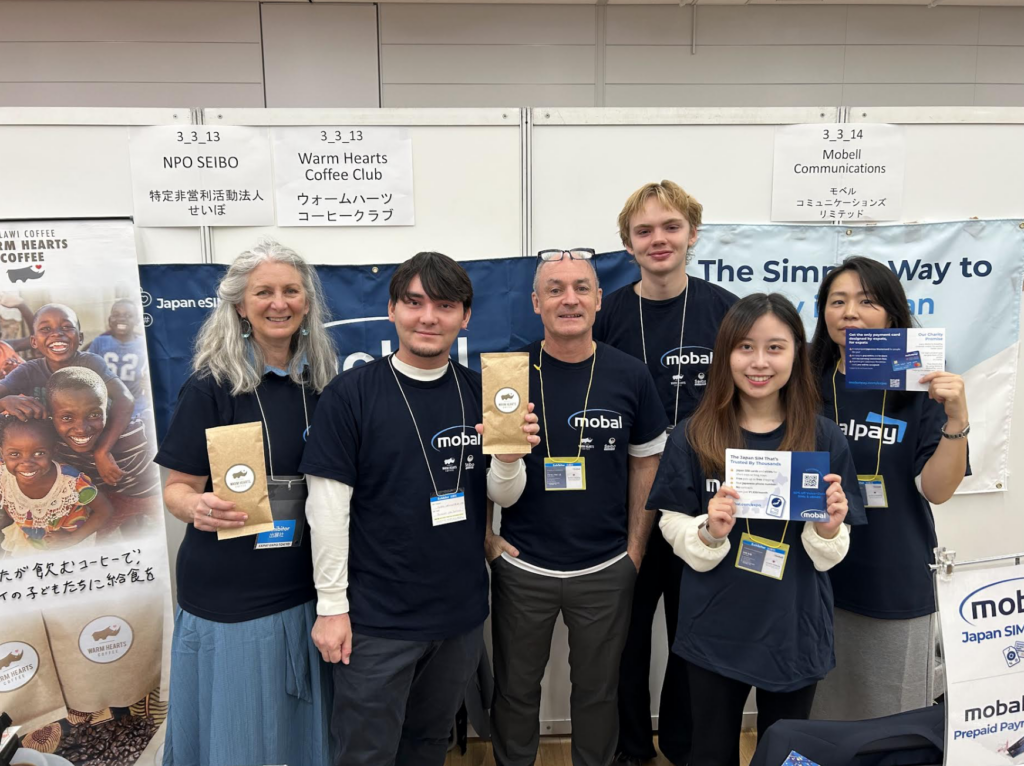
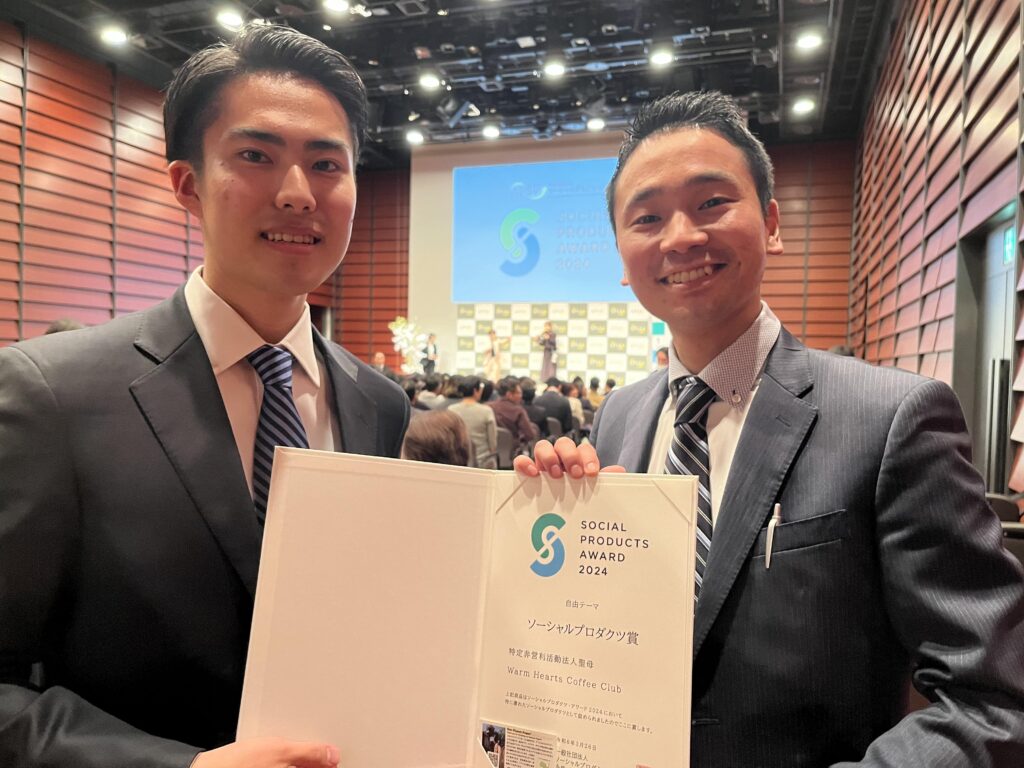
It’s now the 10th anniversary of Seibo Japan. Makoto continues to run the organisation, raising funds through donations and initiatives like Malawian coffee sales via the Warm Hearts Coffee Club.
Mobal, meanwhile, is still doing what it quietly set out to do all those years ago:
- Profits still go to charity
- Social enterprises still provide over 600 meaningful jobs
- More than 20,000 children still receive a hot school meal every day
- Education remains at the centre of everything
Today, the work at Mobal is led by Declan (formerly Makoto’s colleague at Seibo & ex–Malawi volunteer), working alongside Makoto- another example of how careers, causes, and Japan itself have a habit of pulling people back together in unexpected ways.
Good Coffee always leads to a Good Story

One of the most quietly powerful developments in Seibo Japan’s story in Japan came via coffee. Fully funded by Mobal and supported by the wonderfully generous Ataka Trading, Seibo Japan runs a non-profit Malawian coffee business that does far more than sell beans. Yes, Makoto and his team do of course sell coffee online but the real impact happens offline, in classrooms across Japan.
At the time of writing, over 40 partner schools are involved.
Seibo Japan volunteers work with students to organise Malawi coffee sales events- often as part of international studies, ethics, or global citizenship programmes. Students help plan the event, promote it, and run the sale themselves.
Along the way, they learn about:
- Fair Trade and ethical supply chains
- The difference between charity and social enterprise
- How business skills can be used for social good
- What life looks like for students their own age in Malawi
Every yen raised goes directly to charity.
And sometimes, the story doesn’t end there.
In some cases, students later travel to Malawi themselves, meeting communities, visiting schools, and seeing exactly how the funds they helped raise are used.
For anyone who once stood in front of a Japanese classroom as a JET and tried to explain “internationalisation” in real terms, this model feels instantly familiar—and quietly revolutionary.
Learn more here and reach out if you have a school to introduce!
👉 https://www.charity-coffee.jp/en/
Why This Matters to JET Alumni 🇯🇵
If you’re a former JET, this story probably feels familiar.
- A life changed by living abroad
- Small decisions that snowball into something bigger
- Japan acting as a connector between people, cultures, and causes
JET alumni continue to choose Mobal not just because it works but because it aligns.
- No confusing contracts
- English-friendly support
- Japanese phone numbers without the bureaucratic headache
- And purchases that directly support education and social impact
A Little Something Extra for JET Alumni (and a Coffee Warning ☕)
Because this story has always been intertwined with the JET community, there’s a small thank-you built in.
JET alumni—and their friends and family—can receive a 50% discount on a Mobal voice SIM or eSIM using the dedicated JET Alumni discount link.
And if you’re visiting Tokyo?
You’re very welcome to visit the Seibo Japan charity office, where there’s a good chance you’ll meet Makoto himself—though fair warning: you may leave with a bag of Malawian coffee beans, sold with enthusiasm, purpose, and just a hint of mischief.
It’s not a showroom.
It’s not a pitch.
It’s simply another example of how Mobal, Seibo Japan, and the JET community continue to overlap in wonderfully human ways.
Stay Connected. Do Good. Come Back to Japan.
Mobal is proof that not all meaningful projects begin with a business plan.
Sometimes they begin with a holiday.
A moment of discomfort.
And a decision to quietly do the right thing-until it becomes impossible not to share it.
For JETs who still carry Japan with them, this is a story worth staying connected to.
********************
Note: Mobal offers a discount to JETs and JET alumni. 50% off a voice product and 10% off any data product.
From JET to Kumano Adventures: Even with a liberal arts education, more generalist than I ever would have imagined
Career, Interview/Profile, Japan Local, LifeAfterJET, Return on JET-vestment, Travel/Tourism Comments Off on From JET to Kumano Adventures: Even with a liberal arts education, more generalist than I ever would have imagined
***************
Todd Van Horne (Wakayama-ken, Tanabe-shi, 2004-08) is an inbound tourism specialist based in Wakayama Prefecture. He is Operations Manager for Kumano Adventures, a company started by fellow JET alum Giuliana Alfinito (Wakayama-ken, 2017-18), who also previously served as President of the New England JETAA chapter and as a Country Representative for JETAA USA.

I was an ALT in Tanabe City, Wakayama, from 2004 to 2008. It was my 2nd time in Japan and I was a little older than most of the other ALTs. I didn’t have so many shared interests with the JET social world around me, so I found myself spending time with a small group of friends exploring the area, cooking, and studying the language hard on my own.
My placement itself was difficult, sometimes unpleasant, for reasons that probably wouldn’t surprise other JET alumni. In fact, I had my resignation letter typed and translated, and was about to turn it in after recontracting, when suddenly on that day we were assigned a new supervisor. The new supervisor was just as disconnected but much less unpleasant. With my growing independence thanks to improving language ability and understanding of bureaucracy, I could rely less on colleagues I preferred not to depend on. That growing independence was the reason I was able to stay for 4 years. It’s still very strange to me that the life I have now pivoted on that day’s “I’ll see how today goes.”
Outside of work, I became increasingly interested in fermented foods and helped my wife grow and teach her cooking class business.
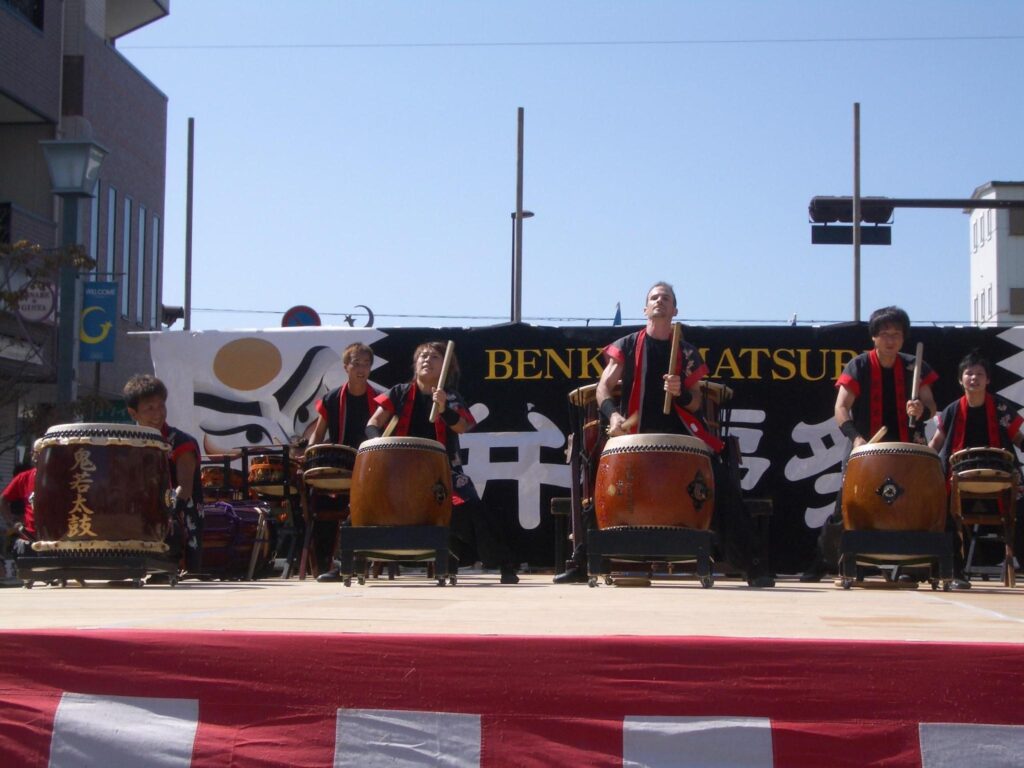
After JET, the plan was to move to the U.S. for a couple of years and then return to Japan. We did exactly that, only to move back just one month before the 2011 tsunami. Like nearly everyone we knew at the time, we struggled during that time. Finally we got our restaurant open, focusing on fully handmade food served with homemade pickles, miso, and sprouted brown rice.
We ignored the naysayers who said you shouldn’t work with your spouse … and paid the price. We had a restaurant, a baby, an immediate family member in failing health, and more. To say it was a tough time is a vast understatement. For a few years I felt like the guy in movies clawing at ice from underwater, trying to find a way out.
A combination of circumstances led to an introduction to a local company, and although I wasn’t looking to be employed, it was the most practical option for a few years. I’m glad I did it, but I would never, ever repeat it. Although staying with the restaurant wasn’t an option at the time, my only keen regret about these 20+ years is that I’m not producing and selling my food and products anymore.
Becoming a parent changed things again. After my daughter was born, I developed a strong interest in the psychology and theory of parenting, likely influenced by my years in education. I separated from my ex-wife, quit that job, and found myself with the space to be the kind of father I wanted to be. My somewhat frustrated interest in education was rocked when I started raising my daughter. It was like a light bulb turning on, to coin a phrase. I began coaching Japanese parents in raising bilingual children, with a lot of parenting philosophy mixed in. It was meaningful work, and was aligned with my values and interests. I randomly met an old friend in a supermarket around that time and recall saying, “I’ve been through the f****** ringer but I’m so happy to be where I am.”
Around that time, a former JET coworker introduced me to Giuliana, who had been a JET in nearby Shingu City from 2017–2018. We hadn’t crossed paths before, unsurprising, given that I was working six days a week during her year on JET. I started helping her informally with operational challenges for her small travel startup Kumano Adventures, and over the course of a year or two, that collaboration deepened. When an opportunity came up to apply for a tourism promotion grant, we decided to partner.
In 2025, we both quit our other jobs and committed fully to Kumano Adventures.

Running a tour business in rural Japan is loads of fun but feels Sisyphean at the same time. I love connecting with local suppliers who are eager to try new ideas, and seeing what we can create together. With so many inbound tourists, sometimes I feel like we’re passing on earning opportunities too often. But our end goal is to create systems that help rural Japan, while making a living. The challenge is being creative and persistent, but also patient in balance, while finding where our vision overlaps with what the consumer base is actually looking for.
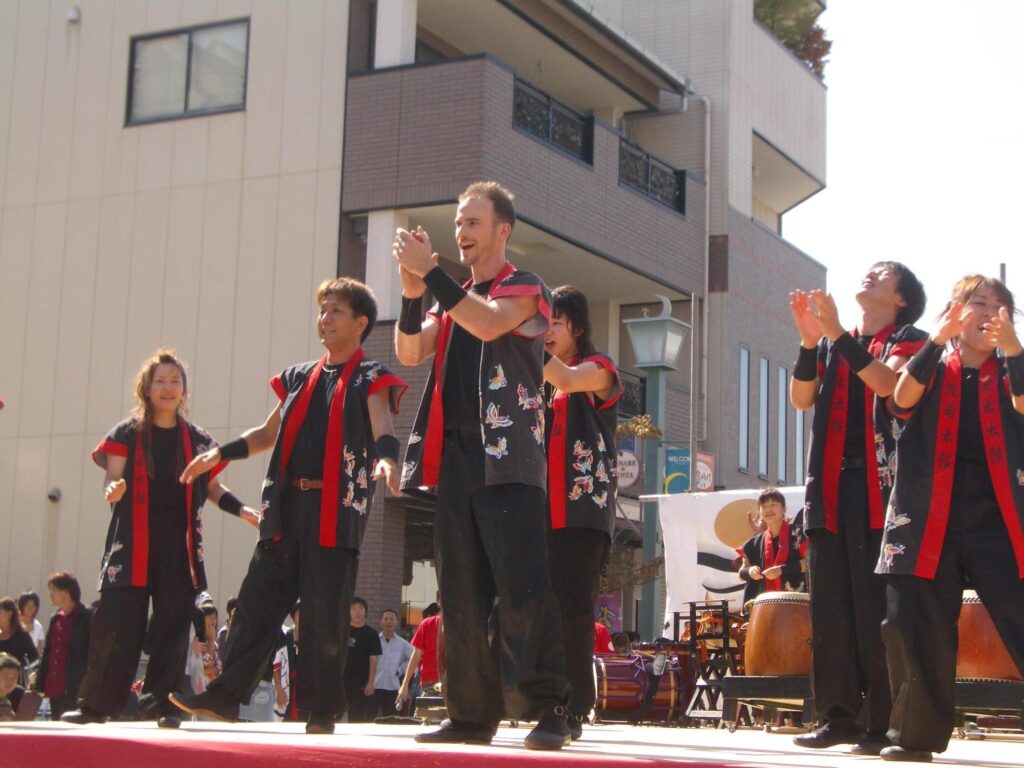
One project that feels especially full-circle for me is our Taiko Retreat. During my JET years, I played in the local taiko group for four years. Separately, the partner of another local ALT, Carrie, also began playing and teaching taiko here and has continued ever since. Carrie later reached out about creating a taiko event back in the place where they were placed for JET, and that conversation eventually became the Taiko Retreat.
Carrie is a dance teacher with a strong focus on physical health and incorporates concepts like godai, the five elements of Eastern philosophy, into her teaching. From my perspective, Carrie’s work emphasizes authenticity at both the personal and student levels while creating a space where people can express themselves honestly. We hope this becomes a recurring event.
For former JETs, there’s something familiar about returning to rural Japan not as a teacher, but as a participant, already knowing how to perceive the pause, open your senses, be thoughtful about your response. As a small way of welcoming that community, we offer a 10% discount for former JET participants.
Recently my friend invited me to his Thanksgiving gathering. During dinner he looked at me and said, “You don’t seem jaded about your time here.” Well … I’m glad that’s my vibe!
Although life’s difficulties never disappear, things are easier for me here now than they’ve ever been. My time in this region started with JET but I wouldn’t really call it a foundation. It was just another experience that had good and bad times, and was part of the path to now.
Law & Language Podcast: Interview with JET alum Scott Alprin,
Audio, Career, Interview/Profile, JETs in the News, Language Study, LifeAfterJET, Networking, Notable JET Alums, Return on JET-vestment Comments Off on Law & Language Podcast: Interview with JET alum Scott Alprin,

Episode 8 of the USLawEssentials Law & Language Podcast an interview with Scott Alprin (Aichi-ken, Kariya-shi, 1992-95) of Alprin Law Office, P.C. Scott is trademark and intellectual property attorney who speaks Japanese and works with many international clients. He discusses his career path and shares insights on law and practicing as an IP attorney.
JET alum Steven Horowitz (Aichi-ken, Kariya-shi, 1992-94), in collaboration with Daniel Edelson of USLawEssentials.com, recently launched “USLawEssentials: Law & Language,” a legal English podcast intended for foreign lawyers, law students, and LLM students as well as other non-native English speakers who want an enjoyable way to improve their legal English. The podcast episodes cover a variety of topics including legal news events and discussions of recent cases as well as interviews with multilingual lawyers. The discussions use accessible language with helpful explanations along the way.
JET alum launches legal English podcast
Audio, Career, JETs in the News, Language Study, Notable JET Alums Comments Off on JET alum launches legal English podcast

JET alum Steven Horowitz (Aichi-ken, Kariya-shi, 1992-94), in collaboration with Daniel Edelson of USLawEssentials.com, has launched a new legal English podcast titled “USLawEssentials: Law & Language.”
The podcast is intended for foreign lawyers, law students, and LLM students as well as other non-native English speakers who want an enjoyable way to improve their legal English. The podcast episodes cover a variety of topics including legal news events and discussions of recent cases as well as interviews with multilingual lawyers. The discussions use accessible language with helpful explanations along the way.
Notably, the first two multilingual lawyers interviewed are both JET alumni! Brian Hersey (Fukuoka-ken, 1994-96) and Brenda McKinney (Hyogo-ken, 2006-09)

Horowitz, the founder of JETwit.com, is a Professor of Legal English and the Director of Online Legal English Programs at Georgetown Law School. He previously served as Director of Legal English Programs at St. John’s Law School.
Edelson is an Adjunct Professor of Law at St. John’s Law School and a practicing attorney in addition to founding USLawEssentials.com. He has previously taught English in Japan and has taught legal English in Korea.
Horowitz and Edelson encourage readers to share the podcast with students and others they know who are seeking to improve their legal English or simply their English in connection with sophisticated topics.
Life After JET: Podcast interview with Stephen Horowitz, Director of Legal English Programs
Audio, Blogs, Career, Interview/Profile, LifeAfterJET, Video Comments Off on Life After JET: Podcast interview with Stephen Horowitz, Director of Legal English Programs
*******
*******
Steven Horowitz (Aichi-ken, Kariya-shi, 1992-94) is the founder of JETwit, a member of the JETAA USA Board of Advisors, and Director of Legal English Programs at St. John’s University School of Law in Queens, NYC, “the most ethnically diverse urban place on the planet.” He also writes for the St. John’s Legal English Blog.
I was recently interviewed for a podcast episode by Louise Kulbicki, founder of StudyLegalEnglish.com, about the legal English work I do at St. John’s Law School with the LLM students and other non-native English speaking students there. Since my experience on JET teaching English and learning to function well in a cross-cultural environment has been core to my current career, and since JETs often want to know what people do after JET, I thought I’d share the interview here in case of interest.
Here’s a link to the podcast episode titled “LL.M. Legal Writing Tips with Stephen Horowitz”
Topics covered:
- Legal English LLM programmes for non-native speakers
- Legal English writing challenges and tips
- Using IRAC – Issue, Rule, Application, and Conclusion
- Understanding categorization
- Legal English resources
And here’s the video version of the podcast:
To learn more about what I do, or if you’re interested in getting into the field of legal English, you can read more at the St. John’s Legal English Blog. Feel free to contact me as well. (Did I mention I’m fortunate to work with two other JET alums at St. John’s Law School?)
Special Request: Long-time JETAA officer needs help saving his home
Uncategorized Comments Off on Special Request: Long-time JETAA officer needs help saving his home
Kansas City, Missour-based JET alum Warren McAllen (Fukuoka-ken, 1988-92), who served for over 10 years as the JETAA Heartland chapter president, has set up a GoFundMe page to try to raise funds to save his home following his mother’s passing. Those of us who have known Warren over the years know what an amazing contributor he has been to JETAA and what a good guy he is as well as what he’s been through over the past few years. Here’s a chance to help someone who has given so much of his time and energy to the JET alumni community over the years.
https://www.gofundme.com/57c9n-save-my-home
JET alum research project seeks JETs and alums with diabetes
Academic Comments Off on JET alum research project seeks JETs and alums with diabetes
A unique request from a JET alum Melissa Smith specifically to US-based JET alumni. Please contact her if you might be able to help:
Who’s going to TESOL International 2017 in Seattle?
LifeAfterJET, Networking Comments Off on Who’s going to TESOL International 2017 in Seattle?
The TESOL International 2017 Convention is coming up: March 21-24 in Seattle! I’ll be there presenting on a panel titled “Legal English: Strategies for Effective Communication in Law School” on Thursday morning at 9:30am.
Are any other JETs or JET alumni planning to attend? If so, please feel free to post in the comments section below or to email me directly at jetwit [at] jetwit [dot] com. It would be great to connect with other JETs there, and I’m sure there must be others.
Hope to see some of you there,
–Steven

St. John’s Legal English: Comprehensible input for legal English students
Academic, Blogs, Career, Graduate School, LifeAfterJET, Writers Comments Off on St. John’s Legal English: Comprehensible input for legal English students
Steven Horowitz (Aichi-ken, 1992-94) is Director of Legal English at St. John’s University School of Law in Queens, NY and publisher of the St. John’s Legal English blog. He will be attending the upcoming TESOL International Conference in Seattle and will be on a panel titled “Legal Language: Strategies for Effective Communication in Law School” scheduled for March 23.
 Comprehensible input for legal English students: Resources, approaches & ideas
International students in LLM and legal English programs at US law schools come to study law, not ESL. At the same time, law study requires deep engagement with texts and concepts that are complex and challenging even for native English speakers. But how do you have substantive class discussions or evaluate students’ legal writing when students are struggling to sufficiently comprehend the language of the reading?
In linguistics, the relevant term is “comprehensible input.”
Click here to read the full blog post on the St. John’s Legal English blog.
Survey: JET alum research survey on microaggressions experienced in Japan
Academic Comments Off on Survey: JET alum research survey on microaggressions experienced in Japan
********************
Hello fellow JET alums! My name is Stephanie Hupp, and I was an ALT in Akita Prefecture from 2011-2015. I worked in a wonderful little town called Yurihonjo. I don’t miss the brutal winters but I do miss living and working in Japan!
However, I have decided to come back to school to get my masters in Communication, specifically in Intercultural Communication. Based on my many years in Japan, I am writing about life for American ALTs in Japan and some of the potentially negative experiences they might have faced (or maybe they experienced none!). I am specifically looking at microaggressions and how they might relate to job satisfaction and satisfaction with co-workers. A microaggression is defied as “brief and commonplace daily verbal, behavioral, or environmental indignities, whether intentional or unintentional, that communicate hostile, derogatory, or negative racial slights and insults toward people of color.” While this definition regards people of color, I am investigating to see if these same experiences happen with Americans as more and more Americans work abroad. A common one many of you might have heard is the compliment “You are good at using chopsticks!” or maybe a restaurant or bar was seemingly nervous because of a potential language barrier.
Unfortunately, my study is only open to American JETs (sorry my UK/Aussie/Kiwi JETs!). I have compiled a short survey (it should take about 20 minutes to complete) as well as a section at the end where you can put an e-mail if you wish to be contacted for an interview. Any help I can get is greatly appreciated, and if you know someone that would like to participate please pass them this message! The link is mobile friendly. You can take the survey here. I hope the results of this survey will help JETs have a better understanding of their experiences, as well as potentially help future JETs fully prepare for life and work abroad.
http://uark.qualtrics.com/SE/?SID=SV_57PuZEMiukOKlal
All the best in your endeavors!
Stephanie Hupp
University of Arkansas Department of Communication
Public Speaking Instructor and TA
Job: HelloEnglish.US seeks ESL tutors for Japanese learners on Skype
Jobs Comments Off on Job: HelloEnglish.US seeks ESL tutors for Japanese learners on Skype
 A job listing directly from HelloEnglish.us which has posted to JETwit previously and had success hiring JET alumni as a result:
Job Position: ESL Tutors needed for Japanese learners on Skype
Job Details: My name is Scarlett and I live in Wilmington, NC. I own a small business that is growing quite rapidly called HelloEnglish.us. I give English conversation classes to people in Japan on Skype. Currently, I have around 400 students. I have about 30 current tutors but it is not near enough. I have over 1800 classes that are prepaid and I am looking to hire 20 more tutors. I am in need of teachers or tutors who would like to earn extra money. One of my teachers was accepted into the JET program. He found it invaluable to work here in a small way to prepare for what was coming in Japan. I also think that this might be very helpful for JET Alumni re-acclimating themselves to their home country. Or like me, an older woman who looks back affectionately on my time in Japan and sees my conversations as a way to re-connect with the culture I know and appreciate so well.
This job pays $12 per 55 minute class completed and is paid through PayPal on a weekly basis. The tutors make their own schedule of when they would like to give classes. The job is “located” on Skype ~ a free computer application.
Here is more information about the positions and how to apply: http://www.onlineeikaiwa.jp/eslteachers.html
I have had previous success hiring alumni of the JET Program and would love to hire more.
JET Talks: George Rose – Baseball and the US-Japan Relationship
Career, Celebrity, LifeAfterJET, Notable JET Alums, Return on JET-vestment, Translating/Interpreting, Video Comments Off on JET Talks: George Rose – Baseball and the US-Japan Relationship
************
What do people do after JET? Here’s one great example.
On November 16, JETAA DC held the latest in their JET Talks series with a talk by JET alum George Rose (Fukushima-ken, 1989-91), former interpreter for Hideki Irabu and current Director of Pacific Rim Operations for the New York Yankees, not to mention former JETAA NY President.
Here’s a video of the talk. (Thanks to JETAA DC Vice-President Joy Young for passing this on!) Many great anecdotes including one about interpreting for Hideki Matsui on the Regis and Kathy Show. Plus, did you know that George played a role in helping the Yankees sign Masahiro Tanaka? Watch and enjoy!
JET alum Bruce Feiler a CNN commentator during Pope’s visit
Article/Journalism, Celebrity, JET Alum Author Beat, JETs in the News, Notable JET Alums, Writers Comments Off on JET alum Bruce Feiler a CNN commentator during Pope’s visit
***************
Bruce Feiler (Tochigi-ken, 1989-90), author of Learning to Bow as well as several books on religion including Walking the Bible, Abraham and Where God Was Born along with other popular books including The Council of Dads, and, most recently, The Secrets of Happy Family, can now add CNN commentator to his resume. He has been providing religion-related perspectives in live conversations with Anderson Cooper, Wolf Blitzer and others.

****************************

To read prior JETwit posts about Bruce Feiler, please click here.
For more regular updates, follow Bruce on Facebook: www.facebook.com/brucefeilerauthor.
And Twitter: www.twitter.com/brucefeiler.
Help out with the annual Fukushima Calendar!
Cultural Outreach, Earthquake Tsunami, Japan Local, Photography, Return on JET-vestment Comments Off on Help out with the annual Fukushima Calendar!
A request for help with this project from JET alum Ryan McDonald (Fukushima-ken):
This is the 4th year we are trying to produce the “This Is Fukushima” calendar that we send to world leaders, media, and royalty. We’ve received thank you notes from President Jimmy Carter, Prime Minister Stephen Harper, and even Her Majesty Queen Elizabeth.
- We take donations and use the money to produce the calendar and then pay for most of the shipping, although for the past 3 calendars the people creating out went out of pocket over $1,000 each.
- Here is a link to the current calendar in PDF form to see the style. Feel free to download it and print it out if you’d like. The actual calendars are professionally printed and look great.
- This link is a write up (in Japanese) about myself and the other people producing it.
- If you have any large photos of Fukushima please email us by October 31st this year. We prefer interesting places unique to Fukushima and not generic nature shots. We want people to say, “wow, I’d like to go see that.”
Photo criteria:
- – must have been shot in Fukushima-ken. It doesn’t matter when (so yes, pre-2011 pics are fine).
- – minimum 300dpi resolution (4000×3000 px) (or very close to it, but 72 dpi usually won’t work)
- – horizontal format is preferred
- Photos can be submitted via email to: ThisIsFukushima@gmail.com
Thanks in advance for your support!
—————————–
今日本語で :
愛する福島県の住民と以前住んでいた方へのメッセージ:
2016年の「This is Fukushima」カレンダーのために只今写真募集中!
写真の提出期限は10月31日までです。
募集する写真の基準:
〓 福島県内で撮られた写真。今年撮られた写真に限らず、もちろん2
〓 解像度の必要最小限は300dpi (4000x3000px)
〓 横向きの写真が望ましい
写真をメールで提出してください: ThisIsFukushima@gmail.com
よろしくお願いします!
