




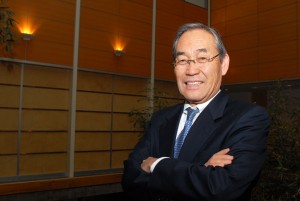
- Japan Society President Motoatsu Sakuri (photo by Ken Levinson)

By Justin Tedaldi, Editor (Kobe-shi CIR, 2001-02) for JQ Magazine
Even century-old organizations can find new ways to change. In April, New York’s Consul General of Japan Motoatsu Sakurai became the first Japanese president of the city’s esteemed Japan Society. JQ talked with President Sakurai (who has graciously hosted JET gatherings at his home numerous times over the years) shortly after his inauguration to ask about his new plans and ideas for the future.
How did become the new president of Japan Society? Did you campaign, or were you appointed directly by their board of directors?
I have long been an admirer of Japan Society, its mission and its programs. In fact, I served as member of Japan Society’s Board of Directors from 2003 until my appointment as Ambassador and Consul General of Japan in New York, after which I became an Honorary Director. Towards the end of my term as Ambassador, when former president Richard J. Wood was looking to retire, the Society’s board approached me to see if I had interest in the position. As my first venture into the nonprofit sector, leading this venerable 102-year old organization seemed like—and now is—an exciting new challenge.
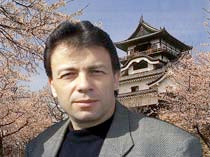
JET alum/Inuyama city councilman Anthony Bianchi
By Michael Glazer (Chiba-ken, 1995-97) for the JETAANY Newsletter
Bensonhurst, Brooklyn native Anthony Bianchi (Aichi-ken, 1987-91), the first-ever North American to hold an elected position in Japan, is still going strong in his role as a city councilman in Inuyama-shi, Aichi-ken. Michael Glazer (Chiba-ken, 1995-97) recently did a recorded interview with Anthony to discuss the hot local topics, learn more about politics in Japan and get a sense of how things look across the pond.
You have a very interesting background. How does a JET program teacher become a city council member?
Well, I’ll try to make the story as short as possible. I studied filmmaking at New York University and I was interested in Kurasawa films and whatnot, and I was out in L.A. for a while. I came back to New York. I was working for New York City and I saw an ad in the paper about the Expo that was held in Gifu about 20 years ago. So I went over to Japan on a homestay program and decided it would be nice to try to live there for a year or so. I joined the JET program, stayed for a couple years, and decided I wanted to stay longer.
Best of JQ: Pride of the Yankees (Far East Edition) (Summer 2008)
 Article/Journalism, JQ Magazine
  Comments Off on Best of JQ: Pride of the Yankees (Far East Edition) (Summer 2008)

- JET alum George Rose with Yankees captain Derek Jeter after winning the 1998 World Series
By Stacy Smith (Kumamoto-ken CIR, 2002-03) for the JETAANY Newsletter
JET Alum George Rose (Fukushima-ken, 1989-91) has mingled with Japanese royalty, interpreted for two baseball superstars named Hideki (Irabu and Matsui) and currently heads Yankee operations in Japan. How did this New York native manage to accomplish all this in his post-JET life? The JETAANY Newsletter had a chance to talk with George about his past exploits and his present position. Here are some excerpts from Stacy, who is collaborating with George to lead Japanese tours during games at Yankee Stadium this summer.
What was your post-JET career path?
I was going for my MBA at Columbia when I had the opportunity to become the interpreter for the new Yankee Hideki Irabu, so I took a leave of absence and worked with him from ’98-’99. When he got traded, I resume my studies and after graduation worked on Wall Street. When Hideki Matsui came over, I did a bit of interpreting for him such as at his opening press conference. Because at the time I had my own business I wasn’t able to do this full-time, but I did help with the interview process for his interpreter. Then last year the Yankees asked if I was interested in helping out with the opening of their office in Tokyo, and I went over last summer. Read More
Current Hiroshima-ken JET Gail Cetnar Meadows, Editor of Hiroshima JET webzine the Wide Island View, shines a light on some of the upcoming events of Japan America Societies…
 Indiana State Fair “Bridges to Japan” exhibit — Starting this year, Indiana’s state fair will have a new international theme each year, and they’re starting by featuring Japan. The exhibit will introduce visitors to Japanese culture and showcase Indiana’s extensive connections to Japan. Visitors can enjoy Japanese cultural activities, performances, exhibits on daily life, Japanese food, and displays on the many economic, sister city, and educational partnerships between Indiana and Japan. Volunteers are being recruited!
- Date: Aug. 6 to 22
- Place: Indiana State Fairgrounds, on the corner of East 38th Street and Fall Creek Parkway in Indianapolis
- For more information, click here.
- Summer Film Series — The Summer Film Series sponsored by the Japan Society of Boston will feature screenings of nine major Japanese movies (most of them new or rarely screened in the Boston area). It’s a wonderful opportunity to see Japanese hit movies or classics by great Japanese directors. Plus: they’re free! You can also enjoy dinner (often featuring Japanese delicacies) before the movies. Pre-registration is required.
- Date: June 29 to Aug. 24
- Time: Most screenings are on Tuesdays starting at 7 p.m. There will be a special A-bomb Memorial Day screening on Friday, Aug. 6
- Place: Movies will be in the Rainbow Hall of Showa Boston Institute. Dinner is in Showa’s cafeteria.
- For more information, click here.
 Canoe Excursion: Historic Franfort Tour — Enjoy a guided canoe/kayak trip with JASK friends, designed for beginners. Children and families are welcome. Price is $30. Float along and breath the fresh air in the midst of beautiful Kentucky river country.
- Date: July 17
- Time: 4 to 6 p.m.
- Place: Kentucky River View Park, Frankfort, Kentucky
- For more information, click here.
- Japanese Dialect Workshops — Impress your Japanese friends with your knowledge of four dialects from the northernmost to the southernmost regions of Japan. These special language workshops are geared for intermediate to advanced Japanese language learners. Each week, a different dialect will be taught by native Japanese speakers from the regions of Okinawa, Kansai, Kyushu and Hokkaido. To register, click here.
- Dates: Wednesdays, July 21, July 28, Aug. 4, Aug. 11
- Time: 6:30 p.m.
- Place: Japan-America Society of Dallas/Fort Worth, 11615 Forest Central Drive, Suite 206, Dallas
- For more information, click here.
Does your Japan America Society have an upcoming event that you’d like to share with JetWit readers? Email Gail Cetnar Meadows the info.
Japan Info e-Newsletter July 2010
Uncategorized Comments Off on Japan Info e-Newsletter July 2010

The July 2010 edition of JapanInfo is now available online: http://editor.ne16.com/he/vo.aspx?FileID=1eebd4a0-af80-4be3-8945-42739cf4d675&m=1a93644da75eb849a0cfdf023ccba12e&MailID=12891461
JapanInfo is published by the Consulate General of Japan in New York/Japan Information Center and is a great source of info for Japan-related things going on in New York and the surrounding area.
Job: Business Development Associate, Unspecified Non-Profit Organization (New York)
Jobs, Uncategorized Comments Off on Job: Business Development Associate, Unspecified Non-Profit Organization (New York)
Job posting by Lauren Sethney (Niigata-shi CIR, 2000-2003). Lauren serves as the Program Director at the Japan-America Society in Dallas-Fort Worth.
via MAX Consulting Group, Inc.
Location: Mid-town, Manhattan NY
Area Industry: Non-Profit Organization
Title: Business Development Associate
Job Description: 1 year long Temporary Assignment
Primary Duties: Discover companies willing to invest in Japan, especially in Service and Environment industry. Attend trade shows and visit potential companies. Follow up and assist those companies willing to develop business in Japan.
Secondary Duties: To assist alliance between Japan and the US in high-tech industry, bring American corporate employees to Japan and vice versa and coordinate business meetings. Assist promoting export business from Japan. Sales experience is preferable but not a must. Proficiency in Japanese is preferable, but not a must. Some business trips.
Please email your resume to info@maxjob.com or call 212-949-6660.
Job: Assistant Director, East Asia & Pacific Unit of the Institute of International Education (D.C.)
Jobs Comments Off on Job: Assistant Director, East Asia & Pacific Unit of the Institute of International Education (D.C.)
Job posting by Lauren Sethney (Niigata-shi CIR, 2000-2003). Lauren serves as the Program Director at the Japan-America Society in Dallas-Fort Worth.
Via Idealist.org
The Institute of International Education seeks an Assistant Director for the East Asia & Pacific Unit.
The Assistant Director (AD) provides leadership and supervision for a team of regional program staff who administer core Fulbright U.S. and Visiting Scholar and related programs for designated world areas. AD roles include carrying out a program portfolio with daily operational responsibilities, managing regional program staff and workflows including co-supervising positions when needed, maintaining a positive team approach, coaching and monitoring performance and collaborating with other managers to assure high quality administration of programs.
Major Responsibilities:
•Manage and oversee core U.S. and Visiting Scholar programs for East Asia and the Pacific, including U.S. awards catalog preparation and application goal setting, recruitment, peer review, candidate processing, affiliation, grant management, program budget analysis and reporting, in a manner that promotes teamwork, collaboration and flexibility within and across staff units
•Administer a program caseload in coordination with regional program staff and according to current policies, procedures and technology tools; maintain compliance with applicable regulations
•Communicate effectively with Director of Scholar Programs on program and staff status and issues; collaborate to coordinate and share experience between programs
•Exercise leadership and supervision of staff, make day-to-day decisions on operations and coordinate responsibilities within world areas, conduct performance evaluations, support professional development of staff, conduct hiring process for approved positions, resolve management and personnel issues
Qualifications:
•Masters’ degree;
•Seven years or more of substantial program management experience;
•Demonstrated effectiveness in supervising and training staff;
•Knowledge and understanding of higher education systems in the U.S. and abroad;
•Ability to work effectively with management teams and to build effective teams;
•Excellent interpersonal, decision-making, implementation and follow through skills; ability to adapt to changing organizational needs and a fast-paced work environment;
•Background in international higher education exchange; living experience and studies relevant to East Asia and the Pacific, particularly China, preferred.
How to Apply:
Please email resume, cover letter and salary history to cies-hr@iie.org
Include the position name and unit in the subject of your email. No phone calls, please.
For a complete job description, please visit http://www.idealist.org/if/i/en/av/Job/388072-152.
Job: English Language Teacher, Unnamed Private School (Hokkaido)
Jobs Comments Off on Job: English Language Teacher, Unnamed Private School (Hokkaido)
Job posting by Lauren Sethney (Niigata-shi CIR, 2000-2003). Lauren serves as the Program Director at the Japan-America Society in Dallas-Fort Worth.
Via Liz (Larson) Sheffield (Sapporo, 1993-1995)
Are you looking for an opportunity to help build an English program from the ground up for elementary school age children?
A new, private school located in Hokkaido will open in September 2011. The school is dedicated to providing a place for young children to experience an international atmosphere. The goal for the English program is to have a well-structured, yet flexible curriculum that isn’t based on conventional textbook teaching. Students will have the opportunity to learn while playing and experiencing activities held in the English-speaking environment.
We are seeking an experienced, creative and dynamic teacher to lead the English program for elementary school age children. Previous teaching experience and a desire to work with young children is a must. Experience in Japan is helpful, but not required. The position will commence in September 2010 or March 2011.
Please send brief history and reason for interest in the position to Courtneyadodson@ gmail.com, by July 25.
Kirsten’s World: Glitter on the Mattress
Uncategorized Comments Off on Kirsten’s World: Glitter on the Mattress

Bow-waka-chika-POW!
By Kirsten Phillips (Niigata-ken, 2005-08) who is currently a teacher in the NYC Teaching Fellows Program.
If you see a faded sign by the side of the road…
My kid bro’s Japanese friend was surprised at his knowledge of love hotels as he had never been to Japan before. But love hotels are one of those garish social conventions that anyone with the faintest modicum of interest in Japanese culture needs to know. There’s no mystery to that fascination.
“It’s really strange.” His Japanese friend said. “Love hotels are the only way Japanese teenagers can really have sex. But what about American teenagers?”
Why do you think Americans have such big cars?
Love hotels are right up there with Read More
WIT Life #108: On the Road
Anecdote Article, Film, Translating/Interpreting, WIT Life Comments Off on WIT Life #108: On the Road
WITLife is a periodic series written by professional Writer/Interpreter/Translator Stacy Smith (Kumamoto-ken CIR, 2000-03). She starts her day by watching Fujisankei’s newscast in Japanese, and here she shares some of the interesting tidbits and trends together with her own observations.
Both films screened last night at Japan Society’s Japan Cuts festival were road movies. The first, Accidental Kidnapper, is reminiscent of Clint Eastwood’s A Perfect World, but I found the second one, One Million Yen Girl, to be more distinctly Japanese. Both feature well-known leads who are easy on the eyes (Katsunori Takahashi and Aoi Yu, respectively) and are backed by strong supporting casts, including Takashi Sasano who makes an appearance in both as an advocate for the main character.
In Accidental Kidnapper he plays a convict who advises Takahashi how to carry out his kidnapping, and in the latter he is a coffee shop proprietor in a small mountain village. In my previous double header, the actor Eita also appeared in both movies; he shows great versatility as one of the main characters in The Foreign Duck, The Native Duck and God in a Coin Locker and has a bit part in Hanging Garden. Both he and Sasano are also in Read More
JET ROI: JET alum Toby Weymiller building eco-friendly kissaten/cafe in Hokkaido
Return on JET-vestment Comments Off on JET ROI: JET alum Toby Weymiller building eco-friendly kissaten/cafe in Hokkaido
 *********
JET Return on Investment (ROI) is a new category on JetWit intended to highlight the various economic, diplomatic and other benefits to Japan resulting from its investment in the JET Program. Why is this important right now? Because the JET Program and JET Alumni Association may be cut by the Japanese government, as explained in this post by Jim Gannon (Ehime-ken, 1992-94) titled “JET Program on the Chopping Block.”
Hokkaido-ken JET alum Toby Weymiller has returned to Japan and spent the last year building an eco-friendly kissaten/cafe (built with natural, sustainable materials) in the area where he worked on JET. And on top of that, he’s been documenting the whole process on his blog “Bomber & Maiko & Toby.” (Bomber is his cat, fyi.) (Update: I previously had heard it was a bed and breakfast but just learned that it’s in fact a kissaten/cafe.)
Here’s the link: http://maikotobybomber.blogspot.com/
(Thanks to JETAA International Vice-Chair for letting me know about this.)

Job: English Teacher, Kobe College High School (Nishinomiya)
Jobs, Uncategorized Comments Off on Job: English Teacher, Kobe College High School (Nishinomiya)
Job posting by Lauren Sethney (Niigata-shi CIR, 2000-2003). Lauren serves as the Program Director at the Japan-America Society in Dallas-Fort Worth.
Via JETAA Chicago
Kobe College High School seeks applications for an English teaching position for grades 7-12.
Contract: Two years; term begins April 1, 2011
Salary: 4,691,200 yen
Extras: Furnished Apt (small fee), Travel & Shipping, Expenses and Language Study
Qualifications:
-B.A. degree. Major in English or Education preferred.
-TESOL certification and teaching experience are preferred.
-Speaker of standard American English with strong grammar skills.
Application Deadline: August 7, 2010
Visit www.kccjee.org for a full job description or e-mail kccjee@comcast. net with questions. To view Kobe College’s website, go to: www.kobe-c.ac.jp
To Apply: Send a letter of application and a resume to:
KCC Japan Education Exchange
2100 Sanders Road, Suite #190
Northbrook, IL 60062
Fax: 847-715-9860Email: kccjee@comcast. net (no on-line links)
*Please include your email address in the correspondence.
Job: Associate TV News Producer, Tokyo Broadcasting System (New York)
Jobs, Uncategorized Comments Off on Job: Associate TV News Producer, Tokyo Broadcasting System (New York)
Job posting by Lauren Sethney (Niigata-shi CIR, 2000-2003). Lauren serves as the Program Director at the Japan-America Society in Dallas-Fort Worth.
Via Tokyo Broadcasting System
The New York News Bureau of Tokyo Broadcasting System (TBS) is seeking an energetic, professional individual to fill an Associate TV News Producer position.
TBS is one of the oldest and largest television and radio broadcasting networks in Japan and broadcasts nationally via 28 affiliate stations. The New York Bureau covers news primarily in the United States for broadcast in Japan.
Responsibilities will include, but not be limited to:
– Assist News Correspondents with daily news coverage and long term news projects.
– Research for news stories, set up interviews, and coordinate schedules.
– Assist with on-site news production and in-house recording, logging and editing of video feeds.
– Compile and prioritize information on daily, weekly, and long-range news events in coverage area.
– Monitor U.S. domestic news sources for information of interest to Japanese audience.
Japanese language ability a plus, but not required.
Strong interest in journalism, economic, political and social news preferred.
Available to travel and work extra hours and occasional weekends and holidays.
Must be legally authorized to work in the U.S.
Start Date: As soon as possible.
Payment: Entry level position with full time and overtime payment.
To apply, please send a cover letter and resume to newsjob@tbsi-us.com. No telephone calls, please.
Job: Associate Director for Administration, Center on Japanese Economy at Columbia University (New York)
Jobs, Uncategorized Comments Off on Job: Associate Director for Administration, Center on Japanese Economy at Columbia University (New York)
Job posting by Lauren Sethney (Niigata-shi CIR, 2000-2003). Lauren serves as the Program Director at the Japan-America Society in Dallas-Fort Worth.
Via Caroline Hasegawa (JET Program Alum)
The Associate Director for Administration will engage in executing programs and overseeing day-to-day activities of the Center on Japanese Economy and Business. The employee will report to directly to the Director for Administration as well as work collaboratively with faculty directors and other officers of the Center.
Key Job Responsibilities:
1. Thoroughly understand and carry out the Center’s mission by working closely with the Director for Administration to execute and oversee day-to-day administrative activities of the Center. Help Director in assigning tasks and monitoring performance of program staff.
2. Coordinate production of Center events. Maintain and monitor the quality and content of the Visiting Fellows Program.
3. Work with Center’s Academic and Administrative Directors to find opportunities for engaging CBS faculty in research related to Japan.
4. Lead efforts to update, improve and maintain the Center’s website, reports, email campaigns and other public relations outreach materials; liaise with the Business School Marketing and Communications office on key PR efforts
5. Assist the Director in conceptualizing and executing a variety of academic and outreach activities, including programs for students, alumni, faculty, and industry professionals.
6. Assist Director with creating Center marketing and fundraising materials.
7. Play a lead role in managing the Center’s new program, entitled “New Financial Architectures: Japan and the US.”
A full description of the job and its requirement can be found at: https://jobs.columbia.edu/applicants/jsp/shared/frameset/Frameset.jsp?time=1278599679364.
JET ROI: JETAA Chapter Beat
JETAA Chapter Beat, Return on JET-vestment Comments Off on JET ROI: JETAA Chapter Beat
**********
JET Return on Investment (ROI) is a new category on JetWit intended to highlight the various economic, diplomatic and other benefits to Japan resulting from its investment in the JET Program. Why is this important right now? Because the JET Program and JET Alumni Association may be cut by the Japanese government, as explained in this post by Jim Gannon (Ehime-ken, 1992-94) titled “JET Program on the Chopping Block.”
It occurred to me tonight that the “JETAA Chapter Beat“ posts that Jonathan Trace (Fukuoka-ken, 2005-08) has been pulling together since November 2008 provide a simple and nice overview of what various JETAA chapters are doing, especially in terms of Japan-oriented cultural outreach and community involvement. The process is simple: Jon subscribes to as many JETAA Chapter email lists, Facebook groups, etc. as he can find. Then each post he copies and pastes a few interesting ones, and…voila! JETAA Chapter Beat!
Here’s the category link:
