




Job: Sales Learning and Development Program Manager, Display – Sydney, Tokyo or Singapore
 Jobs
Jobs  Comments Off on Job: Sales Learning and Development Program Manager, Display – Sydney, Tokyo or Singapore
via Jet alum Michelle Elliott. Posted by Dipika Soni (Ishikawa-ken, 2003-06). Dipika currently works as an in-house translator for PFU (a Fujitsu company) in Kahoku-shi, Ishikawa-ken. She is also the vocalist for the Japanese hardcore punk band DEGRADE.
*Note: If you apply for this position, please let them know you learned of it from JetWit. Thanks.
—————————————————————————————————————–
Job Position: Sales Learning and Development Program Manager, Display – Sydney, Tokyo or Singapore
Job Details:
You will manage learning programs with a focus training Sales on the Google Display Network and YouTube. You will be responsible for partnering with sales leaders to develop learning solutions that align with business objectives and have measurable, long-term business impact. You should possess strong business acumen, have outstanding communications skills and be able to manage multiple projects simultaneously in a fast-paced environment. Experience with program and project management, and work experience in a direct sales organization are a plus.
For more details, click “Read More”.
Job: Server at Upscale Japanese Restaurant (NYC)
Jobs Comments Off on Job: Server at Upscale Japanese Restaurant (NYC)
via Jet alum Jamie Graves. Posted by Dipika Soni (Ishikawa-ken, 2003-06). Dipika currently works as an in-house translator for PFU (a Fujitsu company) in Kahoku-shi, Ishikawa-ken. She is also the vocalist for the Japanese hardcore punk band DEGRADE.
*Note: If you apply for this position, please let them know you learned of it from JetWit. Thanks.
—————————————————————————————————————–
Job Position: Server at Kajitsu, one of New York’s premiere Japanese fine dining restaurants.
Job Details:
About us: Kajitsu is one of New York’s top Japanese restaurants. In the nearly two years since it’s opening the restaurant has been awarded 2 Stars from the prestigious Michelin Guide, one of only 8 restaurants in New York to be selected for 2011. Kajitsu serves shojin-ryori, the vegetarian predecessor to kaiseki cuisine. More information at www.kajitsunyc.com.
Applicants should friendly and organized, and have an interest in Japanese cuisine and food culture. Experience in restaurant service and knowledge of spoken Japanese are a big plus. Work environment is friendly but professional, and very team oriented.
Excellent pay and flexible schedule, working 2-3 nights a week.
How to apply:
Interested applicants should contact us at info@kajitsunyc.com. Please paste your resume in the body of the email, attachments will not be opened.
JET alum Bruce Feiler’s TED talk on The Council of Dads (video)
Books, Celebrity, Notable JET Alums, Uncategorized, Video, Writers Comments Off on JET alum Bruce Feiler’s TED talk on The Council of Dads (video)
JET alum Bruce Feiler, author of Learning to Bow, Walking the Bible and several other best-sellers including his recent book The Council of Dads, recently spoke in connection with the TED lecture series:
FoxHound87: Great Day!
Uncategorized Comments Off on FoxHound87: Great Day!
Joshua Small is a First Year JET currently living in Ikaruga-cho, Nara-ken and has been chronicling his experience on his blog Snorlax87.
I am having a great day today!
First Class: English Conversation for Juniors (2nd Year’s)
The topic of today’s class was “Future Hopes/Dreams.” I borrowed the idea for the warm-up game from Rogue, the ALT in Tenri.
Warm-Up: Pairs of students come to the front of the classroom. Students stand with hands poised in Western style as though they are about to draw guns. I show them an occupation picture card. The first student to shout the occupation on the card and raise their hands like guns is the winner. Sounds silly right? The kids LOVED it! I called on volunteers who could then challenge another to “combat.” The boys got really into it. Instead of drawing simple pistols, some drew bazookas, bow & arrow, etc. Even the losing player’s death was dramatic. Some kids did a simple “touch the chest” move. Others fully acted like they had gotten shot. My favorite moment was the last fight. The winning student “shot” the losing student after yelling the right occupation. Except this time, the losing student did a matrix-style maneuver to dodge the “bullets.” HYSTERICAL…
CLICK HERE to read the rest of the post.
http://snorlax87.blogspot.com/
WIT Life #151: Fireworks from the Heart
Events, Film, Translating/Interpreting, WIT Life, Writers Comments Off on WIT Life #151: Fireworks from the Heart
WITLife is a periodic series written by professional Writer/Interpreter/Translator Stacy Smith (Kumamoto-ken CIR, 2000-03). She starts her day by watching Fujisankei’s newscast in Japanese, and here she shares some of the interesting tidbits and trends together with her own observations.
 Yesterday I had the chance to attend the ANA-sponsored screening of Fireworks from the Heart (おにいちゃんのハナビ), a sentimental film based on the true story of recent high school graduate Taro whose sister Hana suffers from leukemia. The family moves from Tokyo to Niigata for her treatment, a change that Taro resents as has has to leave junior high in the middle of his final year. Hana ends up being Read More
Fellowship for Social Entrepreneurs
Uncategorized Comments Off on Fellowship for Social Entrepreneurs
 Stephanie Boegeman (ALT, Akita-ken, 2006-09) gets her kicks from finding fun crazy ways to see the world and getting paid to do it. She is constantly in search of job, internship, and travel ideas to add to her site Playing With Hire, in the hopes that more JET alumni and like-minded souls join her in her quest to find creative, inspiring, and unique ways to make ends meet.
Those of you with big ideas on how to change the world for the better may want to investigate the Shuttleworth program, which supports social innovation. The award is the equivalent of a year’s salary, plus a travel allowance. The next proposal review is in June. More details on the program can be found here.
JET Alum LinkedIn Groups: Shimane-ken demonstrates its superiority
Local Government, Networking, Return on JET-vestment Comments Off on JET Alum LinkedIn Groups: Shimane-ken demonstrates its superiority
Regarding the JET alum prefectural groups recently set up on LinkedIn, just a quick note to let everyone know that Shimane-ken is kicking major oshiri and is already up to 23 members. Well ahead of any of the other groups.
If you’re ok with this, you shouldn’t be. Now is the time to reach out to people in your prefecture and get them to sign up for the respective LinkedIn Group. The leading group by next week will receive significant accolades on JetWit. (That’s all I can really offer right now. JetWit t-shirts for everyone would be too expensive for me.)
Here’s the link again to all of the prefectural LinkedIn groups along with some explanation about why this is important to the future of JET and JETAA:
https://jetwit.com/wordpress/2011/01/21/saving-jet-jet-alumni-groups-by-prefecture/
*******
p.s. Also a reminder that there are also JET alum Linkedin groups for Translators, Lawyers, Education Professionals, China Connection, Restructuring Professionals and more. Here’s a partial list: https://jetwit.com/wordpress/jet-alum-groups/ (You can also just search on LinkedIn.)
And if you can’t find what you’re looking for, start your own group! Just e-mail the link to jetwit [at] jetwit.com and I’ll post about it on JetWit to encourage more people to join.
Job: Assist in TV development, Fujisankei (Los Angeles)
Jobs Comments Off on Job: Assist in TV development, Fujisankei (Los Angeles)
Posted by Dipika Soni (Ishikawa-ken, 2003-06). Dipika currently works as an in-house translator for PFU (a Fujitsu company) in Kahoku-shi, Ishikawa-ken. She is also the vocalist for the Japanese hardcore punk band DEGRADE.
*Note: If you apply for this position, please let them know you learned of it from JetWit. Thanks.
—————————————————————————————————————–
Job Position: Assist in TV development, Fujisankei (Los Angeles)
Job Details:
Looking to get your feet wet in the entertainment industry?
Fujisankei Communications International (FCI) in Century City, Los Angeles, seeks a temporary worker ASAP to assist their TV development department. The ideal candidate is Japanese/English bilingual, both written and spoken. This candidate will assist in compiling materials to present to Hollywood executives.
Duties include translating TV program material (game shows and comedies) mainly from Japanese to English, as well as, interpreting in meetings between Japanese and American TV executives. Business-level/native-level fluency in both languages is desired. Japanese natives are welcome, however we do not offer visa support. This is a temporary position (9 months) with no benefits. Typical hours are 11 am to 7 pm, Monday through Friday. Some weekend work may be involved, so the ideal candidate must have a flexible schedule. Sorry, LA-local candidates only.
Please send resume and cover sheet to Audrey@fci-la.com No calls, please.
 In the course of creating the JET alum prefectural groups on LinkedIn and encouraging Japanese local government staff to join as well to foster connections and communications, I’ve become aware of the fact that LinkedIn is not anywhere near as popular in Japan as it is in the English speaking world. As word gets around CLAIR of the project, I’ve noticed several Japanese government workers signing up (which is great) who have 0 connections. That means this is the first time they’re using LinkedIn.
- Does anyone else out there have perspectives on awareness of LinkedIn in Japan, to what extent it’s used, whether there are alternative networks out there that are more popular?
- Please share any insights or thoughts in the comments section of this post.
Yoroshiku onegaishimasu.
–Steven Horowitz (Aichi-ken, 1992-94)
LinkedIn profile: http://www.linkedin.com/in/stevenwaseda
FoxHound87: Takoyaki? Yes, please.
Uncategorized Comments Off on FoxHound87: Takoyaki? Yes, please.
Joshua Small is a First Year JET currently living in Ikaruga-cho, Nara-ken and has been chronicling his experience on his blog Snorlax87.
Last Saturday, I enjoyed my first takoyaki party! Mind you, this is not my first time eating takoyaki (fried bread balls with octopus inside), but it was my first time participating in their creation. I went to the center of the universe (Tenri) and, after basking in the warm glow of Oyasama, went to Rogue’s apartment. Since we had some time to kill, she took me to a store that supposedly sold clothes in larger sizes. I didn’t buy anything, but it is good to know there may be a place in this country that I can buy clothes from.
My Japanese friend joined us kind of late, but we all went to the grocery store to pick up supplies. We got snacks, alcohol, soda, and materials for the actual takoyaki.
Rogue bought a takoyaki maker earlier that week. She did all the real cooking. I took all the verbal abuse and helped out in any way I could. Mostly I just drank Melon Cream Soda and ran around doing odd jobs.
Rogue knew that I didn’t actually like takoyaki, so she made a custom batch just for me.
My Takoyaki:
-The takoyaki Batter
-Mini hotdogs
-Cheese
-Ginger
They were yummy! My only problem was the diced, pickled ginger. It’s good, but it overpowers EVERYTHING else. It’s like it takes the other ingredients, kicks them in the nuts, and shouts “I’M THE ONLY FLAVOR! THERE CAN ONLY BE ONE!!!” Yes, Ginger is the highlander of the takoyaki world.
CLICK HERE to read the rest of the post.
http://snorlax87.blogspot.com/
Georgia tries JET-like approach to English teaching
Japan Trends Comments Off on Georgia tries JET-like approach to English teaching
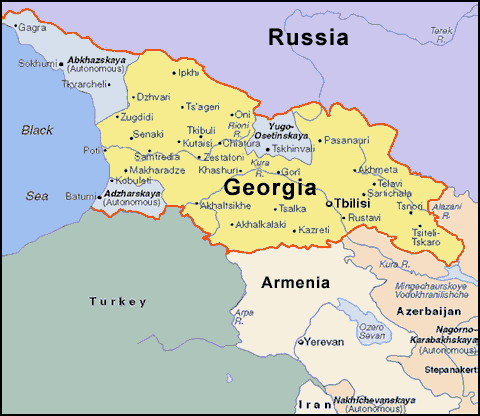 A New York Times article today describes the push in Georgia to put an English teacher in every school and make English, rather than Russian, the required second language. However, while the article mentions the Peace Corps, Teach for America and the South Korean English language effort (probably EPIK) as similar programs, it does not mention JET for some reason.
Here’s the link to the article: http://www.nytimes.com/2011/01/24/world/europe/24georgia.html
JETAA Chapter Beat 1.24.11
JETAA Chapter Beat, JETAA Chapters Comments Off on JETAA Chapter Beat 1.24.11
Freelance writer/editor Jonathan Trace (Fukuoka-ken, 2005-08) takes us on a walk around the JET Alumni community for another edition of JETAA Chapter Beat.
- Shinnenkai – Saturday, January 29th, 6:00 at Shabu-Zen. Celebrate 2011 with some shabu-shabu, good friends, and a raffle.
- Shinnenkai – Saturday, January 29th, 5:00 at Yotsuba Japanese Restaurant in Ann Arbor. Celebrate the new year in style with friends and alumni. Upcoming elections, subchapter issues and other event ideas will also be discussed, so do not miss it.
- Yakiniku BBQ at the Beach – Sunday, January 30th, 11:00 to 2:00 at Shelly Beach in Manly. Spend the day outside with fellow alumni and friends for a BBQ. Suikawari, sun and fun to be had by all.
JETAA New Orleans
- Karaoke Shinnenkai – Saturday, February 12th, 7:00 at Little Tokyo Small Plates and Noodle Bar. Sing, eat, drink and ring in 2011 with the group in New Orleans.
JETAA Minnesota
- Bowling Night – Saturday, January 29th, 8:00 at Memory Lanes. Roll some rocks and catch up with old friends at this fun event.

- Happy Hour – Friday, January 28th, 6:00 at Chizakaya. Kick off the weekend with friends and alumni this Friday.
- Urasenke Tatezome Tea Ceremony – Sunday, January 30th, 12:00 at the Japan Information Center, Consulate General of Japan. The JIC is celebrating 2011 with a traditional tea ceremony.
- Shinnenkai – Saturday, January 29th, 7:00 at Restaurant Riki on 45th St. Join JETAANY for their new year’s celebration. It will be izakaya style food and nomihodai(all you can drink), so don’t miss it.
- Kabuki Club – Sunday, January 23rd, 2:00 at the Oakland Asian Cultural Center. This month’s selection will be the classic “Sukeroku: The Flower of Edo.” A casual Shinnenkai will follow the viewing at a nearby restaurant.

- Annual General Meeting and Shinnenkai – Friday, January 28th, 6:00 to 9:00 at the YWCA Hotel Downtown. Elect new directors and lend your voice to the future of JETAABC, then catch up with friends and alumni at the 2011 Shinnenkai after the meeting.
- Shakuhachi Workshop – Saturday, February 5th, 1:00 to 3:00 at the Roundhouse Community Centre. JETAABC presents a workshop by the renowned Shakuhachi(Japanese bamboo flute) artist and musician, Alcvin Ryuzen Ramos. Learn how to play from the master and enjoy a day of Japanese culture.
- JBook Meeting – Monday, January 24th, 6:30 in the Adams Morgan/U Street Area. Jbook is back for the new year, with this month’s selection being “The Housekeeper and the Professor,” by Yoko Ogawa. The discussion will be followed by a screening of the film, so don’t miss it.
What happened at your chapter’s event? If you attend(ed) any of these exciting events, JetWit would love to hear about them. Just contact Jonathan Trace with any info, stories or comments.
JetWit Society: Japanese royalty at the Museum of Natural History today
Uncategorized Comments Off on JetWit Society: Japanese royalty at the Museum of Natural History today
Just heard from a friend who works at the Museum of Natural History that there is apparently some Japanese royalty visiting the museum right now. No other details at the moment.
Justin’s Japan: NY’s Japan Society Fires Up Sabu Film Retrospective
Article/Journalism, Film, Justin's Japan Comments Off on Justin’s Japan: NY’s Japan Society Fires Up Sabu Film Retrospective

Japan Society's six-film Sabu retrospective begins Wednesday, Jan. 26. (Courtesy of Sabu)
By JQ magazine’s Justin Tedaldi (CIR Kobe-shi, 2001-02) for Examiner.com. Visit his NY Japanese Culture page here to subscribe for free alerts on newly published stories.
This week, New York’s Japan Society presents Run, Salaryman, Run! A Retrospective of Sabu’s Film Works, six slices of cinema packed with high speed, high style, hard luck, and the quirky lusts and lunacies of post-Bubble Japan.
Born Hiroyuki Tanaka in 1964, Sabu is the cult auteur of “punk n’ roll,” alternative comedies, often imitated, never equaled, and far too rarely shown in the U.S. since his 1996 feature debut, Non-Stop a.k.a DANGAN Runner (a film praised by The A.V. Onion Club as “effortlessly clever” and included in this line-up).
In a world of hazards and happenstance, Sabu zeroes in on blue and white collar everymen tossed into dangerously absurd situations from which they desperately try to run. As things speed along, Sabu brings a fresh and frantic twist to traditional film genres (the yakuza film, the thriller, etc.), giving their lean and clean-cropped premises the electroshock treatment and über edgy music scores.
The salute kicks off Wednesday, Jan. 26 with Monster, winner of the FIPRESCI Prize at the 2000 Berlin Film Festival “for its austere, dark wit and keen eye for human foibles.” Other highlights include The Blessing Bell (Netpac Award, 2003 Berlin International Film Festival, Grand Jury Prize, 2003 Cinemanila International Film Festival), and the international premiere of the Japanese auteur’s latest work, the HD-lensed Troubleman.
Sabu has drawn comparisons with Buster Keaton, Johnnie To and Doug Liman, but his satirical jamborees, more than just friendly black comedies, are truly unlike anything else on the silver screen: they are stamina tests, survival riffs, victory rolls.
Click here for the complete story.
New LinkedIn Group: Monbusho English Fellows (MEFs)
Career, Networking Comments Off on New LinkedIn Group: Monbusho English Fellows (MEFs)
Thomas Schalow has set up a LinkedIn group for Monbusho English Fellows (MEFs). MEFs were the forerunners to JETs, and from JetWit’s perspective, are part of the JET alumni community.
Here’s the link: http://www.linkedin.com/groups?mostPopular=&gid=3757582
A little MEF background from Thomas: “The number of MEFs was small. In my year, 1980, for example, there were only 12 MEFs for all of Japan. The program did not run that many years before it morphed into the JET program, so there may be only 100 or so of these MEFs out there.”
