




Fundraising: JETAA Northern California’s Earthquake Relief Efforts
 Earthquake Tsunami, Fundraising, JETAA Chapters
  Comments Off on Fundraising: JETAA Northern California’s Earthquake Relief Efforts
 Via the JETAA Northern California website:
Thank you to everyone who came out to show their support for JETAANC’s Japan Earthquake Relief Benefit on March 23. The event was a great success, raising over $7,000 for Japan! In addition, JETAANC received a donation of over $1,800 from the PiQ Japan Relief Benefit event held in Berkeley on March 21.
JETAA USA announces new Country Representatives
JETAA Chapters Comments Off on JETAA USA announces new Country Representatives
The 2011 Country Representatives are Jessyca Wilcox (2nd term as Country Rep, former JETAA Rocky Mountain Treasurer), Megan Miller Yoo (former JETAA New York President) and Mike Shu (JETAA Northern California, former AJET President).
Congratulations!
Nikki Lindsay
National Elections Officer
Event: 2nd Japanese Heritage Night at Mets Citifield – Tues, June 21
Cultural Outreach, Earthquake Tsunami, Events, Fundraising Comments Off on Event: 2nd Japanese Heritage Night at Mets Citifield – Tues, June 21
Via request of the Consulate General of Japan in New York:
2nd Japanese Heritage Night at Mets Citifield
Please let your members, colleagues, friends and family know that the 2nd Japanese Heritage Night at Mets Citifield will be held on Tuesday June 21st, 2011 when the Mets play the Oakland As with Hideki Matsui in attendance. This is a fundraising event – a portion of each ticket sold through our group will go to Japan relief efforts.
We will be sending out information about Group Sales as soon as the site is set up but this year, seats in three price categories will be grouped together:
- Baseline Box Silver seat =$54.00
- Pepsi Porch seat = $32.00
- Promenade Reserved Infield seat = $19.00
While we understand that not all of you are Mets fans, the Yankees do not provide a Heritage Night and we wanted to have a community event where Japanese and Japanese Americans and all those interested in “things Japanese” could get together and have a good time. We look forward to everyone’s participation again this year.
Last year 400 tickets were purchased. This year, let’s aim for 1,000!
If you are interested in helping out, please contact our organizing committee co-chairs: Ann Harakawa (aharakawa [at] twotwelve.com) or Marianne Yoshioka (mry5 [at] columbia.edu).
Thank you!!
Organizing Committee
Ann Harakawa, Marianne Yoshioka, Gary Moriwaki, Susan J. Onuma, George Hirose
Advisor: Donna Tsufura
WIT Life #164: More notable Nihonjin
Events, Film, Translating/Interpreting, Uncategorized, WIT Life, Writers Comments Off on WIT Life #164: More notable Nihonjin
WITLife is a periodic series written by professional Writer/Interpreter/Translator Stacy Smith (Kumamoto-ken CIR, 2000-03). She starts her day by watching Fujisankei’s newscast in Japanese, and here she shares some of the interesting tidbits and trends together with her own observations.

Interesting article in the NYT today profiling the new head of the M.I.T Media Lab, a 44-year old Japanese venture capitalist named Joichi Ito. Ironically enough, Ito attended both Tufts and the University of Chicago in the past, but didn’t graduate from either as he didn’t like their learning styles. However, his accomplishments include serving on the board of the Internet governance organization Icann and the Mozilla Foundation, and along the course of his career he has invested in more than 12 start-ups such as Flickr and Twitter. In Japan, he helped establish Read More
Surviving in Japan: 6 Ways to Deal with Allergies in Japan
Advice, Blogs, Japan Local, Writers Comments Off on Surviving in Japan: 6 Ways to Deal with Allergies in Japan
Posted by Ashley Thompson (Shizuoka-ken, 2008-2010) of Surviving in Japan: without much Japanese and Lifelines columnist for The Japan Times.

Ashley Thompson is "Surviving in Japan: without much Japanese."
Are you going to Japan, or in Japan, and wondering what to do about your allergies? I know the feeling. I’m allergic to mold and dust mites, which are especially hard to escape in Japan.. Last winter they somehow managed to debilitate me while allowing a little virus to invade my inner ear – labrynthitis. Labryawha? It’s a deep inner ear inflammation. Makes you dizzy, lightheaded and generally unable to move. Some people get vertigo, and motion sickness. Anyway, that all aside the point – you can read the full story here.
*Note: This post is about nasal allergies and rhinitis, rather than food allergies. Please also note I am not a medical professional, and if you have severe allergies you should seek a doctor’s advice and appropriate medication and/or treatment.
Allergies are quite prominent in Japan – with a large number of those suffering primarily from pollen type allergies. So if you too suffer from rhinitis, you will find a very allergy-friendly (so to speak) country in Japan. A few ways to deal:
1. Wear a mask – Folks in Japan wear a mask for a variety of reasons, but most notably to keep allergies in check or to prevent the spread of whatever illness they might currently be carrying. Personally, I avoid wearing the mask because it annoys me, but just saying.
2. Allergy meds – I won’t go into too many specifics, as those with allergies probably already use specific kinds of medicine. My doctor in the U.S. primarily prescribed me Flonase (a nasal spray), which is available in Japan, so if you use Flonase, you can get a prescription here as well (and much cheaper at that, with the national health insurance). Whatever prescription you have in your home country or whatever OTC meds you use, bring the info to a doctor in Japan to find what you need (or a similar alternative). You can also get Claritin by prescription here in Japan. The Japanese pronunciation is: クラリチン.
3. Drink beni fuuki (べにふうき) – a very strong, concentrated green tea. The taste is quite bitter compared with regular green tea, because of the concentration, but studies in Japan have shown that those who drink it have less histamine response – due to the higher number of catechins. Available in supermarkets and online. — CLICK HERE to read the rest of the post.
CLAIR News April 2011
Earthquake Tsunami, Local Government Comments Off on CLAIR News April 2011
Here’s the latest edition of CLAIR News, April 2011. Click here the Japanese edition (PDF).
This edition of CLAIR News contains the following topics:
- Tohoku-Kanto Earthquake and Tsunami
- Tragic News
- New JET Arrivals
- For Returning JETs: Applying for a Partial Refund of Your Pension
- Payments
- Tax Refund on Pension Refund
- Local Inhabitant Taxes
- Proceedures Concerning Status of Residence and Period of Stay
- CLAIR Thanks all TOA Applicants
- AJET Peer Support Group
- Recruitment for Self-Support Group Leaders (SGLs)
- The JET Alumni Association (JETAA)
- ALT Opinion Exchange Meeting
- Japanese Language Courses
- The Local Government Officials Training Programme
- TOA T-Shirt Design Contest
- JET Q&A
- Contracting Organisation Q&A
MOFA Letter of Appreciation to JETAA USA
Earthquake Tsunami Comments Off on MOFA Letter of Appreciation to JETAA USA
Posted at the request of the Consulate General of Japan in New York:
To: JET Programme Alumni Association USA
More than one month has passed since the Great East Japan Earthquake has hit the nation. I extend my heartfelt sympathy to all the people who have suffered as a result of this disaster, both Japanese nationals and non-Japanese including JET Programme participants, and to their families. I especially offer my sincerest condolences to Ms.Taylor Anderson and Mr. Montgomery Dickson, who were the victims of the disaster. I laud their achievement and contribution as JET Programme participants for English education and international exchange activities at the local level. At the same time I express my gratitude to JET Programme participants who have continued to assume their duties in Japan in this difficult time.
I understand that JETAA chapters across the United States of America are working for the earthquake relief efforts in Japan by means of a series events including “JETAA USA Japan Earthquake Relief Fund”. I extend my heartfelt appreciation for such assistance from your organization. I am grateful for the fact that many JET alumni have prayed for Japan and extended support to us. I am deeply impressed by the warm encouragement.
The Government of Japan is currently mobilizing all resources to overcome the situation at Fukushima Daiichi Nuclear Power Station and working hard to stabilize the situation there at the earliest possible date. I would appreciate if those who have been away from Japan following evacuation advice issued by their home country, among other reasons, and also those who hesitate to apply for the JET Programme in this situation in Japan could judge and act calmly based on available information regarding safety in Japan. I would like to point out that the Government of Japan considers that the areas outside the zones for evacuation and staying indoors are safe, and the Government of Japan has required each local authority to restrict the distribution of food products whose radiation doses exceeded the provisional regulation values. The Government of Japan has uploaded the latest information on the websites as follows. I would really appreciate if you could share this message with your JET friends and their possible candidates through your network.
http://www.kantei.go.jp/foreign/index-e.html
http://www.iaea.org/newscenter/news/tsunamiupdate01.html
http://www.nisa.meti.go.jp/english/index.html
http://www.jma.go.jp/jma/en/2011_Earthquake.html
http://www.mofa.go.jp/index.html
http://www.mext.go.jp/a_menu/saigaijohou/index.htm
http://eq.wide.ad.jp/index_en.html
http://www.mhlw.go.jp/english/topics/2011eq/index.html
http://www.mlit.go.jp/en/index.html
http://www.maff.go.jp/e/index.html
There is no doubt that Japan will recover, become vibrant again, and become an even more marvelous country. I strongly believe that Japan will certainly repay, through its contributions to the international community, the cordial assistance from your organization. The Government of Japan will work to the best of its ability to realize the reconstruction of Japan. I appreciate your continued support and cooperation.
To that end, I add my own effort to those of my Government: I extend my best wishes to you for your organization’s future development.
Naoki Murata
Director-General
Public Diplomacy Department
Ministry of Foreign Affairs of Japan
JQ Magazine: JQ&A with Tomoya Suzuki of CLAIR New York’s Japan Local Government Center
Article/Journalism, Interview/Profile, JQ Magazine Comments Off on JQ Magazine: JQ&A with Tomoya Suzuki of CLAIR New York’s Japan Local Government Center

“As a staff member at the JLGC, working with the JET Alumni Association is my first and foremost top accomplishment. I have been able to learn how a volunteer group works in American society, and I am impressed by the alumni’s passion and devotion for its activities to be a bridge between the U.S. and Japan.” (Justin Tedaldi)
By Renay Loper (Iwate-ken, 2006-07). Renay is a freelance writer and international education professional currently seeking FT opportunities. Visit her at Atlas in Her Hand.
I recently had the pleasure of doing a brief Q&A with Mr. Tomoya Suzuki of the Japan Local Government Center (JLGC), CLAIR’s New York branch office dedicated to international exchange and mutual understanding between the U.S. and Japan. Suzuki-san has been working with the JLGC in New York since April 2010 through a temporary overseas assignment with the Tokyo Metropolitan Government (TMG). Suzuki-san lives in New York with his wife and son.
Tell us a little about yourself.
I was born and raised in Chiba Prefecture and moved to Tokyo soon after I started working for TMG. I came to New York for the first time in April 2010, so I have been here for just one year. I am so happy and proud to be living and working in this exciting city!
You are an assistant director at the JLGC. What is your primary focus?
I would say my foci are as a staff member of the JLGC and as a representative of TMG. As a staff member of the JLGC I want to tell Americans, especially local governments, the good points about Japan and its people. As a representative of TMG, I want to facilitate the relationship between Tokyo and New York City, who have one of the oldest sister city relationships—it has been in existence since 1960. Read More
Justin’s Japan: This week’s Nippon in NY events: NY Loves Japan, Japan-a-Mania, Sakura Matsuri
Article/Journalism, Events, Justin's Japan Comments Off on Justin’s Japan: This week’s Nippon in NY events: NY Loves Japan, Japan-a-Mania, Sakura Matsuri
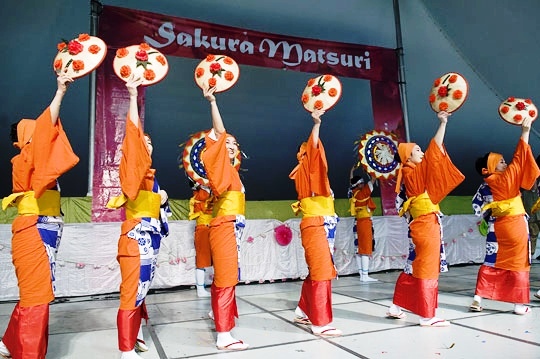
The Japanese Folk Dance Institute of New York joins a superb lineup of peformers at the Sakura Matsuri festival at Brooklyn Botanic Garden this weekend, April 30-May 1. (Jason Gardner)
By JQ magazine editor Justin Tedaldi (CIR Kobe-shi, 2001-02) for Examiner.com. Visit his page here to subscribe for free alerts on newly published stories.
After all those April showers, it’s finally starting to feel like spring. And what better way to welcome those May flowers than with these events, capped off with the 30th(!) annual edition of a Brooklyn Botanic Garden classic.
Wednesday, April 27, 2011, 7:00 p.m.-10:00 p.m.
269 11th Avenue (between 27th and 28th Streets)
Tickets: $100 general admission/$175 VIP (click here for VIP details)
The New York Sake and Japanese Food Community has joined together with non-profit volunteer organization Project by Project to organize a fundraising event to support disaster relief in Japan in the wake of the Tohoku earthquake and tsunami. New York’s leading Japanese food and sake distributors, chefs, restaurants (including Bao Noodles, owned by JET alum Chris Johnson (Oita-ken, 1992-95), who also helped organized the event), food writers, public relations companies, and cooking schools have come together to form NY Loves Japan. Help spread the word through their Twitter and Facebook pages as well.
Saturday, April 30, 12:30 p.m.-4:30 p.m.
Japan-a-Mania
Big Brothers Big Sisters of New York City
223 E 30th Street (between 2nd and 3rd Avenues)
Free to volunteer. RSVP to Katrina Barnas
Back by popular demand! Join fellow members of the JET Program Alumni Association of New York as they teach NYC kids about Japanese culture in partnership with Big Brothers Big Sisters and NY de Volunteer. Step up to show off your origami, katakana or kimono-tying skills, or help with crowd control and meet new friends. Last year’s event drew over 60 kids with their bigs, and even more are expected this year. Also welcome are planners and anyone who can provide contacts for or perhaps lead a karate demonstration.
Saturday, April 30-May 1, 11:00 a.m.-6:00 p.m.
Enter at 900 Washington Avenue (between Crown and Carroll Streets)
Tickets: $10/$15 general admission; free for children under 12 and BBG members
During this season celebrating its historic relationship to Japanese culture and horticulture, the Garden reflects on the recent tragic events in Japan, and invites visitors to find opportunities for contemplation amidst its flowering cherries, Japanese Hill-and-Pond Garden, the bonsai exhibition Graceful Perseverance, and more. Visitors will be invited to make an origami crane that will eventually join thousands of others sent to Japan as a gesture of support and unity.
Click here to learn more about the events.
2012 Japanese Government Scholarships
Academic Comments Off on 2012 Japanese Government Scholarships
via PNW JETAA. Posted by Dipika Soni (Ishikawa-ken, 2003-06). Dipika currently works as an in-house translator for PFU (a Fujitsu company) in Kahoku-shi, Ishikawa-ken. She is also the vocalist for the Japanese hardcore punk band DEGRADE.
*Note: If you apply for this position, please let them know you learned of it from JetWit. Thanks.
———————————————————————————————————————————-
The Consulate-General of Japan in Seattle is now accepting applications for the following 2012 Japanese Government Scholarships for studying in Japan.
Job: TV Producer (Washington DC)
Jobs Comments Off on Job: TV Producer (Washington DC)
via JETAA DC. Posted by Dipika Soni (Ishikawa-ken, 2003-06). Dipika currently works as an in-house translator for PFU (a Fujitsu company) in Kahoku-shi, Ishikawa-ken. She is also the vocalist for the Japanese hardcore punk band DEGRADE.
*Note: If you apply for this position, please let them know you learned of it from JetWit. Thanks.
———————————————————————————————————————————-
Job Position: TV Producer (Washington DC)
Job Details:
After five years in this position, it’s time for me to move on, but I promised my company I would do my best to help them find my replacement. I can’t say enough about how grateful I am for the experiences I’ve had while working here. This is a great job for someone who wants to keep their connection to Japan alive on a daily basis and keep their finger on the pulse of what’s happening in Washington.
—Strader Payton, ALT (Gunma, 2001-03)
Job: Broadcast Coordinator (Tokyo)
Jobs Comments Off on Job: Broadcast Coordinator (Tokyo)
via TVT. Posted by Dipika Soni (Ishikawa-ken, 2003-06). Dipika currently works as an in-house translator for PFU (a Fujitsu company) in Kahoku-shi, Ishikawa-ken. She is also the vocalist for the Japanese hardcore punk band DEGRADE.
*Note: If you apply for this position, please let them know you learned of it from JetWit. Thanks.
———————————————————————————————————————————-
Job Position: Broadcast Coordinator (Tokyo)
Job Details:
As a Broadcast Co-ordinator you will play a vital role in ensuring the overall success of a BBC based project. Reporting to the Operations Manager you will be part of the team responsible for the Japanese versioning of live news and current affairs programming.
Read More
Job: Part Time Language Teacher (Long Island)
Jobs Comments Off on Job: Part Time Language Teacher (Long Island)
via JETAA NY . Posted by Dipika Soni (Ishikawa-ken, 2003-06). Dipika currently works as an in-house translator for PFU (a Fujitsu company) in Kahoku-shi, Ishikawa-ken. She is also the vocalist for the Japanese hardcore punk band DEGRADE.
*Note: If you apply for this position, please let them know you learned of it from JetWit. Thanks.
———————————————————————————————————————————-
Job Position: Part Time Language Tutor, Long Island
Job Details:
Global LT, Inc., an international language training company, is looking for part time, private Japanese language tutors.
How to apply:
Global LT, Inc. welcomes resumes of Japanese language tutors for part time teaching in New York state, New Jersey, Connecticut, etc. Please contact: ptucker@global-lt.com Website: www.global-lt.com
Job: Part Time Language Teacher (NJ)
Jobs Comments Off on Job: Part Time Language Teacher (NJ)
via JETAA NY . Posted by Dipika Soni (Ishikawa-ken, 2003-06). Dipika currently works as an in-house translator for PFU (a Fujitsu company) in Kahoku-shi, Ishikawa-ken. She is also the vocalist for the Japanese hardcore punk band DEGRADE.
*Note: If you apply for this position, please let them know you learned of it from JetWit. Thanks.
———————————————————————————————————————————-
Job Position: Part time language tutor needed (Japanese speaking English tutor)
Job Details:
How to apply
Please contact: yokose01@diary.ocn.ne.jp
Sake and Chefs Tasting to Benefit Relief Efforts in Japan (NYC)
Earthquake Tsunami, Events, Food & Drink, Fundraising, Notable JET Alums Comments Off on Sake and Chefs Tasting to Benefit Relief Efforts in Japan (NYC)
I believe two JET alum sake experts, John Gauntner and Chris Johnson, are involved with the group that is organizing this event — New York Loves Japan: Sake and Chefs Tasting to Benefit Relief Efforts in Japan — which takes place Wednesday, April 27.

