




***************
This editorial in support of the JET Programme by Hitoshi Tanaka appeared originally in Japanese in The Mainichi Daily News. Thanks to Jim Gannon (Ehime-ken, 1992-94), Executive Director of the Japan Center for International Exchange (JCIE/USA), for sharing the article. And special thanks to Laura Kamutaka (CIR Miyagi-ken, Shiogama-shi, 2005-07) for translating it into English.
Don’t Cut Funding of Grassroots Exchange: Earthquake reveals and affirms overseas bond
http://www.jri.co.jp/MediaLibrary/file/report/tanaka/pdf/5570.pdf
Tanaka Hitoshi, Chairman, Institute for International Strategy, Japan Research Institute
The Tohoku earthquake swallowed many lives and left many missing. The unimaginable hardship of the disaster victims weighs heavily on our hearts, and many of us have a strong desire to help with this tragic situation. People who want to take action beyond making a charitable donation. People who want to work together with the disaster victims in any capacity, no matter how small the achievement. Some of those around me set up a nonprofit called Hope for Tomorrow to assist high school students affected by the earthquake, of which I’ve become a representative.
”Hope for Tomorrow” is designed to not only assist the students advancement but to help develop their language skills as well. There’s a reason for this. One of the tsunami victims was Taylor Anderson, an Assistant Language Teacher in Ishinomaki City of Miyagi Prefecture who taught English at both elementary and junior high schools. After the earthquake, the 24-year-old Virginia, US native worked to ensure her students’ safety and, in doing so, lost her life. In honor of her memory, Anderson’s parents have been collecting US donations with the intention of sending them to Japan to help restore school in Ishinomaki.
Anderson was in Japan through the JET Program, a Japanese government program that invites international youth to help Japanese students with foreign language instruction. After 24 years of existence, the program currently boasts over 4,000 participants from 36 countries, with over half coming from the United States. Most participants stay in Japan from two to three years, teach elementary to high school-level Japanese students, and maintain a strong bond with Japan even after returning to their home countries.
Ten years ago when I served as the Consulate General in San Francisco, I spoke with both JET participants who were about to leave for Japan and those that had recently returned. I remember those that returned all spoke passionately of their experiences and had great affection for Japan.
Even the JET participants’ response to the earthquake is remarkable. The JET Alumni Association has chapters across the country working to fundraise for relief efforts. There are those such as Stuart Harris, a JET participant in Iwate prefecture in 1989 who assembled a team of doctors right after the earthquake to provide relief to Japan. JET participants currently in Japan have also collected donations and vigorously volunteered to the relief effort.
Of course, it isn’t only the JET participants that have shown compassion towards Japan. A friend of mine who married an American found a network of people on Facebook, leading them to New York’s Union Square to collect donations less than a week after the earthquake. Passersby would donate cash and in no time more than $10,000 had been raised. We need to protect these precious bonds that transcend national lines.
Unfortunately, this kind of grassroots exchange has been decreasing each year. The number of JET participants has gone from 6,000 participants 10 years ago to 4,000. The Democratic Party of Japan has included the JET program in its budget cuts. From a financial standpoint alone, it seems counterintuitive to shrink a program that yields such positive results.
It is easy to see the Japan-US ties mainly through the relationship between the two governments. But that’s not true. Grassroots exchange is what sustains the important bond between the two countries and is something we must never forget.
Japanese students from Taylor Anderson and Monty Dickson’s towns in to visit U.S. as “envoys”
 Cultural Outreach, Earthquake Tsunami, JETs in the News
  Comments Off on Japanese students from Taylor Anderson and Monty Dickson’s towns in to visit U.S. as “envoys”
Thanks to Andy Anderson, father of Taylor Anderson, for forwarding this article from The Mainichi Daily News:
http://mdn.mainichi.jp/mdnnews/news/20110712p2g00m0dm004000c.html
16 students from quake-hit prefectures to visit U.S. as ‘envoys’
FUKUSHIMA, Japan (Kyodo) — A total of 16 junior and senior high school students from the three prefectures severely affected by the March 11 earthquake and tsunami will visit the United States next month at the invitation of the U.S. government to serve as teen envoys delivering the voices of those affected by the disaster, according to prefectural officials and other sources.
Ten of the 16 were selected from junior high schools in Rikuzentakata, Iwate Prefecture and Ishinomaki, Miyagi Prefecture, where two Americans, Montgomery Dickson, 26, of Alaska and Taylor Anderson, 24, of Virginia, fell victim to the tsunami while serving as assistant language teachers, they said.
From Fukushima Prefecture, which hosts Tokyo Electric Power Co.’s crisis-hit Fukushima Daiichi nuclear power plant, a group of six senior high school students will join. The six boys and girls currently attend school as evacuees and include members of a baseball team.
A consul in charge of the three prefectures and other areas at the U.S. Consulate General in Sapporo said the program is intended to encourage Japanese youth and will be an opportunity for American students to learn about the disaster from them and understand why it is necessary to give support.
Under the plan, the 16 will stay in Pennsylvania and other locales for two weeks starting Aug. 10, with the United States covering travel and accommodation expenses.
Their itinerary includes practicing baseball and softball with American teens and meeting with Cal Ripken Jr., who played in a record 2,632 consecutive major league games.
Dickson was teaching until the day of the disaster, according to sources including the Council of Local Authorities for International Relations, which dispatches assistant language teachers under the Japan Exchange and Teaching Program. Dickson was at the city’s education board when the tsunami struck and was swept away with its building, they said.
Anderson stayed with her elementary school pupils until their guardians came to pick them up before heading home on a bicycle, they said. It is believed she was struck by the tsunami on her way, they said.
The trip participants include five female junior high school students who were taught English by Anderson.
“This is an exchange project to honor the two who died while on their way to accomplish their goals, and we are grateful to the U.S. government,” said an official at the council. “We hope that the students will have exchanges with many people in the United States,” the official said.
(Mainichi Japan) July 12, 2011
Volunteer translators needed for JET alumni Japan disaster relief project
Earthquake Tsunami, Fundraising, Return on JET-vestment, Translating/Interpreting, Volunteer Comments Off on Volunteer translators needed for JET alumni Japan disaster relief project
We may need a team of professional-level translators to help with an upcoming JET alumni project related to disaster relief efforts in Japan. Timing would likely be late September and October.
If interested, please e-mail Steven at jetwit [at] jetwit.com with “Translator” in the subject heading. No commitment necessary right now.
Reminder: You can also click here to join the JET Alumni Translators & Interpreters LinkedIn group.
Background:
Apologies for lack of detail at this point as the project idea is still in the process of being thought through by a couple JET alumni well-placed to set this up.
But the idea, generally speaking, relates to the fact that Japan’s non-profit/civil society sector and culture tends to be less established compared to that of the U.S. In the wake of the Tohoku earthquake/tsunami, many new Japanese organizations have formed and many existing small ones have taken on new roles and responsibilities.
One area they apparently tend to lack is familiarity with grant seeking and applying for grants. There are a number of U.S. foundations and other organizations that have been raising money but have struggled in trying to figure out how to get it to the organizations that could really use it. Part of the obstacle appears to be the grant making process. Grant making organizations tend to need to track and account for how money is doled out and used. And the application and reporting process are key.
Translation of many of these documents into English would of course be a key step for helping U.S. organizations in their efforts to communication with Japanese grant seekers. And this is of course a potentially significant way for the JET alumni community to continue to serve as a bridge to Japan.
Please contact Steven at jetwit [at] jetwit.com if potentially interested in helping.
Yoroshiku!
WIT Life #177: 子ども手当から児童手当へ
Translating/Interpreting, WIT Life, Writers Comments Off on WIT Life #177: 子ども手当から児童手当へ
WITLife is a periodic series written by professional Writer/Interpreter/Translator Stacy Smith (Kumamoto-ken CIR, 2000-03). She starts her day by watching Fujisankei’s newscast in Japanese, and here she shares some of the interesting tidbits and trends together with her own observations.
It’s been a bit of hisashiburi since I’ve written here, but it’s nice to be back. Recently our government has seen its share of wrangling regarding the debt ceiling issue, and there has been similar discord among Japan’s political parties regarding the 子ども手当 (こどもてあて, kodomo teate)or child allowance. Originally one of the DPJ’s key campaign pledges and put into law in April 2010, it granted a uniform 13,000 yen per month to parents with children up to the age of fifteen. However, it has just been announced that in order to prioritize financial resources for the country’s recovery, it will be eliminated in October when it expires.
Next April, this allowance will be replaced by Read More
JQ Magazine: Book Review – ‘The Beautiful One Has Come,’ short stories by JET alum author Suzanne Kamata
Article/Journalism, Books, JQ Magazine, Reviews Comments Off on JQ Magazine: Book Review – ‘The Beautiful One Has Come,’ short stories by JET alum author Suzanne Kamata

“The stories in The Beautiful One Has Come have a universal appeal but will strike a familiar note in particular with those who have spent considerable time outside their comfort zones.” (Wyatt-MacKenzie Publishing)
By Sharona Moskowitz (Fukuoka-ken, 2000-01) for JQ magazine. Sharona works at a literary agency in New York City. She is interested in fresh, new voices in fiction and creative nonfiction.
I began reading Suzanne Kamata (Tokushima-ken, 1988-1990)’s new collection of short stories with no idea what to expect and a sense of up-for-anything enthusiasm. Luckily, that feeling stayed with me throughout the collection and renewed itself automatically as I approached each new story.
There’s an enjoyably uncomfortable tension contained within the pages of The Beautiful One Has Come and it’s precisely that tension, paired with Kamata’s ability to glide between narrative points of view, that makes this collection so strong. The characters who inhabit the pages feel so true I could practically hear their pulses.
The physical settings of the stories vary from Cuba to Egypt to France to Japan among other countries, but the characters seem to inhabit spaces all their own: their minds are the true sites of conflict. The stories deal mostly with women in various states of transition; feeling like outsiders while negotiating their own identities, striving for something just out of reach, or trying to come to terms with loss. There is the foreign housewife who longs for the comforts of her native land, the elderly artist whose husband wrongfully gets the credit for the paintings she has created and the Japanese girl who is obsessed with studying abroad in Egypt.
Though these profiles might sound familiar, each story is buoyed by unique and unexpected details which keep the characters from sinking into stereotypes.
JET alumni to revisit Tohoku to help boost tourism
Earthquake Tsunami, JETs in the News, Notable JET Alums, Return on JET-vestment, Travel/Tourism, Volunteer Comments Off on JET alumni to revisit Tohoku to help boost tourism
———————
Via Mainichi Daily News:
http://mdn.mainichi.jp/mdnnews/news/20110729p2g00m0dm010000c.html
JET alumni to revisit Tohoku to help boost tourism
(photo caption: Greg Lekich and other volunteers are pictured in Tagajo, Miyagi Prefecture, on April 20. (Photo courtesy of Greg.))
TOKYO (Kyodo) — About 20 former English teachers and international relations coordinators at local government offices will revisit places in northeastern Japan, where they used to work, on a Japanese government program aimed at boosting tourism affected by the March 11 quake and tsunami, Japanese officials said Thursday.
As the first batch of the program participants, 14 alumni of the Japan Exchange and Teaching Program from Australia, Britain, Canada and the United States will make a weeklong visit to places of their former assignments in Iwate, Miyagi and Fukushima prefectures from Monday, they said.
The participants are required to write about their experiences and impressions of the current situation in the Tohoku region in their contributions to the media, including social networking sites Facebook and Twitter, the officials said.
The program will last for two months and the Japanese government is shouldering travel expenses for the JET alumni.
(Mainichi Japan) July 29, 2011
Surviving in Japan: What is “Calorie Off” and Why Should You Care?
Advice, Blogs, Food & Drink, Writers Comments Off on Surviving in Japan: What is “Calorie Off” and Why Should You Care?
Posted by Ashley Thompson (Shizuoka-ken, 2008-2010) of Surviving in Japan: without much Japanese and Lifelines columnist for The Japan Times.
My time in Japan so far has seen many changes, as to be expected, and most have been gradual. One such change has been the increasing prevalence of “calorie off” drinks. When I first arrived I remember this option being available, but as the years have gone by some of my favorite beverages converted completely to “calorie off”, including my beloved lemon Mitsuya Cider… (I like CC Lemon too, but I prefer Mitsuya Cider).

Now, just browsing at the local コンビニ (convenience store), it is more difficult to find carbonated (and some non-carbonated) beverages that aren’t “calorie off.” Not that I drink much else aside water in general (and occasionally 100% juice or tea), but even if some new, “limited edition” beverage looks interesting to try I often don’t because it is, of course, “calorie off.”
So, what is “calorie off”? — CLICK HERE to read the rest of the post.
******************
Thanks to Japan Society of Boston President Peter Grilli for passing this on:
July 19, 2011
The Maureen and Mike Mansfield Foundation
and
The Japan Foundation Center for Global Partnership
Announce Recruitment for the Second Group of Participants for the
“U.S.-Japan Network for the Future” Program
[JETwit note: FYI, JET alum David Boling was recently appointed Deputy Executive Director at the Mansfield Foundation.]
The Maureen and Mike Mansfield Foundation and the Japan Foundation Center for Global Partnership, after a successful inaugural program, are pleased to announce the recruitment of a new group of participants for the “U.S.-Japan Network for the Future” program. This program was launched in 2009 to foster a new generation of Japan specialists. The inaugural group of fifteen Network participants has met regularly throughout 2010 and 2011 to build their knowledge of Japan, their policy expertise, and their contacts in Japan-related policy circles. The Foundation and CGP are pleased to make this opportunity available to a second group of emerging Japan specialists.
Purpose of the Program
The purpose of the “U.S.-Japan Network for the Future” program is to identify American professionals who demonstrate an interest in and potential for becoming Japan specialists and policy intellectuals and to support them in this effort. The network will include Japan specialists from all regions of the U.S. with diverse expertise and perspectives and the ability to participate constructively in the bilateral policymaking process and to contribute to U.S.-Japan understanding. The program seeks to nurture a new generation of scholars and professionals working on the following policy areas: U.S.-Japan security relations; U.S.-Japan economic relations; regional cooperation; issues where the two countries confront common domestic challenges (such as aging societies or income inequality); and issues where the two countries have opportunities to work together to resolve global challenges (such as climate change or food security).
Eligibility and Terms
Applicants must be American citizens or permanent residents who are currently and actively involved in the U.S.-Japan dialogue and have a working knowledge of the Japanese language, The program is targeted at scholars with a professional interest in Japan, and professionals who have a strong engagement with Japan and who have work experience in policy-relevant fields. In addition to having an interest in public policy, successful applicants will be able to demonstrate their interest in and potential for becoming future leaders in the U.S.-Japan relationship.
Because we are seeking to identify a future generation of leaders, our preference is for candidates in the mid-career stage. In the academic context, normally this translates into scholars at the advanced assistant or early associate professor levels. Policy professionals should have a Master’s degree and at least five years of Japan and Asia experience.
Participants must be fully dedicated to the two-year program and able to participate in all scheduled meetings. Network participants will be expected to participate in: a two-day workshop in Washington, D.C. (January 2012); a week-long meeting in Washington, D.C. (June 2012); a two-day retreat in Montana (autumn 2012); a week-long Japan study trip (June 2013); and a January 2014 public symposium and current issues panel discussions.
Throughout the two-year program, participants will be expected to: develop their network of contacts; engage with other Network members; engage others in the academic and policy fields with what they have learned about Japan; prepare for and actively participate in the program’s meetings, workshops, and study trip; participate in group activities and support the program’s larger goals and objectives; conduct independent research on key issues of particular interest to them; produce op-ed pieces and commentary/blog posts on important policy issues in U.S.-Japan relations; and produce and seek to publish or otherwise disseminate a brief policy paper. Network participants will present their papers and discuss current issues in the region during the last meeting, the January 2014 public symposium in Washington, D.C.
Financial support for those selected is limited to coverage of travel, accommodations, and meal expenses associated with participation in program meetings and study trips. Program participants may be eligible to compete for cash awards contingent upon publication of their pieces.
Applications and Selection
For an application and application instructions, please go to: http://www.mansfieldfdn.org/programs/networkforthefuture.htm.
Applications are due October 3, 2011 and can be submitted electronically to hr@mansfieldfdn.org or by mail to: The Maureen and Mike Mansfield Foundation, 1401 New York Avenue, NW, Suite 740, Washington, D.C. 20005. Applications will be reviewed by a selection committee and participants will be announced by mid-November, 2011. The Foundation and CGP will select up to fifteen Network participants for this program.
For further information, please contact Sam Dundon, Program Associate, The Maureen and Mike Mansfield Foundation, (202)-347-1994.
Organizers
The Maureen and Mike Mansfield Foundation is a 501(c) 3 organization that promotes understanding and cooperation in U.S.-Asia relations. Maureen and Mike Mansfield’s values, ideals and vision for U.S.-Asia relations continue through the Foundation’s exchanges, dialogues, research and educational programs, which create networks among U.S. and Asian leaders, explore the underlying issues influencing public policies, and increase awareness about the nations and peoples of Asia. The Foundation has offices in Washington, D.C.; Tokyo, Japan; and Missoula, Montana. Please visit the website at http://www.mansfieldfdn.org/
The Center for Global Partnership (CGP) is a part of the Japan Foundation which is a Japanese Independent Administrative Institution (Dokuritsu Gyosei Hojin). To enhance dialogue and interchange between Japanese and U.S. citizens on a wide range of issues, CGP operates grant programs as well as self-initiated projects and fellowships. CGP has offices in Tokyo, Japan and New York, New York. Please visit the website at http://www.cgp.org
Japan America Society Round-up 7.28.11
Japan Society Round-up Comments Off on Japan America Society Round-up 7.28.11
JET alum Gail Cetnar Meadows (ALT, Hiroshima-shi 2007-10), co-founder of Hiroshima JET webzine the Wide Island View, shines a light on some of the upcoming events of Japan America Societies…
 26th Annual Berkeley Kite Festival — Experience the excitement and artistry of modern kite flying at this festival to celebrate the renewal of life and the confirmation of community spirit. Special guests include the Sode Cho Kite Team of Hamamatsu, Japan. This event, which is free and open to the public, features the Japanese-Style Rokkaku Kite Battle for the Skies as well as free kite making and a candy drop for kids.
- Date: July 30-31
- Time: 10 a.m. to 5 p.m.
- Place: Cesar E. Chavez Park at the Berkeley Marina
- For more information: click here.
 Radio broadcast of “Letters from Sendai” — Here is one radio broadcast you won’t want to miss. KERA News is broadcasting a continuing series titled “Letters from Sendai,” featuring letters written by earthquake survivors. Volunteers with the Japan Society helped collect the letters from people in Sendai, translate them into English and record readings of them at the KERA studio. The next installment will air Aug. 1 on 90.1 FM. You can hear it during Morning Edition (6:30-8:30 a.m,) and All Things Considered (4:30-6:30 p.m.). The approximate times will be 6:30 a.m., 8:30 a.m., and 5:20 p.m. For links to podcasts of previous broadcasts from the series, click here.
 Colorado-Yamagata 25th Anniversary Celebration Luncheon — JASC will host a luncheon to celebrate 25 years of exchange between Colorado and Yamagata this August. A delegation of eight from Yamagata, including Vice Governor Takashi Takahashi and Kozo Taira, Chairperson of the Yamagata Prefectural Assembly, will visit Colorado in celebration of the 25th anniversary of the sister-state relationship between Colorado and Yamagata Prefecture. The keynote speaker will be Ichiro Fujisaki, Japanese Ambassador to the United States.
- Date: Saturday, Aug. 6
- Time: Registration starts 11:30 a.m., luncheon at noon
- Place: Brown Palace Hotel, Grand Ballroom, 321 17th St., Denver
- For more information: click here.
Does your Japan America Society have an upcoming event that you’d like to share with JetWit readers? Email Gail the info at gail (at) jetwit (dot) com.
Former Yankee pitcher Hideki Irabu dies in apparent suicide; JET alum served as his translator
Celebrity, Japan Trends, Notable JET Alums, Translating/Interpreting Comments Off on Former Yankee pitcher Hideki Irabu dies in apparent suicide; JET alum served as his translator
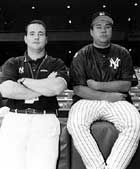
JET alum George Rose (left) in his role as translator for Hideki Irabu (right).
**************
Former star pitcher Hideki Irabu was apparently found dead in his apartment by friends.
Notably, former JETAA New York President George Rose had served as Irabu’s translator during his time with the Yankees when they won the World Series.
Rest in peace, Irabu-san. Thanks for the memories and for doing your part to bridge the culture gap.
JET alum Rob Cornilles considers second shot at Congress following David Wu resignation
Celebrity, JETs in the News Comments Off on JET alum Rob Cornilles considers second shot at Congress following David Wu resignation
This article in the Beaverton Valley Times about the David Wu sex scandal and resignation mentions JET alum Rob Cornilles as one of the Republicans who may run for the vacancy. Rob lost to Wu in the last election with 42% of the vote.
http://www.beavertonvalleytimes.com/news/story.php?story_id=131181238478965800
Video: Panel discussion with JET alums Anthony Bianchi, Laurel Lukaszewski and Jim Gannon
Career, Celebrity, Interview/Profile, Notable JET Alums, Return on JET-vestment, Video Comments Off on Video: Panel discussion with JET alums Anthony Bianchi, Laurel Lukaszewski and Jim Gannon
Thanks to JET alum and Inuyama City Council Member Anthony Bianchi (Aichi-ken, Inuyama-shi, 1988-89) for sharing the video below (in four parts) taken by his son Matthew of a panel discussion from the JETAA USA National Conference held in Washington, D.C. July 14-17.
The panel featured Bianchi along with fellow JET alums Laurel Lukaszewski (Kagoshima-ken, 1990-92) (sculptor artist and former Executive Director of the Japan-America Society of Washington, D.C. as well as former President of Pacific Northwest JETAA) and Jim Gannon (Ehime-ken, 1992-94), Executive Director of the Japan Center for International Exchange (JCIE/USA), and was moderated by JETwit publisher Steven Horowitz (Aichi-ken, Kariya-shi, 1992-94).
Part 1
Part 2
Part 3
Part 4
JET alum Congressional candidate to assume post at Mansfield Foundation previously held by JET alum
Celebrity, Notable JET Alums, Return on JET-vestment Comments Off on JET alum Congressional candidate to assume post at Mansfield Foundation previously held by JET alum
The below announcement was recently sent out by JET alum David Boling, former U.S. Attorney who ran for Congress in Arkansas in the Democratic primary in the last election. David will be the new Deputy Executive Director of the Maureen and Mike Mansfield Foundation which, among other things, manages the Mike Mansfield Fellowship Program, a Congressionally established professional exchange for mid-level federal government employees.
Notably, the position was previously held for 16 years by JET alum Paige Cottingham-Streater who recently was appointed Executive Director of the Japan-US Friendship Commission, a federal agency that provides grants for research, training and exchange with Japan. Paige, who was one of the founders of the JET Alumni Association in 1989, also recently spoke at the JETAA USA National Conference in Washington, D.C. on a panel moderated by former Monbusho English Fellow (i.e., pre-JET) Michael Green who previously served as special assistant to the president for national security affairs and senior director for Asian affairs at the National Security Council (NSC) from January 2004 to December 2005.
Here’s the announcement:
Dear Friends
First, I want to tell you how much I appreciate your support for my race for Congress in 2010. Your friendship and trust is something I treasure. I truly love Arkansas and want to do all that I can to serve the great people of Arkansas.
As you know I have been considering another run for U.S. Congress in 2012. It would have been a difficult race, but I believe that I could have won. I believe that the Second District is winnable for the Democratic Party in 2012. Another opportunity, however, has been offered to me that I feel is right for me and my family at this time.
Today I am excited to tell you that I have accepted a position with the Maureen and Mike Mansfield Foundation as Deputy Executive Director. The Foundation, based in Washington DC, is a nonprofit organization that promotes understanding and cooperation among the nations and peoples of Asia and the U.S. One of my responsibilities will be to oversee the Mansfield Fellows. You may remember that I was a Mansfield Fellow earlier in my career.
During my campaign for Congress at one of the candidate debates I was asked to name my political hero. I responded that two people are my political heroes: Vic Snyder and Mike Mansfield. Everyone knew Vic Snyder. Fewer knew Mike Mansfield.
Mike Mansfield was a miner from Montana who after serving in World War II finished high school and then college. With the support of his wonderful wife,
Maureen, he went on to serve in the U.S. Congress and U.S. Senate. He was the Senate Majority Leader from 1961-1977 and was U.S. Ambassador to Japan for both Presidents Carter and Reagan. He died in 2001 at the age of 98.I had the good fortune to work for Vic Snyder for nearly three years and now I am delighted to have the chance to work for the foundation that honors Maureen and Mike Mansfield’s legacy.
My family and I are embarking on a new adventure in our lives. We promise to stay in touch and we ask that you do the same.
Thank you again for everything.
All the best,
David
Justin’s Japan: Interview with Billy Sheehan of Mr. Big on Touring Tohoku
Article/Journalism, Interview/Profile, Justin's Japan Comments Off on Justin’s Japan: Interview with Billy Sheehan of Mr. Big on Touring Tohoku

Billy Sheehan, right, with Mr. Big: "We had raised about $100,000 for the earthquake relief, and there’s still more to be raised, too. In the end, we raised a bunch of money, and we got a special letter from the Japanese Embassy in Washington, D.C. thanking us for being there." (William Hames)
By JQ magazine editor Justin Tedaldi (CIR Kobe-shi, 2001-02) for Examiner.com. Visit his page here for related stories.
One of the most respected bassists and gentlemen in the music world, Billy Sheehan is back with Mr. Big, the Los Angeles-based rock band he formed in 1988 best known for the hit ballad “To Be with You,” which shot to number one in 15 countries, including the U.S., in 1992. After splitting a decade later, in 2009 the original lineup reformed, followed by the release of What If…, the first album in 15 years from the original lineup.
Now, American fans are finally going to get a chance to see Billy, Paul Gilbert, Eric Martin and Pat Torpey together on stage since their ’90s heyday for a month-long American tour beginning Saturday (July 30) at San Diego’s 4th & B. In this exclusive interview, I spoke with Billy on Mr. Big’s current jaunt around the world, their triumphant return to Japan (where the band is revered), and the possibility of another album from the guys.
So far this year Mr. Big has played all over Europe, Asia and South America. What have your highlights been?
Japan is always amazing. The most difficult thing about touring is getting to and from the gigs…once we’re onstage, there’s no trouble at all, and in Japan, it’s just a breeze. We don’t fly in much, and take a lot of bullet trains, which are super convenient and easy and clean and safe and fast and everything. So Japan is always easy. The rest of Southeast Asia was actually pretty cool, too. We were supposed to do two shows in China, but the Shanghai show got cancelled because the promoters had the wrong visa for us. The shows in Korea, Taiwan and the Philippines were unbelievable, and in Taiwan we actually had to speed away from the venue in a van with literally crowds of people chasing after us (laughs). It was hilarious.
Mr. Big toured Japan less than one month after the earthquake and tsunami, and even did gigs in Iwate and Miyagi Prefectures, the areas most affected by the devastation. What was that experience like?
Really touching. There was a [camera] crew meeting us at the airport and then following us around, and we didn’t know, but they went out in the crowd and interviewed a lot of people, so later on we saw that they had interviewed a guy…I think he was from Sendai. They interviewed him for television, and we didn’t see it until we saw the show. He’d lost everything, and a couple of friends and family, and he’d lost his entire Mr. Big collection, so he actually came to the show to start his collection over again. And I’m telling you, it was so touching, this poor guy, that in his life, the important thing was to come and get his music back together again, really amazing. We had raised about $100,000 for the earthquake relief, and there’s still more to be raised, too—I just saw another $22,000, and I have to see what the figures are for the downloads of the special song we did [“The World Is on the Way”], also, so there’s a bunch more, too.
In the end, we raised a bunch of money, and we got a special letter from the Japanese Embassy in Washington, D.C. [signed by Ambassador Ichiro Fujisaki] thanking us for being there. We didn’t know how it would go when we went there, was it too soon or not, but [remember] after 9/11, where after the dust cleared, all the playhouses and restaurants were going out of business because nobody was going to New York City, so what helped was that going to see a show and having dinner to help the economy rolling again, so we were hoping to get that idea happening. We heard from saké dealers that were going out of business because nobody was drinking because they were all in mourning, you know? It’s a shame that so many lives were lost, but one of the most important things after anything like that is to get back up on your feet again. So I think we helped a bit—I’m cautiously optimistic to say I think we helped a bit. And from the tone of the e-mails and speaking with people after the show, we’re very pleased. So it all ended good.
Was there any hesitation at all about playing those gigs because of the radiation?
For me, no. A couple of the guys in the band were a little concerned about it. I fly transoceanic all the time [across] the Pacific, and you get a dose of radiation every time you do that. I think it’s equivalent to—I forget the figure—one, two or three chest X-rays just by flying over the ocean. And I do know that radiation, to incite fear in people, is almost second to none, you know? It’s invisible, and you don’t know it’s there and the next thing you know, you’ve got a problem. So I knew that there was probably some elevated degree of danger, but I also know that most things of that nature are over-exaggerated, in my experience with my own personal catastrophes of earthquakes and whatever else. They really do overblow it.
So I wasn’t worried personally, but we were more concerned for the fans, and I know that the Japanese government is very conscientious with their safety and rules. I remember I was in Tokyo one time, and there was a typhoon warning for everyone to stay inside. This was years ago, and I was out with a friend of mine, we were walking around, and the streets were deserted; there was nobody anywhere…the people in Japan are really in tune with the warnings and such. And I found out the government wouldn’t have allowed [us] to go on if we were to put a crowd of people in danger, so there was that factor, as well. So a couple of the guys in the band were a little worried about it, but I was okay with it, and in the end, all of us are glad we did it.
For the complete interview, click here.
For Justin’s February 2011 interview with Billy, click here.
JQ Magazine: Four Cups of Sake, ‘Three☆Points,’ Two Beers, and One Night with Sora Aoi
Article/Journalism, Film, JQ Magazine Comments Off on JQ Magazine: Four Cups of Sake, ‘Three☆Points,’ Two Beers, and One Night with Sora Aoi

Sora Aoi at New York's Japan Society for the ‘Three☆Points’ premiere, July 15, 2011. (Justin Tedaldi)
By Rick Ambrosio (Ibaraki-ken, 2006-08) for JQ magazine. Rick manages the JET Alumni Association of New York (JETAANY)’s Twitter page and is the creator of the JETwit column Tadaima!
So I’m here to give you my Three☆Points review. I’m sure you’ll find it somewhere down there. I mean I could just write you about the movie. but that would be unfair, it would be out of context, it would be devoid of what makes this process fun. You see, New York’s Japan Society once again pulled out all the stops for their JAPAN CUTS film festival, and tonight was its apex; the American Premiere of Three☆Points, with a Q&A from actress Sora Aoi and director Blah Blah something Japanese. Not to mention an after party with a DJ, food, and all the beer you can drink. Reviewing things has its perks. If for some reason you don’t know who Sora Aoi is, please, by all means, look her up, Google her. Try doing it at work, under unfiltered pictures. Have your boss and co-workers gather around. It’ll be totally appropriate.
But anyways, there I am at Megu, the uber-fancy restaurant in the Trump World Tower next door to Japan Society. It was Restaurant Week in NYC, so two friends of mine and my girlfriend accompanied me there for a pre-show meal. Little did I know the dinner would be so light on “meal” and heavy on sake-tasting. It was supposed to only be three sakes but they messed up and gave us four. Not so much a problem, but at a place where a single person can easily drop $200 on a meal, going for Restaurant Week and only paying $35 a person results in a curtailed dining experience, no matter how delicious.
So after demolishing a breaded asparagus, a smattering of fresh sushi and a fantastic green tea crepe, I stumbled over to Japan Society ready for my date with destiny. Of course, that would need a moment, since four sakes meant I needed to use the men’s room. The line was out the door, though. People had come out en masse to see Ms. Aoi. I waved to a couple of the volunteers I knew as I jogged down the stairs towards the bathroom. My girlfriend was along for the fun as well, and she darted into the women’s room.
On exiting I lingered, waiting for my girlfriend. I watched where the serpentine line ended; at the opening to the 300-plus seat, meticulously clean theater in Japan Society. I knew both the ticket takers. I debated in my head as to if I should attempt to cut all the eager people in line with a high five to score good seats and impress my girlfriend. My “don’t be a douche” motto rendered this plan a bad idea, and instead just patiently, drunkenly waited for the poor girl who got stuck dating me.
