




JET alums at Japan Writers Conference in Tokyo
 Academic, Events, Notable JET Alums, Writers
  Comments Off on JET alums at Japan Writers Conference in Tokyo
 The 4th annual Japan Writers Conference will be held Oct. 10-11 in Tokyo with 30 writers giving 50-minute presentations about the artistic and business sides of their respective fields, which inlcude fiction, poetry, journalism and even EFL textbook writing. At least four of the presenters are former JETs.
The venue is the Ekoda Campus of Nihon University College of Art. You can find full details by visiting http://www.japanwritersconference.org/or following the event on Twitter via http://twitter.com/JapanWritersCon
Here are some slightly shortened versions of the official descriptions of presentations to be made by JET alums:
DWAYNE LIVELY (Niigata-ken, 1996-99) “My Freeware Life.”
The lecture focuses on my experiments with various freeware writing programs, some of which promise to help improve the writing process. The first part of the lecture introduces a number of freeware writing programs that have been suggested by and/or designed by fellow writers. I will explain the results of my experiments with each program and will demonstrate how easy, or not, they are to use, how they changed my writing process and whether or not I intend to keep using them. Next, I will describe what happened when I attempted to follow a handful of “how to write a novel” plans offered free online. Finally, I will introduce the moral if the lecture, including what I learned and what I managed to accomplish during all the experiments.
Dwayne Lively’s fiction has appeared in Twister, Kansas Quarterly, and The MacGuffin. His non-fiction and reviews have appeared in Transitions Abroad, Literary Magazine Review and online at Notebookism.com. He has been a writer, teacher and editor for the better part of 20 years and worked and taught in Japan, the USA and Albania. In his dwindling free time he’s been finishing up a novel and, on occasion, writing the online journal The Crazy Japan Times ( http://www.crazyjapan.com).
SUZANNE KAMATA (Tokushima-ken, 1988-90): “Marketing for Beginners.”
 Getting your book into print is the easy part. Publishing it – making your work known to the public – takes a bit more effort. These days, writers are often expected to submit a marketing plan along with manuscripts, and most publishers expect writers to take an active role in marketing. So how do you market a book if you’re living in rural Japan, far from your target audience? Suzanne Kamata, author of five books with meagre advertising budgets, will suggest some easy, cheap, and not so obvious ways for expats to spread the word about their books.
Suzanne Kamata again: “Kickstart Your Creativity”
Suzanne Kamata will lead participants in writing exercises meant to warm up the writer and/or kickstart creativity when the muse is absent. Bring a notebook and a writing implement.
Suzanne Kamata is the author of the novel Losing Kei (Leapfrog Press, 2008) and editor of three anthologies – Love You to Pieces: Creative Writers on Raising a Child with Special Needs (Beacon Press, May 2008) The Broken Bridge: Fiction from Expatriates in Literary Japan (Stone Bridge Press, 1997), and Call Me Okaasan: Adventures in Multicultural Mothering (Wyatt-Mackenzie Publishing, 2009). She also serves as fiction editor of the popular on-line journal literarymama.com from Tokushima, Japan, where she lives with her family.
TODD JAY LEONARD (1989-92): “So you want to publish an EFL textbook?–Four Points of View to Consider when Writing a Proposal–The Myths and Realities of EFL Publishing in Japan.”
Most likely, every language teacher in Japan has (at some point during his/her tenure) contemplated writing a textbook to fill a void in the market…in that constant search for the perfect, all encompassing textbook. What are publishers looking for in the current market? What appeals to editors who ultimately decide which titles go to production and which ones do not? What are the salespeople on the front lines hearing from their market base? What must an author do in order to get his/her book published? This presentation focuses on these very questions, offering inside insights from all the various points of view that must be considered when writing a proposal to publish a textbook–the publisher, the editor, the salesperson, and the author.
Todd Jay Leonard has been actively involved in book publishing for twenty years and has published twenty books. He lives, writes, and teaches on the southern island of Kyushu, where he is a university professor at Fukuoka University of Education. He has published extensively in academic journals, magazines and newspapers on cross-cultural, historical, and Teaching English as a Foreign Language (TEFL) themes.
TOM BAKER (Chiba-ken, 1989-91), “Interviewing Creative Subjects: Actors, Authors, Artists and Auteurs.”
Interviewing a creative subject requires thorough preparation to elicit original and interesting quotes. My talk will explain how to do the research, write the questions and conduct the interview. It will briefly touch on turning quotes into a story. A well-prepared interviewer will be familiar with the subject’s previous interviews, online self-expression and body of work. The interviewer will look for themes and connections in the work to ask probing questions about its meaning. The interviewer will prepare questions ranging from basic to technical to off-the-wall, but will use the list only as a guideline to the conversation. The interviewer will tolerate digressions (within reason) and allow thoughtful silences to bear fruit. The interviewer will look for local angles and connections to current events.
Tom Baker has been a staff writer for The Daily Yomiuri since 2001, and has interviewed Sylvester Stallone, Liv Tyler, Marlon Wayans, John Woo, Nicholas Sparks, Barry Eisler, Brian K. Vaughan, Michael Sowa and many others. He is a coauthor of Tokyo Chic and The Sushi Lover’s Cookbook.
Tom Baker covers the 2010 Tokyo Game Show
Article/Journalism, Japan Trends, Writers Comments Off on Tom Baker covers the 2010 Tokyo Game Show
Tom Baker (Chiba-ken, 1989-91) is a staff writer for The Daily Yomiuri. As another example of JET ROI, he is one of at least four former JETS to have been on the newspaper’s staff in recent years. He usually writes for DYWeekend, the arts and leisure section. You can follow Tom’s blog at tokyotombaker.wordpress.com.
Earlier this month he covered the Tokyo Game Show, Japan’s biggest video game industry trade show. His story focused on new motion-sensing control systems from Sony and Microsoft, and also on innovative games by indie creators such as Minori Yokota (shown in the photo). Here is an excerpt:
Some of the freshest and most radically creative offerings at this year’s Tokyo Game Show were part of the Sense of Wonder night, a showcase for innovative indie games from Japan and overseas.
 Minori Yokota, a graduate student at Kanagawa Institute of Technology, declared that he “hates” dating simulation games, which surprised the audience who watched him demonstrate a game called Love Press++: Massage for Your Truelove that he developed together with Prof. Akihiro Shirai and fellow student Taisuke Yamashita.
The game uses a Wii balance board to represent the torso of an imaginary woman, whom the player massages. As Yokota pressed and kneaded, a recording of a voice actress sighed, squealed and cooed–until he rubbed her the wrong way, when she scolded him for his clumsiness.
Humor of a blacker sort was seen in Ulitsa Dimitrova, a German cartoon simulation of the life of a homeless child, while MusicMineSweeper is a whimsical Japanese game that makes music based on the semirandom patterns players create in the popular Minesweeper game.
Players of Record Tripping, by American creators John and Dan Bell, use the scroll wheel of a computer mouse to scratch a record, deejay-style. Then, the same motion is used to contol the rotation of other round objects, such as a windmill, a clock face and safe’s combination dial, with each phase of the game having a different objective.
The youngest presenter was 17-year-old Mahdi Bahrami from Iran, whose elegant Everything Can Draw! uses lines to trace the paths of moving objects. He said he was inspired to create it in geometry class.
Such games might seem to offer hope in a sequel-swamped gaming world, but when a member of the audience asked Bahrami if he intended to pursue a career in video games, the whiz kid gave a one-word answer: “No.”
Read the full article here.
JET Alum Author Profile: Malena Watrous
Interview/Profile, Notable JET Alums, Return on JET-vestment, Writers Comments Off on JET Alum Author Profile: Malena Watrous

Malena Watrous (Ishikawa-ken, 1998-2000), author of the novel "If You Follow Me"
Freelance writer, essayist and blogger Liz Sheffield (Hokkaio-ken, Sapporo-shi, 1993-95) recently came across an article in Writer’s Digest about Malena Watrous, the author of If You Follow Me. The book’s description and the author’s biography made Liz think there was a JET connection. Indeed there was — here are Liz’s thoughts about the novel and her conversation with the author:
Malena Watrous (Ishikawa-ken, 1998-2000) joined the ranks JET alum authors with the recent release of her debut novel, If You Follow Me, published by Harper Collins in March 2010.
Although Watrous admits she didn’t want her novel to become a “Japan weirdest hits” type of book, she does an exceptional job of capturing details and drawing upon common expatriate experiences in Japan. Part of the joy in reading If You Follow Me was having a trip down memory lane. For example: ever receive a handwritten note from your Japanese supervisor admonishing something you did? Check. What about the nasal voice booming over the portable PA system each night as an old man tries to sell his jagaimo? Check. One too many kanpais at the bonnenkai? Check.
Along with these key details, Watrous also weaves together a story that is unique and which is about much more than a gaijin living in Japan. If You Follow Me is the tale of Marina, a young American who moves to Japan with her girlfriend in order to teach English and escape the painful reality of her father’s recent suicide. The cast of characters in the town of Shika includes a quirky co-teacher of English who sings a mean Elvis on karaoke, a silent neighbor boy who is just breaking out of hibernation and the British expat who is attempting to become the next great foreign talent after his stint teaching English in Shika. As is true for many who live abroad, Marina is changed by her experience in ways she never could have anticipated.
“I’d say that the experience made me have a deeper understanding of what it feels like to be different,” Watrous says of the impact the JET Program had on her own life. “It gave me a lasting sense of the value of creating relationships between people of different ages and backgrounds, and made me less afraid of ‘strangers’ of different kinds. It also gave me a greater sense of possibility.”
She notes that she witnessed similar realizations in her students as a result of her presence in their classroom.
“I loved seeing my students become less afraid of the big bad foreigner, which actually happened so quickly and naturally, especially with the elementary school kids, who were just magic to me. I loved those first grade boys with their fuzzy heads, who talked to me like I was another one of them.”
It’s no surprise that the book has received awards and recognition in the United States as well as generous support in Japan. Watrous’ heartfelt and often humorous novel allows readers from any country to experience a journey of sadness and grief that leads to an eventual greater sense of possibility.
So, what can readers expect next from this talented author?
“I’m working on a novel set at least partly in occupied Japan. I hadn’t thought that I’d write another book in Japan, at least not right away, but a character presented herself to me and I’m having a lot of fun with it. Plus–now I’ve got the perfect excuse to make another research trip.”
Go to Motherlogue to hear more about about Malena’s experience writing If You Follow Me.
Commentary: “The Cove is a Total Failure”
Blogs, Japan Trends, Writers Comments Off on Commentary: “The Cove is a Total Failure”
Here’s a blog post from Ryan Cecil Smith (Hyogo-ken, Nishinomiya-shi, 2010) about his attempts to show the controversial documentary film The Cove to students in his town of various age ranges in an effort to foster discussion and reaction.
Here’s the post: http://ryancecilsmith.com/blog/the-cove-is-a-total-failure
Here’s a quote from Ryan’s blog post:
“I think that there should be some reckoning by the makers of The Cove for how poorly the movie has been received in Japan. I’m really disappointed that the movie is targeted so far from a Japanese audience, even though the point of the movie is ostensibly to change a Japanese practice.”
Ryan is very interested in hearing reactions and comments from the JET and JET alumni communities as well as from any other readers. Please feel free to comment below.
You can find additional commentary about The Cove on JetWit here and here.
JET alum James Kennedy turns “Odd-Fish” novel into school curriculum
Books, Notable JET Alums, Uncategorized, Writers Comments Off on JET alum James Kennedy turns “Odd-Fish” novel into school curriculum

In a rather brilliantly creative move, James Kennedy (Nara-ken, 2004-06), author of the acclaimed young adult novel The Order of Odd-Fish, has developed a classroom guide for the novel which is intended to be used by school teachers in class with their students.
In James’ own words:
Some schools have put The Order of Odd-Fish on their reading lists. That’s great!
So I’ve put together a classroom guide for Odd-Fish. It’s 44 pages of discussion questions, lesson plans, and projects. It also features Odd-Fish fan art by enthusiastic readers—art that was featured in our Odd-Fish gallery show in Chicago in April 2010.
This curriculum does the strangeness of the book justice, I think. Aside from the chapter-by-chapter worksheets, there are also activities such as inventing your own Odd-Fish specialty, writing your own articles for the Eldritch Snitch, researching Japanese rituals that inspired the Odd-Fish festivals, baking avant-garde pies, creating urk-ack music, and inventing one’s own Eldritch City mythologies.
It’s also gateway to other fields of study. The knights of the Odd-Fish are, after all, scholars as well as warriors. This curriculum touches on topics as disparate as cockroach anatomy, Shinto and Hindu mythology, the KGB, Wikipedia, foppery, real-life historical eccentrics, and more.
Download the guide for free here. And of course, I always enjoy visiting schools, either in person or by Skype.
Go pester your teachers now! I’m doing this for you, people!
And in JetWit’s opinion, while the novel is in the young adult category, it’s also one of the funniest books you’ll ever read as an adult. To read more JetWit posts about James, click here. And watch the below video to see James doing an extremely dramatic reading from the book at last year’s JET Alumni Author Showcase in New York:
Books: Lars Martison’s “Tonoharu” gets favorable write-up on BoingBoing, makes Amazon’s Top Ten Bestselling Graphic Novels list
Books, Cartoon/Illustration, Notable JET Alums, Uncategorized, Writers Comments Off on Books: Lars Martison’s “Tonoharu” gets favorable write-up on BoingBoing, makes Amazon’s Top Ten Bestselling Graphic Novels list
 There’s a nice review of JET alum Lars Martinson’s graphic novel Tonoharu: Part 1 on the BoingBoing site written by Mark Frauenfelder titled “Tonoharu: Excellent graphic novel about an English teacher in Japan.” And according to Lars’ blog,
“Thanks to Mark Frauenfelder’s writeup about Tonoharu: Part One on Boing Boing, the book has made it into Amazon.com’s Top Ten Bestselling Graphic Novels today!”
Here’s the link to the review: http://www.boingboing.net/2010/08/27/tonoharu-excellent-g.html
Here’s a quote from the review:
“Published in 2008, and a winner of the prestigious Xeric Award, Tonoharu is a story of isolation, frustration, and mystery, with just the right amount of black humor to keep it from being depressing.”
For fans awaiting the next installment, Tonoharu: Part 2 is due out in December.
Notable JET Alums: Aaron Woolfolk’s “The Harimaya Bridge” wins at Pan African Film Festival
Celebrity, Film, Notable JET Alums, Writers Comments Off on Notable JET Alums: Aaron Woolfolk’s “The Harimaya Bridge” wins at Pan African Film Festival

Aaron Woolfolk (Kochi-ken, 1991-93)
Aaron Woolfolk (Kochi-ken, 1991-93), director and writer of the Kochi-based film, “The Harimaya Bridge,” recently won a director’s award at the 2010 Pan African Film Festival.
Click the link below to read the article and learn more about Aaron and his acclaimed film.
http://www.indybay.org/newsitems/2010/08/12/18655970.php

Event: “Sake With the Haiku Geisha” reading, August 13 (NYC)
Celebrity, Events, JETAA Chapters, Writers Comments Off on Event: “Sake With the Haiku Geisha” reading, August 13 (NYC)
JET ALUMNI ASSOCIATION OF NEW YORK (JETAA NY)
with support from the Consulate General of Japan in New York
Presents
A Special Play Reading of critically acclaimed Off Broadway Play
SAKE WITH THE HAIKU GEISHA
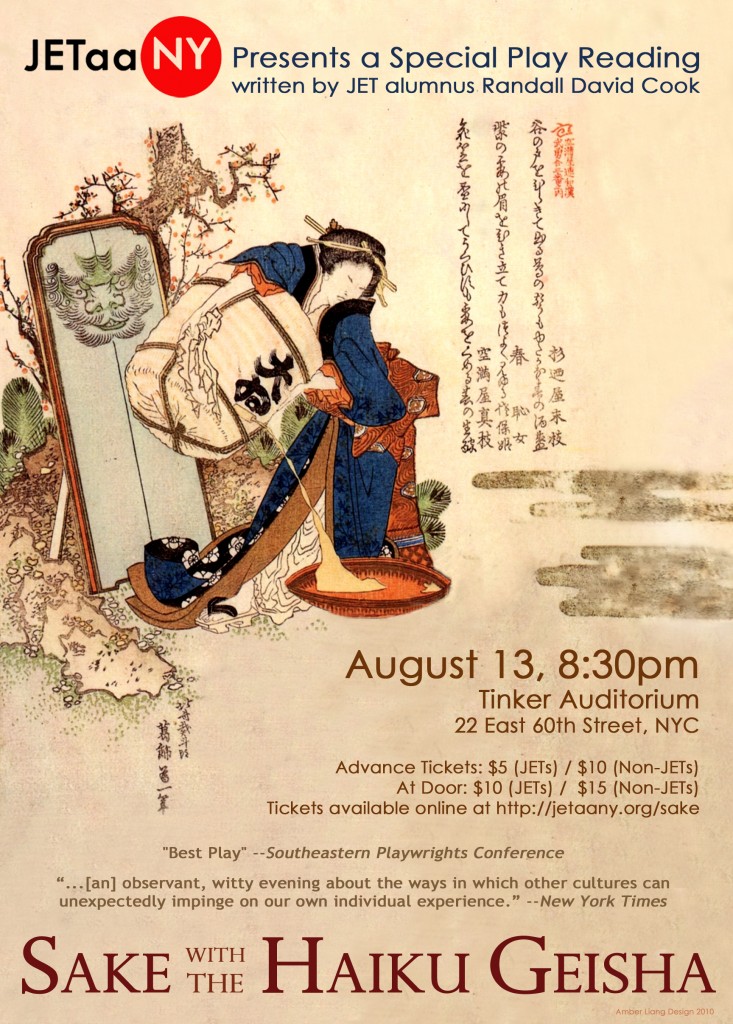
Graphic by JET alum Amber Liang
The JET Alumni Association of New York is pleased to present a limited one-night reading of the critically acclaimed play “Sake with the Haiku Geisha,” written by JET alumnus and playwright, Randall David Cook (Fukui-ken, 1991-93).
Date: Friday, August 13
Start time: 8:30 p.m.
Location: Tinker Auditorium (between Park & Madison Aves.) 22 E 60th St, New York, NY 10065, (212) 355-6100
Cost:
- $5 in advance ($10 at the door) for JET alumni
- $10 in advance ($15 at the door) for Friends of JET
CLICK HERE TO PURCHASE TICKETS ON-LINE VIA PAYPAL
“Sake with the Haiku Geisha” premiered Off-Broadway in 2006 and was based on the collective experiences of three JETs who were placed in Fukui-ken from 1991-1993: an American from South Carolina, a Canadian from Nova Scotia and an English woman from Devon. The structure of the play is inspired by the classic Noh play: an opening ceremony, five acts (each of which uses a different speaker and a spirit or ghost), and a closing ceremony. The show starts on at a farewell party for the visiting JETS, and first three acts are told from the perspective of the visiting JETs, and then the tables turn, and the final two acts are told from the perspective of two Japanese: the supervisor of the Canadian JET, and the geisha’s story, which closes out the play.
The first act, “Sushi and Scones” was a finalist in five major festivals in the USA and England, won the “Best Play” award at the Southeastern Playwrights Conference and was taped and broadcast by as a BBC radio play in late 2005. See a full review of the play in the New York Times.
This event is being organized in cooperation with the Consulate General of Japan in New York.
Tom Baker interviews “Airbender” cast
Article/Journalism, Cartoon/Illustration, Celebrity, Film, Reviews, Writers Comments Off on Tom Baker interviews “Airbender” cast
Tom Baker (Chiba-ken, 1989-91) is a staff writer for The Daily Yomiuri. As another example of JET ROI, he is one of at least four former JETS to have been on the newspaper’s staff in recent years. He usually writes for DYWeekend, the arts and leisure section. You can follow Tom’s blog at tokyotombaker.wordpress.com.
Recently he interviewed two members of the cast of “The Last Airbender” movie during their promotional visit to Tokyo, asking them for their views on the “racebending” controversy surrounding their film. He also covered an insect show now running at a Tokyo museum, reviewed the manga “Otomen,” and weighed in on a couple of other movies now playing in Japan. Here are some excerpts:
“Last Airbender”
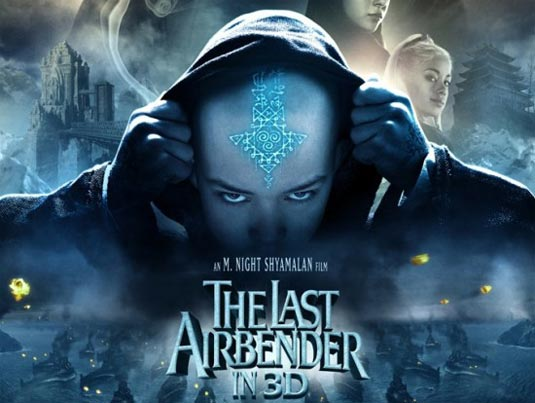 In the United States, some fans of the anime-style cartoon on which the movie is based have protested against the casting of Jackson Rathbone and Nicola Peltz, who are white, in roles the fans saw as Asian.
Asked to comment on that, Rathbone said: “I originally was a finalist for Prince Zuko [a Fire Nation role that went to Slumdog Millionaire star Dev Patel]. Almost a year later, I was brought back in for the character of Sokka…I think what they were really looking for was the qualities that people represent, not so much focusing on race…All these characters [in the cartoon] have so many different features, you can’t really say that they are one race…It’s a shame that people really focus on the race thing and they don’t understand that it’s a story for everyone.”
“And there are over 120 different types of people in the film,” Peltz added.
“In terms of a big-budget film, it’s the most ethnically diverse cast there’s ever been,” Rathbone agreed.
Read the rest of the interview here.
“Insects festival”
Open your window on a hot summer day and you may hear a sound that caught the ear of haiku poet Matsuo Basho in the 17th century: the voices of cicadas, seeping into the rocks. Of course, Japan today is a lot more urbanized than it was in Basho’s time, and cicadas are more likely to sing against a background of asphalt and cement. Yet year after year, the buzzing bugs never fail to show up, even in the heart of Tokyo.
 Visitors to Insects Festival, an exhibition now running at the Edo-Tokyo Museum in Ryogoku, Tokyo, are reminded of such persistence right away with a display of six-legged critters that live in three different Tokyo zones: mountains, fields and downtown areas.
While city-dwellers often resent sharing space with the likes of cockroaches and ants, the emphasis of this show is on seasonal outdoor insects whose diverse shapes, bright colors and occasional songs actually enhance city life…
Read the rest of the article here, or visit the exhibition’s site here.
“Otomen”
 Anyone writing a graduate thesis on the presentation of gender in Japanese pop culture will find abundant material in the manga series Otomen. Readers looking for laughs will also find what they seek in Otomen, but rather less abundantly.
The main characters are a trio of high school students, with the focus on Asuka (a boy who has a name more common for girls), who is in love with Ryo (a girl who has a name more common for boys). Their would-be romance is complicated by the constant presence of their friend Juta, who tries to play cupid, but is more often a third wheel.
Asuka is the captain of the school kendo team, and is admired by everyone as a “real man.” But he is secretly an “otomen,” a boy who is into girly things, such as cute stuffed animals and delicate pastries. He is at least as skilled at cooking and sewing as he is at sports, but he keeps that side of himself hidden. Ryo is Asuka’s mirror image in that she has been raised by her socially inept father to follow in his footsteps as a martial arts champion, but she strives to put up a feminine front at school. Juta has a secret, too, as he is actually a best-selling manga artist who is using the couple as a model for his stories…
Also playing…
You can read Tom’s review of “Inception” here, and his review of “Zombieland” here.
Tom Baker reviews “Crazy Heart” and “Brothers”
Article/Journalism, Film, Reviews, Writers Comments Off on Tom Baker reviews “Crazy Heart” and “Brothers”
Tom Baker (Chiba-ken, 1989-91) is a staff writer for The Daily Yomiuri. He usually writes for DYWeekend, the paper’s arts and leisure section. You can follow Tom’s blog at tokyotombaker.wordpress.com.
Recently he reviewed movies, “Crazy Heart” and “Brothers.” He found poetry in both of them. Here are some excerpts:
“Crazy Heart”
Country music singer-songwriter Bad Blake (Jeff Bridges) smokes like a chimney, drinks like a fish, sweats like a pig, and urinates into a plastic jug while driving from town to town. As I watched him perform under hot lights at a variety of small and unglamorous venues in the movie Crazy Heart, I could almost smell him. He didn’t smell very nice.
…
On the bright side, Bad’s personal problems are grist for the mill. One of his most popular songs looks back on a dissipated life with the refrain, “Funny how fallin’ feels like flyin’/for a little while.”
Anyone who doubts that country music is the primary home of modern American poetry should meditate on that line. “Funny how fallin’ feels like flyin'” is alliterative and catchy, but also trenchant. And Bad has flown and fallen quite a way…
Read the rest of the review here.
“Brothers”
In William Shakespeare’s play about his life, King Richard II is forced to surrender his crown to his usurper cousin Henry IV. In doing so, Richard compares himself and Henry to two buckets in a well: “The emptier ever dancing in the air,/The other down, unseen and full of water:/That bucket down and full of tears am I,/Drinking my griefs while you mount up on high.”
The title characters in Brothers, although they dwell in an American suburb rather than an English castle, are not unlike the tragic royal cousins.
Sam (Tobey Maguire) is an upstanding husband, father and U.S. marine who is about to be separated from his family for a tour of duty in Afghanistan. On the eve of Sam’s departure, his surly brother Tommy (Jake Gyllenhaal), a ne’er-do-well with a drinking problem, rejoins the extended family after a stint in prison…
Read the rest of the review here.
An International List of Writing Organizations and Opportunities
Advice, Article/Journalism, Blogs, Books, Career, Events, Jobs, Networking, Writers Comments Off on An International List of Writing Organizations and Opportunities
Laura Popp (Mie-ken, 2009-Present) is a current JET who writes fantasy and science fiction for children and young adults, and is an occasional playwright/film maker. Her short work includes a short story titled “In theShadow Realm” and a documentary she made in Malawi. To read about her amazing adventures all over Japan, go to her blog at laurajanepopp.blogspot.com.
Here is a practical list of organizations, market guides, and networking opportunities for jump starting your writing career. My apologies that it is heavy on the America and Speculative Fiction side, but that is who I am and what I write, so that is what I know best. But hopefully everyone can find something useful from this list:
How to Present Yourself to a Publisher or Agent at a writers conference
Advice, Article/Journalism, Books, Career, Networking, Uncategorized, Writers Comments Off on How to Present Yourself to a Publisher or Agent at a writers conference
**************
Laura Popp (Mie-ken, 2009-Present) is a current JET who writes fantasy and science fiction for children and young adults, and is an occasional playwright/film maker. Her short work includes a short story titled “In theShadow Realm” and a documentary she made in Malawi. To read about her amazing adventures all over Japan, go to her blog at laurajanepopp.blogspot.com. (And check out the Authors/Books section of the JetWit Library for a list of more writers in the JET-o-sphere.)
Tired of submitting queries to agents and editors and simply getting form rejection letters or worse, NO RESPONSE? Wondering if they`re even bothering to read your stuff? Frustrated by wanting to submit to publishing houses that only receive submissions from agents and “referred” writers? Consider meeting publishers and agents at a conference!
Recently I returned from a writers` conference in my home in Oklahoma and came back with some great success stories to tell. Even better than the wonderful presentations on writing, polishing and marketing were the opportunities for networking and industry contacts. One literary agent asked me for the first fifty pages of my middle grade novel Dargon, another agent requested a proposal for my young adult novel Treasure Traitor, and a publisher from Simon and Shuster asked to see the full manuscripts of BOTH. A travel publisher also requested a proposal for a non-fiction travel-essay book on Japan, and best of all, a Christian magazine publisher accepted one of my stories on the spot! Of course, most of these are just birds in the bush, if you will, but they are certainly a good start.
So how did you do it? you may be wondering. Well, let me tell you…
Do your homework
Many conferences post information about editors and agents who will be attending in advance. Research them and pick the ones that look like they may be interested in your completed fiction projects or non-fiction ideas. Note that most agents and publishers will ONLY consider finished fiction works and proposals for non-fiction articles and books.
Try to make an appointment
If you have the option to make an appointment, Read More
JQ Magazine’s May/June 2010 “JET Author Issue” Out Now!
Article/Journalism, Celebrity, Interview/Profile, JQ Magazine, Notable JET Alums, Writers Comments Off on JQ Magazine’s May/June 2010 “JET Author Issue” Out Now!
 It’s a veritable JET literary review in the new issue of JQ, featuring an interview with bestselling Learning to Bow author Bruce Feiler and three-time Stephen Leacock Medal winner Will Ferguson! Click here to view.
Additional contents below. Thanks to JQ editor Justin Tedaldi (Kobe-shi CIR, 2001-02) for another solid issue. Contact Justin if you’d like to pitch or write a story for the next issue.
CONTENTS
- Page 3….From the Editor, New Country Reps
- Page 4….Nippon News Blotter / Wynne Memorial
- Page 5….JETAANY Election Recap
- Page 5….Gorgeous Entertainment by Anthony Waldman
- Page 6….Int’l Center of New York by Pamela Kavalam
- Page 6….Yoko Shioya of Japan Society by Lyle Sylvander
- Page 7….JETlog Feauturing Gail Cetnar Meadows
- Page 8….Bruce Feiler: The JQ Interview by Justin Tedaldi
- Page 9….JETAANY Society Page Photos
- Page 10…Nihonjin in NY: Nobuya Nagahama by Stacy Smith
- Page 11….Echostream Rocks the Anime Circuit by Earth Bennett
- Page 13.…Robataya Restaurant Review by Nancy Ikehara
- Page 13….The Niigata Sake Book by Yukari Sakamoto
- Page 14.…Will Ferguson: Canadian Cousin by Joshua Graubart
- Page 15….The Funny Page
Tom Baker interviews 2 movie directors, pans one manga
Article/Journalism, Books, Celebrity, Interview/Profile, Reviews, Writers Comments Off on Tom Baker interviews 2 movie directors, pans one manga
Tom Baker (Chiba-ken, 1989-91) is a staff writer for The Daily Yomiuri. He usually writes for DYWeekend, the paper’s arts and leisure section. You can follow Tom’s blog at tokyotombaker.wordpress.com.
He recently interviewed Shane Acker, director of the animated film “9” and Richard Kelly, who most recently directed “The Box,” a thriller starring Cameron Diaz. He also reviewed the manga “Hot Gimmick.” Here are some excerpts:
Shane Acker
 [The characters in the movie are all animated dolls with numbers instead of names.] A different personality aspect is dominant in each one. Rigid orthodoxy is represented by leader 1 (voiced by Christopher Plummer), creativity by inventor 2 (Martin Landau), bravery by warrior 7 (Jennifer Connelly) and so on. Elijah Wood does the voice of 9, the truth-seeker of the group, and John C. Reilly voices his timid friend, 5…
The most amusing character is 8 (Fred Tatasciore), who embodies sheer physicality. In one scene, he achieves a moment of strange bliss by stroking his head with a large magnet, an activity that Acker called “degaussing himself.”
“In film school, especially in the days of video, if you had a videotape and you wanted to just wipe it clean, there’s a degaussing machine, which is basically like a supermagnet, and you would wave the videotape over the degausser and it would just take off all the footage that’s on there,” Acker explained. “So that’s the kind of idea, he’s sort of wiping his memory banks. You realize why he’s so dumb.”
Richard Kelly
Imagine that a mysterious stranger has just handed you a wooden box with a red button on top. He explains, rather convincingly, that if you push the button two things will happen: Someone whom you don’t know will die, and you will receive a payment of 1 million dollars…
 In writer-director Richard Kelly’s movie The Box, based on a short story by Richard Matheson, the stranger’s name is Arlington Steward (Frank Langella), and he is conducting a high-stakes social experiment by visiting the homes of middle-class American couples and offering them the choice of pushing the button or not.
“Tonally this movie crosses a lot of genres,” Kelly, who previously wrote and directed Donnie Darko (2001) and Southland Tales (2006), told The Daily Yomiuri in a recent phone interview. “It’s a science fiction film, it’s a domestic melodrama, it’s a suspense film, there’s elements of horror in it, and there’s also some black comedy inherent…The conceit of pushing this button on this contraption and someone you don’t know dying is very mischievous. Anyone who would build this contraption and make this offer is smirking when they do it. And Matheson was smirking, I’m sure, when he wrote this short story.”
…[The story is set in the 1970s because] the mysterious stranger is a character type whose day has passed, according to Kelly. “When I set out to write this screenplay, I initially was trying to figure out how to make it work present-day, but when you introduce modern technology and the Internet, social networking sites, Google maps, satellite maps, reality TV, just our media-saturated world that we live in…there is no such thing as a real stranger anymore. Everyone can be found on the Internet. You can find anyone’s house, you can go onto a satellite map with a 360-degree view.”
“Hot Gimmick”
 [In this manga, a high school girl’s seriously unhealthy relationships with her would-be boyfriends is presented as perfectly normal.]
For example, the day after one of her suitors is unable to reach her by phone (for reasons that are no one’s fault), he slaps her across the face so hard that bystanders rush to offer first aid. But Hatsumi chases after him to make the following speech, which he receives in stony silence: “I’m sorry. For being so clueless. For…never being able to get your calls…I’m so sorry. I’m really sorry. For not understanding how you feel about me. I’m sorry.”
Later, when one of the boys proposes to her, she thinks, “Maybe if we got married, he’d finally be nice to me.”
She seems unaware of some basic principles of healthy human interaction, such as this simple standard: If a friend arranges for you to be gang-raped, that person is not really your friend.
JET Author: Bruce Feiler’s latest on living with cancer
Writers Comments Off on JET Author: Bruce Feiler’s latest on living with cancer
You may have seen his face on The Colbert Report or his byline in The New York Times, but the bestseller Bruce Feiler got his start after college in JET. His first publication, though, was spurred by his experience in Japan as a JET teacher in the inaka: Learning to Bow: An American Teacher in a Japanese School in 1991.
Many successful titles and even a PBS miniseries later, Feiler is back with another personal account on his experience after he was diagnosed with cancer. The young father of two daughters set off to write to them with the advice of six guiding men in his life. The group of his college roommates and childhood friends, penned “The Council of Dads,” provide the wisdom that he seeks for himself and his family. The rest of his personal battle with chemo therapy and lingering fears for his family unfold in his latest book: The Council of Dads – My Daughters, My Illness, and the Men Who Could Be Me.
As an early reviewer from United’s Hemispheres Inflight Magazine noted: “The book’s power comes in part from Feiler’s willingness to delve into emotions—including feelings of tenderness not only for our children and spouses but between male friends—that aren’t often spoken of with such candor.” And it’s not surprising, because for much of his career as a writer, he has lead readers through both the clamor of a JET classroom and the Biblical journey through the steps of Abraham.
Check out his extensive speaking event schedule for May and June. He’ll be hitting bookstores and cafes in California, Georgia, Illinois, Maryland, Massachusetts, Missouri, New York, North Carolina, Ohio, and Pennsylvania in two months!
Follow him on Twitter or Facebook, and here’s a trailer for his book.
