




JQ Magazine: JQ&A with Jenn Doane of the Hiroshima Ange Violet
 Article/Journalism, Interview/Profile, JQ Magazine
  Comments Off on JQ Magazine: JQ&A with Jenn Doane of the Hiroshima Ange Violet
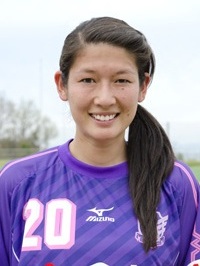
“On JET I was deeply involved in both my town and my prefecture, and in turn developed close relationships with both foreigners and Japanese people. Seattle is a diverse place, but I don’t think I would ever have had such a dynamic and interesting life outside of my day job!”
Seattle native Jenn Doane (Shimane-ken, 2010-12) has played soccer since she was eight years old. Having been a four-year starter on her high school varsity team, a three-year starter in college, and selected to play for the Olympic Development Program, she is now the first American to play professional soccer on a Japanese team, the Hiroshima Ange Violet. JQ learned all about her path to the team in this exclusive interview.
How did you become interested in Japan and the JET Program?
I have known about the JET Program since I was young, actually—my parents were both very involved in the Japanese community in Seattle: My mother was the executive director of the Japan America Society and the Japanese American Chamber of Commerce, and my dad served as president of the Society as well, and I think they have even been asked to be interviewers for prospective JET candidates. However, as any teenager would, I wasn’t interested in anything my parents were! I am three-fourths Japanese and one-fourth Caucasian (my mom is full, my dad is half, and both were born and raised in America).
I wasn’t necessarily ashamed of being Japanese, but I grew up in a mostly Caucasian suburb–and while I don’t think I was ever really picked on or anything, being Japanese wasn’t something I was overly proud of! You should have seen the reactions of my friends when I sometimes brought onigiri and kamaboko in my school lunch!
I was planning to be a Spanish major in college until my junior year when I decided to switch my focus to Japanese and study abroad in Osaka. I think I finally came around and got more curious about my heritage and the Japanese language. Many students from my college (Whitman) do the JET Program, and after a wonderful study abroad experience and hearing from all the raving alums, I thought it would be the perfect thing to do after graduating. So, here I am (or rather, there I was…).
I noticed you were a violinist for the Whitman Women’s Symphony. Any plans to continue with the violin in Japan?
Unfortunately, I have not touched a violin in a long time—however, I really have a passion for music and have found other ways to realize the musician in me! I joined a singing group in the countryside (we sing all the Glee hits) and have also been learning guitar. If I had easier access to a violin, I would definitely love to get back into it!
If you don’t mind sharing, what was it like to be on JET and teach at schools during the time of the disasters last year?
Compared to the JETs and teachers actually living in Tohoku, I can’t say that things were dramatically different. However, there was a kind of solemnness in the air after what happened— lots of moments of silence, and donations boxes all around school and town. One of my college friends is a JET in Miyagi Prefecture and we couldn’t get a hold of him for two weeks after the earthquake…it was terrifying. Thankfully, he had been at a relief shelter without Internet or phone access.
I also had the opportunity to volunteer in one of the hardest hit towns of Tohoku (Kesennuma) about six months after the tsunami, just helping sort debris and cleaning ruined houses, and it was such a moving experience—I met some incredibly strong and inspiring people, people who lost loves ones, everything they owned, or both.
JQ Magazine Seeks Writers for Winter 2012!
Article/Journalism, JQ Magazine Comments Off on JQ Magazine Seeks Writers for Winter 2012!
Visit JQ magazine online at http://jetaany.org/magazine
As winter approaches, JETAA New York’s JQ magazine continues to provide content with an ever-expanding array of articles, interviews and features (see our recent stories here). We’re now looking for new writers, including recent returnees and JET vets, from all JETAA chapters worldwide for posting stories via our host at the global JET alumni resource site JETwit.com. (Scribes are also encouraged to join the JET Alumni Writers group on LinkedIn.)
Below are story ideas grouped by JET participants and alumni (JET World) and those more on Japanese culture (Japan World). And if you’re a JET or JETWit contributor from anywhere in the world with a story idea of your own, let us know!
Click “Read More” below for our winter 2012 ideas pitch package, and contact JQ editor Justin Tedaldi (magazine [at] jetaany [dot] org) to sign up for stories.
JQ Magazine: Book Review – ‘The Buddha in the Attic’
Article/Journalism, Books, JQ Magazine, Reviews Comments Off on JQ Magazine: Book Review – ‘The Buddha in the Attic’
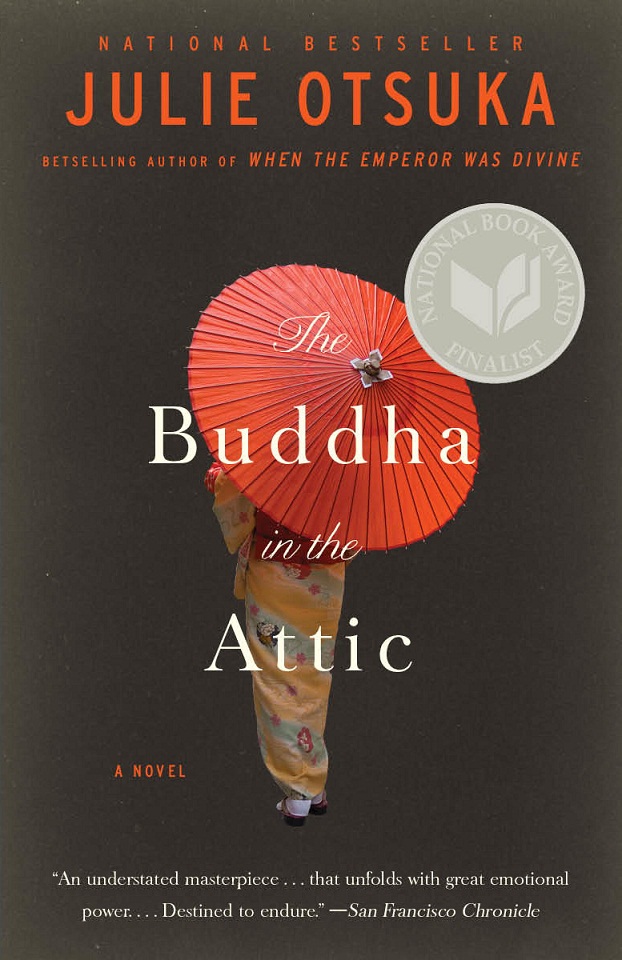
“Just the right length, the perfect amount of general and specific, and no solid story but yet the story that so many people in the United States—and elsewhere—can tell about hope, and heartbreak, and the ways in which lives change that most of us never intend or imagine.” (Knopf)
By Liz Mathews (Hiroshima-ken, 2005-06) for JQ magazine. Liz is the JETAA New York Book Club wrangler.
I would like to start by saying that the JETAANY Book Club discussed reading Julie Otsuka’s The Buddha in the Attic for at least five months before choosing it for our fall meeting. This is notable because 1) we were right in our primary reason for putting it off; and 2) we were even more right in finally selecting it to read. It’s easy to explain the first note: Over the summer we thought it best to opt for a lighter, more beachy read, and not a novel about Japanese “picture brides” and their distressing existences in the United States of the early 20th century.
As for the second point, autumn and its colder, shorter, darker days did turn out to be a much more appropriate setting to read Otsuka’s carefully composed novel. Otsuka wrote her book in eight sections, writing mostly from the perspective of the women—the women as a united “we”—who came across the ocean to a new life of false promises, how they endured meeting their husbands the first time, how they got along (or didn’t) with their employers and new fellow countrymen, and what happened as a new, Japanese American generation grew.
For all the suffering in those first five sections, there is hope written between the lines. Hope for a new life with a wonderful husband, hope that hard work will pay off in acceptance, and hope for their children in that, as one of the paragraphs ends, “Whatever you do, don’t end up like me.” But then, as one club member put it, “You come to this country, you work your ass off, you think you’re getting somewhere…and then you don’t” (referring to the war’s outbreak).
When we got together to discuss The Buddha in the Attic, we spent a fair amount of time talking about the perspective the story was written from—first person plural—and how initially we didn’t like it, but then either grew accustomed to it or could at least appreciate it as a tool. One attendee stated, “Everyone’s situation is different. You can’t even generalize the Japanese experience.” Another pointed out, “[Otsuka] has a new story in every sentence.” We laughed a little at this realization, probably as all our thoughts turned back to our own departure orientations, when we were constantly told those very same things.

“From the very beginning I saw Gordon Hirabayashi’s story as a unique and quintessentially American story, and although he was Japanese American himself, I hoped that the play would have a broad appeal, not just for that community, or just the Asian American community, but for people of all ages, ethnicities, and walks of life.” (Lia Chang)
By Ann Chow (Hyogo-ken, 2007-09) for JQ magazine. Ann is a native New Yorker who gets scared of the big, scary world, but ventures out into it anyway. She coined the term “stealth gaijin” (or thinks she did because she hadn’t heard of it before writing a bunch of articles under that moniker during her time on JET). When not portraying 14-year-olds on Gossip Girl, she can sometimes be found playing a (much older) law clerk on Law and Order: SVU.
Jeanne Sakata is an award-winning stage actress who has performed with many well-known companies on the country’s biggest stages, including the Lincoln Center Theater and the John F. Kennedy Center. She made her playwriting debut in 2007 with Hold These Truths (formerly Dawn’s Light: The Journey of Gordon Hirabayashi), the story of the Japanese American activist and Presidential Medal of Freedom winner, who passed away earlier this year at age 93.
Hold These Truths first premiered in 2007, and has been performed multiple times around the country since then. It is now a part of the Library of Congress Playwrights Archive in the Asian American Pacific Islander Collection in Washington, D.C., and is now having its Epic Theatre Ensemble New York premiere run (starring Joel de la Fuente and directed by Lisa Rothe) through Nov. 18 at the Theater at the 14th Street Y in repertory with Dispatches from (A)mended America.
JQ recently spoke with Sakata about her profound fascination with Hirabayashi’s life, the meticulous research that went into writing Hold These Truths, and what she hopes the play will accomplish.
What are the goals you are trying to achieve with Hold These Truths?
I hope, first, that Hold These Truths will spread awareness of Gordon Hirabayashi, whose story is still virtually unknown to so many Americans. As a young college student during World War II, Gordon stood up for the principles of the Constitution when the United States government failed miserably to do so, persecuting and imprisoning him for his actions. Earlier this year, Gordon passed away in January at the age of 93, and, amazingly, a few months later in April, President Obama posthumously awarded him the Presidential Medal of Freedom, the nation’s highest civilian honor, for the courageous stand he took so many decades ago. So I feel, this year especially, that Gordon’s story is a vitally important one to anyone who cares about our country, and the principles of the Constitution. Second, I hope the play will spread awareness on the East Coast of the mass incarceration of all people of Japanese ancestry during World War II on the West Coast, as knowledge of this tragedy seems to be much less prevalent here than out west.
In general, people on the West Coast know more about this time in American history. What reactions do you expect now that it’s playing here in New York?
As I said earlier, one common reaction we’ve had is that of shock that something so horrible happened during the World War II years in America. Many of our East Coast audience members who lived through those years have said that they were aware that “something bad” happened to the Japanese on the West Coast during that time, but they did not know just how bad it was. For example, they did not know that anyone in Seattle who was one-sixteenth Japanese, or babies from orphanages who had any Japanese blood, were ordered to be penned up behind barbed wire. They don’t know that so many children and young American citizens were torn out of their schools and imprisoned, and for so many years. But I also hope the reaction to Gordon’s story we’ve had here so far will continue—that people will be delighted, as well as profoundly moved and inspired, to learn about him.
How did you choose the subject matter for the play? Did you have family that lived in the internment camps?
I myself am a third-generation Japanese American, and in the 1990s I happened to see a documentary video about Gordon titled A Personal Matter: Gordon Hirabayashi vs. the United States. I was shocked that I had never heard his story before, and I started to find out everything I could about him. The more I read, the more fascinated and intrigued I became. The story just grasped me and wouldn’t let me go, becoming an obsession, and I knew I couldn’t rest until I tried to write a play about Gordon.
My mother’s side of the family was living in Colorado during World War II, and so did not have to go to the camps, although they experienced plenty of hostility and racism in the town where they lived. My father’s family, however, all lived in Watsonville on California’s West Coast, so all of them were rounded up and imprisoned in the camp in Poston, Arizona. As I was growing up, my father and aunts and uncles never spoke of the experience, I believe, because it was so traumatic for them, as it was for so many others.
JQ Magazine: Autumn in Nagasaki
Article/Journalism, JQ Magazine, Travel/Tourism Comments Off on JQ Magazine: Autumn in Nagasaki

Hashima, aka “Gunship Harbor,” as seen from a tour boat in Nagasaki.
By Mohan Nadig (Hyogo-ken, 1998-99) for JQ magazine. Mohan currently lives in Tokyo.
A word of advice: If you haven’t been to Nagasaki, go.
Since my time as a JET in Hyogo Prefecture in 1998, I’ve been on something of a mission to visit every prefecture in Japan at least once. Last year, one of the remaining spots high on my list was Nagasaki.
I’d planned to visit on several occasions in the past but never made it–I was finally inspired to book a ticket after reading David Mitchell’s fascinating novel The Thousand Autumns of Jacob de Zoet, which is set in the region at the turn of the 19th century.
The timing of my visit last October turned out to be very fortuitous. A friend from Nagasaki told me that I would be there during the Okunchi Festival and that a friend of hers would be able to show me around town.
Upon arriving in Nagasaki by train from Fukuoka, the first thing that struck me about the city center was its amazing ugliness, which is of the “what could they possibly be thinking?” variety. I was hard pressed to find a corner not marred by some rusting hulk, dilapidated structure or tacky signage left over from the 1970s. For a city with such a significant history, the lack of beautification and preservation efforts is stunning.
Fortunately, I very quickly found a wealth of redeeming features: hospitable people, nuggets of history waiting to be discovered around every corner, and fantastic views of the sea–and of course, the festive atmosphere of Okunchi.
JQ Magazine: Book Review – ‘Salvation of a Saint’
Article/Journalism, Books, JQ Magazine Comments Off on JQ Magazine: Book Review – ‘Salvation of a Saint’
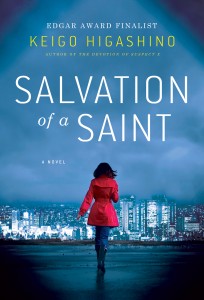
“The detectives in ‘Salvation’ are in constant motion, interrogating suspects, racking their brains for a break in the case. Insomniacs, they observe, question and theorize with an obsessive resolve, as good fictional crime detectives are apt to do.” (St. Martin’s Press)
By Sharona Moskowitz (Fukuoka-ken, 2000-01) for JQ magazine. Sharona is interested in fresh, new voices in fiction and creative nonfiction.
(Click image for an exclusive sample from the audiobook)
With more twists and turns than a mountain route through the Japanese Alps, Keigo Higashino’s latest murder mystery Salvation of a Saint is a seamless, well-constructed suspense novel with all the elements of a classic murder mystery, though he adds considerable fizz to the formula with a few unconventional characters and a very unlikely murder technique.
Yoshitaka is the unfortunate victim, poisoned early on in the story by arsenic laced coffee which he drinks with tepid oblivion. Despite being offed so soon, throughout the novel we learn quite a bit about him as his character is constructed in fragments that piece together to tell the story of his life.
And what an unsavory fellow indeed.
Narcissistic, duplicitous and with a chauvinistic tendency to view women solely in terms of their reproductive potential, Yoshitaka is not terribly likeable, to put it mildly. During the time of his murder he was in the process of leaving his wife Ayane because of her inability to bear him a child, a fact which he states openly with unabashed grandiosity. He was also, conveniently for the plot, in the midst of an affair with Ayane’s trusted confidant and apprentice Hiromi.
So whodunit? Was it a crime of passion committed by one of Yoshitaka’s jilted lovers past or present? Perhaps a jealous colleague? Or were Ayane and Hiromi secretly in cahoots?
JQ Magazine: JQ&A with The Inaka Founder Chris Allison
Article/Journalism, JQ Magazine, Website Comments Off on JQ Magazine: JQ&A with The Inaka Founder Chris Allison

“Japan’s inaka offers something completely different. In the inaka you can find nature restaurants, shops, and people that will do a much better job representing a different culture and a different experience—an experience you can only get in Japan.”
By Sarah Rogers-Tanner (Kyoto-fu, 2009-11) for JQ magazine. Sarah hails from Afton, Minnesota and learned a thing or two about the inaka in her small town of Ujitawara, located in the mountains outside of Kyoto City. While there, Sarah taught students ages 2-15 and is now pursuing her master’s degree in elementary inclusive education at Teachers College, Columbia University.
Chris Allison (Oita-ken, 2009-12) is a recent JET returnee who spent three years teaching at both an academic high school, as well as a rural, agricultural school. Originally from a small town in Indiana, Chris studied international business and Chinese at Bethel College and began studying Japanese while on JET. Though he is in the U.S. for the time being, Chris hopes to soon be back in Asia again, this time teaching English in Beijing.
Over the past few years, Chris noticed the need for a website that, as opposed to focusing on the prefecture as a whole, exhibits what each town in Japan has to offer. Chris founded The Inaka so that foreigners living in Japan can share pictures and information about their towns for future generations of ALTs and tourists alike. Chris hopes to bring tourism not only to the larger cities but also to the small towns that many of us JET alumni came to love.
Chris says that by increasing the tourism to these towns and cities, we also increase the breadth of knowledge that the world has about Japan, allowing us to give something back to our second home abroad. Now, The Inaka needs your help. The upload process is very easy, so take a look at your prefecture and see what you can contribute!
What made you fall in love with the inaka?
This is slightly off topic a bit, but I often get asked, “What is there to see in Japan?” Up until recently, I didn’t really know how to answer this question. For most countries it is a fairly simple question. For China, “Great Wall.” For France, “Eiffel Tower.” Japan doesn’t really have that one thing that makes it stand out. Sure you could say something like Tokyo or Kyoto, but those are cities and not single attractions.
There was never one thing that I could say that I felt gave a fair representation of Japan. Then it hit me. I could not think of one specific place or attraction, because the entire country is filled with them. No matter what town you go to, you will find heaps of history and sights that will amaze you. The inaka is what makes Japan stand out as a country; it is where you will find the history, nature and culture of what I have come to know as the real Japan. I think it makes the country worth traveling to.
That is why I love the inaka!
JQ Magazine: Inside the JETAA New York Book Club
Article/Journalism, Books, JQ Magazine Comments Off on JQ Magazine: Inside the JETAA New York Book Club

The JETAA New York Book Club with August’s selection, “The Thousand Autumns of Jacob de Zoet” by David Mitchell.
By Greg Anderson, (Fukuoka-ken, 1990-92) for JQ magazine. Greg is part of the fourth class of the JET Program, which began in 1987. He is currently employed as an auditor with the U.S. Treasury Department and is a new member of the JETAA New York Book Club.
Gone are the amazing, fascinating, fast-paced days of life in Japan filled with culture shock. As JET alums, most of us are employed in vocations that have no connection to Nippon at all. Ask yourself this question: After you have successfully completed another week or day at work, what do you have to look forward to? If you’re job hunting, then you have experienced another week of success/failure, but next week holds new opportunities. If you have children, you can look forward to screaming demanding creatures that we all love but sometimes drive us crazy. If you don’t have children, you may have an annoying spouse, boyfriend or girlfriend who has never been to Japan, has no interest in Japan, and wishes that you would get over your preoccupation with it and grow up. Once a JET, always a JET!
The JET experience transforms all who participate in the program; you will never be the same again. What can you do when you miss the connection to Japan? Besides going to Sapporo Ramen (located on 152 West 49th Street), you can attend a JET book club meeting. Every other month, JET alumni and others interested in Japan get together to discuss a Japan-related book over a nice relaxing glass of wine, soda, or water (but feel free to bring your choice of beverage). It does not end there! The hors d’oeuvres provided are smashing, and at a mere two to three dollars are a better bargain than McDonald’s. Participants also have the option of bringing goodies to supplement the menu, and you never know what surprises to expect.
The book club was started about three years ago, by two enterprising JET alums, Jessica Langbein and Michael Glazer, who suggested that JETAANY should have a book club. In fact, when the club first started, the meetings were held at the home of another JET, Katrina Barnas. The genesis of the book club was neither Japan nor the JET Program, but began as a college major. Jessica was a Japanese literature major in college and as a JET alumna was seeking some literature that would pique her interest. It was suggested to her that she speak to fellow alumnus Michael, and over a cup of coffee the JETAANY Book Club was born. Facebook was used to recruit new members.
JQ Magazine: JQ&A with Paige Cottingham-Streater, Executive Director of the Japan U.S.-Friendship Commission
Article/Journalism, Interview/Profile, JQ Magazine Comments Off on JQ Magazine: JQ&A with Paige Cottingham-Streater, Executive Director of the Japan U.S.-Friendship Commission

“It’s impressive to see not only the countries and communities from which JET alumni herald, but also the ways in which they contribute to the program during and after their involvement. The Japanese government should certainly be pleased with the return on its investment in introducing so many people to Japan.” (Courtesy of JUSFC)
By Renay Loper (Iwate-ken, 2006-07) for JQ magazine. Renay is a freelance writer and associate program officer at the Japan Foundation Center for Global Partnership. Visit her blog at Atlas in Her Hand.
Paige Cottingham-Streater (Mie-ken, 1988-89) is a co-founder of the JET Alumni Association and executive director of both the Japan-U.S. Friendship Commission (JUSFC), a federal agency that provides grants for research, training and exchange with Japan, and the United States-Japan Conference on Cultural Interchange (CULCON), a binational advisory panel to the U.S. and Japanese governments
Cottingham-Streater previously served as deputy executive director of the Maureen and Mike Mansfield Foundation, where she worked for 16 years. In 2004, she received the Japan Foreign Minister’s Commendation in recognition of her longstanding work to strengthen U.S.-Japan relations. The award commemorated the 150th anniversary of the Treaty of Peace and Amity between Japan and the United States.
A regular on the U.S.-Japan relations conference circuit in the United States and abroad, Cottingham-Streater spoke with JQ recently to discuss her rich career, advice for today’s JETs, and thoughts about the future between America and Japan.
What initially sparked your interest in Japan?
My father served in the Korean War and spent time in Japan, so I was initially introduced through his recollections of the history and phrases he learned. In 1970, I was an elementary school student and Japan was hosting the World Exposition in Osaka, so my family traveled [there] to attend the expo and experience Japanese culture. As a young person, I was interested in the similarities and differences between Japan and the U.S. We arrived in Tokyo and saw department stores and familiar automobiles, but there were distinct and subtle differences, such as language spoken and [the] size of automobiles. I returned home wanting to learn more, so in high school I took an Asian Studies class. As a freshman in college, I took another Asian studies class and then more Japanese studies classes [ultimately leading to a] double major in Asian Studies and Government, with the goal of becoming a lawyer who could build a career involving Japan.
JETAA began in 1989. What was your personal motivation for creating the organization?
I’d had a wonderful and rewarding year in Japan that I didn’t want to end completely when I returned to the U.S. I also wanted to find some small way to repay the generosity I had received from the community and country that hosted me. Before departing Japan, several of us who were not renewing met to explore ways in which we could stay connected with each other and support the program by recruiting others and sharing information about Japan. There were a handful of us who were returning to different parts of the United States so we decided Washington, D.C. should be the central focus. When I returned to D.C., I contacted the Japanese embassy about the possibility of working with them as well as the JET office to hold meetings and build a mailing list.
How many other people did you co-found it with?
I found four others in Washington, D.C. who had also recently returned. California, New York, and Philadelphia quickly grew shortly thereafter.
Where would you like to see JETAA go?
I’d like to see JETAA build an infrastructure and organize itself in a way that allows the organization to operate as a single entity, with chapters serving the unique needs of local communities in the U.S. and overseas.
JQ Magazine: Book Review – ‘Heart of a Samurai’
Article/Journalism, Books, JQ Magazine, Reviews Comments Off on JQ Magazine: Book Review – ‘Heart of a Samurai’

“Many people join the JET Program looking to form international bonds between their home countries and Japan, but Manjiro Nakahama faced bigger challenges into trying to end Japan’s isolationist policy. ‘Heart of a Samurai’ gives you a fun glimpse of one of Japan’s most important historical figures.” (Abrams)
By Rashaad Jorden (Yamagata-ken, 2008-2010) for JQ magazine. Rashaad worked at four elementary schools and three junior high schools on JET, and taught a weekly conversion class in Haguro (his village) to adults. He completed the Tokyo Marathon in 2010, and was also a member of a taiko group in Haguro.
You might know that under the policy of sakoku, no Japanese were permitted to leave the country. So when Japanese people were finally able to do so, it must have been a fascinating story. And thanks to Margi Preus, people have an easy-to-read tale about one of the first Japanese to venture outside of the country’s borders.
Preus’ book Heart of a Samurai offers a look into the life of Manjiro Nakahama, a fisherman-cum-aspiring samurai whose life is turned upside down when his boat is shipwrecked during an 1841 fishing trip. He and his four comrades are stranded on a remote island until members of an American whaling vessel arrive.
It was aboard the John Howland that Manjiro first learned about a world previously foreign to him. Unlike his comrades, the ever-inquisitive Manjiro is not scared of “butter stinkers” (a derogatory term for foreigners) and he learns English so quickly, he forms a bond with ship captain William Whitfield. Whitfield eventually takes Manjiro back to the United States, where the young man lives with the captain’s family. After spending several years exploring the world by sea, Manjiro eventually returns to Japan to accomplish his goal.
This book will resonate with people because it addresses the theme of being shocked at the world’s differences—some of which are hilarious (Aboard the John Howland, Manjiro is stunned by the existence of buttons, pockets, forks and knives while later expressing similar astonishment by seeing men wearing watches) and some that are not so funny (Manjiro is stunned to see segregation in a church). And in addition to adjusting to a culture where everything seemed to changing, Manjiro must also tackle racism and a new language while working to prove himself to people in a new country.

Sayaka Takeda, a veteran recruiter with Actus Consulting Group, wants to help you find a job.
By Preston Hatfield (Yamanashi-ken, 2009-10) for JQ magazine. Preston moved from San Francisco to New York City in January 2012 and is now accepting submissions from people who want to be his friend. Abduct him from his house in the middle of the night, or find him on Facebook and ask about his JET blog in which he details his exploits and misadventures in that crazy Land of the Rising Sun we all love.
If you have been back from JET for a year or two, you probably already know the story. If you are just now returning and you have not been keeping up with the news, let me fill you in: The economy, well, it sucks. And while that fact may not exactly be news considering that the markets crashed back in 2008, it is very possible, especially for those who have lived abroad since then, that the recession has not affected you yet. But according to the Wall Street Journal, with 8.2 percent unemployment, an additional 88 million unemployed Americans not a part of that calculation due to having stopped actively searching for jobs, and three consecutive lackluster jobs reports coming out of Washington in the past months (which according to the Journal makes this the “weakest quarter for job growth since the labor market began to recover in 2010”), returning expats are in for a rude homecoming.
Speaking from experience, the generous salary and benefits JETs enjoy seems like a well that will never run dry, and when I came home in the summer of 2010 and bounced between part-time jobs, internships, and temporary positions for the better part of two years, I was kicking myself for walking away from a guaranteed contract in Japan before my limit was up. If I could do it again, they would have to drag me onto that America bound plane kicking and screaming.
I am writing mainly to the JETs who are coming home this year—more specifically, to young JETs who will be making their valiant attempts to join the American workforce for the first time since graduation— and please know that I am not trying to scare you. Hey, you survived teaching in Japanese classrooms, nothing can scare you anymore. But I am here to warn you that the road ahead may be rough, and you would be wise to manage your expectations when you decide to start your next job search. It can be stressful. On top of the reverse culture shock and post-JET depression that some of you will experience, the added pressure of needing a job and the frustration of sending out résumé after résumé without response can bring you down and tempt you to sign on with whatever Japan teaching pops up on a Google search. I trust that you and I are not the only ones who have felt this way, but before you do that, take a step back and consider your other options.
Hopefully, as you are readjusting to life in the States you will be formulating a rough game plan for the challenge ahead, but if you do not already have a field that you are determined to break into, if grad school is not yet on your radar, and if you really want to strengthen your understanding of Japan and maintain your connection to Japanese culture, then perhaps working at a Japanese company in America is an option. There are a handful of established Japanese staffing agencies with offices throughout America’s major cities that place people in a variety of full and part-time positions. But do these companies want to interview, much less hire, former English teachers such as ourselves? I caught up with a recruiter in Midtown Manhattan to find out.
JQ Magazine: Book Review – ‘Orchards’ Is Elegant, Powerful, Profound
Article/Journalism, Books, JQ Magazine, Reviews Comments Off on JQ Magazine: Book Review – ‘Orchards’ Is Elegant, Powerful, Profound

“‘Orchards’ is at once a celebration of life and a somber reflection on the choices we make and their often irrevocable consequences.” (Random House)
By Sharona Moskowitz (Fukuoka-ken, 2000-01) for JQ magazine. Sharona is interested in fresh, new voices in fiction and creative nonfiction.
Meet Kanako Goldberg. Half Japanese, half Jewish, the teenage narrator of Holly Thompson’s breathtaking 2011 novel Orchards is more bagels and lox than natto and rice. After the suicide of her classmate in New York, Kanako is sent by her Japanese mother to spend the summer with her relatives on their mikan farm in a rural village tucked beneath the shadows of Mount Fuji. The trip to Japan is not only a chance to bond with her Japanese kin, it’s something of a temporary exile, a time to reflect on her life and her classmate’s untimely death at a safe geographical remove.
The victim’s name was Ruth and she is evoked repeatedly throughout the novel in the second person, as if to haunt the reader as much as she seems to be haunting Kanako’s conscience. Who was Ruth? What exactly was the extent of her suffering and how long did she have to endure before making the desperate decision to take her own life? Slowly we learn about Ruth’s battle with bipolar disorder and the unfortunate events that prompted her to do the unthinkable.
Despite her remorse, Kanako was not exactly the bully. She was more of a neutral bystander neither provoking nor defending the tortured teen, though in retrospect she feels just as culpable as Lisa, Ruth’s lead tormentor. (Lisa’s own fate, which I won’t give away here, adds an unexpected twist to the story.)
The tragic event took place in an apple orchard, a place where the cycle of death and rebirth is in plain, colorful view. While this metaphor might seem forced or terribly obvious, so elegant is Thompson’s language and so powerful and gentle her analogies that the overall effect is profound and genuinely moving.
JQ Magazine: San Francisco Hosts Fourth Annual J-Pop Summit Festival
Article/Journalism, Events, JQ Magazine Comments Off on JQ Magazine: San Francisco Hosts Fourth Annual J-Pop Summit Festival

The 2012 J-Pop Summit Festival will be held in San Francisco’s Japantown August 25-26. (NEW PEOPLE, 2011)
d
By Lindsay Martell (Saitama-ken, 1995-1997) for JQ magazine. Lindsay is a freelance writer and a voice-over actor in Oakland, California. Visit her website here.
Whether you have a penchant for hunky Lelouch Lamperouge (the hunky antihero of the anime series Code Geass: Lelouch of the Rebellion) or a serious hankering for Lolita fashion, the pop-y, edgy, dynamic stuff you love is busting at the seams with this year’s J-Pop Summit Festival in San Francisco’s Japantown August 25-26.
With its campy theme of “Cyberpop Overload,” the second annual gathering is a Japanophile’s dream come true—noshing on chicken teriyaki bento or pork katsu curry from a JapaCurry food truck as you bop along to the scores of bands busting out tunes—this mecca of all things related to Japanese pop culture has something for everyone: fashion, film, anime, video games, technology and thumping music. And for JET alums who are feeling particularly natsukashii? Kite-kudasai!
Personally, I can’t wait. Not a day goes by when I don’t miss Japan. I haven’t lived there since the mid-’90s, when I was an ALT in Saitama, and yet, I can still feel the humid summer air, tatami beneath my feet, and the salty perfection of roasted senbei crunching in my mouth. At that time, I couldn’t get enough of the hypnotic pop scene. Most of it was a mere 1.5 hours away in Shibuya—a deliriously crazed hub of all things punk and pop.
And while I am now thousands of miles away from that edgy scene, J-Pop is an easy trip—a place brimming with kawaii-ness around every corner. More than 55,000 people got their pop on at the festival in 2011, and even more are expected to join in the fun this year.
JQ Magazine: Film Review – ‘Love Strikes!’ Twice at JAPAN CUTS Film Festival
Article/Journalism, Film, JQ Magazine, Reviews Comments Off on JQ Magazine: Film Review – ‘Love Strikes!’ Twice at JAPAN CUTS Film Festival

‘Love Strikes!’ star Masami Nagasawa, center, with JAPAN CUTS festival curator Samuel Jamier at Japan Society, July 14, 2012. (Shinobu Torii)
By Rick Ambrosio (Ibaraki-ken, 2006-08) for JQ magazine. Rick manages the JET Alumni Association of New York (JETAANY)’s Twitter page and is the creator of the JETwit column Tadaima!
Love Strikes! had its encore screening July 22 at Japan Society’s annual JAPAN CUTS film festival, and I can tell why they had to run it a second time: a main character with a wide range, beautiful girls, and the hilarious situations he gets himself into with them (though the funny stuff is a little frontloaded, but we’ll get to that).
Hitoshi Ohne’s Love Strikes! (or Moteki 「モ テキ」) is based on a manga of the same name and is the sequel to the popular television series. The main character, Yukiyo Fujimoto (Mirai Moriyama) is a young man entering middle age and finding his luck with women wanting. From out of nowhere, he has his moteki, or time of great popularity with women of the opposite sex, which is said to happen to a man just three times in his life.
The movie’s events find us after his first moteki, with Yukiyo wishing for another shot with a great girl. That great girl’s name is Miyuki (Masami Nagasawa), whom Yukiyo makes a connection with over Twitter. We then see our introspective thirty-something hero chasing her all over Japan, making laughs, breaking hearts, and learning through the whole process.
JQ Magazine: Book Review – ‘Monkey Business Volume 2’
Article/Journalism, Books, JQ Magazine, Reviews, Roland Kelts Comments Off on JQ Magazine: Book Review – ‘Monkey Business Volume 2’

“Anyone can read this book and appreciate it. It provides a window into the heart, mind, and soul of the Japanese people following the tsunami, earthquake and nuclear disaster.” (A Public Space)
By Greg Anderson, (Fukuoka-ken, 1990-1992) for JQ magazine. Greg is part of the fourth class of the JET Program, which began in 1987. He is currently employed as an auditor with the U.S. Treasury Department and is a new member of the JETAA New York book club.
Monkey Business: New Writing from Japan is an anthology of opinions, thoughts, and stories written by some of the most prominent writers from the past and present on the subject of Japan and co-edited by Japanamerica author Roland Kelts (Osaka-shi, 1998-99). I love this book!
Why? Because anyone can read this book and appreciate it. You do not have to be an aficionado of Japan or, frankly, be able to locate it on a map. This book provides a window into the heart, mind, and soul of the Japanese people following the tsunami, earthquake and nuclear disaster. Just as in the United States following the events of September 11, 2001, Americans were forced to pause and consider American values, the American way of life and America’s relationship with rest of the world, along with what it means to be an American.
The events of March 11, 2011 were a watershed moment for the people of Japan. Nothing will ever be as it once was in Japan. The loss of life, failed technology, and deceit/lies are themes that are all addressed in this issue of Monkey Business, released earlier this year. What’s great about this book is that there are two ways that it can be read: You can read it chronologically from page one through page 210, you can browse the index to find an interesting story, or you can simply thumb through the book (like I did), find a story that strikes your fancy, and begin reading (I assure you that you will not be disappointed).
