




JQ Magazine: Book Review — ‘Year Zero: A History of 1945’
 Article/Journalism, Books, JQ Magazine, Reviews
  Comments Off on JQ Magazine: Book Review — ‘Year Zero: A History of 1945’

“Though so many of the complexities of World War II and ensuing changes can not easily be summarized, Buruma’s analysis of 1945 provides several enlightening answers that begin to answer the question of how and to what degree a sense of normalcy is achieved after destruction.” (Penguin Press)
By Sheila Burt (Toyama-ken, 2010-12) for JQ magazine. Sheila is a scientific writer at the Center for Bionic Medicine at the Rehabilitation Institute of Chicago. Read more of her writing at her blog.
Consider the following historic events: the bombings of Dresden begin; Franklin D. Roosevelt dies after serving 12 years as president; the B-29 bomber Enola Gay drops “Little Boy” on Hiroshima followed days later by “Fat Man” on Nagasaki, resulting in hundreds of thousands of deaths, unprecedented instant destruction, and long-lasting illnesses caused by radiation exposure; after six long, bloody years, the Second World War finally ends.
Now consider that all of these events took place in 1945.
Following these milestones in the span of only a few months, how could countries so deeply entrenched in World War II return to any sense of normalcy? How do you rebuild a broken nation?
Author and journalist Ian Buruma explores these questions and postwar disorder in his latest book, Year Zero: A History of 1945.
Writing about a single year (or several months within a single year) is not new—among a few other examples, Bill Bryson recently covered the summer of 1927 in One Summer: America, 1927; in 2010; cultural critic Fred Kaplan analyzed the significance of 1959 in his book 1959: The Year Everything Changed; and in 2005, Mark Kurlansky declared 1968 as The Year that Rocked the World.
For Buruma, a Luce Professor of Democracy, Human Rights and Journalism at Bard College and the author of several books, including the novel The China Lover, 1945 may not be more significant than other years but one of the most groundbreaking for transformations. Rather than focusing on the postwar efforts of a single country, Buruma looks at the countries destroyed or nearly destroyed by the ferocity of World War II, specifically narrowing in on the postwar chaos and change in Europe and Japan. “How did the world emerge from the wreckage? What happens when millions are starving, or bent on bloody revenge?” he asks in the prologue.
JQ Magazine: Manga Review — ‘Showa 1939-1944: A History of Japan’
Article/Journalism, Books, JET Alum Author Beat, JQ Magazine, Reviews Comments Off on JQ Magazine: Manga Review — ‘Showa 1939-1944: A History of Japan’

“Showa is an enjoyable book to read, and this volume in particular will appeal to those interested in World War II and comprehensible narratives of the political and military intrigue of the time.” (Drawn and Quarterly)
By Julio Perez Jr. (Kyoto-shi, 2011-13) for JQ magazine. A bibliophile, writer, translator, and graduate from Columbia University, Julio is currently working at Ishikawa Prefecture’s New York office while seeking opportunities with publications in New York. Follow his enthusiasm for Japan, literature, and board gaming on his blog and Twitter @brittlejules.
School might be out, but that doesn’t mean your educational summer reading can’t be fun. Welcome to part two of Shigeru Mizuki’s manga history of Japan during the Showa period! If you’re just tuning in or need a refresher, check out JQ’s review of the first book, Showa 1926-1939: A History of Japan. This series is translated beautifully in English by none other than JET alum Zack Davisson (Nara-ken, 2001-04; Osaka-shi, 2004-06) and published in North America by Drawn and Quarterly.
Illustrious manga artist Mizuki continues his retelling of the Showa period through his mouthpiece character Nezumi-Otoko (sometimes translated as Rat Man) of GeGeGe no Kitaro fame, and in this section includes events you have no doubt heard of such as the attack on Pearl Harbor and the Battle of Midway as well as ones you probably have not such as the Japanese campaign in the Dutch East Indies and the Battle of the Coral Sea, the first true incident of carrier warfare and air-to-air combat.
Mizuki also inserts his own autobiographical story into narrative, providing both a macro historical view and micro personal view of the war. As established in the previous volume, he has portrayed himself in a pretty poor light from the get-go, a good for nothing son that is too lazy to hold a job, can’t properly attend any school, and only seems to have a strong interest in eating as much food as possible. But the humble and comical portrayal of himself should be taken with a grain of salt, as Mizuki points out himself, in this era, “If we had a little food in our bellies, it was considered a blessing….We didn’t think about the future because we didn’t have one. Hard times at home were just the tip of the iceberg. After that there was the army, where all your future holds is an unmarked grave on a godforsaken island.”
JQ Magazine: JQ&A with Harry Hill, Chairman of CULCON
Article/Journalism, Cultural Outreach, JQ Magazine, Return on JET-vestment Comments Off on JQ Magazine: JQ&A with Harry Hill, Chairman of CULCON

“My advice to the JETs is, don’t be afraid to take center stage and be memorable (of course in a respectful way), because these seemingly random relationships or encounters can be the source of great opportunity.” (Courtesy of Culcon.jusfc.gov)
By Alexis Agliano Sanborn (Shimane-ken, 2009-11) for JQ magazine. Alexis is a graduate of Harvard University’s Regional Studies—East Asia (RSEA) program, and currently works as an executive assistant at Asia Society in New York City.
As a martial artist, Monbusho Fellow, JET, consultant and CEO, there seems little that Harry Hill (Gifu-ken CIR, 1987-88) has not done or experienced when it comes to U.S.-Japan relations.
Now, Hill can add another feather to his cap: last February, the Japan-U.S. Friendship Commission and CULCON (the Conference on Cultural and Educational Interchange) in Washington, D.C. appointed him has their new chairman. For those familiar with Hill and his history, this appointment comes as no surprise: Hill knows Japan as intimately as he knows America. He began his career there as a Monbusho English Fellow in the mid-’80s and then served as a JET in Gifu Prefecture, experiences that helped him to tap into hitherto unexplored entrepreneurial sectors, in particular sports-related infomercials.
Since 2006, his company, Oak Lawn Marketing has been the largest infomercial brand in Japan. If you’ve seen Billy’s Bootcamp advertised there, you have Hill to thank for. Now back stateside, Hill uses his broad background in education, culture, business and non-profits to further strengthen interpersonal understanding between the U.S. and Japan. JQ caught up with Hill at his new digs—asking about life, opportunities and the risks that inevitably lead to his success.
Could you explain your background with Japan?
I developed a passion for martial arts, budo, and Shorjinji Kempo, in particular, during my time at college. This passion creates a curiosity and interest in Japan. During the summer of my sophomore year, I spent several weeks imagining my future. One of the books that influenced me at the time was Japan as Number One by Ezra Vogel. Looking around my immediate peers and acquaintances, I knew very few people who knew about Japan or could be considered Japan experts. Yet, many smart and respectable people were stating that Japan and Asia was the next land of opportunity. So I decided to start Japanese language training in my junior year with the intent of finding opportunity in Japan.
How did your time as a Monbusho English Fellow and JET lead to a career as an entrepreneur?
I was an MEF in Gifu Prefecture from 1985-1987 and the first CIR in Gifu during the first year of the JET Program from 1987-1988. As an MEF, I worked at both the kencho and kyoiku center. At the kyoiku center I helped put together teacher training programs for English teachers. In my two years in Gifu, I probably met and helped with training probably almost every junior high school or high school teacher in Gifu. I was also essentially a one-shot teacher. During my two year stint, I visited something like 230 of about 240 junior high schools and high schools, hence my job was more of a cultural ambassador who offered exposure to the English language and U.S. culture.
In 1988, Gifu hosted a regional exposition “Mirahaiku.” Since I also had a desk at the kencho, I was asked by the general affairs division to make the English name for the expo, which I named “Future Watch ’88.” The English name received a significant amount of press coverage, more from local media and to a lesser extent English language media, but inspired the organizers that the expo should have an international flavor. As a CIR from 1987-1988, some of my main responsibilities was to work for the planning organization for the expo, which was a hybrid of individuals seconded from both business and government. The expo was a great success, and the network of business leaders and government leaders with whom I worked side by side gave me the confidence that I could do business and open doors if I started my own business.
JQ Magazine: Book Review — ‘A True Novel’
Article/Journalism, Books, JQ Magazine, Reviews Comments Off on JQ Magazine: Book Review — ‘A True Novel’

“A True Novel remarkably depicts the sense of isolation that anyone who has lived abroad or moved to a new place experiences. It captures the very human and conflicted desires to simultaneously fit into a society while also desiring to rebel against its impositions.” (Other Press)
By Julio Perez Jr. (Kyoto-shi, 2011-13) for JQ magazine. A bibliophile, writer, translator, and graduate from Columbia University, Julio is currently working at Ishikawa Prefecture’s New York office while seeking opportunities with publications in New York. Follow his enthusiasm for Japan, literature, and board gaming on his blog and Twitter @brittlejules.
This is the story of a poor boy that had the misfortune to fall in love with a rich girl. A classic Gothic tale of romance transplanted and re-imagined in postwar Japan. If you like your lovers star-crossed and your antiheroes of the rags to riches variety, then you’re in for a treat with Minae Mizumura’s A True Novel. Winner of the Yomiuri Literature Prize in 2002, A True Novel is a book filled with familiar themes executed in interesting new ways. It is a re-imagining of Emily Brontë’s Wuthering Heights in postwar Japan, with parallels among some characters, but different enough to be original and uniquely Japanese.
A True Novel is a unique and engrossing tale that brings together three seemingly unrelated characters who are united not only by a resigned sense of isolation from their surroundings but also united in their encounters and fascination with the book’s protagonist, Taro Azuma. The focus of the novel is the story of his tragic youth, a poor boy who falls in love with a rich girl, and his growing awareness that he would always be incompatible with her in the eyes of others. He flees to America, where he claws his way up from the dregs of society and overcomes the obstacles of class and wealth to become one of the richest Japanese men of his time. While we learn about his fascinating life through the three different viewpoints of the characters with their sometimes humanly biased perspectives, the book also gives insight into the complex identities of the uprooted lives of immigrants and refugees both in Japan and in America, as well as how attitudes toward them have changed over time. A True Novel remarkably depicts the sense of isolation that anyone who has lived abroad or moved to a new place experiences. It captures the very human and conflicted desires to simultaneously fit into a society while also desiring to rebel against its impositions.
Mizumura has masterfully brought to life narrators and characters from different generations, countries, and social classes, and provides fascinating insight into their lives during different periods of Japanese history. From the bleak years of Imperial Japan’s home front during the Pacific War, and the humbling postwar period, through its modern economic success, and finally to the bubble burst and recent events, Japanese modern history comes alive in an intimate and immediate way that inspires new appreciation and curiosity for the human side of history.
JQ Magazine: J-POP Summit Festival Returns to San Francisco with Music, Fashion, Film
Article/Journalism, Cultural Outreach, Events, Food & Drink, JQ Magazine, Music Comments Off on JQ Magazine: J-POP Summit Festival Returns to San Francisco with Music, Fashion, Film

The annual J-POP Summit Festival returns to San Francisco July 19-20, featuring special performances from May’n and Tokyo Girls’ Style. (Dave Golden)
.
By Sam Frank (Wakayama-ken, 2004-06) for JQ magazine. Sam is the webmaster at the Jewish Community Federation in San Francisco.
Japan is a country that likes to borrow from another culture and make it their own. Punk rock, Spaghetti Westerns, and baseball are just a few things Japan has adopted over the years, and in 2009, the J-POP Summit Festival in San Francisco added a bona fide community event to that list. Similar to Coachella, Lollapalooza, and Outside Lands, the J-POP Summit Festival is an annual street fair held in the City by the Bay that celebrates Japanese popular culture. By introducing the latest in Japanese music, film, art, fashion, gaming, anime, food, as well as niche subcultures, the festival has become a prominent platform to showcase the latest trends and creative innovations from Japan.
“POP is our tradition” is the theme this year’s J-POP Summit Festival, which will be held in San Francisco’s historic Japantown district the weekend of July 19-20. Last year’s event welcomed more than 80,000 attendees, making it one of the largest Japanese festivals in the United States. While Japan is participating in America’s summer festival tradition, it has found a way to distinguish itself from the pack. Bringing together food, fashion, entertainment, and film promises to give the people of San Francisco a lasting impression of Japanese culture.
“Each year we strive to present a compelling mix of the hottest entertainment trends happening in Japan right now, and the J-POP Summit has become a wonderful and unique composite of pop and rock music, edgy kawaii-inspired fashion, modern graphic art, and film and anime content,” says Seiji Horibuchi, president/CEO of NEW PEOPLE, Inc. and chairman of the J-POP Summit Festival. “This year’s event promises to be another important milestone for the evolution of J-pop culture and its fan base in the U.S.”
JQ Magazine: Film Review – JAPAN CUTS 2014 at Japan Society
Article/Journalism, Film, JQ Magazine, Reviews Comments Off on JQ Magazine: Film Review – JAPAN CUTS 2014 at Japan Society

Ken Watanabe (right), stars in Unforgiven, premiering July 15 at Japan Society in New York as part of their annual JAPAN CUTS film festival. (© 2013 Warner Entertainment Japan Inc.)
By Lyle Sylvander (Yokohama-shi, 2001-02) for JQ magazine. Lyle has completed a master’s program at the School of International and Public Affairs at Columbia University and has been writing for the JET Alumni Association of New York since 2004. He is also the goalkeeper for FC Japan, a New York City-based soccer team.
This year’s JAPAN CUTS—North America’s biggest festival of new Japanese film—kicks off July 10-20 at New York’s Japan Society, continuing its tradition of showcasing the latest films from Japan along with some special guest stars and filmmakers. This year’s highlights include Japan’s blockbuster The Eternal Zero, The Great Passage (Japan’s submission for the Academy Award last year) and the post-3/11 documentary The Horses of Fukushima. Below are three of the 28 films in this year’s lineup that were made available to JQ at press time.
Eiji Uchida’s Greatful Dead marks the latest entry in the “dark and twisted” Japanese genre. The sordid story follows Nami (Kumi Takiuchi) as she follows “solitarians” (old and psychotic loners) around Tokyo and snaps selfies with them when they die. She enters into a morbid friendship with one particular “solitarian” (Takashi Sasano) and the rest of the film explores the darker side of humanity and mental illness in modern-day Japan. Uchida also seems to be making a statement about those most marginalized in modern Japan—the young and the elderly. Japan’s youth have a staggeringly large unemployment rate while the aging demographic makes for a perilously underfunded social security system.
Also using horror conventions for social satire is Miss Zombie, taking place in a futuristic Japan where zombies can be domesticated as servants and pets. Directed by Hiroyuki Tanaka (here using the pseudonym “Sabu”), Miss Zombie follows Shara, a mail order zombie whose owner, Dr. Teramoto, feeds her rotten vegetables in exchange for domestic labor. The film takes a darker turn as she is raped by two handymen—an event that sexually arouses Dr. Teramoto. Soon, Shara’s services are no longer limited to domestic chores. Even Dr. Teramoto’s wife finds her services useful after their son drowns. Overall, Sabu brings a fresh and interesting approach to the zombie film—a far cry from the works of George A. Romero and the countless imitators he inspired.
JQ Magazine: Video Game Tunes Launch World Tour with ‘rePlay: Symphony of Heroes’
Article/Journalism, JQ Magazine, Music Comments Off on JQ Magazine: Video Game Tunes Launch World Tour with ‘rePlay: Symphony of Heroes’

rePlay: Symphony of Heroes continues its tour at Jones Hall in Houston on July 5. (Jane Dempster)
By David Namisato (Aomori-ken CIR, 2002-04) for JQ magazine. David is an illustrator in Toronto who spent two years on JET as a CIR while also teaching half of Ajigasawa-machi’s elementary schools. David is best known for Life After the B.O.E., a webcomic and graphic novel he created about the wacky and wonderful experiences of the JET Programme. David is currently working on Mark to Minna (マークと皆/Mark and the Gang) a yon-koma (四コマ/ four-panel) comic strip about the life of Japanese-Canadian boy and his family in Toronto for Torja magazine, a Japanese-language magazine in Toronto, and also on his fantasy action-adventure comic, The Long Kingdom (check out issues 1, 2, and 3). See all of David’s projects at www.namisato.org.
As a child in the late ’80s, I would pause a video game mid-play just to enjoy the music. In the early ’90s, I had the good fortune of having a classmate from Japan who would lend me his CDs of orchestral performances of popular video game music. Music plays such an important role in setting the mood and pace in a video game, and even outside the context of the game, the same music maintains its impact, and is a delight to listen to.
For the past decade, Jason Michael Paul has been producing orchestral performances of video game music. His concerts have toured the U.S., Canada, Europe and Australia, appealing to a wide audience of video game fans. And as Paul said to me in a recent interview for JQ, the concerts are also an opportunity to expand people’s awareness of the art of video game music. Perhaps you have heard of, or even attended one of Paul’s concerts such as Dear Friends: Music from Final Fantasy in 2004, PLAY! A Video Game Symphony in 2006, or The Legend of Zelda: Symphony of the Goddesses in 2012-13.
This year, Jason Michael Paul Productions brings us the rePlay: Symphony of Heroes international tour, which made its world premiere at the Sydney Opera House in March, and its U.S. premiere in Florida on April 19. Performed by a live orchestra of 68 musicians and a 24-person choir, and featuring award-winning music from 16 classic games with all-new arrangements by the original composers as well as the world premiere of new music, rePlay: Symphony of Heroes will thrill fans of video games and classical music alike.
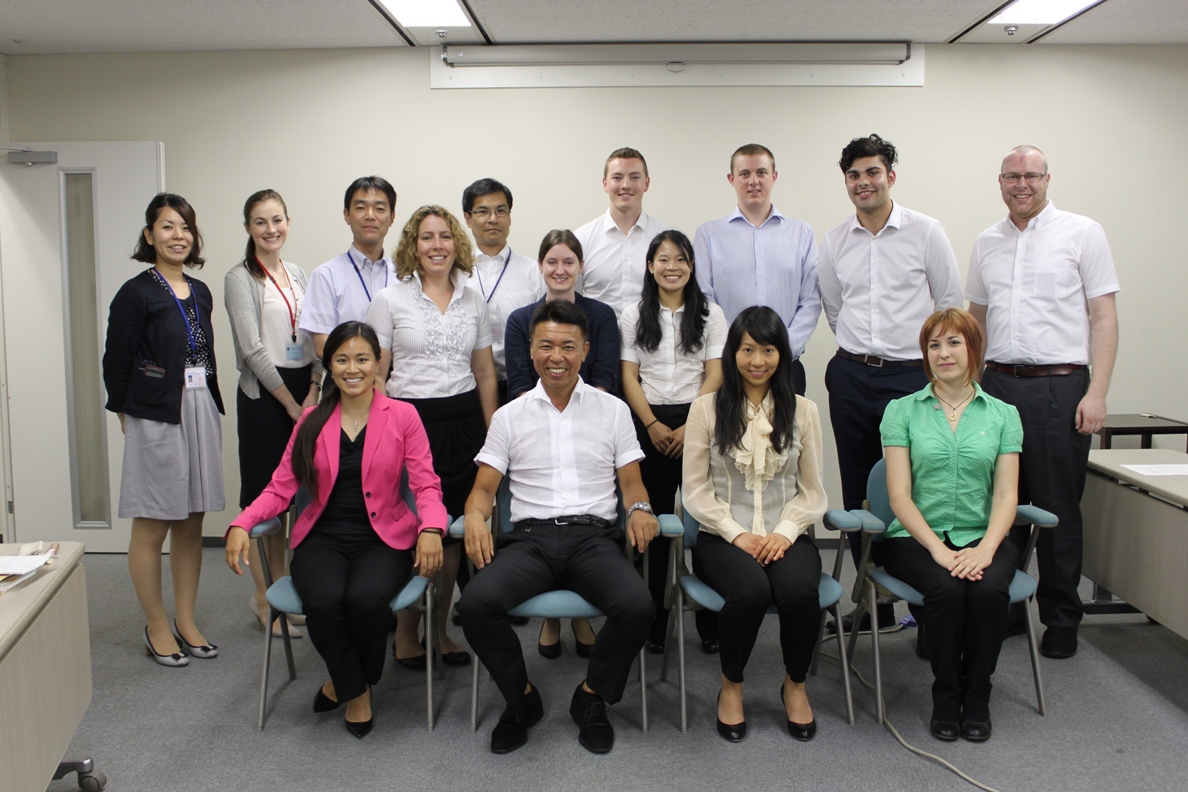
AJET Chair Kay Makishi (front row, left) at the Spring AJET Opinion Exchange Meeting in Tokyo, June 2014. (Courtesy of AJET)
By Eden Law (Fukushima-ken, 2010-11) for JQ magazine. Eden lived and worked in the core city of Iwaki on JET, and is JETAA New South Wales‘s webmaster, meaning he is the voice on all the online and social media for the Sydney-based chapter like Twitter, Instagram (both @jetaansw) and Facebook.
At the start of this year, dramatic changes took place as CLAIR (the Council of Local Authorities for International Relations) formally announced changes to its relationship with AJET (the Association for Japan Exchange and Teaching), with the full details made public by the latter on their Facebook page on a post dated January 27. The immediate outcome of this decision means that AJET’s participation and input at CLAIR-organised events such as the Tokyo Orientation and After JET conferences will be discontinued.
While AJET has had a low profile in the collective consciousness of many on the programme, these changes will inevitably impact all JET participants, most immediately in how conferences will be held and run, and how AJET will continue to represent and assist the needs of the JET community. Historically, the volunteer organisation has existed from the start of the JET Programme and is run by JETs to benefit and support participants in Japan. Now, it faces the biggest challenge of its 27-year history.
For those who may not have heard of or know about AJET, its constitution describes it as a volunteer organisation whose purpose is to foster a successful working relationship between JET Programme sponsors and participants, as well as to promote and support the JET community. In turn, it presents itself as a representative of the same community. Founded in 1987 right from the start of the JET Programme itself, AJET’s early work was very much focused on providing a support network for the first participants.
Kay Makishi (Fukuoka-ken CIR, 2011-14), 2014’s outgoing AJET chair who completed her one-year term on the AJET council, sums up her focus on the JET community: “I wanted to see more energy spent on starting projects like our Professional Development Conference Calls…[and] collaborating more with JETAA so JETs have more support finding jobs post-JET,” she explained.
JQ Magazine: Heisei Nakamura-za Kabuki Returns to NYC This Summer
Art, Article/Journalism, Celebrity, Events, JQ Magazine Comments Off on JQ Magazine: Heisei Nakamura-za Kabuki Returns to NYC This Summer

After a seven year absence, Heisei Nakamura-za brings Kabuki to New York’s Lincoln Center Festival July 7-12. (© Shochiku)
By Mark Frey (Kumamoto-ken, 2002-06) for JQ magazine. Mark served as the editor for JETAA Northern California’s Pacific Bridge newsletter from 2007-11, and is currently chapter president as well as coordinator of the JETAANC Kabuki Club.
A warm thought to heat you up as the Fourth of July approaches: real, live Kabuki is coming back to New York City July 7-12 as part of the annual Lincoln Center Festival.
This is great news for Kabuki fans in America. And if you were ever curious about Kabuki, it is a rare chance to see the real thing in your own backyard. The performance is part of a very interesting project called “Heisei Nakamura-za,” which was started about a decade ago by the late, great Kabuki actor Nakamura Kanzaburo, who passed away unexpectedly at age 57 in December 2012.
Kanzaburo wanted to give audiences the chance to experience Kabuki the way it used to be in the “good old days” of the Edo period. Back then, Kabuki was a popular entertainment for the common people. It featured smaller theaters, a more intimate relationship between actor and audience, and a more festive, earthy, raucous feel. So Kanzaburo started constructing temporary theaters in Japan and around the world that reflected this atmosphere. He extended the mood to the plays he staged, putting a contemporary spin on old classics.
In 2012, this reporter was fortunate enough to be able to see Kanzaburo perform in the last Heisei Nakamura-za theater he constructed, in Tokyo’s Asakusa district. It was an unforgettable experience. Some of the best actors of our day were walking a couple feet away from me on the theater’s modest hanamichi runway. A special energy flowed between the actors and the audience that I hadn’t felt at established Kabuki theaters. At the end of the final play, the entire back wall of the theater disappeared and we enjoyed a beautiful, open-air night view of the Sumidagawa River and the newly constructed Skytree Tower. It was a magical evening.
JQ Magazine: From JET to the U.S. Department of State, Alumni Share Their Stories
Article/Journalism, JQ Magazine, Local Government Comments Off on JQ Magazine: From JET to the U.S. Department of State, Alumni Share Their Stories
By Sheila Burt (Toyama-ken, 2010-12) for JQ magazine. Sheila is a scientific writer at the Center for Bionic Medicine, a research group located within the Rehabilitation Institute of Chicago. She blogs about urban issues and Japan at www.sheilaburt.com, and writes the column “Letters from Japan” for Gapers Block. Follow her on Twitter @smburt.
Many of those who apply to the JET Program, and for several other teaching or translation positions in Japan, have a strong interest in international relations and diplomacy. But how does one transition from being eigo no sensei to a government career in the Foreign Service?
Via email, JQ reached out to three former ALTs who now work overseas for the U.S. Department of State to learn more about how they successfully made the big jump, and how their time in Japan influenced their respective careers.
Katrina Barnas, Consular Officer in Ecuador

Katrina Barnas (Chiba-ken, 2001-02) holds a BS in journalism from Northwestern University and a Master’s in Public Administration from Columbia University’s School of International and Public Affairs. After working for nine years in higher education administration at Columbia, she joined the Foreign Service in 2013 and recently started her first tour as a Consular Officer in Ecuador, where she assists American citizens in Ecuador and interviews other nationalities interested in traveling to the U.S. for tourism, study and work. She has also been an active member of the JETAA community, serving as vice president of the JET Alumni Association of New York (JETAANY) from 2005 to 2007, and then as a founding member of its board of directors from 2006 to 2011. Here, Barnas discusses how she applied to the JET Program on a whim—and how that decision ultimately shaped her future career path.
I wasn’t sure what I wanted to do after college. I had studied journalism but in my senior year, I was no longer sure that was the path I wanted to pursue. I liked traveling and children, so when some of my friends applied for JET I decided to apply as well. It is interesting to look back on it now since at the time I did not have a strong interest in Japan, but now I can’t imagine my life without a Japanese influence.
JET helped make my choice of joining the Foreign Service less daunting because I knew that I had done this before and succeeded. Through JET, I had experienced working in another country—getting beyond just a visit and belonging someplace very different from my hometown, and I knew that although it was going to be different that I could do it.
JQ Magazine: Book Review—‘Cinema of Actuality’
Article/Journalism, Books, JQ Magazine, Reviews Comments Off on JQ Magazine: Book Review—‘Cinema of Actuality’

“Artists often make great sociological commentators, and Furuhata’s book sheds new light on the insights of these filmmakers.” (Duke University Press)
By Lyle Sylvander (Yokohama-shi, 2001-02) for JQ magazine. Lyle has completed a master’s program at the School of International and Public Affairs at Columbia University and has been writing for the JET Alumni Association of New York since 2004. He is also the goalkeeper for FC Japan, a New York City-based soccer team.
Yuriko Furuhata’s Cinema of Actuality: Japanese Avant-Garde Filmmaking in the Season of Image Politics examines a turbulent and disruptive period in Japanese history. As in other areas of the world, Japan in the late 1960s-early 1970s marked an era of youthful rebellion against the establishment, in both its public and private spheres. Furuhata’s analysis examines this period through the alternative Japanese film movements going on at the time, from New Wave figures like Masahiro Shinoda, Yasuzo Masumura and Hiroshi Teshigahara, to avant-garde filmmakers like Toshio Matsumoto and Kiyoteru Hanada. However, most of the films studied in the book are by Nagisa Oshima, largely considered to be the father of the Japanese New Wave and the “Jean-Luc Godard of Japan.” By eschewing the more traditional tendencies of the directors from Japan’s Golden Age such as Akira Kurosawa, Kenji Mizoguchi and Yasujiro Ozu, these directors incorporated such formalist experiments as jump cuts, disjointed angles, shaky handheld camerawork, pop music and, most importantly, the inclusion of television news footage.
Since many of these directors were relatively young, they shared the political sensitivities of the student protesters, who sanguinely staged media events to garner attention. The “season of politics” era was prominently displayed in nightly television newscasts, which covered a wide spectrum of politically disruptive events, from hijackings to hostage crises to mass student rallies and protests. The aesthetics of this new generation of film appropriated this contemporary media coverage in attempt to both reflect and critique it. By converging with other media cultures, these filmmakers engaged in a theory-filled dialog with the nature of representation itself, in effect becoming simultaneously media practitioners as well as theorists/critics. By making this powerful argument, Furuhata—an Assistant Professor of McGill University’s Department of East Asian Studies and World Cinema Program—forcefully disputes film scholar Noël Burch’s often-quoted notion that Japan was a cinema culture devoid of theory and serious study.
JQ Magazine: Book Review — ‘The Guest Cat’
Article/Journalism, Books, JQ Magazine, Reviews Comments Off on JQ Magazine: Book Review — ‘The Guest Cat’

“This is one of many books that you simply cannot judge by its cover. At only 140 pages, The Guest Cat touches on a surprising range of interesting topics, and even if you’re not a cat person you can find a lot to like.” (New Directions)
By Julio Perez Jr. (Kyoto-shi, 2011-13) for JQ magazine. A bibliophile, writer, translator, and graduate from Columbia University, Julio is currently working at Ishikawa Prefecture’s New York office while seeking opportunities with publications in New York. Follow his enthusiasm for Japan, literature, and board gaming on his blog and Twitter @brittlejules.
Born in 1950, Takashi Hiraide is a talented writer across many fields including genre-bending essays and highly acclaimed poetry. His prose novel The Guest Cat (translated by Eric Selland) blends both together to produce a beautiful piece that was released in English last January. It is a winner of Japan’s Kiyama Shohei Literary Award and is a best-seller in France. This is one of many books that you simply cannot judge by its cover. At only 140 pages, it touches on a surprising range of interesting topics and even if you are not a cat person, you can find a lot to like in the book. Even the narrator admits that he does not consider himself a cat lover:
“There are a few cat lovers among my close friends, and I have to admit that there have been moments when that look of excessive sweet affection oozing from around their eyes has left me feeling absolutely disgusted. Having devoted themselves to cats body and soul, they seemed at times utterly indifferent to shame. When I think about it now, rather than my not being a cat lover, it may simply have been that I feel a disconnect with people who were cat lovers. But more than anything, I’d simply never experienced having one around.”
That is not to say that Chibi, the titular guest cat, is not lovable; on the contrary, she charms everyone she meets, but do not pass on this small gem of a book thinking it is simply a chronicle of an owner doting on his pet. It is better considered a story of how a special cat brings light and life into the minds of the humans that are blessed to have her company.
JQ Magazine: JQ&A with Melody Wong on the Drop That Eggroll Podcast
Article/Journalism, Interview/Profile, Japan Trends, JQ Magazine Comments Off on JQ Magazine: JQ&A with Melody Wong on the Drop That Eggroll Podcast

“JET gave me insight into a deeper rooted area of the Japanese culture that I appreciate. There were so many similarities of Japanese culture that I saw in my Chinese culture, and it really made me appreciate both as separate entities.” (Courtesy of Melody Wong)
By Wendy Ikemoto (Ehime-ken, 2006-2011) for JQ magazine. Wendy is a Hawaii-transplant and current Secretary of the JET Alumni Association of New York (JETAANY). When she isn’t working with librarians, you’ll find her visiting JET friends around the globe.
Melody Wong (Okayama-ken, 2011-13) is a native of Los Angeles and a member of the JET Alumni Association of Southern California (JETAASC). Prior to JET, she attended the University of California at Riverside and worked in finance for half a decade before deciding to switch things up to teach English in Japan. In December 2013, she launched the Drop That Eggroll podcast with her co-host and good friend, Alex Lau. Together, they explore subjects that span across Asian ethnicities, ranging from fun topics like pretty Korean boys and Filipino cuisine to more controversial fare like the Tiger Mother’s tips for success and ANA’s “whiteface” commercial.
Six months after DTE’s launch, JQ caught up with Melody to get the scoop on how the podcast came to be, what the future holds for it, how JET has influenced her views on the Asian culture, and why you all should be tuning in.
Can you start by describing your background for us?
I’m a second-generation Chinese American, born and raised in Los Angeles. I speak Cantonese and English fluently. The only Asian country I’ve ever lived in was Japan (two years), though I’ve traveled back and forth between China and the U.S. throughout my childhood.
Where were you on JET?
I was a JET in a tiny little town called Kibichuo-cho in the Okayama Prefecture. My town was so small and rural that even people in Okayama barely knew about it. There was no train station, so no one could really get to me unless they had a car, so I drove out everywhere all the time. I was an assistant language teacher (ALT) to multiple elementary and junior high schools.
How do you and Alex know each other?
Alex and I met through our mutual friend Larry. In high school, I was an avid member of the community service club, Key Club. My high school was part of a larger division that included lots of other local high schools, which is how I met Larry. Larry attended the Art Center College of Design and became friends with his classmate Alex. Through some social engagements, Alex and I met. All three of us, including several other friends, went on a trip to Japan in 2010, which was the trip that ultimately influenced me to join the JET Program.

“With wit and humor, Miyazaki offers insight from his long career with every turn of the page. Like an unforgettable sunset or the first time a cooking experiment came out well, he discusses experiences that leave you unexpectedly changed.” (VIZ Media)
By Alexis Agliano Sanborn (Shimane-ken, 2009-11) for JQ magazine. Alexis is a graduate of Harvard University’s Regional Studies—East Asia (RSEA) program, and currently works as an executive assistant at Asia Society in New York City.
I consider myself an aficionado of director and animator Hayao Miyazaki and Studio Ghibli. Having seen his work countless times, visited the museum in Tokyo and done a fair amount of supplemental reading, I figured Turning Point—a collection of Miyazaki interviews and articles spanning 1997 through 2008 and newly translated by Beth Cary and Frederik L. Schodt—would probably be a rehash of the similar. I presumed it would be a book for Japan or anime specialists. On the back cover there’s even a quote from the L.A. Times: “Essential reading for anyone interested in Japanese or Western animation.” However, this statement is entirely too narrow and ultimately misleading.
In fact, the book (which is a sequel to Starting Point: 1979-1996, also translated by Cary and Schodt and now available in paperback) is less about animation and Japan than it is the human condition and those existential questions that keep you awake at night. Miyazaki, at one moment reserved and the other candid, plunges fearlessly into complex, introspective and intellectual issues about human’s relationship with education, child-rearing, philosophy, history, art, environmentalism and war (to name a few).
He does this with a sprinkle of romanticism and a dusting with realism. Using his seemingly continual dissatisfaction with the world, Miyazaki aims to positively spark change and inspire. He insists that his films are not just flights of fancy; rather, he makes them to motivate the next generation to improve the world. “Children learn by experiencing…it is impossible to grow up without being hurt,” he writes. “Experiences like: accepting the duality of human nature, the importance of grit, conviction, and perseverance, and respecting nature and the land….For children willing to start, our films become powerful encouragement.”
JQ Magazine: Concert Review—Yoshiki Classical World Tour Dazzles San Francisco with Surprise X Japan Guest
Art, Article/Journalism, Celebrity, JQ Magazine, Music, Reviews Comments Off on JQ Magazine: Concert Review—Yoshiki Classical World Tour Dazzles San Francisco with Surprise X Japan Guest

“The night offered something for everyone in Yoshiki’s ability to merge and bring together different genres and listeners and touch the collective beating heart therein.” (Shirong Gao)
By Shirong Gao (Shiga-ken, 2005-07) for JQ magazine. A member of JETAA Northern California, Shirong is a graphic designer, Illustrator, and breakfast food lover who worked in a Japanese countryside as seen only in Studio Ghibli movies. For more, visit gaoshirong.com.
Every night, as a child drifting off to sleep, I looped a rock ballad. My personal lullaby. A song by multi-million-selling heavy metal band X Japan, the Rising Sun’s answer to KISS. Yet not even in dreams did I see myself growing up to one day meet its leader, Yoshiki, and witness how far he’s come in his career.
A classically trained musician turned rock legend, Yoshiki has now returned to his more refined roots, embarking on a world tour of Yoshiki Classical concerts featuring music from the eponymous solo album released last year in collaboration with talents the likes of Beatles producer Sir George Martin and the London Philharmonic Orchestra.

Shirong Gao
On April 28, Davies Hall, home to the San Francisco Symphony, was packed on a Monday night to host only the second date of Yoshiki’s tour following its debut in Costa Mesa three days prior. “Definitely a different scene from a typical classical concert,” commented attendee Arisa Takahashi (Nara-ken CIR, 1991-92), who has also performed at the hall as part of the Sing Out, Davies! choral workshop. “There were people with blue hair, dressed in their frilly Lolita finery, sitting alongside classical music attendees.”
