




Jobs: Purpose Campaigns (NY)
 Jobs
Jobs  Comments Off on Jobs: Purpose Campaigns (NY)
Via JETwit and JETAANY Webmaster Lee-Sean Huang (Oita-ken, 2003-06) who works for Purpose. Please make sure to mention “JETwit via Lee-Sean” if you apply for any of these positions.
Purpose is actively hunting for a senior Movement Strategy Director and a CTO among our top priority hires. We’re also on the lookout for great talent for a Finance Manager, Creative Director, Developers, and Project Mangers – full list.
For Movement strategy Director, we want someone who can architect major projects for clients, and create and run new partnerships and incubated ventures. As you know, our 3 core disciplines are marketing/communications, strategy consulting and political organizing — so the ideal candidate will be very strong in at least one of these areas (e.g. a super talented political organizer who has helped to start or build a movement organization). Full job description
For CTO, we’re looking for a world-class team leader to oversee all aspects of technology, from the overall vision, to the buy/build/integrate decision-making process, to development and deployment of the organization’s applications and web presence, and management and growth of the technology team. Demonstrated interest in technology for social change and mass digital participation is a must. Full job description
For the right person, these roles are an opportunity to shape and direct major areas of a rapidly growing (approaching 50 people) organization.
Job: Japanese Research Institute is looking for a Japanese/Spanish bilingual research assistant, ASAP!
Jobs Comments Off on Job: Japanese Research Institute is looking for a Japanese/Spanish bilingual research assistant, ASAP!
Via Pasona, N.A. Please make sure to indicate you learned about the job via JETwit if you apply. Yoroshiku!
————————————————————————-
Japanese Research Institute is looking for a Japanese/Spanish bilingual research assistant, ASAP!
————————————————————————-
Location: Downtown NY
Position: Research Assistant
Salary: Temp – $14.00/hour (*Possible to become a permanent position)
Working Hour: 9-5/M-F
Job Description:
– Research industries and companies in South/North America .
– Have an appointment for the interview with local organization.
* Industry Example- Automobile, Energy etc.
Requirement:
– Japanese proficiency/ Reading and Writing, Spanish or Portuguese proficiency/ Speaking and reading
– Entry level is welcome.
– Basic PC skills (Word, Excel and PowerPoint)
If you are interested in this position, please contact at mtakemura@pasona.com.
New LinkedIn group: JET Alum Okane
Career, Fundraising, Networking, Return on JET-vestment Comments Off on New LinkedIn group: JET Alum Okane
All JET alumni and Friends of JET are welcome and encouraged to join a new LinkedIn group:
JET Alum Okane
http://www.linkedin.com/groups?home=&gid=4045224&trk=anet_ug_hm
For JET alumni who have an interest in, work in or aspire to work in fields related to money – i.e., finance, fundraising, investment, accounting, tax, economics, insurance, etc.
Click here for a list of all of the other JET Alum LinkedIn groups you can join.
JETAA USA e-mail subscription now available
JETAA Chapters Comments Off on JETAA USA e-mail subscription now available
FYI, you can now get JETAA USA website updates via e-mail just like many of you already do for JETwit. (I just worked with Country Rep Jessyca Wilcox to get it set up on the JETAA USA site.)
Just go to www.jetaausa.com and enter your email into the subscription field in the right sidebar.
(If you’re not already getting JETwit posts sent to your inbox, just go to the subscription field in the right sidebar on JETwit.)
Update 08/14/11: See below for responses so far from various chapters.
This survey is intended to help figure out how much collaboration exists between JETAA chapters and the Japan-America Societies in their area.
It comes on the heels of having a chance to talk with and listen to Peter Kelley, President of the National Association of Japan America Societies (NAJAS), and JET alum Marc Hitzig, Deputy Director of the Japan-America Society of Washington, D.C., who both spoke at the JETAA National Conference in Washington, D.C. a couple weeks ago, as well as a recent conversation with Japan Society of Boston‘s President, Peter Grilli, and Program Marketing Manager (and JET alum) Bhaird Campbell.
*Please e-mail responses to Steven Horowitz (Aichi-ken, Kariya-shi, 1992-94) at jetwit [at] jetwit.com or post in the comments section below.
From talking to JETAA officers at various conferences and in other contexts, it seems that each JETAA chapter has it’s own unique relationship with its local Japan-America Society (JAS). And of course every JAS has its own unique characteristics.
As a result, I’d like to ask JETAA chapters cooperation with:
- Gathering responses from JETAA chapters that comment on or share some of the collaborations with JAS that have been successful or beneficial in various ways; and
- Getting a sense of what the relationship history has been, whether any JET alums work for the JAS and any additional thoughts you might have on the topic.
For example:
- With respect to JETwit, I started just subscribing to all of the JAS e-mail lists which led to an ongoing and periodic Japan-America Society Round-up post, now written by Gail Meadows (Hiroshima-shi 2007-10).
- In Washington, D.C., the Japan America Society, among other things, runs the annual Cherry Blossom Festival which attracts thousands of people and involves many JET alum volunteers who play a very significant role in running the event. It also happens to have a JET alum, Marc Hitzig, working there, and another JET alum, Laurel Lukaszewski, who previously served as the organization’s Executive Director.
- In Minnesota, apparently there’s usually a JETAA Minnesota officer who is active on the Board of the Japan America Society in Minneapolis.
There are clearly many more great examples of collaboration and a lot more info to gather. By gathering the information here, I hope to get a bigger picture sense of the JETAA chapter relationship with JAS and figure out if there are ways to foster greater collaboration and sharing of info and ideas in the future.
As responses are received, I’ll add the text to this post so that it becomes a record and a resource available to JETAA chapters and to JAS.
Why? This ties in with the “Return on JET-vestment” concept as well as with big picture strategic thinking about the future of JETAA and JET. It’s a first step that will hopefully shed light on the topic and open up new ideas and opportunities.
*Please e-mail responses to Steven Horowitz (Aichi-ken, Kariya-shi, 1992-94) at jetwit [at] jetwit.com or post in the comments section below.
Yoroshiku onegaishimasu!
********************************
Updated 08/20/2011
Apropos of nothing, here’s a great piece by Rick Ambrosio (Ibaraki-ken, 2006-08) about a recent film event at Japan Society in New York featuring an appearance by Sora Aoi.
********************************
9. JETAA Heartland & The Heart of America Japan-America Society
Via JETAA Heartland President Warren McAllen:
I’m not sure how far back JET Alum involvement with JAS goes, but I do know that we have had members in common with The Heart of America Japan-America Society almost as long as there has been a chapter in KC and several of our members have held positions on the JAS Board over the years.
We have a joint event this weekend, HJETAA and HoA JAS co-sponsor the Japan Pavilion at the Greater Kansas City Ethnic Enrichment Festival (http://www.eeckc.org/). We promote JET and recruit new members (and find some who have slipped through the cracks over the years) and help JAS with their fundraising efforts. We may, eventually, do our own fundraising at this event attended by 10′s of thousands of people.
We also sponsor networking events with JAS and other Japan-related org’s two or three times a year. Last year we organized a food tasting for the UMKC Jazz Band and JAS members who were selected to perform at the National Culture Festival in Kurashiki, Okayama, Kansas City’s Sister City.
Of course, we have a booth at the GKC Japan Festival and our members are involved in many phases of the organization and execution of the festival (I was almost it’s Executive Director, at one point). This year we have volunteered to do a presentation on JET and the Alumni Association on one of the event stages as well.
This year we worked with JAS to inaugurate the GKC Japanese Film Festival and look forward to continued cooperation on future film festivals. We also worked together on disaster relief fundraising
Naturally, we promote each other’s events and I recommend the JAS to all JET recruits and returning members. We’ve talked about reciprocal membership but we’re still negotiating.
On an individual basis, many of our members are also in JAS and are involved in varying ways from simple membership and volunteering to serving on the board, as I mentioned earlier, organizing events and making presentations.
Tsunami: JET alum Harvard professor Ian Miller’s NY Times article
Academic, Article/Journalism, Earthquake Tsunami, Japan Local, JETs in the News, Notable JET Alums, Return on JET-vestment, Writers Comments Off on Tsunami: JET alum Harvard professor Ian Miller’s NY Times article

Harvard history professor Ian Miller (Miyagi-ken, Miyako-shi)
*************
Thanks to a recent conversation with Peter Kelley, President of the National Association of Japan-America Societies, I just learned of this New York Times article by Harvard history professor and JET alum Ian Miller (Miyagi-ken, Miyako-shi) which ran March 19, 2011.
Bitter Legacy, Injured Coast
http://www.nytimes.com/2011/03/20/opinion/20miller.html?_r=1&pagewanted=1
By IAN JARED MILLER
Cambridge, Mass.
THE rugged Sanriku Coast of northeastern Japan is among the most beautiful places in the country. The white stone islands outside the port town of Miyako are magnificent. The Buddhist monk Reikyo could think of nothing but paradise when he first saw them in the 17th century. “It is the shore of the pure land,” he is said to have uttered in wonder, citing the common name for nirvana.
Reikyo’s name for the place stuck. Jodogahama, or Pure Land Beach, is the main gateway to the Rikuchu Kaigan National Park, a crenellated seashore of spectacular rock pillars, sheer cliffs, deep inlets and narrow river valleys that covers 100 miles of rural coastline. It is a region much like Down East Maine, full of small, tight-knit communities of hardworking people who earn their livelihoods from tourism and fishing. Sushi chefs around the country prize Sanriku abalone, cuttlefish and sea urchin.
Today that coast is at the center of one of the worst disasters in Japanese history. Despite the investment of billions of yen in disaster mitigation technology and the institution of robust building codes, entire villages have been swept out to sea. In some places little remains but piles of anonymous debris and concrete foundations.
I taught school in Miyako for more than two years in the 1990s, and it was while hiking in the mountains above one of those picturesque fishing villages that I came across my first material reminder of the intricate relationship between the area’s breathtaking geography, its people — generous and direct — and powerful seismic forces.
On a hot summer day a group of middle-school boys set out to introduce me to their town, a hamlet just north of Pure Land Beach. While I started up the steep mountainside the children bounced ahead of me, teasing me that I moved slowly for someone so tall. “Are you as tall as Michael Jordan, Miller-sensei?” yelled one boy as he shot past me up the trail.
“Not quite,” I told him, pausing on a spot of level ground to look out over the neat collection of tile roofs and gardens that filled the back of a narrow, high-walled bay.
“What is this?” I asked, pointing to a mossy stone marker that occupied the rest of the brief plateau. A chorus of young voices told me that it was the high-water mark for the area’s biggest tsunami: more than 50 feet above the valley floor.
“When was that?” I asked, but the boys couldn’t say. Read More
JETwit needs your help identifying any earthquake/tsunami/nuclear disaster relief projects or efforts that have been started, organized, managed or otherwise undertaken by JETs or JET alumni.
What else is missing from this list?
View Japan Relief Efforts in a larger map
View Japan Relief Efforts in a larger map
The ones we’re aware of to date (8/12/11) are:
1. Smile Kids Japan (founded by Mike Maher-King (Fukui-ken, 2006-11) collaborating with Tokyo-based NPO Living Dreams to form the Smiles & Dreams Tohoku Kids’ Project (among other efforts).
2. The Fruitree Project, started by Paul Yoo (Akita-ken), which has now evolved into Volunteer AKITA and has led to the Big CLEAN which has already brought volunteers to help cleaning efforts in Kessenuma.
3. I’ve heard that Fukushima JETs have been organizing efforts to clean up the beaches, but I don’t have any details. Can anyone provide more info?
4. Hearts For Haragama (http://hearts4haragama.wordpress.com). Billy McMichael (CIR Fukushima) is one of the 7 founders of project aimed at raising funds for the Haragama Youchien kindergarten in Soma, Fukushima. (Thanks to former JETAA DC President Michelle Spezzacatena for passing this on.)
5. “Kat Geeraert, an ALT in Soma (Fukushima), is doing an amazing job with her foundation “Friends of Soma.” http://www.somafriends.com/ (Thanks to Catherine Lefrancois (JHS ALT in Fukushima-ken, Fukushima-shi) for passing this on.)
6. AJET is playing a significant role in facilitating and coordinating volunteer efforts for current JETs and has also been collaborating with other good organizations/efforts such as Peace Boat, Foreign Buyers Club and 5toSurvive. (Thanks to Cailin Arena (Osaka) for passing this on.)

7. “Save Miyagi was founded by Canon Purdy (Miyagi-ken, 2008-10) to help out students in Minamisanriku. Canon is currently back in Japan, working with officials to see where the money will be used.” (Thanks to Jen Wang (Miyagi-ken) for passing on the info.)
8. Hotdogs and Hugs is an aid organization formed by Saga-ken JETs. Among other things, they organized a volunteer group that traveled all the way from Saga (western Kyushu) up to Tohoku, collecting donations and fundraising along the way. (Thanks to Ling Tran (Saga-ken, Yoshinogari-shi, 2009-11) for passing on the info.)
9. Osaka AJET: “We have done extensive food drives and collections through our schools we work in, those goods, money, supplies have then been coordinated with Kozmoz International (A small not-for profit in Kyoto) and we have taken the needed items to Tohoku ourselves. We will be doing another drive across Osaka, hopefully in dozens of schools where JETs are placed from the start of this second term.” (Thanks to Matthew Cook, who serves as both AJET Chair and is a member of Osaka AJET, for sharing this info.)
10. The MUD Project: It turns out that Colin Renie (CIR Yamagata-ken, 2007-10) has been running a volunteer project that has enabled many JETs to volunteer in Tohoku with particular emphasis on Minamisanriku as well as other areas of Miyagi and Iwate. Lots of good info, photos and updates on the project’s Facebook page: https://www.facebook.com/mudproject
**********
What else is missing from this list?
Please post to the comments section or e-mail jetwit [at] jetwit.com with more info.
Yoroshiku!
***************
This editorial in support of the JET Programme by Hitoshi Tanaka appeared originally in Japanese in The Mainichi Daily News. Thanks to Jim Gannon (Ehime-ken, 1992-94), Executive Director of the Japan Center for International Exchange (JCIE/USA), for sharing the article. And special thanks to Laura Kamutaka (CIR Miyagi-ken, Shiogama-shi, 2005-07) for translating it into English.
Don’t Cut Funding of Grassroots Exchange: Earthquake reveals and affirms overseas bond
http://www.jri.co.jp/MediaLibrary/file/report/tanaka/pdf/5570.pdf
Tanaka Hitoshi, Chairman, Institute for International Strategy, Japan Research Institute
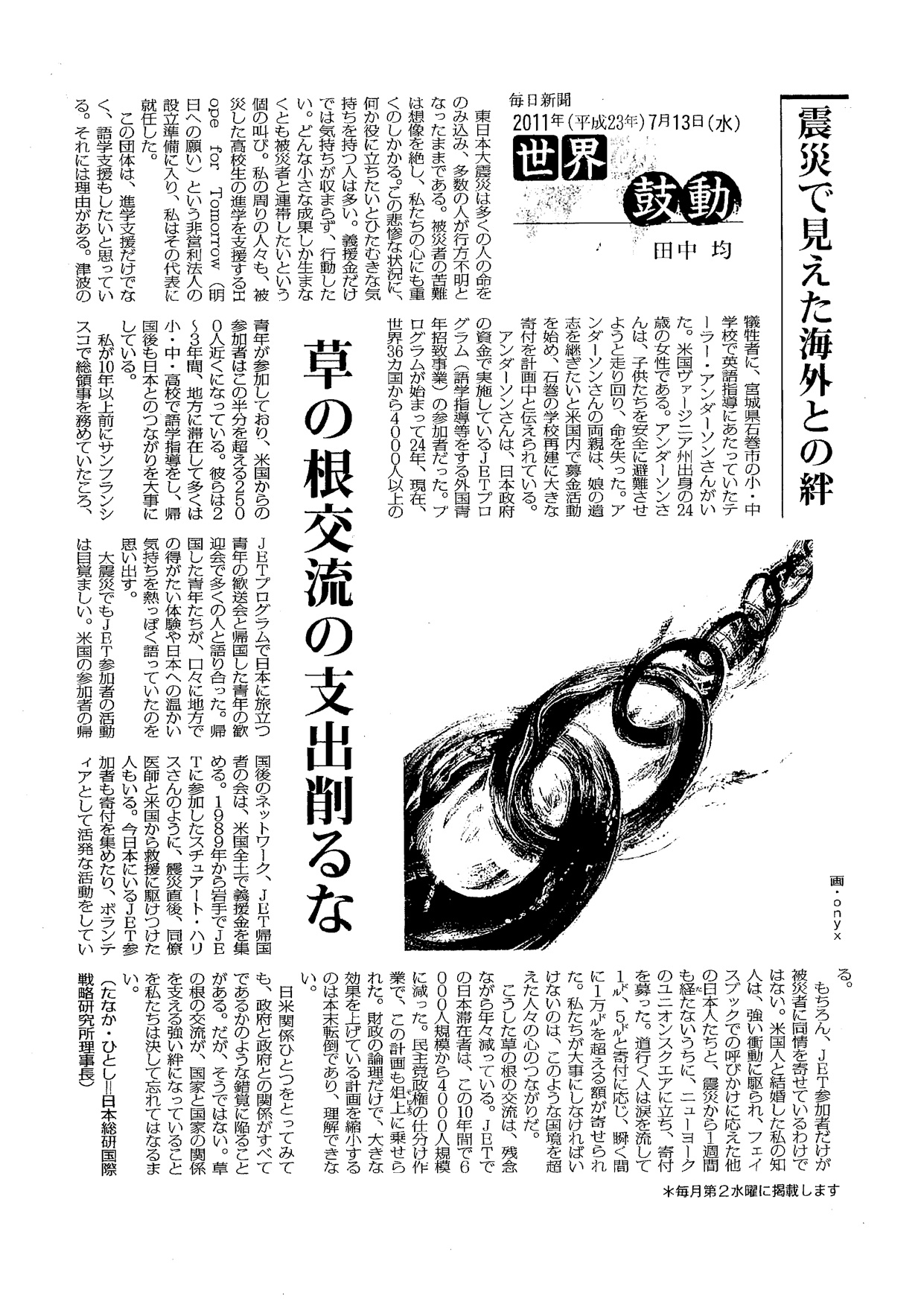
The Tohoku earthquake swallowed many lives and left many missing. The unimaginable hardship of the disaster victims weighs heavily on our hearts, and many of us have a strong desire to help with this tragic situation. People who want to take action beyond making a charitable donation. People who want to work together with the disaster victims in any capacity, no matter how small the achievement. Some of those around me set up a nonprofit called Hope for Tomorrow to assist high school students affected by the earthquake, of which I’ve become a representative.
”Hope for Tomorrow” is designed to not only assist the students advancement but to help develop their language skills as well. There’s a reason for this. One of the tsunami victims was Taylor Anderson, an Assistant Language Teacher in Ishinomaki City of Miyagi Prefecture who taught English at both elementary and junior high schools. After the earthquake, the 24-year-old Virginia, US native worked to ensure her students’ safety and, in doing so, lost her life. In honor of her memory, Anderson’s parents have been collecting US donations with the intention of sending them to Japan to help restore school in Ishinomaki.
Anderson was in Japan through the JET Program, a Japanese government program that invites international youth to help Japanese students with foreign language instruction. After 24 years of existence, the program currently boasts over 4,000 participants from 36 countries, with over half coming from the United States. Most participants stay in Japan from two to three years, teach elementary to high school-level Japanese students, and maintain a strong bond with Japan even after returning to their home countries.
Ten years ago when I served as the Consulate General in San Francisco, I spoke with both JET participants who were about to leave for Japan and those that had recently returned. I remember those that returned all spoke passionately of their experiences and had great affection for Japan.
Even the JET participants’ response to the earthquake is remarkable. The JET Alumni Association has chapters across the country working to fundraise for relief efforts. There are those such as Stuart Harris, a JET participant in Iwate prefecture in 1989 who assembled a team of doctors right after the earthquake to provide relief to Japan. JET participants currently in Japan have also collected donations and vigorously volunteered to the relief effort.
Of course, it isn’t only the JET participants that have shown compassion towards Japan. A friend of mine who married an American found a network of people on Facebook, leading them to New York’s Union Square to collect donations less than a week after the earthquake. Passersby would donate cash and in no time more than $10,000 had been raised. We need to protect these precious bonds that transcend national lines.
Unfortunately, this kind of grassroots exchange has been decreasing each year. The number of JET participants has gone from 6,000 participants 10 years ago to 4,000. The Democratic Party of Japan has included the JET program in its budget cuts. From a financial standpoint alone, it seems counterintuitive to shrink a program that yields such positive results.
It is easy to see the Japan-US ties mainly through the relationship between the two governments. But that’s not true. Grassroots exchange is what sustains the important bond between the two countries and is something we must never forget.
Japanese students from Taylor Anderson and Monty Dickson’s towns in to visit U.S. as “envoys”
Cultural Outreach, Earthquake Tsunami, JETs in the News Comments Off on Japanese students from Taylor Anderson and Monty Dickson’s towns in to visit U.S. as “envoys”
Thanks to Andy Anderson, father of Taylor Anderson, for forwarding this article from The Mainichi Daily News:
http://mdn.mainichi.jp/mdnnews/news/20110712p2g00m0dm004000c.html
16 students from quake-hit prefectures to visit U.S. as ‘envoys’
FUKUSHIMA, Japan (Kyodo) — A total of 16 junior and senior high school students from the three prefectures severely affected by the March 11 earthquake and tsunami will visit the United States next month at the invitation of the U.S. government to serve as teen envoys delivering the voices of those affected by the disaster, according to prefectural officials and other sources.
Ten of the 16 were selected from junior high schools in Rikuzentakata, Iwate Prefecture and Ishinomaki, Miyagi Prefecture, where two Americans, Montgomery Dickson, 26, of Alaska and Taylor Anderson, 24, of Virginia, fell victim to the tsunami while serving as assistant language teachers, they said.
From Fukushima Prefecture, which hosts Tokyo Electric Power Co.’s crisis-hit Fukushima Daiichi nuclear power plant, a group of six senior high school students will join. The six boys and girls currently attend school as evacuees and include members of a baseball team.
A consul in charge of the three prefectures and other areas at the U.S. Consulate General in Sapporo said the program is intended to encourage Japanese youth and will be an opportunity for American students to learn about the disaster from them and understand why it is necessary to give support.
Under the plan, the 16 will stay in Pennsylvania and other locales for two weeks starting Aug. 10, with the United States covering travel and accommodation expenses.
Their itinerary includes practicing baseball and softball with American teens and meeting with Cal Ripken Jr., who played in a record 2,632 consecutive major league games.
Dickson was teaching until the day of the disaster, according to sources including the Council of Local Authorities for International Relations, which dispatches assistant language teachers under the Japan Exchange and Teaching Program. Dickson was at the city’s education board when the tsunami struck and was swept away with its building, they said.
Anderson stayed with her elementary school pupils until their guardians came to pick them up before heading home on a bicycle, they said. It is believed she was struck by the tsunami on her way, they said.
The trip participants include five female junior high school students who were taught English by Anderson.
“This is an exchange project to honor the two who died while on their way to accomplish their goals, and we are grateful to the U.S. government,” said an official at the council. “We hope that the students will have exchanges with many people in the United States,” the official said.
(Mainichi Japan) July 12, 2011
Volunteer translators needed for JET alumni Japan disaster relief project
Earthquake Tsunami, Fundraising, Return on JET-vestment, Translating/Interpreting, Volunteer Comments Off on Volunteer translators needed for JET alumni Japan disaster relief project
We may need a team of professional-level translators to help with an upcoming JET alumni project related to disaster relief efforts in Japan. Timing would likely be late September and October.
If interested, please e-mail Steven at jetwit [at] jetwit.com with “Translator” in the subject heading. No commitment necessary right now.
Reminder: You can also click here to join the JET Alumni Translators & Interpreters LinkedIn group.
Background:
Apologies for lack of detail at this point as the project idea is still in the process of being thought through by a couple JET alumni well-placed to set this up.
But the idea, generally speaking, relates to the fact that Japan’s non-profit/civil society sector and culture tends to be less established compared to that of the U.S. In the wake of the Tohoku earthquake/tsunami, many new Japanese organizations have formed and many existing small ones have taken on new roles and responsibilities.
One area they apparently tend to lack is familiarity with grant seeking and applying for grants. There are a number of U.S. foundations and other organizations that have been raising money but have struggled in trying to figure out how to get it to the organizations that could really use it. Part of the obstacle appears to be the grant making process. Grant making organizations tend to need to track and account for how money is doled out and used. And the application and reporting process are key.
Translation of many of these documents into English would of course be a key step for helping U.S. organizations in their efforts to communication with Japanese grant seekers. And this is of course a potentially significant way for the JET alumni community to continue to serve as a bridge to Japan.
Please contact Steven at jetwit [at] jetwit.com if potentially interested in helping.
Yoroshiku!
JET alumni to revisit Tohoku to help boost tourism
Earthquake Tsunami, JETs in the News, Notable JET Alums, Return on JET-vestment, Travel/Tourism, Volunteer Comments Off on JET alumni to revisit Tohoku to help boost tourism
———————
Via Mainichi Daily News:
http://mdn.mainichi.jp/mdnnews/news/20110729p2g00m0dm010000c.html
JET alumni to revisit Tohoku to help boost tourism
(photo caption: Greg Lekich and other volunteers are pictured in Tagajo, Miyagi Prefecture, on April 20. (Photo courtesy of Greg.))
TOKYO (Kyodo) — About 20 former English teachers and international relations coordinators at local government offices will revisit places in northeastern Japan, where they used to work, on a Japanese government program aimed at boosting tourism affected by the March 11 quake and tsunami, Japanese officials said Thursday.
As the first batch of the program participants, 14 alumni of the Japan Exchange and Teaching Program from Australia, Britain, Canada and the United States will make a weeklong visit to places of their former assignments in Iwate, Miyagi and Fukushima prefectures from Monday, they said.
The participants are required to write about their experiences and impressions of the current situation in the Tohoku region in their contributions to the media, including social networking sites Facebook and Twitter, the officials said.
The program will last for two months and the Japanese government is shouldering travel expenses for the JET alumni.
(Mainichi Japan) July 29, 2011
******************
Thanks to Japan Society of Boston President Peter Grilli for passing this on:
July 19, 2011
The Maureen and Mike Mansfield Foundation
and
The Japan Foundation Center for Global Partnership
Announce Recruitment for the Second Group of Participants for the
“U.S.-Japan Network for the Future” Program
[JETwit note: FYI, JET alum David Boling was recently appointed Deputy Executive Director at the Mansfield Foundation.]
The Maureen and Mike Mansfield Foundation and the Japan Foundation Center for Global Partnership, after a successful inaugural program, are pleased to announce the recruitment of a new group of participants for the “U.S.-Japan Network for the Future” program. This program was launched in 2009 to foster a new generation of Japan specialists. The inaugural group of fifteen Network participants has met regularly throughout 2010 and 2011 to build their knowledge of Japan, their policy expertise, and their contacts in Japan-related policy circles. The Foundation and CGP are pleased to make this opportunity available to a second group of emerging Japan specialists.
Purpose of the Program
The purpose of the “U.S.-Japan Network for the Future” program is to identify American professionals who demonstrate an interest in and potential for becoming Japan specialists and policy intellectuals and to support them in this effort. The network will include Japan specialists from all regions of the U.S. with diverse expertise and perspectives and the ability to participate constructively in the bilateral policymaking process and to contribute to U.S.-Japan understanding. The program seeks to nurture a new generation of scholars and professionals working on the following policy areas: U.S.-Japan security relations; U.S.-Japan economic relations; regional cooperation; issues where the two countries confront common domestic challenges (such as aging societies or income inequality); and issues where the two countries have opportunities to work together to resolve global challenges (such as climate change or food security).
Eligibility and Terms
Applicants must be American citizens or permanent residents who are currently and actively involved in the U.S.-Japan dialogue and have a working knowledge of the Japanese language, The program is targeted at scholars with a professional interest in Japan, and professionals who have a strong engagement with Japan and who have work experience in policy-relevant fields. In addition to having an interest in public policy, successful applicants will be able to demonstrate their interest in and potential for becoming future leaders in the U.S.-Japan relationship.
Because we are seeking to identify a future generation of leaders, our preference is for candidates in the mid-career stage. In the academic context, normally this translates into scholars at the advanced assistant or early associate professor levels. Policy professionals should have a Master’s degree and at least five years of Japan and Asia experience.
Participants must be fully dedicated to the two-year program and able to participate in all scheduled meetings. Network participants will be expected to participate in: a two-day workshop in Washington, D.C. (January 2012); a week-long meeting in Washington, D.C. (June 2012); a two-day retreat in Montana (autumn 2012); a week-long Japan study trip (June 2013); and a January 2014 public symposium and current issues panel discussions.
Throughout the two-year program, participants will be expected to: develop their network of contacts; engage with other Network members; engage others in the academic and policy fields with what they have learned about Japan; prepare for and actively participate in the program’s meetings, workshops, and study trip; participate in group activities and support the program’s larger goals and objectives; conduct independent research on key issues of particular interest to them; produce op-ed pieces and commentary/blog posts on important policy issues in U.S.-Japan relations; and produce and seek to publish or otherwise disseminate a brief policy paper. Network participants will present their papers and discuss current issues in the region during the last meeting, the January 2014 public symposium in Washington, D.C.
Financial support for those selected is limited to coverage of travel, accommodations, and meal expenses associated with participation in program meetings and study trips. Program participants may be eligible to compete for cash awards contingent upon publication of their pieces.
Applications and Selection
For an application and application instructions, please go to: http://www.mansfieldfdn.org/programs/networkforthefuture.htm.
Applications are due October 3, 2011 and can be submitted electronically to hr@mansfieldfdn.org or by mail to: The Maureen and Mike Mansfield Foundation, 1401 New York Avenue, NW, Suite 740, Washington, D.C. 20005. Applications will be reviewed by a selection committee and participants will be announced by mid-November, 2011. The Foundation and CGP will select up to fifteen Network participants for this program.
For further information, please contact Sam Dundon, Program Associate, The Maureen and Mike Mansfield Foundation, (202)-347-1994.
Organizers
The Maureen and Mike Mansfield Foundation is a 501(c) 3 organization that promotes understanding and cooperation in U.S.-Asia relations. Maureen and Mike Mansfield’s values, ideals and vision for U.S.-Asia relations continue through the Foundation’s exchanges, dialogues, research and educational programs, which create networks among U.S. and Asian leaders, explore the underlying issues influencing public policies, and increase awareness about the nations and peoples of Asia. The Foundation has offices in Washington, D.C.; Tokyo, Japan; and Missoula, Montana. Please visit the website at http://www.mansfieldfdn.org/
The Center for Global Partnership (CGP) is a part of the Japan Foundation which is a Japanese Independent Administrative Institution (Dokuritsu Gyosei Hojin). To enhance dialogue and interchange between Japanese and U.S. citizens on a wide range of issues, CGP operates grant programs as well as self-initiated projects and fellowships. CGP has offices in Tokyo, Japan and New York, New York. Please visit the website at http://www.cgp.org
Former Yankee pitcher Hideki Irabu dies in apparent suicide; JET alum served as his translator
Celebrity, Japan Trends, Notable JET Alums, Translating/Interpreting Comments Off on Former Yankee pitcher Hideki Irabu dies in apparent suicide; JET alum served as his translator
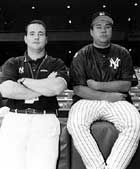
JET alum George Rose (left) in his role as translator for Hideki Irabu (right).
**************
Former star pitcher Hideki Irabu was apparently found dead in his apartment by friends.
Notably, former JETAA New York President George Rose had served as Irabu’s translator during his time with the Yankees when they won the World Series.
Rest in peace, Irabu-san. Thanks for the memories and for doing your part to bridge the culture gap.
JET alum Rob Cornilles considers second shot at Congress following David Wu resignation
Celebrity, JETs in the News Comments Off on JET alum Rob Cornilles considers second shot at Congress following David Wu resignation
This article in the Beaverton Valley Times about the David Wu sex scandal and resignation mentions JET alum Rob Cornilles as one of the Republicans who may run for the vacancy. Rob lost to Wu in the last election with 42% of the vote.
http://www.beavertonvalleytimes.com/news/story.php?story_id=131181238478965800
Video: Panel discussion with JET alums Anthony Bianchi, Laurel Lukaszewski and Jim Gannon
Career, Celebrity, Interview/Profile, Notable JET Alums, Return on JET-vestment, Video Comments Off on Video: Panel discussion with JET alums Anthony Bianchi, Laurel Lukaszewski and Jim Gannon
Thanks to JET alum and Inuyama City Council Member Anthony Bianchi (Aichi-ken, Inuyama-shi, 1988-89) for sharing the video below (in four parts) taken by his son Matthew of a panel discussion from the JETAA USA National Conference held in Washington, D.C. July 14-17.
The panel featured Bianchi along with fellow JET alums Laurel Lukaszewski (Kagoshima-ken, 1990-92) (sculptor artist and former Executive Director of the Japan-America Society of Washington, D.C. as well as former President of Pacific Northwest JETAA) and Jim Gannon (Ehime-ken, 1992-94), Executive Director of the Japan Center for International Exchange (JCIE/USA), and was moderated by JETwit publisher Steven Horowitz (Aichi-ken, Kariya-shi, 1992-94).
Part 1
Part 2
Part 3
Part 4
