




Jobs: Wall Street Journal/Dow Jones Newswires (Tokyo)
 Jobs
Jobs  Comments Off on Jobs: Wall Street Journal/Dow Jones Newswires (Tokyo)
Request received directly from Wall Street Journal/Dow Jones Newswires (Tokyo) (where notably a number of JET alums work or have worked):
Steven:
Thanks very much for your offer to help me spread the word about opportunities in The Wall Street Journal/Dow Jones Newswires Tokyo bureau.
At a time when other American media are cutting back in Japan, we’re expanding. We’ve created a new Japanese language website and a new Japan RealTime blog. We’ve got a number of openings, due both to newly created positions and to vacancies. I’m biased, of course, but I think this is a uniquely incredible chance for anybody interested in Japan journalism.
We’ve recently integrated The Wall Street Journal and Dow Jones Newswires bureaus here, so everybody works for both. Everyone writes for the paper, WSJ.com, and the wires. Our openings span a wide range of experience levels and subjects. We’re looking for managers, reporters, and desk editors for beats ranging from policy to markets to finance. The main criterion we have is a very strong preference for people who can report — do interviews, attend press conferences, read documents — in Japanese. That’s why I’m tapping into your network. We’ve had great success with JET alums who can work in Japanese at the highest levels.
Anybody who’s interested in finding out more can contact me at: jacob.schlesinger@wsj.com. Also, below are some specific listings, with online application links.
Best,
Japan Editor, The Wall Street Journal/Dow Jones Newswires.
Wall Street Journal/Dow Jones Tokyo finance reporter:
This reporter will cover finance, M&A, and broader capital market trends in one of the world’s leading economies for WSJ. The ideal candidate will have a proven track-record of scoops. Japanese fluency preferred. The Journal Tokyo bureau is integrated with Dow Jones Newswires, and this reporter will work closely with the DJN team, filing in real-time for wires and the web, as well as for the paper.
Application link: https://newscorp.taleo.net/careersection/djexternal/jobdetail.ftl?lang=en&job=000101957
Dow Jones Newswires/Wall Street Journal Tokyo economy/economic policy reporter:
This reporter will join our economics team, covering economic reports, and fiscal and monetary policy. The ideal candidate will have some background and knowledge of the subject and some journalism experience. Japanese fluency preferred. The job will involve the full spectrum of news reporting: flashing headlines and filing stories in real-time for Newswires and WSJ.com, as well as writing news and feature stories for the newspaper.
Application link: https://newscorp.taleo.net/careersection/djexternal/jobdetail.ftl?lang=en&job=000102065
Dow Jones Newswires/Wall Street Journal Tokyo markets reporter
This reporter will write about all aspects of the Tokyo shares market, including blue chips and companies in the news, derivatives, and the Nikkei 225 Stock Average. The main responsibility will be giving investment professionals real-time, comprehensive intelligence on the Tokyo stock market, via Market Talk. One of Newswires’ most popular services, Market Talk provides readers with a constant stream of short, analytical items on newsworthy market events–the stock reporter can expect to do several of these items an hour while the exchange is open. This person will also write longer stories on key market developments and trends. Many of the reporter’s stories will be published online at WSJ.com and by the Wall Street Journal. Experience with financial journalism, and specific experience covering markets preferred. Knowledge of Japanese is essential.
Application link:https://newscorp.taleo.net/careersection/djexternal/jobdetail.ftl?lang=en&job=000102356
Dow Jones Newswires/Wall Street Journal Tokyo deputy bureau chief, money/policy:
As deputy Tokyo bureau chief for money/policy in the integrated DJN/WSJ office, this person will run coverage of the Japanese economy and economic policy, managing a group of reporters following the Bank of Japan, the Ministry of Finance, the Prime Minister’s office, and the Diet. S/he will craft ideas and edit/file stories, from flashing headlines and real-time fills for Newswires and WSJ.com, to handling news and feature stories for the newspaper. We’re looking in particular for a candidate with a proven track record of breaking market-moving news and analysis in these crucial areas. This manager will also be responsible for mentoring the team, helping develop further their reporting and writing skills. Japanese fluency strongly preferred.
Application link: https://newscorp.taleo.net/careersection/djexternal/jobdetail.ftl?lang=en&job=000101681
Dow Jones Newswires/Wall Street Journal Tokyo copy editor:
The Dow Jones Newswires/Wall Street Journal Tokyo bureau is seeking a copy editor to join our news desk. The ideal candidate will have the right mix of experience in the field of journalism, knowledge of financial markets, and Japanese language ability. More importantly, we’re looking for someone who has a keen attention to detail, a knack for tracking down the top news of the day, and skill at multitasking. We’d like an editor who can turn an ordinary news article into the extraordinary on an extremely tight deadline. This position would be perfect for an experienced veteran or someone looking to gain a foothold in the fast-paced world of financial journalism.
Application link: https://newscorp.taleo.net/careersection/djexternal/jobdetail.ftl?lang=en&job=000102135
#####
WIT Life #135: Marathon mania
Events, Translating/Interpreting, Uncategorized, WIT Life, Writers Comments Off on WIT Life #135: Marathon mania
WITLife is a periodic series written by professional Writer/Interpreter/Translator Stacy Smith (Kumamoto-ken CIR, 2000-03). She starts her day by watching Fujisankei’s newscast in Japanese, and here she shares some of the interesting tidbits and trends together with her own observations.
We are in the heart of marathon season, a favorite time of year for runners such as myself. I have to admit that I love the sport enough to attempt to do two marathons in a row, the Marine Corps Marathon in DC last weekend and the NYC Marathon this weekend. It will be a first but hopefully my body is up to the challenge!
The running culture has always been huge in Japan, and with the establishment of the Tokyo Marathon in 2007 the number of runners further swelled. Although I have gotten into the marathon every year since its start (and run all but one), most of my Japanese friends Read More
Hokkaido JET Annual Musical Production Tradition Continues
Article/Journalism, Music, Writers Comments Off on Hokkaido JET Annual Musical Production Tradition Continues
Snow, Sea and Song
Hokkaido’s hills are alive with the sound of music, thanks to the efforts of its ALTs
 By Caroline Cronshaw (Hokkaido, 2006-09) – Caroline is an amateur illustrator and instructor at the University New Brunswick in Saint John, New Brunswick, Canada. She has painted and designed posters for the HAJET Hokkaido Players’ productions for the past four years, and is currently working 2011’s poster as of this article. Her work can be seen at http://carrie-ko.deviantart.com.
Whether they choose to go to Hokkaido or not, several hundred new JET participants, some of whom have never seen a snowflake before in their lives, come to live on the northernmost island in the Japanese archipelago each year.
Hokkaido, with its vast tracts of wilderness and ghostly former coal mining towns, can cause even the most steadfast and Canadian of JETs to surrender to homesickness and cabin fever during its long and snowy winters. It’s those same cold and white expanses that probably inspired the Ainu peoples to come up with place names like Shiretoko – ‘the ends of the earth’. Indeed, it’s not easy being a homesick alien living in a half-buried BOE-owned hut in midwinter.
Thankfully, however, the ALTs of Hokkaido have come up with an unusual cure for the winter blues: musical theatre.
Since the mid-1990s, denizens of many Hokkaido communities have been witness to a mysterious caravan of vans and cars rumbling into town on a Friday night and parking in front of a local community centre or temple. These vehicles, laden with wooden planks and props, belong to none other than the members of the HAJET Hokkaido Players, an amateur theatre troupe comprised of JET participants from across the island. While some members do have experience in acting or stage production, there is no requirement except dedication and the desire to help bring international understanding to the people of Hokkaido. The troupe is partly administered by HAJET, the Hokkaido AJET chapter, and is entirely non-profit. If there is money left over or gained from performances, most of it is used to sponsor the Hokkaido English Challenge, an annual non-profit English-language summer camp program also organized by HAJET. The rest of the profit is saved for next year’s show.
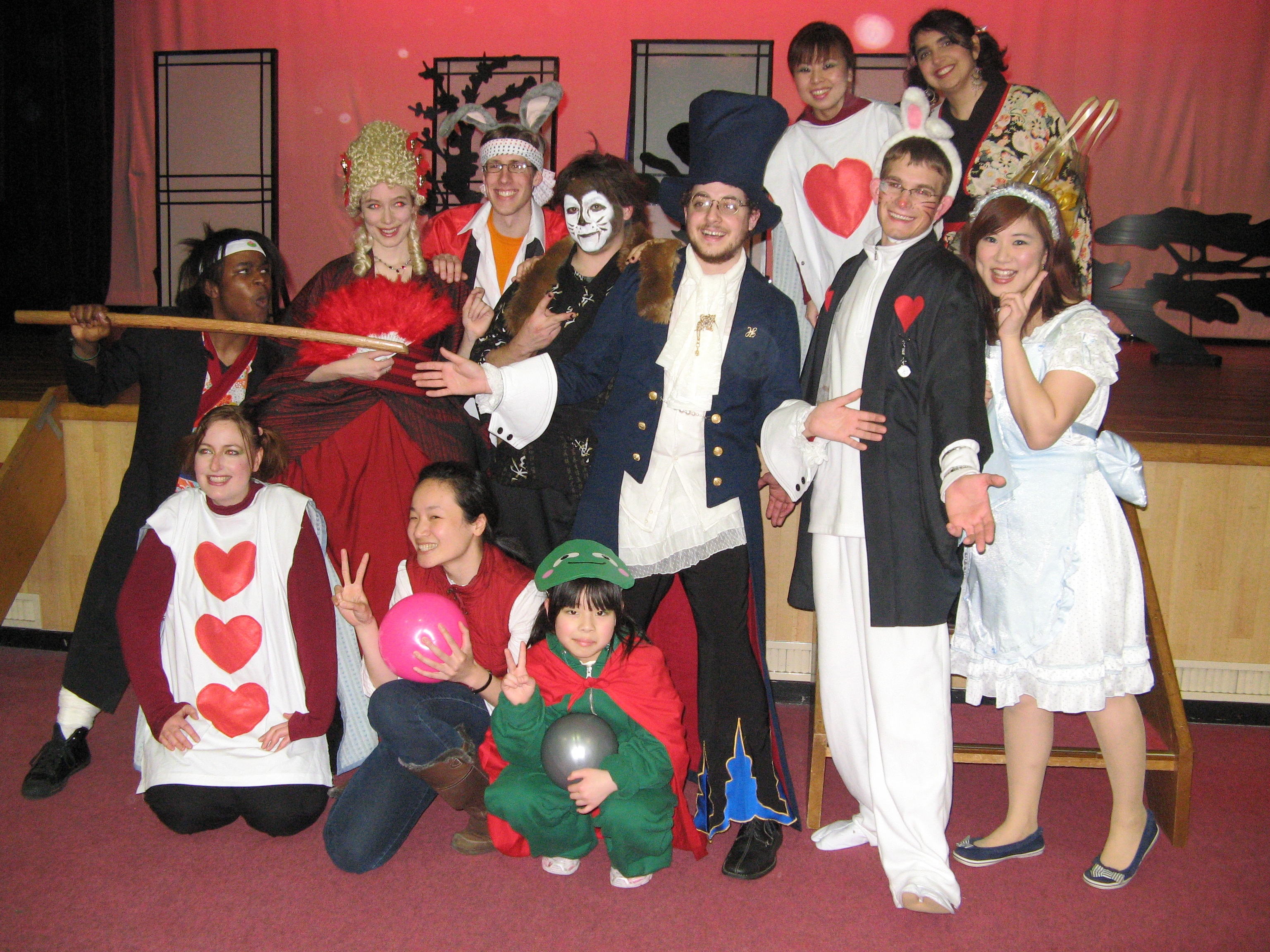 Among the various Broadway staples the HAJET Hokkaido Players have performed are such familiar titles as West Side Story, Annie, Peter Pan, Oklahoma!, and Guys and Dolls. They also on occasion perform original works, such as 2009’s Alice in Japan, originally written by ALTs in Niigata. This year’s production will be an original play based on The Jungle Book (the Kipling novel, not the Disney adaptation). According to the Players’ current director, Melissa Golden, the production will incorporate elements of Bollywood cinema and traditional Indian costume, as well as make use of Lion King-style animal masks.
The Players start planning their productions early in the year, around the end of August when the newbies first arrive from overseas. Recruitment is usually done around early to mid September during the various welcome parties (with an island that big, you’d need to have several parties), and the first rehearsal is typically scheduled for later in the month or in early October. From that point onward, it’s full speed ahead, and anyone who can’t commit will be left in the dust. Despite the subject, it’s serious business.
Depending on the show and the wishes of the director, the English script is augmented with either lines in Japanese, framed scene-by-scene with Japanese narration, or both. This is to help audience members without English proficiency or previous knowledge of the play to understand what is going on. The Players also do their research in more pop culture-related subjects Read More
JET ROI: JET alum op-ed in Asahi Shimbun – The JET Program is a ‘triumph of soft power’
Article/Journalism, Notable JET Alums, Return on JET-vestment, Uncategorized, Writers Comments Off on JET ROI: JET alum op-ed in Asahi Shimbun – The JET Program is a ‘triumph of soft power’
Jim Gannon
The below op-ed titled “POINT OF VIEW: The JET Program is a ‘triumph of soft power’” appeared in the November 5, 2010 edition of the Asahi Shimbun. It was written by three JET alumni with expertise in Japan-U.S. policy and relations:
- James Gannon (Ehime-ken, 1992-94) – Executive Director of the Japan Center for International Exchange (JCIE/USA) and author of the “Chopping Block” article.
- Michael Auslin – Director of Japan Studies at the American Enterprise Institute.
- Paige Cottingham-Streater – Deputy Executive Director of the Maureen and Mike Mansfield Foundation.
(Here’s the link for the original article on the Asahi Shimbun website: http://www.asahi.com/english/TKY201011040234.html)
POINT OF VIEW: The JET Program is a ‘triumph of soft power’
Michael Auslin
In its 23 years, the Japan Exchange and Teaching Program has brought more than 50,000 young foreigners to Japan, including over 25,000 Americans, to teach in the school system as well as to support international exchange activities.
Each of us grew to know Japan through our participation in the JET Program, and this experience has changed the direction of our careers and enriched our lives.
In fact, the JET Program has touched the lives of so many people who might otherwise not be exposed to Japanese society that it is regarded by many outside of Japan as the most successful public diplomacy initiative in the world over the last several decades.
Paige Cottingham-Streater
Therefore, we were especially dismayed to learn that it has been criticized in the last round of the budget screening process.
Since it was launched at the height of Japan-bashing in the late 1980s, the JET Program has produced an extraordinary legacy.
On the one hand, we would like to think that it has been beneficial for Japanese students and communities. We have heard many stories about how students’ personal interactions in the classroom with JET participants have made English into a “living language” for them and helped motivate them to use English for communication rather than just as an exam topic.
We get the sense that, in our globalizing world, even students who never mastered English have benefited from their interactions with JET participants from countries they may never have thought much about before.
The JET Program’s least recognized contribution, however, may be its most important. This is the remarkable success it has had as a public diplomacy program. By exposing thousands of young professionals to Japanese society, it has built up deep person-to-person ties between Japanese people and an entire generation of non-Japanese from around the world.
In our country, the United States, the impact of this program on U.S.-Japan relations is quite extraordinary. It is no exaggeration to say that it has become an important pillar of the bilateral relationship.
As they grow older, former JET participants have started to take important posts in government, business, and civil society, bringing their personal networks and a deep appreciation of the importance of strong U.S.-Japan relations to their everyday work.
In the U.S. government, for example, JET participants have worked on the frontlines of U.S.-Asia relations in the White House, the State Department and other agencies. Two JET alumni even ran for the U.S. Congress–Rob Cornilles, who ran on the Republican ticket in Oregon, and Dan Seals, a Democrat from Illinois.
Similarly, when one looks at the emerging generation of Japan experts in American academic circles and think tanks, it appears that the majority are graduates of the JET Program, many of whom may have otherwise taken a very different direction in their studies and careers.
This is true of the grassroots organizations that sustain U.S.-Japan relations, too. At least 4 of the 40 Japan-America Societies in the United States are headed by former JET participants.
In evaluating the contributions of the JET Program, it is important to keep in mind the role it is playing in strengthening the foundations of Japan’s engagement with the rest of the world and the world’s engagement with Japan. People who are immersed in Japanese communities tend to develop a lifelong connection to Japan, and we are just starting to reap the rewards of this far-sighted program.
In our rapidly changing world, where it is critical for countries to project an active global presence and where a robust U.S.-Japan partnership on a wide range of issues has become even more important, the connections built by the JET Program are an invaluable asset.
The JET Program has been a triumph of soft power. We are so grateful for the opportunity that has given us and believe that continuing the JET Program–and further strengthening it–is important for Japan and all of its friends around the world.
JETAA Sydney Spring 2010 Newsletter “JET Journeys”
JETAA Chapters, Writers Comments Off on JETAA Sydney Spring 2010 Newsletter “JET Journeys”

This just in from JETAA Sydney:
“The Spring 2010 edition of JET Journeys is hot off the press! You can read all about what’s been going on with JETAA in Sydney and internationally, and what is coming up in the next few months. CLICK HERE to download the newsletter (PDF).” (http://sydneyjetaa.us1.list-manage.com/track/click?u=074f1003f7e0dbeb3de9861cc&id=847c5766bb&e=876d85e269)
FoxHound87: Now is the Fall of My Discontent…
Uncategorized Comments Off on FoxHound87: Now is the Fall of My Discontent…
Joshua Small is a First Year JET currently living in Ikaruga-cho, Nara-ken and has been chronicling his experience on his blog Snorlax87.
I am a Floridian. Last winter, in my hometown, the temperature dipped below 32 for 14 days straight. This was a record. However, following this freak cold snap, the temperature returned to normalcy (normalcy = a bit nippy).
Japan is known (and proud) of their 4 distinct seasons. Summers are hot, Fall and Spring are pleasant, and Winter is cold. As Fall continues, the temperature gets lower and lower. Japan doesn’t get cold fronts like Florida. It just gets cold. I am slowly coping with the idea that my legs will be imprisoned in long pants until April or May.
CLICK HERE to read the rest of the post.
http://snorlax87.blogspot.com/
No JETs in Congress this term – Seals, Cornilles both lose in close races
Notable JET Alums Comments Off on No JETs in Congress this term – Seals, Cornilles both lose in close races
JET alumni Dan Seals (Democrat-Illinois) and Rob Cornilles (Republican-Oregon) both lost their bids for a Congressional seat. Had either of them won, they would have been the first JET alums in the U.S. Congress.
In Illinois’ 10th district, Robert Dold defeated Seals by a 51% to 49% margin, winning 103,274 votes to Seals’ 98,882 votes. And in Oregon’s 1st district, incumbent Democrat David Wu won a seventh term in Congress with 54% of the vote to Cornilles’ 42%.
Isshokenmei ganbarimashita. Minnasan o-tsukare sama deshita.
JETwit Diary 11.02.10
JetWit Diary, Uncategorized, Writers Comments Off on JETwit Diary 11.02.10
 JETwit Diary is a new feature by Steven Horowitz (Aichi-ken, 1992-94), founder and publisher of JETwit.
It’s time to re-connect with JET alum readers.
Sure, I connect with JET alums all the time. At JETAANY events, meetings and conferences as well as in exchanges with numerous alums around the world via e-mail, Facebook, LinkedIn, the JETwit Jobs Google Group, etc.
But when I was the Editor for JETAANY Quarterly Newsletter (now “JQ“), I not only wrote a “Letter from the Editor” each issue. I also wrote the “JETAANY Society Page” (under the pen name “Yoku Shitteiru” for those who remember) which was extremely enjoyable and satisfying, albeit rather labor-intensive and time-consuming.
Additionally, when I first created the Writers Interpreters Translators (WIT) Group (which eventually evolved into the JetWit site), for several months I wrote a weekly email update in which I shared various accomplishments and activities of members and also wrote introductions about new members. I remember greatly enjoying the process of gathering and sharing thoughts, information and ideas as well as trends and patterns that I observed. And it was that process that led to the “JET Alumni Author Showcase.”
However, the need to manage the JetWit site (which is all done in my spare time) plus my recent induction into fatherhood have limited my ability to spend time actually writing. Today I still communicate with the JET and JET alum community via JetWit, but I recognize that there’s an indirect quality to it. I spend time recruiting others to write and provide structure and perspective for their contributions. So in that sense I communicate through their voices and through the decisions I make on what content to post.
As a result, a number of conversations, interactions, thoughts and other things that happen along the way don’t get mentioned, such as:
- The pleasant e-mail exchanges that occur as people respond to the JET-Sister City List Project I set up earlier this week. For example, it turns out that Hokkaido JETs put on a huge musical productions every year. And the person who told me about it asked if she could write something for JetWit about it. (Answer: Mochiron!) I love hearing about things like this. And I love even more being able to let the rest of the JET alum community know that things like this exist.
- That a news reporter is working on a story about JET alum Dan Seals, who is running for Mark Kirk’s vacated seat in Illinois and has a good chance to become the first JET alum to hold a seat in Congress. Notably, two other JET alums have run for Congress this year: Rob Cornilles who faces a tough incumbent in Oregon, and David Boling who lost in the primary in Arkansas.
- The good work being done by Byron Nagy with the JETAA Tokyo chapter, which is very focused on service and volunteer activities and is also doing a terrific job of bringing people together and assisting with networking and job hunting.
- Ideas I haven’t had time to put into action yet, including a JET alum storytelling event modeled on The Moth Storytelling Hour, an annual award recognizing JET alums who have given back to Japan and a JET essay compilation focusing on the themes of cooking and being alone.
- Efforts by several JET alums to generate more pro-JET press coverage in the media, particularly in the Japanese language media.
I realize that I’ve missed having the opportunity to write, synthesize some thoughts, share information and share perspectives that come to me in the course of my work with JetWit as well as in the course of my role with JETAANY.
As a result, going forward I’m going to attempt to write periodic JETwit Diary entries that capture some of what’s going on that doesn’t fit on the site in other forms. Just as I tell other JETwit writers, this is all one big experiment. So let’s try it out, see what we learn along the way and we’ll take it from there. Because in the end, it’s all about the journey.
Ganbarimasu and yoroshiku onegaishimasu.
Steven Horowitz (Aichi-ken, 1992-94)
Brooklyn, NY
Steven is available on a consulting basis to assist organizations with any writing, communications, community building, membership retention and creative marketing needs.
By Tuesday night, we should know whether the U.S. Congress will have its first JET alum member. Or possibly even members.
Dan Seals is running as a Democrat in Illinois’ 10th district for the seat vacated by Mark Kirk (who is running for the Senate seat vacated by Barack Obama). And Seals led Republican nominee Robert Dold by as much as 12 points according to a poll in early October. Though now the race is considered very tight. This is Seals’ third time running for the seat, which he narrowly lost last year to Mark Kirk.
And Rob Cornilles is running on the Republican ticket in Oregon’s 1st district against Democratic incumbent David Wu. There the race is also tight, though Wu as the incumbent is apparently considered to have a slight advantage.
Ganbatte!
***********
**********
Snorlax87: English Festival!
Uncategorized Comments Off on Snorlax87: English Festival!
Joshua Small is a First Year JET currently living in Ikaruga-cho, Nara-ken and has been chronicling his experience on his blog Snorlax87.
I gave up one of my Saturdays to help out an English festival last weekend.
Morning: I arrived at the high school near Yaginishiguchi (say that 5 times fast) station a little late for the festival. Luckily, one of the judges was also late, so everyone overlooked my indiscretion. The morning was reserved for the 61st Nara Inter-High School Speech Competition (a real mouthful). This time, I got to lay back and just listen to the speeches. Other Nara ALTs were judges along with the same guy from the Nara Board of Education. A student from my school was competing, so I felt somewhat obligated to attend and cheer her on.
CLICK HERE to read the rest of the post.
http://snorlax87.blogspot.com/
Speech contests…
Uncategorized Comments Off on Speech contests…
Joshua Small is a First Year JET currently living in Ikaruga-cho, Nara-ken and has been chronicling his experience on his blog Snorlax87.
Last Tuesday, I judged my first speech contest. The Koriyama Rotary Club sponsored a Junior High School speech contest at my school. Storm (the other ALT at my school) and I were designated judges for the contest in addition to a representative from the Nara Board of Education, and 2 Japanese Teachers of English (JTE). Storm and I were called into the Principal’s office to meet the other judges and presumably to keep us from talking to the contestants. We sat silently as everyone babbled on in Japanese. I assume they were just introducing themselves and making small talk. I am always nervous around my principal. He is a very nice man, but always seems so unapproachable. The teachers are always SUPER polite to him including bowing and such…
CLICK HERE to read the rest of the post.

Update 11/10/10: Had a nice email exchange with Carlo Capua (Niigata-ken, 2000-02) who is on the Board of Directors for Sister Cities International, a global network of 2000+ cities who do exchanges with each other at different levels – teacher, humanitarian, governmental, elected official, etc. According to Carlo, SCI is in almost 200 countries around the world.
Update 11/7/10: It turns out there’s a list on the CLAIR website of all of the cities/towns and sister cities: http://www.clair.or.jp/cgi-bin/simai/e/05.cgi?n=U.S.A. (Though it doesn’t indicate whether there are JETs in the locale.) Thanks to JETAA USA Country Rep Jessyca Wilcox for letting us know about this.)
Update 11/5/10: Thanks for all the responses so far. Keep’em coming!
Welcome to the JET-Sister City List Project!
The Goal: To create a list of Japanese cities (and prefectures) where JETs lived that have a sister city relationship with another country.
How can you help? Email jetwit@jetwit.com with your name, prefecture, city/town and years on JET as well as any sister city relationships that your town had. If you already see your city listed, email your name anyway so we can include you as well.
The Result: JetWit will add to the below list as responses are received.
The Purpose: To lay some groundwork that may help Japanese cities/prefectures that hosted JETs increase their “return on investment” from their initial investment.
(Note #1: There actually is a Japanese government publication that lists every Japanese sister city relationship. However, it does not list any correlation with JETs.)
With all of the above in mind, please email your responses to jetwit@jetwit.com. Yoroshiku onegaishimasu!
1. Hokkaidō
Hokkaidō
- Chitose-shi + Anchorage, Alaska – Sara (Salzer) Niwa (Hokkaido, Chitose-shi, 1999-2002)
- Iwamizama City + Pocatello, Idaho; Canby, Oregon; Acheng, China – Caroline Cronshaw (Hokkaido, 2006-09) (Caroline adds that Iwamizawa sends several students to Pocatello each year, and Pocatello returns the favor by sending several of its students to Iwamizawa. There is a tower-shaped monument in front of Iwamizawa City Hall that symbolizes the friendship between Pocatello and Iwamizawa.)
- Sapporo-shi + Portland, Oregon – Liz Sheffield (Hokkaido-ken, Sapporo-shi, 1993-95) (Liz adds, “I originally went to Sapporo for two weeks when I was in high school as part of a Sister City exchange delegation from Portland. Then six years later, I was placed in Sapporo as an AET. Thanks to my return to Sapporo , I was able to build an even stronger relationship with the Shibuyas, my host family from my original visit to Sapporo . Now, fifteen years after the JET Program, I am still in regular contact with the Shibuyas.”
2. Tōhoku
Aomori Prefecture + Maine – Zack Bass (CIR Aomori-ken, Aomori-shi, 2006-Present) (Zack adds, “I’ve had the wonderful opportunity to be highly involved with promoting and coordinating our prefecture’s continuing relationship with our sister state of Maine in the USA. We have many exchange programs between schools and municipalities within Aomori Prefecture and local towns and schools in Maine that continue to this day. We are very proud of our strong exchange with Maine, and many of our JETs throughout the prefecture have invested much time and hard work in strengthening our ties. Recently, we have been working towards expanding the Maine & Aomori relationship even further by exploring fisheries, energy, and business exchange opportunities in addition to our long tradition of cultural and educational exchange. I hope to get more of our JETs to contribute more about their local municipal based exchange programs in the next few weeks.Thank you for doing this!”)
- Hachinohe City + Federal Way, Washington; Lanzhou, China
- Beth Bryant (Aomori-ken, Hachinohe-shi 1993-94; Misawa-shi 1994-96)
- Natalie Kruckenberg (Aomori-ken, Hachinohe-shi 2010- present) – Natalie adds:
Federal Way Exchange: When the Hachinohe International Exchanges and City Promotions Association (formed in September, 1990) met to discuss possible locations for a sister city, Tacoma of Pierce County was presented. Tacoma has a friendly relationship and had been exchanging with the Hachinohe Chamber of Commerce, the most recent exchange being in 1992. The Hachinohe Chamber of Commerce contacted the Mayor of Tacoma who introduced Hachinohe to a neighboring city, the City of Federal Way. After exchanges betwen the two cities, on August 1st, 1993, the Sister City agreement was signed. Since then the official visits and youth exchanges between Federal Way and Hachinohe have continued every year.
Lanzhou Exchange: The International exchanges with Lanzhou including Hachinohe Gas Cor. technical cooperations, yourth exchanges and inspectorates began back in 1983 when the 4th Hachinohe delegation traveled to Lanzhou. In April 1998, Hachinohe and Lanzhou signed a sister city agreement. Since then the official visits and youth exchanges between Federal Way and Hachinohe have continued every year.
- Misawa City + Wenatchee, Washington
- Beth Bryant (Aomori-ken, Hachinohe-shi 1993-94; Misawa-shi 1994-96)
- Mutsu City + Port Angeles, Washington
- Amy Miller (Aomori-ken, Mutsu-shi, 2006-11) Amy adds: “Mutsu City and Port Angeles City have been sister cities for 15 years. Every year a group of select Junior High School students from Mutsu City visit Port Angeles City in January as Junior Ambassadors. They put on a “Japanese Culture Fair” at the middle school in Port Angeles to teach American students about Japanese culture. The high school students from Tanabu High School English class also visit Port Angeles every year. A mixed delegation of middle school, high school, and adults visits Mutsu once every two years.”
- Tsugaru-shi + Bath, Maine
- Mike Moses (CIR Aomori-ken, 2010 – present) Mike adds: “The friendship between Tsugaru and Bath, Maine has a long history. In 1889, the ‘Cheseborough,’ a ship built in Bath, Maine, tragically crashed off the coast of Shariki (now Tsugaru City). The people of Shariki nursed the surviving sailors back to health, and a friendship between the two cities has continued since. Since 1990, Bath and Tsugaru have coordinated a sister-city exchange program, in which delegations are sent every year to experience each other’s rich culture and history. Also, the Cheseborough Cup, an international swimming competition, is held in Tsugaru every year. The goal of the race is to eventually swim the 10,200 km distance between Bath and Shariki. We hope to continue and expand upon the current sister city relationship.”
- Tsuruta Town + Hood River, Oregon
- Emma Sayers (CIR Aomori-ken, Tsuruta-cho, 2010-Current) – Emma adds: “Tsuruta has had a sister city agreement with Hood River, Oregon, USA since 1977. The mayor of Tsuruta at that time (and at present), Mayor Nakano, had wished to bring internationalisation to Tsuruta by joining it with a similar city in the USA. Exchange visits between their respective residents, junior high school students and high school students take place every year. Tsuruta also employs a sister city English teacher from Hood River to visit local kindergartens and primary schools alongside the JET Programme CIR. It’s an extremely well-cultivated sister city relationship, and I’m honoured to be able to help out with the events and visits! Good luck with the JET-Sister City List Project, it’s a great idea and I hope this helps a little. I’ve not been in Tsuruta long but I love it, and I think the sister city agreement has a lot to do with that as everyone here has been so welcoming.
Iwate Prefecture
- Esashi City + Shepparton, Australia; Reutte/Breitenwang, Austria
- Therese Stephens (Iwate-ken, Esashi-shi, 1996-99)
- Kitakami-shi + Concord, California; Shibata-shi, Miyagi-ken, Japan; Sanmenxia, Henan Province, China
- Margie Wiggins (Iwate-ken, Kitakami-shi, 2010-Present)
- Margie adds: “I have worked a little with the Rotary Club in town and know they sometimes send representatives (typically businessmen) to Concord, California to visit and learn more about the city; however, I am not sure what relationship, if any, has been built and fostered with our other two sister cities. The Rotary is also active in sponsoring a Rotary Youth International Exchange of Short-Term, which consists of two groups of ten high school students (from both Iwate-ken and Miyagi-ken) visiting Texas and Oklahoma (I apologize I cannot remember the exact cities) in March every year. American students from these cities then travel here in June and July respectively.”
Miyagi Prefecture + Delaware
- Shichigahama-machi + Plymouth, Massachusetts – Doug Durgee (CIR Miyagi-ken, 2006-07) (Doug adds that they alternate sending kids on a short one or two week trip every year and used to also send kids on a one-year exchange program, though the funding for the one-year exchange program may have dried up in the past couple years.)
- Sendai-shi + Riverside, CA; Rennes, France; Acapulco, Mexico; Minsk, Belarus; and Gwangju, S. Korea; Dallas, TX is also listed as a friendship city. – Nata Nam (Miyagi-ken, Sendai-shi, 2007-09) (Nata also shared a link to a nice article about collaboration on a symposium between Tohoku University and University of California-Riverside: http://newsroom.ucr.edu/news_item.html?action=page&id=2481 Thanks also to Dough Durgee for additional sister city info.)
- Tome-shi + Southlake, Texas; Vernon, British Columbia – Jennifer Wang (Miyagi-ken, 2008-09) (Jennifer adds that Southlake, TX is her hometown, and she actually became interested in JET through the Sister Cities exchange program. Every year, Tome and Southlake send student ambassadors to the other’s city. They switch off each year for adults from the Tome International Friendship Association and Southlake Sister Cities. She said she doesn’t know as much about the program with Vernon, but when she was there, a large adult delegation from Vernon visited.)
Akita Prefecture
- Kisakata-machi + Anacortes, Washington – Brett Rawson (Akita-ken, Nikaho-shi, Kisakata-machi, 2007-09)
- Noshiro-shi + Wrangell, Alaska – Stephanie Boegeman (ALT Akita-ken Noshiro-shi 2006-2009); Andrew McCarthy (Akita-ken, Noshiro-shi, Futatsui-machi, 2005-08) (Andrew notes that the actual town he lived in, Futatsui-machi, merged with Noshiro in 2006, though it does not appear to have a separate sister city of its own.)
Yamagata Prefecture + Colorado
- Kahoku Town + Canyon City, Colorado – Alex Stevenson (Yamagata-ken, Kahoku-machi, 2000-03)
- Yamagata City + Boulder, Colorado – Jessica (Oppenheim) Moy (CIR Yamagata-ken, Yamagata-shi, 2003-06) (Jessica adds, “While in high school, I participated on two sister state/prefecture trips to Yamagata, Japan and loved it. After graduating from Colorado State University, I ended up returning to Yamagata City as a CIR on the JET program. My big project at the end of my stay was holding a Bolder-Boulder race in Yamagata. Boulder and Yamagata have many sister city exchanges not only with government, citizen, and student exchanges, but also with rotary.”)
Fukushima Prefecture
3. Kantō
Ibaraki
- Tsukuba-shi + Irvine, California
- Beth Yamamuro (Tochigi-ken, Ashikaga-shi, 1987-1989) Beth adds: “While living in Irvine, California I helped the local sister cities organization as well as the city officers in their exchanges with their sister city of Tsukuba, Ibaraki-ken. It was kind of funny how the visitors from Tsukuba would always try to hide the fact that they would also be visiting another California sister city, Milpitas. It was like they were having a secret affair.”
Tochigi
- Ashikaga-shi + Springfield, Illinois
- Beth Yamamuro (Tochigi-ken, Ashikaga-shi, 1987-1989) Beth adds: “Ashikaga has a continuing sister city relationship with Springfield, Illinois, thanks largely to the efforts of my predecessor, Monbusho English Fellow Linda Benoit (the last MEF year before JET was initiated). I just re-visited my town after 23 years and was unable to meet one of my favorite Japanese teachers because she was chaperoning a delegation to Springfield.”
Gunma
Saitama + Ohio, USA (Thanks to Michelle Elliott for the info.)
- Koshigaya City + Campbelltown, NSW, Australia – Michelle Elliott (Saitama-ken, 1999-2002)
Chiba + Wisconsin
- Chiba City + Houston, Texas – Lisa Hannabach (Chiba-ken, Chiba-shi, 1990-91, Yachiyo-shi, 1992-95)
- Ichikawa-shi + Gardena California – Lisa Hannabach (Chiba-ken, Chiba-shi, 1990-91, Yachiyo-shi, 1992-95) (Lisa was a private ALT in Ichikawa from 1995-2000.)
- Ichihara City + Mobile, Alabama– Ryan Hart (Chiba-ken, Ichihara-shi)
- “Ichihara shares a sister city relationship with Mobile, Alabama. There were a total of 8 teachers in Ichihara when I lived there. 7 of them where through the JET Program. 1 of them was hired directly through the sister city relationship with Mobile. So technically, we didn’t have a JET from Mobile, but we did have a teacher that was essentially a JET each year.”
- Narashino-shi + Tuscaloosa, Alabama – [JET? ___________]
- Narita City + Naestved (Denmark) since 2003; Xianyang-city (China) since 1988; San Bruno, California; Jeongeup-city (South Korea); Jung-Gu of Incheon-city (South Korea)since 1998
- Celine Castex (Chiba-ken, Narita-shi, 2006-11) (FYI, Celine is currently the Volunteer Self-Support Group Leader for the French-speaking community of JET.)
- Yachiyo-shi + Tyler, Texas – Lisa Hannabach (Chiba-ken, Chiba-shi, 1990-91, Yachiyo-shi, 1992-95)
Tokyo
Kanagawa
- Yokohama-shi + Vancouver, British Columbia; San Diego, California – Ilonka Osvald (Yokohama-shi, 1996-98) (Ilonka adds, “Vancouver and Yokohama have been sister cities for a long time, and there were quite a few JETS in my year who were placed due to the sister city connection (mainly Vancouver and San Diego).”
4. Chūbu
Niigata
Toyama
Ishikawa
- Kanazawa City + Buffalo, New York; Jeonju, Korea; Nancy, France; Ghent, Belgium; Irkutsk, Russia; Porto Alegre, Brazil; Suzhou, China – Sophie Bocklandt (Belgian CIR Ishikawa-ken, Kanazawa-shi, 2006-11)
Fukui
- Fukui City + New Brunswick, NJ
- Beata Wilk (Fukui-ken, Fukui-shi/Harue-cho, 2004-08)
Being from NJ I found out as soon as I arrived in Fukui about the sister city between my state and Fukui Prefecture. Fukui-ken usually recieved a number of NJ JETs every year– I believe at the request of the Fukui BOE but I can’t be sure of that. What I do know about the relationship for sure is that:
From the mid-1800s local governments in Fukui, Japan sent students to New Brunswick to learn English and study at Rutgers College. Fukui City sent their student in 18671. These historic ties and exchanges continued for over a century and led to formal agreements being signed with New Brunswick and Fukui in 1982.
As for the New Brunswick, NJ- Fukui-shi relationshsip, to the best of my knowledge this Rutgers University exchange still continues.
Fukui City also has a high school exchange. It is rather competitive and the exchange between NJ and Fukui only happens once every 2 or 3 years. (In the other years there is an exchange between Fukui and a sister city in China). High school students can apply for the program and if chosen, they get to go to a high school in NJ for about two months (if I remember correctly). The exchange is to New Providence High School (New Providence, NJ) and one more NJ high school (unfortunantly I do not remember the other school). They students stay with host families while in NJ and there is always an orientation for the high school students to prepare them for NJ. The Fukui BOE asks some NJ JETs to help in the orientation. We attended about 4 or 5 sessions, in the first few we made presentations about New Jersey geography, places of interest, food, etc. Then in groups we told the Japanese students about high school life in New Jersey and answered their questions. In later sessions, the Japanese students presented about Fukui Prefecture. We gave them an audience to practice on but also helped them expand, edit, and tweak their presentations so that they would be better addressed to NJ High School students.
Side note:
Since then New Brunswick has also established 3 other sister city ties, one more with Japan.
Fukui also has sister city ties with a few other cities, but I believe they are all in other countries. I know the Fukui International Activities Plaza (FIA) has all the information displayed- unfortunantly I do not remember much of it besides NJ relationships.
Yamanashi + Iowa: The sister-state relationship is detailed in the book “Sweet Corn and Sushi,” the story of Iowan farmers who donated 35 hogs to livestock farmers in Yamanashi after a typhoon devastated the area, according to a Japan Times article: http://search.japantimes.co.jp/cgi-bin/nn20100408a3.html (Thanks to Renee Tress (Yamanashi-ken, 2006-09) for the info and link.)
- Kiyosato region + Kentucky – Apparently most JETs in the Kiyosato region are from Kentucky. More info at http://www.city.hokuto.yamanashi.jp/hokuto_wdm/html/English/15558004369.html (Thanks to Renee Tress (Yamanashi-ken, 2006-09) for the info and link.)
- Nirasaki-shi + Fairfield, California – Renee Tress (Yamanashi-ken, 2006-09) (Renee also shared a link to a Facebook page for this long-running sister city relationship: http://www.facebook.com/pages/Fairfield-Nirasaki-Sister-City-Program/218241943857?v=info)
Nagano
- Nagano-shi + Clearwater, FL – Ravi Kumar (CIR Nagano-ken, Nagano-shi, 1998-2001) (Ravi adds, “It was a fairly active relationship. We arranged for 3 english teachers every year from Clearwater to come to live and work in middle schools in Nagano City. We had Japanese teachers of English go to Clearwater during their summer months to improve and learn English. During the summer, we also had a student exchange where 12 students from Nagano would visit Clearwater and 12 students from clearwater would visit Nagano.)
Gifu
- Gifu City + Cincinnati, Ohio
- Kathy Crutcher (Gifu-ken, Hozomi-cho (now Mizuho-shi), 2000-01) Kathy adds that her hometown is Cincinnati, which is why she was placed near Gifu City.
- Ikeda-cho + Mililani, Hawaii – Dylan Gen Fujitani (Gifu-ken, Ikeda-cho, 2005-07) (Dylan indicated that he’s not clear if the relationship is between towns or just between schools. But still nice to know about.)
- Takayama City + Denver, Colorado – Anna Thompson (Gifu-ken, Takayama-shi, 2002-04) (Editor’s note: I visited Takayama several times. It’s up in the mountains and beautiful. I remember one of my principals explaining to me that back in the days before everyone honeymooned in Hawaii, Takayama was a popular honeymoon destination.)
Shizuoka
- Kakegawa-shi + Eugene, Oregon – Andrew Osanka (Shizuoka-ken, Kakegawa-shi and Mori-machi, 1991-94)
Aichi
- Kariya-shi + Missassauga, Ontario – Steven Horowitz (Aichi-ken, 1992-94)
- Toyohashi-shi + Toledo, OH – Justin Moy (Aichi-ken, Toyohashi-shi, 2008-10) (Justin notes that as of 2010-11, there will be no more prefectural JETs in eastern Aichi)
- Toyokawa-shi + Cupertino, California – [JET? __________]
- Toyota City + Detroit, Michigan – [JET? _______] [Editor’s note: Toyota is next to Kariya, and as I recall they hired ALTs directly and not through the JET Program or a private company such as Interac (which didn’t even exist back when I was there.)]
5. Kansai
Mie
Shiga
- Nagahama-shi + Augsburg, Germany & Verona, Italy (Thanks to James Low (Shiga-ken, Nagahama-shi, 2009-11) for the info.)
Kyoto
- Kameoka-shi + Stillwater, Oklahoma [JET ______?] (Thanks to Stillwater, OK native Brad Rickelman (Saitama-ken, Hatogaya-shi, 1995-96) for the info.)
- Kyoto-shi + Oklahoma City, Oklahoma – (Thanks to Eric Hawkinson (Kyoto-fu, 2005-10) for the info.)
- Miyazu-shi + Del Ray Beach, Florida; Nelson, New Zealand – Eric Hawkinson (Kyoto-fu, 2005-10) (Eric, fyi, is the creator of the ALT website resource TeamTeachers.com.)
Osaka
- Izumi City + Bloomington, Minnesota – Kate Maruyama (Osaka-fu, Izumi-shi, 2005-08) (FYI, Kate grew up and went to college in Minnesota.)
- Ibaraki City + Minneapolis, Minnesota – [Any JETs?_______] (Thanks to Kare Maruyama for sharing the info.)
- Osaka City + Chicago, Illinois – Roland Kelts (Osaka-shi, 1998-99)
Hyōgo Prefecture + Seattle, Washington – [JET? __________]
- Himeji City + Phoenix, Arizona – [JET? __________]
- Nishimiya City + Spokane, Washington – Anna Amen (Hyogo-ken, Nishimiya-shi, 2007-08)
- Nishiwaki-shi + Renton, Washington – Mitchell Kimura (Hyogo-ken, Nishiwaki-shi, 1995-97) (Mitchell notes that Nishiwaki-shi is the “belly-button” of Japan. :-)
Kobe + Philadelphia (Thanks to James Low (Shiga-ken, Nagahama-shi, 2009-11) for the info.)
Nara
Wakayama
6. Chūgoku
Tottori
- Nichinan-cho + Scotts Valley, California
- Clara Solomon (Tottori-ken, Nichinan-cho, 1999-2001) (Clara said, however, that she thinks the sister city program may not still exist due to funding cuts.)
- Yurihama-cho (formerly Hawai-cho) + Hawaii County, Hawaii (Editor’s note:This is the first example of a county having a sister city relationship that I’ve come across.)
- Mark Fujishige (Tottori-ken, Yurihama-cho, 2008-11)
- Michelle Otake (Tottori-ken, Yurihama-cho, 1995-98)
- Matt Ackerman (CIR Tottori-ken, Yurihama-cho, Current as of 2010)
Michelle adds:
“I was the first permanent JET ALT stationed in that town originally/formerly called Hawai-cho, Tottori-ken from 1995 to 1998. At that time Mayor Masanao Inoue, a big advocate of fostering international relationships and “opening” up the town to the world which included participating in the JET Program, asked me to help them build a sister city friendship with my home state Hawaii. To sum up a long story of mostly disappointing phone calls and letters, good fortune finally came to me when I contacted Mr. Rudy Legaspi, who was the Executive Assistant to the Mayor of the County of Hawaii. Mr. Legaspi expressed great enthusiasm and support in establishing sister city ties with Hawai-cho. In 1996 Ms. Yukiko (Kametani) Yamasaki, a local Hawai-cho Town Office employee and liaison for Mayor Inoue’s Office, and I flew over to the city of Hilo, Hawaii and formerly met up with the County of Hawaii officials, including Mr. Legaspi and Mayor Stephen K. Yamashiro, to set up the initial groundwork for the sister city friendship. On October 16, 1996, Mayor Inoue of Hawai-cho, Tottori-ken and Mayor Yamashiro of the County of Hawaii, Hawaii officially cemented a sister city friendship.”
“Due to mostly economic reasons, many towns and villages across Tottori prefecture and the rest of Japan from 2001 to 2005 were swallowed up, readministered, and renamed in municipal mergers. In 2005 Hawai-cho along with Togo-cho and Tomari-son became Yurihama-cho. And the sister city friendship between Yurihama-cho and Hawaii County is still very much alive and well.”
Matt adds:
“Prior to 2004, one of the towns that was merged into what is now Yurihama-cho was known as Hawai-cho. In order to take advantage of this name, the chamber of commerce started to promote the town as “The Hawai of Japan” in the 90’s. In 1995, the town got its first ALT from Hawaii(in America), Michele Otake. It’s my understanding that she did most of the legwork in searching for and getting in contact with a suitable sister city.”
“With the exception of Honolulu, local government in the state of Hawaii is all organized on the county level, so I assume that’s why we have this relationship with a county rather than a particular city. Also, my guess is they were probably going for the matching name as well.”
“Since establishing this relationship, our town has enjoyed regular visits of government and chamber of commerce officials both to and from Hawaii. We have also welcomed a group of musicians and dancers from Hawaii to perform in the hula festival we hold every year. In addition, we have been conducting a school exchange/home stay program for middle school students since 1998, The town has been utilizing a CIR to help coordinate all of these activities since about 2000 or 2001.”
Shimane
- Fujiyoshida-shi + Colorado Springs, CO (Thanks to Jessyca Livingston (Shimane-ken, Fujiyoshida-shi) for the info.)
- According to Jessyca on 08.06.12: “Colorado Springs, CO and Fujiyoshida-shi, Shimane-ken just celebrated their 50th anniversary this past weekend. A group of Rocky Mountain JET Alums were present to both participate and offer translation services for the 150 delegates that were here for the celebration. It was really wonderful to connect with so many alums- especially the ones from Colorado Springs that had been “posted” to Fujiyoshida on JET. It was a great feeling to be able to give back in that capacity!”
Okayama
- Kurashiki-shi + Kansas City, MO (Thanks to Kansas City native William Nealy (Oita-ken, Oita-shi, 1994-97) for the info.)
Hiroshima
- Fukuyama-shi + Maui, Hawaii; Hamilton, Ontario; Pohang City, Korea; Tacloban City, Philippines; Kazanlak, Bulgaria – Shaula Evans (CIR Hiroshima-ken, Fukuyama-shi, 1992-94)
Yamaguchi
7. Shikoku
Tokushima
- Miyoshi-shi + The Dalles, Oregon & Tukwila, Washington – Smitha Pradhi (Tokushima-ken, 2005-07); Andrew Kim (Tokushima-ken, Miyoshi-shi, 2005-08) (Smitha explains that the towns of Ikeda-cho and Ikawa-cho had long-running sister-city relationships with these two U.S. towns respectively, and then merged with a few other towns to become Miyoshi-shi during a 2006 gappei). (Andrew adds, “I was a 3-year JET and now head the committee in Tukwila, WA. The Miyoshi-Tukwila Sister City relationship currently focuses on a cultural exchange between Junior High School students but has expanded to High School students and Adults. At this time, Tukwila hosts Miyoshi citizens every other Autumn while Miyoshi hosts Tukwila every other Spring. We have established this exchange since November 19, 1979.”
- Tokushima-shi + Saginaw, Michigan; Leira, Portugal; Dangong City, China – Olivia Nillson (Tokushima-ken, Tokushima-shi, 2006-09) (Olivia adds, “Every year, students from Tokushima would travel to Saginaw, and vice versa. While I was there, we had a choral group from Saginaw visit and give concerts in the city.”)
Kagawa
- Takamatsu-shi + St. Petersburg, Florida – Lily Lam (Kagawa-ken, Takamatsu-shi, 2004-09); Dave Wilson (Kagawa-ken, Kotohira-cho, 2008-10) (Lily adds, “Every year, St. Pete sends over someone to teach as an ALT at one of the local Takamatsu high schools. Delegations of students from Takamatsu also get sent to visit St. Pete every once in a while, and vice versa (see press release). I was completely unaware of the sister city relationship between St. Pete and Takamatsu, until I arrived in Takamatsu and found a disproportionately large number of people who actually knew where St. Petersburg was.”
Ehime
- Matsuyama City + Sacramento, California; Freiberg, Germany – Stewart Andrew Curry (Ehime-ken, Matsuyama-shi, 1987-89 – when the acronym was “AET” rather than “ALT)
Kōchi
- Motoyama-cho + Urausu-cho, Hokkaido, Japan – Margie Banin (Kochi-ken, Motoyama-cho, 2005-07) (Margie, fyi, is an “Expat Coach” and is also in the process of setting up a company to lead tours to Shikoku! Margie adds, “Yes, Motoyama’s sister city is Japanese! Apparently there is a link because Motoyama families emigrated up there at some point – not sure when, not sure how many, but enough to have a strong connection – and both cities want to keep the ties strong. The junior highs do field trips annually, one year MJH goes north, the next UJH comes south. Also, the yakuba have an employee exchange, where each year a Motoyama employee goes to Urausu and an Urausu employee comes to Motoyama in exchange. Urausu has a booth at Motoyama’s festival in the fall. And so on & so forth. Those are the main activities that I recall. The relationship is very much alive, strong & well.”)
8. Kyūshū
Fukuoka
- Fukuoka-shi + Atlanta, Georgia + Oakland, California + Honolulu, Hawaii
- Brian Hersey (Fukuoka-ken, Fukuoka-shi, 1994-96)
- Sharon Tatro (Fukuoka-ken, Fukuoka-shi, 2002-07 – Sharon is a Co-President of JETAA Southern California)
- Taea Takagi (Fukuoka-ken, Nogata-shi, 2006-08 – and a Hawaii native)
- Kelsey Soma Turek (Fukuoka-ken, Fukuoka-shi, 2005-07 and current President of JETAA Hawaii) (Kelsey notes that the sister city relationship is why Fukuoka has a lot of Hawaii JETs.)
- (Mark Frey (Kumamoto-ken, 2002-06) who is an active member of JETAA Northern California, reports that he’s currently involved in developing a partnership between the Oakland-Fukuoka Sister City Association (OFSCA) and JETAA Northern California.)
- Mark Juloya (Fukoka-ken, Kaho-machi, 2004-07) (Mark is currently serving as the Treasurer for JETAA Southern California.)
Saga
Nagasaki
- Nagasaki City + St. Paul’s, Minnesota – [Any JETs?_____] – (Thanks to Kate Maruyama for sharing the information.)
- Sasebo City + Albequerque, New Mexico – Kate Meyer (Nagasaki-ken, 2006-10) (Kate notes that there is a large number of JETs in Nagasaki-ken who are from Minnesota.)
Kumamoto + Montana, USA (Thanks to Mark Frey (Kumamoto-ken, 2002-06) for the info.) (Kathy Laubach adds, “To the best of my knowledge, Montana [state] and Kumamoto Prefecture share a “sister” relationship and perhaps this is worth mentioning so as not to have people assume the relationships are only between Kumamoto and Billings and Helena in Montana.”)
- Kumamoto City + San Antonio, Texas; Billings, Montana; Helena, Montana; Heidelberg, Germany; Guilin, China; Bristol, United Kingdom; Ulsan, South Korea – Mark Frey (Kumamoto-ken, Kumamoto-shi, 2002-06), Angela Riu Gordon (Kumamoto-ken, Kumamoto-shi, 2004-06); Kathy Laubach (CIR Kumamoto-ken, Kumamoto-shi, 2003-06)
Ōita
Miyazaki
Kagoshima
- Amami City (formerly Naze City) + Nacogdoches, Texas – Barbara “Chieko” Rothengass (Kagoshima-ken, Naze-shi, 2003-06) (Barbara is the chapter president for JETAA Texoma and notes that McMichael Middle School does a student exchange with Amami-shi.)
Okinawa
- Ishigaki City + Kauai County, Hawaii; Suao City, Taiwan – Troy Nakamura (CIR Okinawa-ken, Ishigaki-shi, 2005-07)
JETAA DC Career & Graduate School Forum – Monday Nov 8 & Wed Nov 10
Career, Events, JETAA Chapters, Uncategorized Comments Off on JETAA DC Career & Graduate School Forum – Monday Nov 8 & Wed Nov 10
 The Career & Graduate School Forum sponsored by JETAADC, the Embassy of Japan and CLAIR New York, will take place on Monday, November 8 and Wednesday, November 10 at the National Academy of Public Administration in Washington, DC (Chinatown). Whether you are a JET Alumni, Friend of a JET, or work at an organization that has hired JETs in the past – all are welcome to attend and participate in the Career Forum.
Please visit the Event Homepage for more information and to RSVP! ( http://events.constantcontact.com/register/event?llr=mpyot6dab&oeidk=a07e31ooteo0117d03a)
- Monday, November 8th, 2010
Resume-Writing Workshop with Beth Colley
This two-hour workshop will cover how to build out your resume, with specific focus on the JET Program for both Careers and Graduate School.
- Wednesday, November 10, 2010
Panel Discussion: “Careers and Graduate School after JET”
Networking Reception to follow from 7PM to 9PM.
Food, wine, beer, and other refreshments will be served. We are actively seeking out companies or organizations that hire JET Alumni to participate. If you or someone at your company is interested in attending, please contact Leigh Ann at outreach.dc@jetalumni.org. If you are not a JET Alumni but receiving this message, please sign up as a Non-Member (FOJ) and receive a $5.00 discount off the standard registration fee!
- Registration
JETAADC* Member: $10 (for both events), $5 for one event
JETAADC Non-Member (FOJs): $15 (for both events), $10 for one event
*All JETAA Members may register at JETAADC Member price listed above.
New York’s Japan Society hosts design summit, MUJI minds
Article/Journalism, Books, Events Comments Off on New York’s Japan Society hosts design summit, MUJI minds
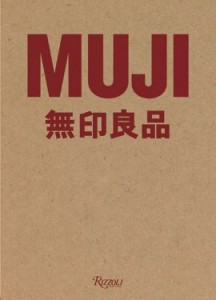
The MUJI book is in stores now. (©MUJI, Rizzoli New York, 2010)
By JQ magazine’s Justin Tedaldi (CIR Kobe-shi, 2001-02) for Examiner.com. Visit his NY Japanese Culture page here to subscribe for free alerts on newly published stories.
Architecture, interior design and innovative household items take center stage at Japan Society in November through its upcoming lectures The Design Difference and America Meets MUJI.
For The Design Difference, Japan Society’s U.S.-Japan Innovators Network will gather architecture and design visionaries Yoshiharu Tsukamoto of Atelier Bow-Wow and John Peterson of Public Architecture to exchange ideas in a bid to help solve some of the world’s most vital social problems. Moderated by Designers Accord’s globally recognized innovator Valerie Casey, The Design Difference is part of the Innovators Network’s two-day exchange program in partnership with Designers Accord, Common Ground Community and the Brownsville Partnership, and GOOD magazine.
In its 30 years of existence, celebrated retailer MUJI has made an impact as a global standard for goods of simplicity, practicality and sustainable design. True to its name—shorthand for mujirushi, or “no brand,” reflecting its lack of labels or elaborate packaging—MUJI is mighty, with over 100 outlets outside of Japan. InAmerica Meets Muji, internationally acclaimed designers Naoto Fukasawa, Kenya Hara and John Maeda discuss the concepts behind the creation, design and essence of MUJI.
Along with Jasper Morrison, Fukasawa and Hara are the co-authors of the new coffee table book MUJI. Published by Rizzoli New York, the tome explores through illuminating essays and hundreds of photos MUJI’s inner workings via its founding principle to develop new and simple products at reasonable prices by making the best use of materials while minimizing their impact on the environment. For the MUJI faithful, Fukasawa and Hara will be on hand after Wednesday’s talk for a special book signing reception.
Click here to read the rest of the article.
JET ROI: Why JET Matters – Japanese language education, national security and the future of US-Japan relations
Return on JET-vestment Comments Off on JET ROI: Why JET Matters – Japanese language education, national security and the future of US-Japan relations
In a recent discussion on the JETAA Education Professionals LinkedIn Group, JET alum and Japanese language consultant Beth Yamamuro shared some perspectives and thoughts on the decline in administrative support for Japanese language study. Beth’s comments prompted Matt Gillam, a long-time CLAIR-NY staff member and a graduate of Columbia’s School of International and Public Affairs, to offer some useful insights into the role of JETs and the JET Programme in the bigger picture of US-Japan relations.
With their permission, and with the aim of helping to make the JET and JET alum community more aware of its role in the bigger picture, JetWit is posting their comments below. (For the record, Matt’s comments are his own personal views and are not on behalf of CLAIR-NY):
Here are Beth’s comments:
I did want to share with you what I’m learning in the Japanese Language Teaching class I posted about earlier. It seems there is sort of a crisis in the Japanese as a second language field these days. Despite a growing number of students in classes, there is a decreasing amount of financial and administrative support. Japanese is not a strategically important language to the US like Chinese and Korean are, so there are fewer (or no?) government grants to study it. The Chinese government is subsidizing many Mandarin education programs within the US, and as a result some institutions are giving up their Japanese programs in favor of Chinese. Having bilingual speakers of English and Japanese IS strategically important to Japan, and the JET program is a unique system already in place to support the development of large groups of such speakers.
Another issue in which the JET program could play a part is the lack of qualified teachers of Japanese. With the increasing emphasis on standards in all levels of foreign language education, teacher training for the specific education community involved is more important than ever. JET participants tend to be people who are in some way interested in education, and many go on to be teachers on returning to their home country, whether or not that was their original career plan.
Here are Matt’s comments:
This is a really interesting report on what’s going on with Japanese language education recently, and in my opinion it reflects an extremely short-sighted policy shift by the U.S. government just when it’s becoming clear (again) that we need Japan as an ally to deal with an increasingly belligerent China and an increasingly (who’d have thought it possible?) unstable Korean Peninsula. I think Japan is slowly beginning to come out of its recent phase of thinking the US-Japan security alliance is merely burdensome and no longer particularly relevant, and China was their new best buddy. However, the events of the past few weeks, especially, have the US and Japan both realizing that China is not growing into the steady, dependable partner we’d all been hoping for. It is doubly unfortunate that Japan herself has not made any efforts to counter this growing neglect and promote Japanese language acquisition or actively cultivate those who have an interest in becoming teachers. As far as I know, there is only the JET Program to fill this void.
Each country is important in its own way and each requires attention. China, despite recent tensions, is a vital component of the world economy and a critical trading partner for the US and Japan, besides being an indispensable player in addressing security and environmental issues. They also possess a rich and ancient culture and history. It is likely that political and economic realities will eventually compel them to soften their ham-handed, nationalistic approach to dealing with other countries, but when that might happen is unclear. South Korea has become the steadier partner in many ways, partly because they have made extensive efforts to strengthen ties with the US and to appeal to American feelings of goodwill toward an old ally and trading partner. But South Korea is vulnerable in ways Japan is not, and with their smaller economy and more limited capabilities in economic and security terms they are no replacement for Japan.
We cannot maintain a significant presence in Northeast Asia and thereby maintain credibility with our security partners as a counterweight to China without our bases in Japan (read, primarily, “Okinawa”), and to keep those bases we need people who can work with the Japanese and understand their needs and concerns, and not blunder through crises like the Pentagon and the Administration did with the new Hatoyama administration and the Futenma fiasco.
Everyone got lulled into thinking the US-Japan relationship was rock-solid and boring and could cruise along on auto-pilot without anyone actively managing it. That, along with being dazzled by the rise of China, South Korea’s great success in democratizing and building itself into an economic powerhouse (albeit on a smaller scale than Japan or China) in Northeast Asia, and the two wars in the Mid-east/South Asia, have led to a deeply unfortunate neglect of Japan and the pivotal role the country plays in keeping Asia and the world stable. We had hoped China would take the path of integrating into the world economy and governance structure as a responsible player, but, at least for the moment, they have chosen to emphasize nationalism and uncompromising self-interest instead. That is not good news for Japan or the US, obviously.
As student exchanges and other ties between Japan and the US wither, JET becomes one of the few initiatives to consistently maintain a flow of people between the two countries, and is, I think, thereby critical in supporting that larger security relationship.
