




Justin’s Japan: Interview with ‘Fried Chicken and Sushi’ Cartoonist/JET Alum Khalid Birdsong: Part 2 of 2
 Article/Journalism, Justin's Japan, Notable JET Alums
  Comments Off on Justin’s Japan: Interview with ‘Fried Chicken and Sushi’ Cartoonist/JET Alum Khalid Birdsong: Part 2 of 2

Khalid Birdsong at work. (Courtesy of K. Birdsong)
By
JQ magazine’s Justin Tedaldi (CIR Kobe-shi, 2001-02) for Examiner.com. Visit his NY Japanese Culture page here to subscribe for free alerts on newly published stories.
For Fried Chicken and Sushi, was it a conscious decision to make the lead character black?
Of course, definitely. I’m obviously an African American, and I think that I was concerned because I thought, is anybody going to want to read about this black guy going to Japan? I felt like I wanted to be true to who I am, and there’s a certain kind of way of being able to comment on race, the way that we perceive and look at people. When you go to Japan, they don’t really care who you are, you’re just a foreigner. So it’s a different kind of perception, and I really like that idea. If I keep Karl as black, I can have things that I think about that can be a whole lot easier to write, but I think it would be an interesting thing that you don’t see very often.
What kinds of crazy situations did you observe in Japan regarding Japanese people’s impression of you?
Where do I start? One thing in general is that everyone would ask me questions about America as if everyone in America does the same thing, you know? Since the Japanese people have a shared history and are all kind of the same race, they say, “Well, what is it like in America?” and “What do families eat for dinner in America?”, and it’s always so difficult to answer those questions because I have to say, well, it depends—we have a lot of cultures and so everybody’s different, and people celebrate different things. So that always would frustrate me because they want to generalize and put us all into one box, and it was hard to do. I always found that to be funny and I would start laughing when they would ask me those questions and look at me strangely: “Why are you laughing? This is a very serious question!”
What were some of the funnier or grossly inappropriate things that you experienced there that may or may not make the cut for future episodes of Fried Chicken and Sushi?
Maybe I’ll put this one in there—I don’t know if I’m the only one where this happened—but a lot of students always are asking if you have a girlfriend or something like that. But I would have several students come up to me and ask if I had a lover, like, “Do you have a lover?” And I always would say, “Uhh…well, no.” It was just the kind of English that they would use. I’m sure that you remember that there were just certain words that were always just a little different, and it would make me laugh all the time when they asked me that question, which I would always get.
Did you find yourself in the situation of having to educate your students on certain cultural things?
All the time. About America, and talking about holidays and what people do, just like the whole Christmas thing, like, “How do you celebrate Christmas?”, you know? “Christmas is not for lovers in America and we have family over.” That kind of explanation would go on and on. Certain things, even racial issues—they would learn about Martin Luther King and then they felt like there were no problems for black people in America anymore because of Martin Luther King, and everyone’s treated equally all the time in America. So there are a lot of cultural issues that I would try to discuss and help them to understand. Also, even though we have things that are different, there’s things that are the same, too. They always wanted to know what’s different, but I tried to say that things are still the same. We have families that we love and we like to celebrate and laugh and eat, and so I think that was allowed because they want to act like we’re so different and no one’s like Japanese people, but we actually do share things in common just as people.
How about race-related questions?
Just being tall and getting the students who were just shocked at how tall I was, I got that all the time: “Oh, dekai! Se ga takai!”, “you’re so tall,” and everything. They thought that I played basketball, and I really, really suck at basketball [laughs]; it’s really embarrassing. So I was leaving school one day and the kids were out playing basketball, so of course they called me over, “Oh, Birdsong-sensei, please shoot the basket.” So I thought, okay, sure—I knew I was going to miss, and they’ll see how much I suck, and it’ll be great. So of course I shoot it, and of course I make it, and they’re all like, “WOAH! You’re the greatest!” [laughs] Here we go, living up to the stereotype. Those things didn’t happen much, but they would happen on occasion, that’s for sure.
Click here for the rest of the interview.
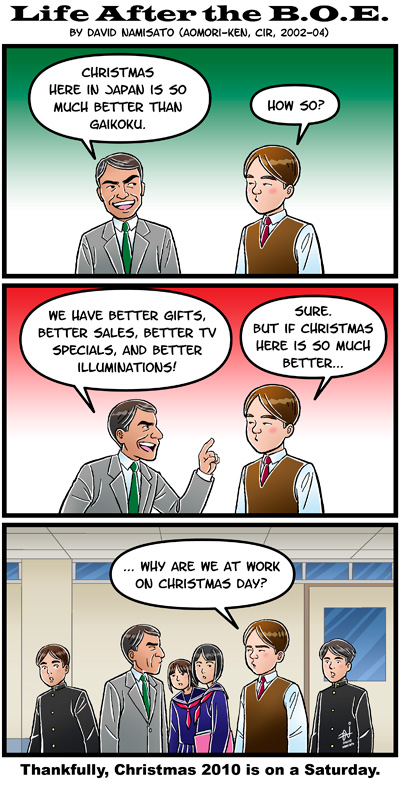
Life After the B.O.E.: Better Christmas
Cartoon/Illustration Comments Off on Life After the B.O.E.: Better Christmas
Life After the B.O.E. is a comic series about the JET experience by David Namisato (Aomori-ken, 2002-2004), a professional illustrator currently living in Toronto.
Visit David’s website at www.namisato.org.
JapanInfo e-Newsletter December 2010
Uncategorized Comments Off on JapanInfo e-Newsletter December 2010

The December 2010 edition of JapanInfo is now available online: http://editor.ne16.com/he/vo.aspx?FileID=569cab53-5818-4cc5-93c0-8d69ff4225b9&m=c084f6d45dcb1543a1f92db467644006&MailID=14668522 *(Click here to subscribe to JapanInfo by email.)
2010 Foreign Minister’s Commendation
Seiji Ozawa to Take the Conductor’s Podium at Carnegie Hall
New Yorkers Discover the Charms of Ishikawa
INSIDE THE ARMOR
The Art of Cut Paper in Philadelphia
VISIT JAPAN: Faster and Further on the Bullet Train
CULTURE CONNECTION: THE JAPANESE PROGRAM AT HUNTER COLLEGE
From the Ambassador’s Desk
JapanInfo is published by the Consulate General of Japan in New York/Japan Information Center and is a great source of info for Japan-related things going on in New York and the surrounding area.
Click here to subscribe to JapanInfo by email.
Boren Awards for International Language Study
Academic, Career, Language Study Comments Off on Boren Awards for International Language Study
 Stephanie Boegeman (ALT, Akita-ken, 2006-09) gets her kicks from finding fun crazy ways to see the world and getting paid to do it. She is constantly in search of job, internship, and travel ideas to add to her site Playing With Hire, in the hopes that more JET alumni and like-minded souls join her in her quest to find creative, inspiring, and unique ways to make ends meet.
Still honing your Japanese skills and looking for someone to subsidize your studies? American students who fit this description may want to look into the Boren award. There’s even a guaranteed government job waiting for you when you graduate. *Deadlines are in February*. More information on applicant criteria and other applicable languages is here.
Job: Educational Outreach Country Coordinator (US Embassy in Tokyo)
Jobs Comments Off on Job: Educational Outreach Country Coordinator (US Embassy in Tokyo)
via former JETAA DC Newsletter editor Gina Anderson. Posted by Dipika Soni (Ishikawa-ken, 2003-06). Dipika currently works as an in-house translator for PFU (a Fujitsu company) in Kahoku-shi, Ishikawa-ken. She is also the vocalist for the Japanese hardcore punk band DEGRADE.
*Note: If you apply for this position, please let them know you learned of it from JetWit. Thanks.
—————————————————————————————————————–
Job Position: Educational Outreach Country Coordinator (US Embassy in Tokyo)
Closing Date for Applications: January 10, 2011
Job Details:
U.S. Embassy Tokyo is looking for a Foreign Service National for the Educational Outreach Country Coordinator position. This person would be doing Education USA Outreach for all of Japan and would be collaborating with Fulbright Japan and working from inside the U.S. Embassy in Tokyo.
Under the direct supervision of the Assistant Cultural Affairs Officer (ACAO) and with support from the Regional Educational Advising Coordinator (REAC)/Northeast Asia, the Educational Outreach Country Coordinator is responsible for three core areas related to U.S./Japan student mobility:
1) providing U.S. higher education services to the Japanese public by organizing and administering thematic programs, seminars, workshops, and school presentations on how to study in the United States;
2) managing, strengthening, and expanding the network of Education USA advising centers throughout Japan by developing and implementing a sustainable marketing and outreach program and by training and guiding Education USA advisers in their goals for student outreach;
3) serving as the primary resource on Japanese education for U.S. educators, government agencies, and other interested parties. The country coordinator works with the ACAO and Cultural Affairs Officer (CAO) to design medium and long-term strategies, including annual work goals, to implement these objectives.
A copy of the complete position description listing all duties and responsibilities is available in the Human Resources Office. Please contact Minako Morimoto (MorimotoMX@state.gov / ext. 5629).
For further job and requirement details, and for how to apply, go to -> http://japan.usembassy.gov/e/info/tinfo-jobs.html
Job: English/Spanish Bilingual Sales/Marketing position at a Japanese Chemical Company (NYC)
Jobs Comments Off on Job: English/Spanish Bilingual Sales/Marketing position at a Japanese Chemical Company (NYC)
via Actus Consulting Group. Posted by Dipika Soni (Ishikawa-ken, 2003-06). Dipika currently works as an in-house translator for PFU (a Fujitsu company) in Kahoku-shi, Ishikawa-ken. She is also the vocalist for the Japanese hardcore punk band DEGRADE.
*Note: If you apply for this position, please let them know you learned of it from JetWit. Thanks.
—————————————————————————————————————–
Job Position: English/Spanish Bilingual Sales/Marketing position at a Japanese Chemical Company, New York City
Job Details:
The New York sales office of a Japanese Chemical manufacturing company is currently seeking candidates for their new Sales/Marketing position. This position will be responsible for marketing/business development and sales activities for chemical products such as Chloroprene, Thermal Functional Filler, Chlorinated Polyethylene, etc. Will report to the General Manager of the department who is a Japanese expatriate.
Main responsibilities are to manage overall sales/marketing functions of the above products and develop new business in North and South America. Job includes both domestic and international (Canada, Brazil, and Mexico, etc.) business trips visiting distributors, clients, attending trade shows, etc.
Requirements:
Regular business hours are from 9am to 5pm.
Some over time as needed.
Starting salary is 50~55K + possible bonus.
Full benefit after an initial 3-month of introductory period.
How to apply:
Please send your resume and cover letter as an MS Word attachment to moya@actus-usa.com to apply. Make sure to mention in your email to what position you are applying.
Job: Recruitment Consultant (Tokyo)
Jobs Comments Off on Job: Recruitment Consultant (Tokyo)
via Actus Consulting Group. Posted by Dipika Soni (Ishikawa-ken, 2003-06). Dipika currently works as an in-house translator for PFU (a Fujitsu company) in Kahoku-shi, Ishikawa-ken. She is also the vocalist for the Japanese hardcore punk band DEGRADE.
*Note: If you apply for this position, please let them know you learned of it from JetWit. Thanks.
—————————————————————————————————————–
Job Position: Recruitment Consultant, Tokyo
Job Details:
What makes a Recruitment Consultant at this agency different from any other recruiter or head hunter?
Requirements:
We can offer you:
If you are a great communicator, a hard worker, an ambitious person who loves working in Japan, and if you like to see excellent financial rewards for your efforts and achievements, you have the qualities they look for!
About the company:
Established in Tokyo in 1999, this company is a quality-driven executive recruitment company, specializing in the IT, Finance, Accountancy, Human Resources, SCM, Engineering and Sales & Marketing markets. The essence of this company is best expressed in their dedication to teamwork, constant self-improvement, excellence and ethics in the way we work with our clients and candidates, and a strong sense of fun and camaraderie.
If this sounds like the kind of organization you would like to work for, please apply!
How to apply:
Please send your resume and cover letter as an MS Word attachment to moya@actus-usa.com to apply. Make sure to mention in your email to what position you are applying.
Job: Japanese/English Bilingual Sales Assistant in NYC (temp to possibly hire)
Jobs Comments Off on Job: Japanese/English Bilingual Sales Assistant in NYC (temp to possibly hire)
via Actus Consulting Group. Posted by Dipika Soni (Ishikawa-ken, 2003-06). Dipika currently works as an in-house translator for PFU (a Fujitsu company) in Kahoku-shi, Ishikawa-ken. She is also the vocalist for the Japanese hardcore punk band DEGRADE.
*Note: If you apply for this position, please let them know you learned of it from JetWit. Thanks.
—————————————————————————————————————–
Job Position: Japanese/English Bilingual Sales Assistant in NYC (temp to possibly hire)
Job Details:
The New York office of a Japanese trading company specializing in Iron and Steel (Ferrous) products seeks an assistant to the company President who is responsible for all the business activities in this small office of currently 3 staff (President, Accountant and Logistics Coordinator).
The job includes not only secretarial duties such as managing phone calls and emails for the President, preparation of various reports to be submitted to their HQ in Japan or presentation materials, arranging business trips for the President, etc., but supportive duties to the President from the every aspects of their business. He/She who fills this position will be expected to learn about the company’s business, clients, markets, reporting duties, and more. It will be a great chance for those who are interested in learning global business.
No prior experience necessary but welcome. Must be able to communicate in Japanese at Business level at least verbally. Business-level (or more advanced) English language skills both verbally and in writing, good PC skills required. Must have bachelor’s degree in Business, Economics or related field. Some knowledge of Accountancy will be very helpful.
The job starts as a full-time temp assignment but there is a big possibility to be hired as a permanent employee depending on your performance. The hourly wage while temping will be around $16. (Negotiation may be possible depending on your experience.) Business hours are 9am to 5pm with an hour of unpaid lunch break, Mon through Fri.
How to apply:
Please send your resume and cover letter as an MS Word attachment to moya@actus-usa.com to apply. Make sure to mention in your email to what position you are applying.
Job: Executive Director at Japan America Society (Seattle)
Jobs Comments Off on Job: Executive Director at Japan America Society (Seattle)
via Japan-America Society of the State of Washington (JAS). Posted by Dipika Soni (Ishikawa-ken, 2003-06). Dipika currently works as an in-house translator for PFU (a Fujitsu company) in Kahoku-shi, Ishikawa-ken. She is also the vocalist for the Japanese hardcore punk band DEGRADE.
*Note: If you apply for this position, please let them know you learned of it from JetWit. Thanks.
—————————————————————————————————————–
Job Position: Executive Director at the Japan America Society of the State of Washington
Job Details:
Responsibilities of the Executive Director include the following:
Overall Direction of the Society: Managing the office and initiating and leading the annual and multi-year strategic business and program planning process in close collaboration with the Board and Executive Committee for their review and approval. Upholds and models the mission statement, values, vision, and community tradition of the Society, modeling a high degree of accountability.
Financial and Budget: Initiating and leading the fund development efforts, financial management, and annual budgeting process in close collaboration with the Board and Executive and Finance Committees for their review and approval.
Program Development and Implementation: Initiating and leading interesting and innovative programs. This includes identifying prospective program offerings, recruiting speakers, arranging venues and maximizing attendance. The Executive Director collaborates with the Program Committee and executes program plans. The three major standing annual fund development programs include the annual meeting, golf tournament and the holiday celebration and auction.
Membership Recruitment/Retention: Initiating and implementing membership recruitment and retention strategies. The Executive Director collaborates with the Membership Committee in being responsible for recruiting new and retaining existing members.
Management and Administration: Managing an office of three staff in a collegial and supportive environment. Models accountability and ensures all staff is held to the highest level of performance.
For more details click “Read More”.
Job: Program Director at Japan-America Society of Dallas/Fort Worth
Jobs Comments Off on Job: Program Director at Japan-America Society of Dallas/Fort Worth
via Japan-America Society of Dallas/Fort Worth. Posted by Dipika Soni (Ishikawa-ken, 2003-06). Dipika currently works as an in-house translator for PFU (a Fujitsu company) in Kahoku-shi, Ishikawa-ken. She is also the vocalist for the Japanese hardcore punk band DEGRADE.
*Note: If you apply for this position, please let them know you learned of it from JetWit. Thanks.
—————————————————————————————————————–
Job Position: Program Director at Japan-America Society of Dallas/Fort Worth
Job Details:
The Japan-America Society of Dallas/Fort Worth is seeking a fulltime Program Director to plan and implement programs about Japan and the U.S.-Japan relationship. Additional responsibilities include managing the society’s membership program and promoting the organization and its programs to the community.
Click here for a detailed job description and required qualifications
How to apply:
To apply, send cover letter and resume to Anna McFarland, Executive Director, at anna@jasdfw.org.
Job: Researcher for Japanese Energy Association (Washington, D.C.)
Jobs Comments Off on Job: Researcher for Japanese Energy Association (Washington, D.C.)
via International Access Corporation. Posted by Dipika Soni (Ishikawa-ken, 2003-06). Dipika currently works as an in-house translator for PFU (a Fujitsu company) in Kahoku-shi, Ishikawa-ken. She is also the vocalist for the Japanese hardcore punk band DEGRADE.
*Note: If you apply for this position, please let them know you learned of it from JetWit. Thanks.
—————————————————————————————————————–
Job Position: Researcher
Job Details:
Researcher required for prestigious Japanese energy association located in Washington, D.C. Bachelors Degree required, Masters desirable. Candidate will monitor and report on U.S. energy/regulatory/policy issues and will develop written descriptions of Japanese energy industry issues for the U.S. market. Familiarity with Japanese language and culture not required but desirable. Requires Word, Excel, PowerPoint and wide experience with Internet-based research. $40,000 annually with fully-paid health/dental/life insurance, 401(k), profitshare plan, very generous holidays and dynamic, international working environment.
Salary: $40,000
Start Date: Jan 3, 2011
Requirements: Bachelors Degree minimum; Masters’ Degree desirable
How to apply:
Send your resume together with a COVER LETTER to:
Elizabeth McCarthy IAC, 1015 18th St. Suite 504, Washington D.C. 20036
Jobs: Kyoto Consortium of Japanese Studies Professors needed
Jobs Comments Off on Jobs: Kyoto Consortium of Japanese Studies Professors needed

Via Shinpai Deshou, an online resource to help Japanese Studies majors figure out how to make a living doing what they love:
The Kyoto Consortium of Japanese Studies is looking to fill two professor positions, one for the upcoming academic year and one for the next. The deadline date for the 2011-12 application is JANUARY 3, 2011; for 2013-14, the deadline is FEBRUARY 18, 2011 . The full job announcement in all its glory can be found here.
Report: “Reinvigorating US-Japan Policy Dialogue and Study” and implications for JET
Academic, Article/Journalism, Japan Trends, JetWit Diary, Return on JET-vestment, Writers Comments Off on Report: “Reinvigorating US-Japan Policy Dialogue and Study” and implications for JET
 There’s a very JET-relevant report just published by the Japan Center for International Exchange titled “Reinvigorating US-Japan Dialogue and Study.” (Notably, JET alum Jim Gannon (Ehime-ken, 1992-94), Executive Director for the US office of JCIE, was involved in the drafting of the report.)
Though the report only mentions the JET Program once (on page 33 of the report), it’s clear that the still largely untapped resource that is the JET alumni community of over 50,000 worldwide (25,000+ in the US) has the potential and the ability to play a significant role in US-Japan relations going forward given the decline in energy and resources devoted to US-Japan policy dialogue and study cited in the report.
The gist of the report is that “the institutional base of US-Japan policy dialogue and study has started to erode in recent years.” However, the report also “finds fertile ground to deepen bilateral dialogue and better leverage the extensive human networks that have developed between the two societies.”
The main obstacles to reversing this trend appear to be:
- a shrinking institutional base for US-Japan relations and failure to fully take advantage of available resources (e.g., the JET alum community);
- reduced funds available in Japan to support these activities (due in a large part to a down economy); and
- to some extent, increased interest in and focus on China
As JET alums, the above trends may be beyond our control. But we are a big part of that extensive human network that needs to be leveraged. And regardless of the obstacles, the ball is in our court to be part of the solution. Tough times call for innovative solutions.
Gambarimashou.
Justin’s Japan: Interview with ‘Fried Chicken and Sushi’ Cartoonist/JET Alum Khalid Birdsong: Part 1 of 2
Interview/Profile, Justin's Japan, Notable JET Alums Comments Off on Justin’s Japan: Interview with ‘Fried Chicken and Sushi’ Cartoonist/JET Alum Khalid Birdsong: Part 1 of 2
By JQ magazine’s Justin Tedaldi (CIR Kobe-shi, 2001-02) for Examiner.com. Visit his NY Japanese Culture page here to subscribe for free alerts on newly published stories.
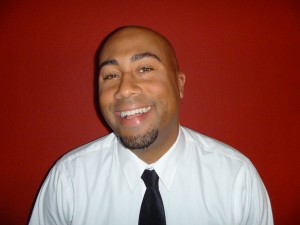
Cartoonist/JET alum Khalid Birdsong. (Courtesy of K. Birdsong)
Cartoonist and teacher Khalid Birdsong lived in Japan for two years working as an assistant English teacher on the JET Program. Last spring he launched the original webcomic Fried Chicken and Sushi, which is published twice a week and based loosely on his real-life experiences in Japan, mining the cross-cultural humor that living abroad provides.
Birdsong now lives in the San Francisco Bay Area with his wife, whom he met in Japan, and baby daughter. He plans to visit Japan next year, which he feels will inspire even more stories. I spoke with the artist about his time on JET, life as a teacher, and the future of his creation.
Where did you grow up, and what is your history with comics?
I guess I’d call Atlanta, Georgia, home—that’s where I’ve spent most of my life. I’ve traveled quite a bit. I’ve lived in several countries—in Nigeria, Germany, the Bahamas and also Japan. So I’ve kind of had that international view of things. I’ve always enjoyed reading comics no matter where I might be living. I’ve always liked to draw them, but I didn’t really read American comics until I was in middle school. Mainly, I would read Asterix and the European comics, and I’d watch a lot of animation. But I’d still draw my own comics and make up my own characters and do my own comic books and then sell them for a quarter to my friends; people always knew me as the comic book kid. So I just kept it going—even in college, I went to Howard University in Washington, D.C., and I studied graphic design and illustration there. Everything I learned, I tried to bring it back into comics and cartooning. I also did T-shirt designs, and did some freelancing for a couple of years on my own, which meant that I was freelance working, but I was also a security guard, and I was waiting tables, and all the other things that you do. And I just fell into teaching art in elementary school, and I’ve been teaching ever since. I really, really love it. It’s great.
How did you get hooked on Japanese culture?
I think like most people in high school, at least when I was in high school in the early ’90s, it was this brand new thing, when trying to look at Japanese animation when you didn’t have a translation and watching stuff you couldn’t understand with friends—and trying to read any certain comics that you could get your hands on—it was something new and exciting. I just always thought, “Boy, it must be interesting to actually live in Japan; that must be something amazing to do.” But I never thought I would really ever do it. I was just interested in the art and language. Even in college, same thing—it became more prevalent. I would enjoy more and more anime and manga, along with American comics. So I think that’s what really started me off. I was drawing comics, but I was still drawing in an American-type cartoony style. I didn’t have that quote-unquote manga style, but that’s what kind of started me into it. And then I started thinking what it would be like to live over there once I started actually teaching art.
That’s when you discovered the JET Program?
Yeah, when I was teaching art, I guess I had this feeling—I was in my mid-20s, and I just thought it would be nice. Me and my friend Jason, who’s actually the J in the Fried Chicken and Sushi comic—we both talked about going to Japan just to visit just for a couple of weeks. And so we tried to plan a trip, but we didn’t have the money and all this—didn’t quite happen. And then, he actually found out about the JET Program online, and then I looked into it, too, and we said, “We should try to apply, let’s do it.” I was already teaching [in the U.S.], so we applied, and I went through the, whatever, nine-month span of time that it takes to go through everything, and I made it in and he didn’t, and it really was not cool; it really hurt us both. But he’s a good friend, so he said, “You need to go on ahead and do it,” and so I did.
So the relationship between the two characters in the comic is based on real life.
It is. A lot of what I’m telling in the comic is based on truth in my life, but there are things that I may change or over exaggerate or add on as time goes by, as Karl’s character develops and becomes more of his own character and individual, and the same with J. So there’ll be things that I make up, but I try to keep as much of it as I can based on some of my real experiences—I think people can tell what comes from truth and real experience.
So you’re saying you didn’t have a talking tanuki spirit haunting you?
[laughs] That’s great! You know, the thing with that is, in real life I really do have a very overactive imagination. You might have known some Japanese when you went over there, but for me, I really didn’t. I listened to some CDs and studied some basic greetings and everything, so when I was there I had no idea what anyone was saying. I would just get lost in my own imagination, and there were tons of stories going on in my head and all this—I would imagine things moving around that weren’t moving around. So no, I didn’t have a tanuki, but I wanted to have something that would represent that state of craziness I was in, where I’m there but also kind of detached from it all.
Because of budget woes, there’s been talk of the Japanese government trimming or potentially cutting the JET Program altogether. As a JET alum, what are your thoughts on the value and benefits of the program from your own experiences?
I think that for me, it was great to be able to travel to another country and to get international experience as a teacher and teach English and be able to travel in a place where I never thought I would and learn a new language, so that is very valuable for me. I think that even though people argue, saying that maybe having a native speaker in the classroom is not that all that important for Japanese people, I think that it’s still great for them to have someone from another country, because I feel that Japanese people don’t really get a chance to really experience or talk to or have someone that’s not Japanese around them typically. So I think it’s a great way for them to not just learn about other cultures and what’s around them, not to mention English, but in terms of international relations I think it’s a really great program for that.
And the work you’re doing now is an extension of those ideals.
I totally agree, it’s really great. It challenges stereotypes, and I wish we could have more of it instead of cutting it down.
Click here for the rest of the interview.
From JET alum Rosa Sobrino who is a producer for a Japanese morning show in NY:
“Live Japanese TV News program looking for some awesome volunteers to participate as extras on Thursday, December 16, 2010 from 2:30p.m.-5:30p.m. in Brooklyn. We will be introducing a local stunt school and would like to ask some people who can do basic exercise to come. If you are interested, please contact Rosa anytime at 917-755-0955 asap.”
