




Job: Inside Sales/Customer Service job (SF)
 Jobs
Jobs  Comments Off on Job: Inside Sales/Customer Service job (SF)
via Jet alum and JET Program Coordinator in SF, Peter Weber. Posted by Dipika Soni (Ishikawa-ken, 2003-06). Dipika currently works as an in-house translator for PFU (a Fujitsu company) in Kahoku-shi, Ishikawa-ken. She is also the vocalist for the Japanese hardcore punk band DEGRADE.
*Note: If you apply for this position, please let them know you learned of it from JetWit. Thanks.
—————————————————————————————————————–
Job Position: Inside Sales/Customer Service job (SF)
Job Details:
Essential duties and responsibilities include the following.
Qualification Requirements:
To perform this job successfully, an individual must be able to perform each essential duty satisfactorily. The requirements listed below are representative of the knowledge, skill, and/or ability required. Reasonable accommodations may be made to enable individuals with disabilities to perform the essential functions. Employee must have a thorough knowledge of the freight forwarding industry in both air and ocean. Employee must have a basic knowledge of sales. Employee must have a good knowledge of customer service techniques.
How to apply:
Go to http://www.iiicareer.com/applicant/jp/detail.php?recid=39638
Job: Associate, Nikkei Horizons Continuing Education Program (Seattle)
Jobs Comments Off on Job: Associate, Nikkei Horizons Continuing Education Program (Seattle)
Via JETAA Pacific Northwest e-mail list:
Nikkei Concerns, a non-profit elder-care organization primarily serving the Japanese-American and Asian-American Communities in the Greater Seattle area, is seeking qualified applicants for their Nikkei Horizons Associate vacancy for Nikkei Horizons Continuing Education Program.
The position will assist in planning, coordinating, administering and marketing a continuing education program that encourages friendships and creates lasting memories through a wide range of exciting activities such as adventurous excursions locally and aboard, computer lessons, exercise and wellness classes, and learning about Japanese art, culture, traditions and more.
The ideal candidate will have experience in planning and coordinating activities, be a people-person who is detailed-oriented, possesses excellent customer service and communication skills and has a passion for enhancing the lives of our community members. Fluent in Japanese preferred.
Interested qualified individuals should email their resume and a cover letter to jlardizabal@nikkeiconcerns.org (Jeannette Lardizabal, Human Resources Specialist, 206-726-6525). Complete job descriptions are available upon request.
Please visit the Nikkei Concerns website at www.nikkeiconcerns.org for more information about our organization.
Position advertisement is open until filled. First considerations will be given to resumes and cover letters received by 5:00 p.m. Friday, January 21, 2011.
See attachment for application information
Continuing Education Program
1601 E. Yesler Way
Seattle, WA 98122
JETAA Chapter Beat 1.10.11
JETAA Chapter Beat, JETAA Chapters Comments Off on JETAA Chapter Beat 1.10.11
Freelance writer/editor Jonathan Trace (Fukuoka-ken, 2005-08) takes us on a walk around the JET Alumni community for another edition of JETAA Chapter Beat.
- General Meeting – Thursday, January 13th, 6:00 at Reline in Harvard Square. Welcome the new president and discuss the future of NEJETAA.
- Shinnenkai – Saturday, January 22nd. More details to follow.
- London Pub Night – Thursday, January 13th, 6:30 at Life. Practice your Japanese, see old friends and have some authentic Japanese cuisine at this month’s Pub Night in London.
- JETAA Creative Entrepreneurs Salon – Friday, January 14th, 8:00 at Brick Lane. Check out this networking event for freelancers, business owners and entrepreneurs. Share your experiences and make new friends in the new year.
- Pub Night – Friday, January 21st, 7:00 at Kingston Taphouse and Grille. Join JETAABC for the first pub night of 2011 with friends and alumni.

- Kabuki Club – Sunday, January 23rd, 2:00 at the Oakland Asian Cultural Center. This month’s selection will be the classic “Sukeroku: The Flower of Edo.” A casual Shinnenkai will follow the viewing at a nearby restaurant.
- Tampa Subchapter Shinnenkai – January 23rd, 5:30 to 7:30 on West Sitios Street in Tampa. Celebrate the new year with friends, family and alumni.
- General Meeting – Monday, January 10th, 6:30 a.m. to 9:30 a.m. in Chicago. Lend your voice to the future of JETAA Chicago at the first Executive Board meeting of the new year.
- Shinnenkai – Saturday, January 15th at the JIC. Celebrate 2011 Japanese style, with food, friends, games and more. More details to follow.

- JBook Meeting – Monday, January 24th, 6:30 in the Adams Morgan/U Street Area. Jbook is back for the new year, with this month’s selection being “The Housekeeper and the Professor,” by Yoko Ogawa. The discussion will be followed by a screening of the film, so don’t miss it.
- JETAASC Retreat 2011 – Saturday, January 22nd, 9:00 to 3:00 in West Covina. Spend the day getting to know your fellow JET alumni, or catch up with old friends at this year’s retreat. Discuss the future of JETAASC and don’t forget to bring your favorite dish for everyone to share.
What happened at your chapter’s event? If you attend(ed) any of these exciting events, JetWit would love to hear about them. Just contact Jonathan Trace with any info, stories or comments.
WIT Life #149: 成人の日
Japan Trends, Translating/Interpreting, Uncategorized, WIT Life, Writers Comments Off on WIT Life #149: 成人の日
WITLife is a periodic series written by professional Writer/Interpreter/Translator Stacy Smith (Kumamoto-ken CIR, 2000-03). She starts her day by watching Fujisankei’s newscast in Japanese, and here she shares some of the interesting tidbits and trends together with her own observations.

Yesterday Japan celebrated 成人の日 (seijin no hi) or Coming of Age Day, and 1.24 million youngsters took part in this celebration (成人式 or seijinshiki). This was the lowest number of participants ever, and the fourth straight year in which the number of 20-year olds has declined. This morning’s news interviewed the 1500 or so Chiba youths who were lucky enough to have their ceremony at Disneyland. They were asked how they felt about becoming adults, and the majority expressed uncertainty regarding their future and being able to find jobs. This year’s group was born in 1990 when the economic bubble burst, and they have Read More
Justin’s Japan: Interview with NEA Jazz Master Hubert Laws
Article/Journalism, Interview/Profile, Justin's Japan Comments Off on Justin’s Japan: Interview with NEA Jazz Master Hubert Laws

2011 NEA Jazz Master Hubert Laws. (Courtesy of Spirit Productions)
By JQ magazine’s Justin Tedaldi (CIR Kobe-shi, 2001-02) for Examiner.com. Visit his NY Japanese Culture page here to subscribe for free alerts on newly published stories.
With a career in music that began in the 1960s, Grammy-nominated flautist Hubert Laws’ latest honor is the NEA Jazz Master Award, which since 1982 is the highest prize the U.S. bestows upon living jazz musicians.
Laws will appear at a free panel discussion with the other 2011 NEA Jazz Masters at New York’s Jazz at Lincoln Center on Jan. 10. (Doors open at 12:45 p.m., and a live video stream can be seen here.) The following night, he will perform at the annual NEA Jazz Masters Awards Ceremony and Concert. For those who can’t attend the sold out show, there will be a live video stream on the NEA website along with a simulcast on the Newark-based WBGO Jazz 88.3 FM and their site, and Sirius/XM Satellite Radio’s Real Jazz Channel 70.
This year also marks the artist’s 40th anniversary of his first trip to Japan. I spoke with him about his time there along with some of his other personal highlights as a musician.
Congratulations on your NEA Jazz Master award. How does it feel to receive this honor?
After learning of its significance, it is a humbling experience to be named among other respected artists of special accomplishment.
How did you find out that you won his award? Did you or anyone else campaign for it?
I happened to be on a tennis court playing doubles when my cell phone rang during a changeover. The gentleman asked if I had a moment—I said, “About 90 seconds.” When he announced the award, I said, “I think my partners will wait a little while longer.” I was not aware of this award, so could not “campaign” for it.
Tell us about your history playing in Japan and working with Japanese artists as a musician.
My first tour in Japan began in Tokyo in 1971 with the “CTI All-Stars” [Freddie Hubbard, Stanley Turrentine, George Benson, Grover Washington, Ron Carter, Bob James, Ester Philips, Hank Crawford and others].
We were greeted at Narita Airport by fans with banners and fanfare as though we were rock stars. That tour included several cities for about two weeks. Since then, 15 other trips there included my own group at the Blue Note Club, another with Ron Carter and his group, Chick Corea and his group, and Sonny Rollins with the Yomiuri Symphony Orchestra, where I premiered the Concertino for Flute and Orchestra by Harold Blanchard. This performance can be seen on the 30 Year Retrospective DVD; and excerpts can be seen on my website. The Laws family [Ronnie, Debra, Eloise and Hubert] appeared at the Cotton Club there in 2007. A JVC Jazz Festival was held there. where Eloise and I appeared there along with Nancy Wilson and others.
My most recent CD features Japanese child prodigy and pianist/keyboardist Yayoi Yoshida in flute adaptations of classical compositions: Rachmaninov’s Piano Concerto #2 and Samuel Barbers’ Adagio for Strings. Excerpts also can be heard on my site.
Why do you think the Japanese enjoy jazz so much?
As a culture, it appears that the Japanese gravitate heavily toward education. This value seemingly leads to appreciation of substance. There is great “substance” in the art of improvised music commonly known as “Jazz.” As in any culture, the “foreign mystique” may also play a part. “A prophet is not unhonored except in his home territory and in his own house.” –Matthew 13:57, New World Translation of Holy Bible.
Click here for the rest of the interview.
Job: Bilingual (J-E) event attendant for trade show (NYC)
Jobs Comments Off on Job: Bilingual (J-E) event attendant for trade show (NYC)
Via Actus Consulting:
*Note: If you apply for this job, please indicate that you learned about it via JetWit.
Japanese company who is attending a trade show seeks a Japanese English Bilingual Event Attendant.
Job responsibilities will include but not limited to:
1. Assist communication between a vendor and visitors by interpreting
2. Explain and promote products
Dates and Hours:
Jan 29, 3:30-5:30pm
Jan30-Feb 2, 9:00am-6:00pm (include lunch break 30 min / afternoon break 30 min)
Feb 3, 9:00am-12:00pm
Salary: $14/hr
Location: New York, NY
Qualification: Must be able to communicate both in Japanese and in English. Event attendant experience a big plus.
Contact: infony@actus-usa.com
A New Year’s Resolution for Law Students: Organize.
Academic, Advice, Blogs, Career, Graduate School Comments Off on A New Year’s Resolution for Law Students: Organize.
**********
Matt Leichter (matt [dot] leichter [at] gmail [dot] com) (Saitama-ken 2003-05) is a renegade attorney who plays by his own rules. He operates a think tank of one, The Law School Tuition Bubble, where he archives, chronicles, and analyzes the rising cost and declining value of legal education in the United States. He also maintains the “Bankruptcy Legal Topics,” and, “Bankruptcy Billables,” sections for Steven Horowitz’s Bankruptcy Bill. For further reading regarding JETs and the law, he recommends JETs with J.D.s.
If you don’t know already, the New York Times ran a seven-page article in its business section detailing the crisis America’s legal education system faces. It even generously linked to The Law School Tuition Bubble. Yay! The whole article is worth the read, but towards the end it erred:
Today, American law schools are like factories that no force has the power to slow down — not even the timeless dictates of supply and demand.
There is one force that can stop these factories: law students. Find out why I think they should organize.
WIT Life #148: Mikarimba
Events, Translating/Interpreting, WIT Life, Writers Comments Off on WIT Life #148: Mikarimba
WITLife is a periodic series written by professional Writer/Interpreter/Translator Stacy Smith (Kumamoto-ken CIR, 2000-03). She starts her day by watching Fujisankei’s newscast in Japanese, and here she shares some of the interesting tidbits and trends together with her own observations.
On Friday night I had the opportunity to see the performance of marimbist Mika Yoshida at Carnegie Hall. The program was entitled “Mikarimba Madness” and also featured drummer Steve Gadd and bassist Eddie Gomez, as well as the participation of special father/son guests clarinetist Richard Stoltzman and pianist Peter John Stoltzman. During the night Yoshida wore a wide range of expressions on her face from fierce to completely content, as she both Read More
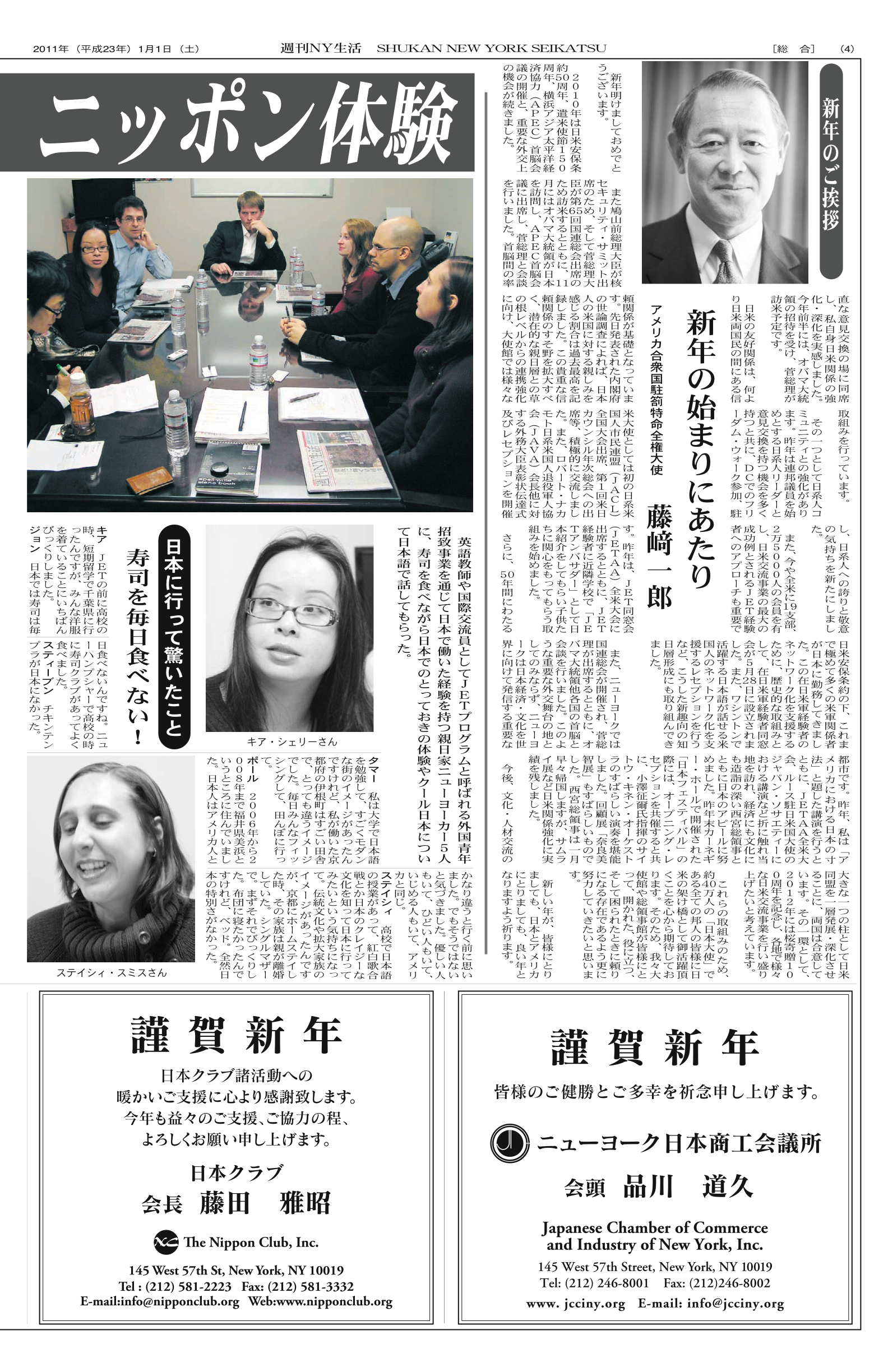
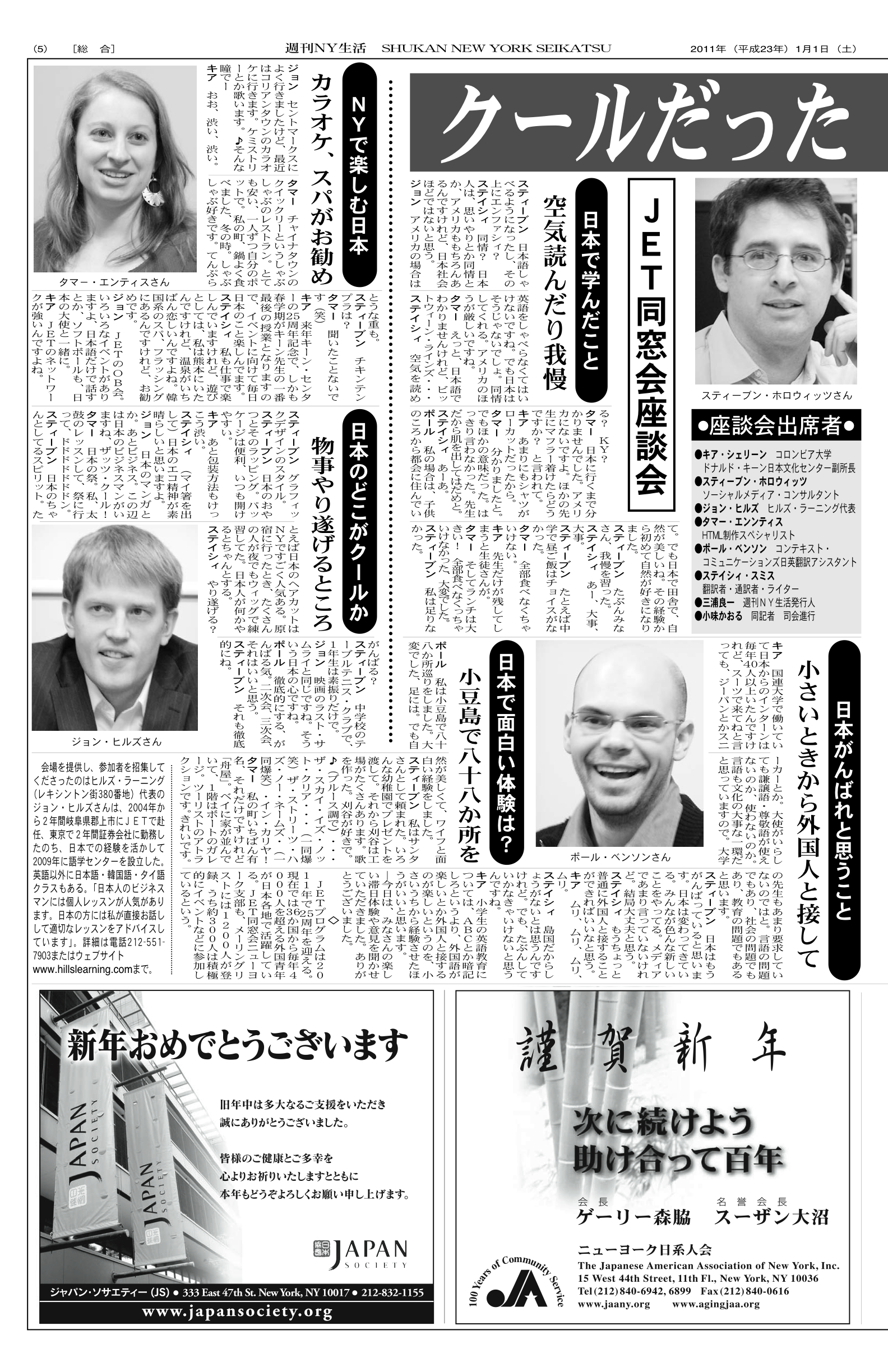
See some familiar JET faces (including that of JetWit founder Steven Horowitz) in the latest issue of Shukan NY Seikatsu, a free, weekly Japanese newspaper available in New York. Along with Steven, JET alums Stacy Smith, Kia Cheleen, Tamar Entis, and Paul Benson sat down with the paper to talk about their experiences for a special New Year’s issue. The even was organized by Jon Hills, founder of Hills Learning (and husband of JET alum Kendall Murano).
The group was asked about what they learned from Japan, what they loved about their areas, what they thought was cool about Japan, and what their reactions were to some of the criticisms Japanese teachers have of JETs. The resulting “NY Cool” feature is front page news, with the full length article inside.
Read the full issue online here (the JET profiles are on page 4 and 5):
http://viewer.nyseikatsu.com/viewer/index.html?editionID=331&directory=../editions&page=1
For more background on the write-up, see this previous JetWit post.
Happy reading!
-Gail Meadows
Associate Editor, JetWit
JETAA Northern California Rajio Taiso – TOMORROW!
Events, JETAA Chapters Comments Off on JETAA Northern California Rajio Taiso – TOMORROW!
Hi everyone!
Just a reminder that we will be meeting at 11:00am tomorrow morning for some Rajio Taiso!
JETAANC is kicking off the new year with some good, ole Rajio Taiso! Back in August 2010 at the JETAA National Conference, delegates came up with the great idea of filming JET alumni around the world practicing the long time favorite, Rajio Taiso. This infamous Japanese calisthenics routine is performed daily and at special sporting events, like an undoukai! What a better way to show how JET alumni are still connected to Japanese culture! Who could forget that piano music and voice counting out each movement?
JETAA USA asked all chapters to film themselves doing rajio taiso in front of a landmark and we thought that having the Golden Gate Bridge and SF cityscape in the background would be perfect! So we’re headed to the Marin Headlands!
When: Saturday, January 8 from 11am-12pm
Where: Marin Headlands, Conzelman Road at Kirby Cove (map)
All are welcome to join! Even if you’re a little bit rusty, we will practice the routine a few times before filming, so come on out!
To get a better idea of what we’re doing, here’s the video that our friends at JETAA Portland made (http://www.facebook.com/l/c5af5k7y9RlwljjtpZ4o9Iq06xA;www.youtube.com/watch?v=zqGUsHusnWE).
See you there!
~Melissa Chan
JETAANC Media Coordinator
books@jetaanc.org
JET alum manga artist featured in New York Times
Article/Journalism Comments Off on JET alum manga artist featured in New York Times
 Kudos to JET alum Zach Wood (ALT Niigata 2007-09), who was recently featured in a New York Times article about the increase in the number of Japanese universities offering degrees in manga and animation. Zach is a graduate of Stanford University in California and is studying manga at Kyoto Seika University, which established Japan’s first manga program. Universities offering these kind of programs say they are hoping to significantly increase the number of international students enrolled. See the article here:
Japanese Universities Draw Foreign Students With Manga
Blog post about JET Programme on U.S. Embassy website
Blogs, Return on JET-vestment Comments Off on Blog post about JET Programme on U.S. Embassy website

Mark Dieker with Japanese students in the mid-90s
The following link comes via JET alum Aurelien Hancou (Okayama-ken 2003-06), now a Senior Programme Coordinator at CLAIR. Hancou writes to share a guest blog post by Mr. Mark S. Dieker, Consul for Political and Economic Affairs at the U.S. Consulate in Fukuoka:
http://zblog.japan.usembassy.gov/e/zblog-e20101221a.html
The post is a great testimony of the value and benefit of the JET Programme. Check it out!
Sake World e-newsletter by John Gauntner (January 2011)
Books, Celebrity, Notable JET Alums Comments Off on Sake World e-newsletter by John Gauntner (January 2011)
 The January 2011 issue of the Sake World e-newsletter by JET alum and the leading non-Japanese sake expert in the world, John Gauntner (a.k.a. “The Sake Guy”), is now available online. In this issue:
1. Greetings
2. The Suffix “-shu”
3. Announcements and Events: Sake professional course in Japan
4. Sake Education Central
Additional links:
JET alum shares perspectives of Japan in Metropolis magazine
Article/Journalism, Writers Comments Off on JET alum shares perspectives of Japan in Metropolis magazine
 JET alum Mark Flanigan (Nagasaki 2000-04) wrote to JetWit to share his writing “debut” in Tokyo, featured in Metropolis Magazine. Following his stint in Nagasaki, Mark returned to Japan as a Rotary International World Peace Fellow at International Christian University (ICU) / 国際基督教大学 in Tokyo. He says:
I am very happy and also humbled to have been selected to write for such a great magazine. In my article, I talk about some of the different impressions I have found here, as a JET and now as a Peace Fellow, and compare/contrast my feelings of my two different times spent living in Japan.
Click here to read the article, “Found and Lost: Reflections on my two Japans.”
Justin’s Japan: Interview with NEA Jazz Master David Liebman
Article/Journalism, Interview/Profile, Justin's Japan Comments Off on Justin’s Japan: Interview with NEA Jazz Master David Liebman

2011 NEA Jazz Master Dave Liebman. (Marek Lazarski, courtesy of the National Endowment for the Arts)
By JQ magazine’s Justin Tedaldi (CIR Kobe-shi, 2001-02) for Examiner.com. Visit his NY Japanese Culture page here to subscribe for free alerts on newly published stories.
Brooklyn-born saxophonist and flautist Dave Liebman is one of this year’s recipients of the NEA Jazz Master Award, which since 1982 is the highest honor the United States bestows upon living jazz musicians. Liebman is best known for his work with the legendary trumpeter Miles Davis, joining his band in 1973 for a 16-month stint and playing on two studio albums, the final ones that Davis would record for the rest of the decade, as well as several live bootleg concerts that are available.
Liebman will appear at a free panel discussion with the other 2011 NEA Jazz Mastersat New York’s Jazz at Lincoln Centeron Jan. 10. (Doors open at 12:45 p.m.)The following night, he will perform at the annual NEA Jazz Masters Awards Ceremony and Concert. For those who can’t attend the sold out show, therewill be a live broadcast on the Newark-based WBGO Jazz 88.3 FM and their website, and Sirius/XM Satellite Radio’s Real Jazz Channel 70. I spoke with the artist about his thoughts on winning this award, his history in Japan, and his intriguing relationship with Miles.
How is one picked to be an NEA Jazz Master?
This is a very good question, which I hope to find out at the ceremony [laughs]…I think past inductees are a part of it—I have no idea. I can’t wait to know, assuming they will tell me the process.
Did you have to campaign for it?
Absolutely not; this was a phone call that came out of nowhere. I think my boss at the Manhattan School of Music, Justin DiCioccio, said he recommended [me], but the truth is, if you go to the site right now, you can put yourself in…the public is free to nominate anybody on the website. So that’s all I know about the process. How it goes from there to deciding [the inductees], I don’t really know, and I’m curious to find out.
You’ve played with Japanese artists and appeared on their albums since the early ’70s. How did that come about, and what were your impressions from visiting Japan through the years?
Of course, I had a lot of action in the ’70s and into the ’80s, but not so much in the last 10 to 15 years. First of all, the Japanese audience at that time was fantastic, and of course Miles Davis was a gigantic hero. The fact that I was with Miles put me right away into a special arena, and sure enough as soon as I got there I recorded. When I was on my first tour with Miles in Japan—it was the only time I went with Miles to Japan—I recorded my first record as a leader [First Visit, with Jack DeJohnette, Richie Beirach and Dave Holland], because Stan Getz’s group was there and the rhythm section was ready to go. I recorded with Abbey Lincoln also that week. In those days, when you went to Japan somehow you ended up with record dates. They were very, very enthusiastic, and business was good.
And then I had, of course, a long-term relationship with Terumasa Hino, the trumpet player, and drummer Motohiko, his brother who passed away a few years ago. I worked many times with the Hinos in Japan at a lot of festivals. Most notably there were two big concerts that I did in the ’80s—one for John Coltrane with Wayne Shorter and then in the ’90s with Michael Brecker, again for Trane ten years later. But as I said, not so much in the last ten to fifteen years. It was fascinating how deep the Japanese audience got into the music and how enthusiastic they were. But it seems to have faded, from what I understand. This generation is not as interested as before. So I can’t speak about the present jazz situation there, but I certainly enjoyed my visits.
Why do you think the Japanese had such an interest and enthusiasm for jazz?
I don’t know. I think they were fascinated by anything American, first of all. They probably loved Dolly Parton, or Sting, or whomever. I think they really liked Western culture. They were fairly prosperous during that period and when prosperity comes, people have more time to do leisure activities, enjoy culture and arts and so forth.
I think the Japanese temperament in general, the arts of Japan—everything from the sword stuff to the tea ceremony to the kimonos to the shakuhachi—they’re a really high class, sophisticated culture; that’s part of their being. And jazz, being as sophisticated as it is appealed to them. I think that’s part of what made them like it more than other cultures in Asia for example. I don’t see China—although we don’t know yet—embracing it the way Japan did, just from the difference of their M.O., the way they are as people. Japan is culturally kind of like the equivalent in Europe of the Germans, who are also very musically sophisticated and are really the best audience to play for as far as educated goes.
When was the last you played in Japan?
I think 2004 or ’05, we did a festival in Kyoto celebrating the history of the city; it was a special festival and I played with my regular working group of the last twenty years. I think that was the last time. You know, in general they just really appreciate art.
Read the rest of the interview here.
