




X Japan’s Yoshiki Takes Manhattan, Meets JET Alums
 Article/Journalism, JQ Magazine, Music
  Comments Off on X Japan’s Yoshiki Takes Manhattan, Meets JET Alums
On May 23, X Japan mainman Yoshiki–who is widely regarded as Japan’s premier rock musician–was in New York City to promote his weekly “Yoshiki Radio” show, which launches on SiriusXM’s Boneyard (channel 38) tonight at 8:00 p.m.
Fujisankei (FCI) News was there, and they interviewed JET alumni Sam Frank of UnRatedNYC and JQ magazine editor/Japanese Culture Examiner Justin Tedaldi for their “Today’s Eye” segment broadcasted on Japanese TV! Check out the video below for Justin’s comments. (Direct link at http://www.fujisankei.com/video_library/art/yoshiki-radio.html)
JQ Magazine: JQ&A with JETAA Country Representative Megan Miller Yoo
Article/Journalism, Interview/Profile, JQ Magazine Comments Off on JQ Magazine: JQ&A with JETAA Country Representative Megan Miller Yoo

“I can’t ever say this enough, but working with the JETAANY executive committee has been an amazing experience. We have such a great team of dedicated volunteers who really want to see the organization succeed and will go to great lengths to make sure that happens.” (Katharine Andriotis)
By Renay Loper (Iwate-ken, 2006-07) for JQ magazine. Renay is a freelance writer and international education professional currently seeking FT opportunities. Visit her blog at Atlas in Her Hand.
Philadelphia native and current Long Island City, NY resident (by way of Hyogo-ken and Washington, D.C.), Megan Miller-Yoo (Hyogo-ken ALT, 2000-02) is the outgoing president of JETAANY (2008-11) and new JETAA USA Country Representative (CR). During her time as an ALT, Megan demonstrated her commitment to the JET Program via her creation of the Volunteer Special Interest Group (VSIG) for AJET.
Since returning to the U.S., Megan has been involved in the Washington D.C., Philadelphia, and New York chapters of JETAA. Megan also served on the Board of Directors for JETAANY. She recently graduated from NYU with her MBA, currently works as an engineering underwriter, AVP with Swiss Re and lives in Long Island City with her husband.
Megan recently spoke with us to share more about her time as JETAANY president, and her new role of CR.
Where did you spend your JET years?
I was an ALT in Hyogo-ken from 2000-02. I worked in the suburbs of Akashi (home of the world’s longest suspension bridge and famous for its tako), which is along the coast between Kobe and Himeji.
You recently finished your third term as JETAANY’s president. How did you get involved with JETAANY?
I moved to New York in November 2005, on the day of the New York City Marathon, which made navigating my U-Haul truck through the city pretty awful. After a year in the city I still did not have a strong network, so I researched JETAANY and showed up at a quarterly meeting being held at Two Boots pizza in early 2007. I was hooked right away and with impending officer elections, Kat Barnas convinced me that very night to take over her spot as vice president. I served as VP from 2007-08 and then moved into the president role for the next three years.
During your tenure, what brought you the most joy?
I can’t ever say this enough, but working with the JETAANY executive committee has been an amazing experience. We have such a great team of dedicated volunteers who really want to see the organization succeed and will go to great lengths to make sure that happens. When you consider that we all have full-time jobs but everyone finds time to make JETAANY events the same caliber as something you’d pay to have done, you start to understand the impact that Japan had on us and how eager we are to give back.
What do you hope your JETAANY legacy will be?
During my tenure I strove to ensure that we delivered high caliber events and benefits to our member base. From the upgraded format of the e-mail announcements and website to the diversity and quality of events, I encouraged everyone involved in the organization to really give it their all and do the best job they could. I believe that people have started to realize what JET alums are capable of and what the value of our network is to Japan, to our home countries, and also to us as members of the network. We are a group of diverse, talented professionals who can really make an impact wherever we choose to focus our efforts, and my goal was to showcase that in everything we did.
How did you go about becoming a CR? What made you make the switch? Read More
JQ Magazine: Book Review – “The Thousand Autumns of Jacob de Zoet”
Books, JQ Magazine, Reviews Comments Off on JQ Magazine: Book Review – “The Thousand Autumns of Jacob de Zoet”

"Brimming with potent imagery, the novel is suffused with a generous dose of personal observation and philosophical musing, much of which sounds strikingly contemporary." (Random House)
By Sharona Moskowitz (Fukuoka-ken, 2000-01) for JQ magazine. Sharona works at a literary agency in New York City. She is interested in fresh, new voices in fiction and creative nonfiction.
A former Japanese colleague of mine once described his homeland to me as an “island of repression.” He spoke with mixed emotion of the burdensome pressure Japanese feel to fulfill their cultural and societal duties and how his lifelong dream was to escape for a year and live abroad. He lamented his kinsmen’s gradual loss of “Japaneseness,” fearing that despite the superficial Westernization, or perhaps because of it, Japan was barely keeping up with the rest of the world. Interested to hear more I pressed him to elaborate. He shifted his eyes downward, paused a moment, and took a long deep breath before finally responding, “Maybe…it’s complicated.”
Complicated indeed. David Mitchell’s historical novel, The Thousand Autumns of Jacob de Zoet which takes place at the turn of the 19th century, paints a vivid portrait of a bygone Japan with its rugged landscape, samurai lords and characters who commute by horse and palanquin. Medicine is administered in the form of crude herbal concoctions and the natural world is generally viewed through a lens of superstition. Nevertheless, those who know Japan well will recognize a familiar current running throughout the narrative. To read the book is to get a feel for the seeds of what would eventually flower into the complexity of modern day Japan as we know it.
The story is set near Nagasaki on the island of Dejima where the eponymous hero lives and works for a Dutch trading company. Dejima has been designated a Dutch trading post and its foreign denizens are strictly forbidden from entering the mainland, their interactions with the Japanese governed by rigid rules and careful monitoring. Jacob’s original plan was to come to Japan for five years, accrue a nice fortune and return to Holland to marry his fianceé Anna. His plan, however, is thrown off kilter by unforeseen complications including dubious business practices, a bleak future and most profoundly, his burgeoning secret love for Orito Aibagawa, a Japanese midwife on the island. Orito is highly educated and hardy, unlike the other women we encounter in the novel. Something of a feministic anachronism, she is more concerned with scholarly pursuits than domestic life. With her ironclad will and opinions expressed without equivocation, one imagines that even today she would stand out in Japanese society. (And due to her strong character she still wouldn’t care.)
Orito’s physical appearance is marred by a burn scar on her left cheek, putting her at a considerable disadvantage in finding a suitable Japanese marriage partner. To Jacob, though, her beauty is unique; he is unfazed by her scar and perhaps even more intrigued with her because of it. Unfortunately, he knows that as a foreigner she is entirely off limits to him. Captivated by her exoticness, he ponders, “to what God would a Japanese midwife pray?”
JQ Magazine: Brooklyn’s Cherry Blossom Festival Turns 30!
Article/Journalism, Events, JQ Magazine Comments Off on JQ Magazine: Brooklyn’s Cherry Blossom Festival Turns 30!

The view from Sakura Matsuri, held April 30-May 1 at Brooklyn Botanic Garden. (Sam Frank)
By Sam Frank, an ALT who taught English in Hiraizumi-Cho, Iwate Prefecture, from 2002-04 and worked in Shirahama-cho, Wakayama Prefecture as a JET from 2004-06. He currently manages the New York Division of UnRated Magazine and works as a Project Manager/Web Producer at Arrow Root Media.
For three decades the Brooklyn Botanic Garden has been home to the Sakura Matsuri cherry blossom festival, a two-day festival comprised of both traditional and contemporary Japanese arts and culture, including dance, martial arts, manga, costume play (“cosplay”), workshops, demonstrations, and guided tours of the Garden’s Japanese plant collections.
While Brooklynites view this tradition as an authentic Japanese experience, there are many differences between this festival and ones in Japan. When you think of cherry blossoms in Japan, there is one word that comes to mind: Hanami. Hanami usually consists of friends and familes having picnics under the trees, and often involves consuming large amounts of sake (Japanese rice wine). This happens because Japanese law doesn’t crack down on public consumption of alcohol, unlike our friendly officers in Brooklyn. Also, people in Brooklyn are only permitted to eat in certain restricted areas, whereas folks in Japan are not only able to eat wherever they want (or find a spot), but are allowed to bring outside food into the cherry blossom areas.
Although Brooklyn’s version of Sakura has a few more restrictions then its Japanese counterpart, the cultural shows, guest appearances, and unique events that take place at the Botanic Garden in early May add a special flavor to the experience.
Read the rest of the article and more photos, click here.
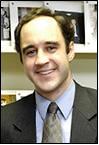
Jim Gannon (Ehime-ken, 1992-94), Executive Director for the Japan Center for International Exchange.
By Renay Loper (Iwate-ken, 2006-07). Renay is a freelance writer and international education professional currently seeking FT opportunities. Visit her at Atlas in Her Hand.
JET alum Jim Gannon (Ehime-ken, 1992-94) is the executive director of the Japan Center for International Exchange in New York. A Columbia graduate who previously worked for the for the Japan Bank for International Cooperation, he penned last year’s “JET Program on the Chopping Block” article, which helped alert and educate JETs and JET alumni to the threats facing the future of the JET Program. Since then, he has served as an invaluable resource to the JET Alumni Association, providing informal advice and perspective and serving on the JETAA New York Board of Directors.
How has your day-to-day work with JCIE been affected by the Tohoku catastrophe?
It has been a whirlwind since the morning of Friday, March 11, although fortunately all of our friends, family, and coworkers in Japan are safe. On the Japan side, JCIE has been working for decades to strengthen Japan’s nonprofit sector. That gives us a strong base of knowledge in this area, plus we have extensive experience channeling philanthropic contributions from overseas to Japanese organizations, and have also have been working closely for years with the country’s major humanitarian organizations, which have now mobilized to respond to the disaster. Meanwhile, on the U.S. side, JCIE is one of the few Japanese nonprofit organizations with a strong American presence which can receive tax deductible donations. This has put us in a unique position to be able to help.
On day one, we were asked to advise major U.S. humanitarian organizations trying to get into Japan to help, and we have since been working long hours to contribute on various fronts. To take advantage of our understanding of who is who in Japan’s nonprofit sector and the capacity to fundraise in the United States, we established a set of funds to aid Japanese nonprofits on the frontlines of the relief and recovery efforts. The amount of money committed to these by American donors has reached almost $2 million, and most of that is already reaching Japanese communities. The main fund, the Japan NGO Earthquake Relief & Recovery Fund, splits donations up 50-50 between immediate relief efforts and the types of long-term recovery efforts that are absolutely vital, yet typically underfunded, and we will be increasingly focusing on supporting the long-term recovery. In addition to this, we have also been working with a wide range of U.S. foundations, companies, and experts to discuss how to better coordinate the U.S. philanthropic approach to the Japanese disaster. So, my plate has been very full, but we felt we had an obligation to do this given our unique capacity in this area.
What is the mood of the country, generally speaking, since the events?
Difficult to answer, since I have not been there since the disaster. However, my conversations with colleagues and friends indicates that, while people are on edge due to the continuing aftershocks and the radiation risk, there is a deep conviction of the need to rebuild, and extraordinarily selfless efforts by people from all over Japan to do what they can to help. But I can’t talk definitively on the mood from my own experience.
What are JCIE’s priority areas for rebuilding?
In terms of short-term relief efforts, it is critical to empower communities in Japan to help themselves, and this becomes even more important when talking about the long-term recovery. It is essential for local nonprofit organizations—a group that extends far beyond the Red Cross—to be able to play roles if communities are going to be equipped to rise to this challenge. But Japan’s philanthropic sector is weak, and government and business often overlook the nonprofit sector in Japan. This is why we are placing priority on getting funding and other support to a wide range of organizations that are Japanese-run and that are truly nongovernmental and nonprofit in nature.
JQ Magazine: JQ&A with Tomoya Suzuki of CLAIR New York’s Japan Local Government Center
Article/Journalism, Interview/Profile, JQ Magazine Comments Off on JQ Magazine: JQ&A with Tomoya Suzuki of CLAIR New York’s Japan Local Government Center

“As a staff member at the JLGC, working with the JET Alumni Association is my first and foremost top accomplishment. I have been able to learn how a volunteer group works in American society, and I am impressed by the alumni’s passion and devotion for its activities to be a bridge between the U.S. and Japan.” (Justin Tedaldi)
By Renay Loper (Iwate-ken, 2006-07). Renay is a freelance writer and international education professional currently seeking FT opportunities. Visit her at Atlas in Her Hand.
I recently had the pleasure of doing a brief Q&A with Mr. Tomoya Suzuki of the Japan Local Government Center (JLGC), CLAIR’s New York branch office dedicated to international exchange and mutual understanding between the U.S. and Japan. Suzuki-san has been working with the JLGC in New York since April 2010 through a temporary overseas assignment with the Tokyo Metropolitan Government (TMG). Suzuki-san lives in New York with his wife and son.
Tell us a little about yourself.
I was born and raised in Chiba Prefecture and moved to Tokyo soon after I started working for TMG. I came to New York for the first time in April 2010, so I have been here for just one year. I am so happy and proud to be living and working in this exciting city!
You are an assistant director at the JLGC. What is your primary focus?
I would say my foci are as a staff member of the JLGC and as a representative of TMG. As a staff member of the JLGC I want to tell Americans, especially local governments, the good points about Japan and its people. As a representative of TMG, I want to facilitate the relationship between Tokyo and New York City, who have one of the oldest sister city relationships—it has been in existence since 1960. Read More
JQ Magazine: JQ&A with Yumi Tanaka of the New York Peace Film Festival
Article/Journalism, Film, JQ Magazine Comments Off on JQ Magazine: JQ&A with Yumi Tanaka of the New York Peace Film Festival

See ‘A Thousand Cranes’ at the New York Peace Film Festival March 12-13. (Daiei Motion Picture Co.)
By JQ magazine editor Justin Tedaldi (CIR Kobe-shi, 2001-02). For more Japanese culture, visit his Examiner.com page here.
Manhattan’s Upper East Side kicks off the weekend with the 4th Annual New York Peace Film Festival, which promotes a deeper understanding of international relations from films and presentations worldwide. Saturday focuses on the devastation of the atomic bomb, beginning with the 1958 Japanese film A Thousand Cranes, the story of young Hiroshima bomb victim Sadako Sasaki. JQ caught up with Yumi Tanaka, the festival’s co-founder and executive producer, for this exclusive interview.
Tell us a little about yourself.
I was born and raised in Japan and came to the States to attend college. Upon graduation, I landed a job and remained in the country. When I moved to NYC for a job, I also started taking an acting class. I thought it will help me at business meetings when I have to do a presentation. I loved theater since I was a child. My first experience was with the Takarazuka Revue at the age of three with my father. I studied theater, as literature helped me taking these acting classes, and I was recommended to do a stand-up comedy workshop then. That’s how I started doing stand-up comedy while holding a real job. Then, I pursued the entertainment industry. I took serious acting classes from a teacher who had taught many famous comedians like Ray Romano, and the list goes on.
It was 9/11 that changed my life. I wanted to do something more meaningful instead of being onstage at smelly comedy club to make drunks laugh. In 2005, I met a Hiroshima survivor visiting New York for an NPT [Nuclear Non-Proliferation Treaty] conference. He told me his life story; how he was hiding as a hibakusha [atomic bomb survivor] for a long time. Then, he said, “Hibakusha are getting older. If we all die, the, there’s no people who carry on to tell our stories.” That was the moment. I thought I could use my knowledge and experiences with theater to tell their story.
In 2006, I met Jonathan Fluck, who used to run children’s theater for over 20 years. He had just produced a poetry performance of Hiroshima and Nagasaki. A mutual friend introduced us. Although Jonathan had never been to both cities, his passion towards nuclear abolition was in sync. So we started the New York Peace Film Festival in 2007, and we’ve held one every year except 2009 due to the bad economy.
JQ Magazine’s September/October “Sayonara Print Issue” Out Now!
Article/Journalism, Interview/Profile, JQ Magazine Comments Off on JQ Magazine’s September/October “Sayonara Print Issue” Out Now!
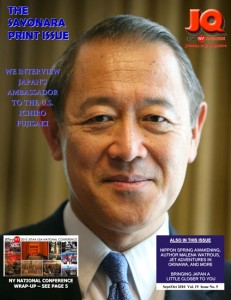
JQ magazine returns with another fall classic! Features include the JETAA USA National Conference wrap-up, a review of JET alum author Malena Watrous‘ new book If You Follow Me, and an exclusive interview with Japan’s Ambassador to the United States Ichiro Fujisaki. Click here to view.
BIG NEWS! This is also JQ‘s final issue in traditional print form. It will return after a brief hiatus as an all-online publication. With no space limitations or monthly deadlines, JET readers from all chapters are encouraged to submit stories, announcements, updates and commentary to help make us a stronger and more unified “national international” publication.
Additional contents below. Thanks to JQ Editor Justin Tedaldi (Kobe-shi CIR, 2001-02) for another sugoi issue. Contact Justin if you’d like to pitch or write a story for future editions.
CONTENTS
- Page 3……..From the Editor, Ambassador of Japan to the United States
- Page 4……..Nippon News Blotter / JETAANY’s Secretary Ties the Knot
- Page 5……..JETAANY Society Page – National Conference Wrap-up by Goshippu Garu
- Page 7……..Ambassador Ichiro Fujisaki: The JQ Interview by Justin Tedaldi
- Page 8……..JoAnn M. Hunter Goes from Broadway to Tokyo by Lyle Sylvander
- Page 9……..Through the Eastern Looking-Glass with Malena Watrous by Sharona Moskowitz
- Page 10……JETlog featuring Stuart Wallace
- Page 11…….Book Corner: Just Enough by David Kowalsky
- Page 11…….Life After the B.O.E. by David Namisato
JQ Magazine’s July/August “Hot Button Issue” Out Now!
Article/Journalism, Interview/Profile, JQ Magazine Comments Off on JQ Magazine’s July/August “Hot Button Issue” Out Now!
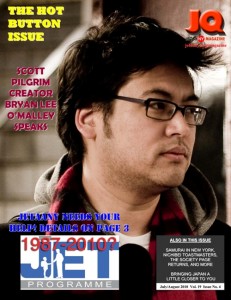 JQ knows you’re going to see Scott Pilgrim vs. the World, the summer’s coolest comic book movie, so why not get to know the the guy who started it all, cartoonist Bryan Lee O’Malley? Their new “Hot Button” issue features an exclusive interview with Bryan, a recap of the new Samurai in New York museum exhibition, and the return of the JETAANY Society Page, plus more! Click here to view.
Additional contents below. Thanks to JQ Editor Justin Tedaldi (Kobe-shi CIR, 2001-02) for another sugoi issue. Contact Justin if you’d like to pitch or write a story for the next issue.
CONTENTS
- Page 3……..From the Editor, Japan Local Government Center Executive Director
- Page 4……..Nippon News Blotter / Welcome Suzuki-san
- Page 5……..JETAANY Society Page by Goshippu Garu
- Page 6……..JETlog featuring Byron Nagy
- Page 6……..Samurai in New York Exhibition by Mark Brandstetter
- Page 7……..Bryan Lee O’Malley: The JQ Interview by Justin Tedaldi
- Page 8……..Nihonjin in New York featuring Noriko Hino by Stacy Smith
- Page 9……..Book Corner: Nintendo Magic by David Kowalsky
- Page 10……Nichibei Toastmasters by Pam Kavalam
- Page 11……The Funny Page
- Page 11……The Heiz Rocks On by Hugh Prysten
JET ROI: Top Ten “Best of JQ” Articles That Support Our Cause
Article/Journalism, JQ Magazine, Return on JET-vestment Comments Off on JET ROI: Top Ten “Best of JQ” Articles That Support Our Cause

Wondering how JET alums give back to the community and make new connections with Japan after their work on the program is over? JQ Magazine Editor Justin Tedaldi (Kobe-shi CIR, 2001-02) has compiled a list of ten relevant articles from the past two years that exemplify the dedication of our members.
2010 May/June – Bruce Feiler interview (an author who’s probably the biggest “JET celebrity” out there. Wrote his first book about his JET experiences) by Justin Tedaldi
2010 January/February – Aaron Woolfolk interview (JET alum, first African American to direct a feature film in Japan) by Lyle Sylvander
2010 January/February – Peace Corps profile (talks with those who joined Peace Corps after the positive experience they had on JET) by Marea Pariser
2009 Fall – International Visitor Leadership Program interpreting (shows how JETs can become invaluable interpreters to continue grassroots internationalization at home) by Stacy Smith
2008 Summer – Ambassador Nishimiya interview (boosts visibility of new Japanese officials to our readers; demonstrates strong relationships between JETAA chapters and local government) by Anne Koller
2009 Spring – Hikaru Utada interview (probably the longest English-language interview with Utada out there. It was even translated into Japanese by a resourceful fan) by Justin Tedaldi
2009 Spring – JETAANY Author Showcase (names four notable JET alum authors and also stands as a unique event organized by JETAANY) by Gina Anderson and Justin Tedaldi
2009 Spring – President Sakurai of Japan Society interview (this piece examines JET’s relationship with non-profit cultural centers and is included in Japan Society media kits) by Justin Tedaldi
2008 Fall – Anthony Bianchi interview (JET done good in Japan) by Michael Glazer
2008 Summer – George Rose interview (JET done good at home) by Stacy Smith
Comments are welcome. Spread the word!

By Justin Tedaldi, Editor (Kobe-shi CIR, 2001-02) for JQ Magazine. Portions of this interview were originally published on Examiner.com.
Award-winning bestselling author, journalist, and—in his own words—“professional traveler” Bruce Feiler (Tochigi-ken, 1987-88) has been a writing books for nearly 20 years, the most recent of which focused on social issues and religion. Bruce’s new book, The Council of Dads: My Daughters, My Illness, and the Men Who Could Be Me, was inspired by his diagnosis with cancer two years ago. Faced with an uncertain future and concerned about his family, he asked six of his peers to form a “Council of Dads” to help guide his young daughters through their lives. JQ spoke with Feiler about the start of his writing career, which began with 1991’s Learning to Bow, an account of his time living in Japan as an English teacher on the inaugural year of the JET Program, as well as his thoughts about the program today.
You’re now cancer-free. When did you receive this prognosis, and what was your treatment like?
I was first diagnosed in July 2008, and I had osteosarcoma, which is so rare that only one hundred adults a year get it. Twenty years ago they would have cut off my leg and hoped, since there was a fifteen percent survival rate. They determined that one cocktail of chemo could be effective, and I had that. I basically had four months of chemo, a 15-hour surgery to rebuild my leg, and then four more months of chemo. So, I’ve technically been cancer-free since my surgery when they cut the tumor out of my femur. I’ve been cancer-free now for about 15 months. I’m full of hope walking forward.

JET Filmmaker/JQ subscriber Aaron Woolfolk at the New York premiere of his film ‘The Harimaya Bridge,’ December 2009
By Lyle Sylvander (Yokohama-shi, 2001-02) for JQ Magazine
Most JETs enjoy telling tales about the cities they lived in. But it’s a select few who take the extra step of making movies that actually take place in them. JETAA Southern California’s Aaron Woolfolk (Kochi-ken, 1992-93) is the writer and director of The Harimaya Bridge, which received a theatrical release in Japan last year and premiered in New York’s Upper West Side in December as part of the African Disapora Film Festival.
The film stars Ben Guillory as Daniel, an American man who travels from San Francisco to Kochi after his estranged son—who works as an assistant English teacher—Mickey (Victor Grant) dies in a traffic accident. There, Daniel’s own prejudices spark rows with his Japanese hosts and daughter-in-law Noriko (Saki Takaoka) as he discovers secrets his son left behind. The film will receive a wider release in the U.S. for spring 2010, and JQ talked with Aaron about the making of the film.
How did you get involved with JET?
During my senior year in college, I ran into a couple of friends who were on their way to pick up an application for the JET Program. I had nothing to do when I saw them, so I tagged along. I had never heard of the program before, but it definitely intrigued me. I had always wanted to experience another culture firsthand, and thought the best way to do that would be to live in that culture, rather than merely visiting it for a limited time.

Lisa Reitmeier and B.J. Whetstine of the Peace Corps at the World AIDS Day panel
By Marea Pariser (Kagoshima-ken, 2003-04) for JQ Magazine
What comes to mind when you think of the Peace Corps? Is it the image of young, daring humanitarians performing HIV/AIDS work across Africa? Or how about the ambitious environmentalist who flocks to third-world Latin America to build aqueducts in the locals’ backyards? Sure, we all know the stereotype—adventurous, somewhat-experienced travelers willing to spend two years out in the bush roughing it with the locals as a result of their passion to see the world and underlying desire to help others.
Perhaps we’ve thought about the opportunity for ourselves. And it’s likely that we all know at least one person who’s a current or returned Peace Corps volunteer. What probably doesn’t come to mind, though, regarding this nearly 50-year-old program—founded in 1961 by the Kennedy administration—is the image of native English speakers flying abroad to teach English as a second language to locals in over 70 countries where the Peace Corps has presence.
Sound familiar? It should.
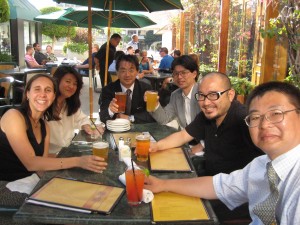
- Of course a nomikai is the official way to end the three-week journey. Otsukaresama IVs!

By Stacy Smith (Kumamoto-ken CIR, 2002-03) for JQ Magazine
Since becoming a freelance Japanese translator/interpreter/writer, one of the opportunities that I have enjoyed the most has been interpreting for the Department of State’s International Visitor Leadership Program (IVLP). IVLP is an exchange program designed to build mutual understanding between the U.S. and other countries through carefully designed visits that reflect the participants’ (the titular IVs) professional interests and to support U.S. foreign policy goals. For IVs, it involves meeting professional counterparts and learning to appreciate America’s ethnic, cultural, political and socioeconomic diversity.
IVs are established or potential foreign opinion makers in government, public policy, media, education, labor, the arts and other key fields, and after being nominated by someone they are selected by American embassies abroad. Since the program’s inception in 1940, there have been over 140,000 participants (about 5,000 each year), including 290 current and former heads of government such as Tony Blair and several Japanese prime ministers.
However, here in the States all IVs are considered “honorary Americans.” This means that no matter what their rank is back home, during the program everyone is of equal status. This takes quite a bit of pressure off the lowly interpreter (who of course has hopes of being fondly remembered when her former participants go on to become big shots!).
Best of JQ: Ambassador Shinichi Nishimiya: Diplomat, Collaborator, Fly Fisher (Summer 2009)
Article/Journalism, JQ Magazine Comments Off on Best of JQ: Ambassador Shinichi Nishimiya: Diplomat, Collaborator, Fly Fisher (Summer 2009)

Anne with Ambassador Nishimiya (photo by Noriko Furuhata)
By Anne Koller (Fukuoka-ken, 2002-2004) for JQ Magazine.
Having been spotted at various local Japan events, JETs were curious to know more about the new Consul General Shinichi Nishimiya. JQ talked with Ambassador Nishimiya to find out his plans for the consulate in New York and how JETAANY can help.
How are you and your family adapting to New York life? What has been the hardest part about living in the city and the most satisfying? What do you miss the most about our beloved Nippon?
We are adapting very well. The hardest part has been the weather. Nobody told us that NY weather is this unstable and unpredictable. [Jokingly] I have been told that there is no spring or fall between the long hot summer and a long, cold winter: then how do you describe what we have now? The most satisfying part of living in New York for my wife and I is meeting people. Everyone has been very welcoming and kind. I miss ramen! There are ramen shops everywhere in Japan and they are always open. You can go to places in New York, but it isn’t the same. I do think the lack of eating ramen has allowed me to live a healthier life here which my wife is certainly happy about [laughs].
