




JQ Magazine: Book Reviews – ‘Belka, Why Don’t You Bark?’ and ‘The Future Is Japanese’
 Article/Journalism, Books, JQ Magazine, Reviews
  Comments Off on JQ Magazine: Book Reviews – ‘Belka, Why Don’t You Bark?’ and ‘The Future Is Japanese’
A pair of this year’s releases from Haikasoru.
Belka, Why Don’t You Bark?

“As a writer, Furukawa is possessed of a kinetic voice that seems to teeter on the edge of insanity. The hyperactive prose is sometimes poetic, sometimes sharp like a stinging slap in the face. Often, it’s both.” (Haikasoru)
By Sharona Moskowitz (Fukuoka-ken, 2000-01) for JQ magazine. Sharona is interested in fresh, new voices in fiction and creative nonfiction.
War: It’s a Dog’s Life. Battle Is a Bitch. War and Fleas.
These were just a few of the potential titles I had streaming through my mind as I sat down to write the review of Belka, Why Don’t you Bark?, the newly translated novel by Hideo Furukawa. But the truth is, love it or hate it (and you very well may hate it, but more on that later), Belka is far too original to be reduced to silly catchphrases or bromides.
At the very start of the novel, readers are met with a detailed canine family tree complete with the dogs’ names and nationalities. In looking back, this might as well have been a de facto warning: if anthropomorphism is not your thing, put this book down immediately.
The story begins in 1943 on the Aleutian Island of Kiska where four military dogs are left by the Japanese and then claimed by U.S. troops after the Japanese retreat. One dog dies and the other three go on to produce the offspring that populate the novel and occupy the branches of the family tree. Belka chronicles the lives of the military dogs who trace their roots back to Kiska, intertwined with the story of the young daughter of a yakuza boss who is kidnapped in the USSR and has a psychic connection to dogs. Belka is a book about history through canine eyes, namely the wars of the 20th century, as Furukawa tells us “history is moved, rolled this way and that, so simply. The twentieth century was a pawn, as were the dogs.”
JQ Magazine: Book Review – Haruki Murakami’s ‘1Q84’
Article/Journalism, Books, JQ Magazine, Reviews, Roland Kelts Comments Off on JQ Magazine: Book Review – Haruki Murakami’s ‘1Q84’

“Murakami’s previous books were like delicious sandwiches that left you wanting more. 1Q84 is like a two-foot long sub that filled you to bursting, but you’re still not totally satisfied.” (Vintage International)
Roland Kelts, don’t kick me in the balls—
One man’s attempt to review a book honestly while still keeping friends
By Rick Ambrosio (Ibaraki-ken, 2006-08) for JQ magazine. A staple of the JET Alumni Association of New York (JETAANY) community, Rick manages their Twitter page and is an up-for-anything writer.
My girlfriend wouldn’t shut up about it.
“1Q84 is the best! Ah, when it comes out in English you need to read it!” Just talking about it made her rush to find her old copies (it was broken up into three books in Japan) and start reading them again. She was enthralled, to say the least. I’ve been a Murakami fan for a while: Norwegian Wood was emotional and sexually riveting; Dance Dance Dance was creepy as hell but lots of fun; Kafka on the Shore blew my mind. So I was hungry for 1Q84.
I picked it up shortly after it came out…and put it down for a while…then picked it up again…then down… then up…I think you get the idea. My feelings can kind of be summed up like this: Murakami’s previous books were like delicious sandwiches that left you wanting more. 1Q84 is like a two-foot long sub that filled you to bursting, but you’re still not totally satisfied.
The plot follows two people tied together by fate, love, and inter-dimensional happenstance. Tengo is an author and math teacher who finds himself embroiled in a shady plot to write an award-winning book. Aomame is a fitness instructor with a decidedly darker side job. Both find themselves in an altered version of 1984 called 1Q84 that deviates from the previous reality in specific ways. Those changes seem to revolve around a cult, a beautiful young girl, a book and mysterious “Little People.” Their battle to beat the odds and find each other, discover where they are, and who’s behind the changed world is an epic journey told through alternating perspectives.
1Q84 had all the things I love about Murakami: Super complex, interesting and engaging characters, crazy inter-dimensional sex, lots of mystery, and supernatural elements that bring it right on the cusp of reality, teetering between a fantasy realm and the real 1984. His ability to walk that line (like a cat walking a picket fence for those who love cats not only in Murakami novels, but also in reviews of Murakami novels) is astounding and he does it…for a really long time.
JQ Magazine: Concert Review – ‘The Legend of Zelda: Symphony of the Goddesses’
Article/Journalism, JQ Magazine, Music Comments Off on JQ Magazine: Concert Review – ‘The Legend of Zelda: Symphony of the Goddesses’

“There was so much attention paid to the nuance, so much consideration given to the fans, that the show became a kind of homage to both the franchise’s legacy and to every avid gamer whose collective fealty raised Zelda into one of the highest echelons of video game lore.” (Preston Hatfield)
By Preston Hatfield (Yamanashi-ken, 2009-10) for JQ magazine. Preston moved from San Francisco to New York City in January 2012 and is now accepting submissions from people who want to be his friend. Abduct him from his house in the middle of the night, or find him on Facebook and ask about his JET blog in which he details his exploits and misadventures in that crazy Land of the Rising Sun we all love.
If life is one ongoing adventure and each day is its own side quest, then several days ago the already labyrinthine halls beneath Madison Square Garden were not those of a theater but a dungeon, and the spirited host of attendees was nothing short of raiders in pursuit of plunder. Their coveted treasure on this magical evening of Nov. 28 was The Legend of Zelda: Symphony of the Goddesses from Jason Michael Paul Productions. Wielding the baton like her own personal Master Sword (or, as was the case at the onset of the Wind Waker movement, an actual replica of the Wind Waker), conductor Eimear Noone led the Orchestra of St. Luke’s into an epic musical campaign that toured across Hyrule and the 16 games in Zelda’s renowned platform, which is currently celebrating 25 years since its American debut on the original 8-bit Nintendo Entertainment System.
The evening commenced with a rousing overture in the form of “The Legend of Zelda Medley” before embarking a four-part movement that began with the crowd favorite Ocarina of Time, and concluded with A Link to the Past, the game where many of the now iconic Zelda themes first premiered. Each movement in this symphonic journey—this Tour de Triforce, if you will—began at the beginning of each game and proceeded to tell the familiar tales of heroism and mystic wonder, transitioning almost fairylike from one key moment to the next, as large screens over the orchestra showed in-game footage for context and intermittently focused on soloists and the choir.
JQ Magazine: Book Review – ‘Professor Risley and the Imperial Japanese Troupe: How an American Acrobat Introduced Circus to Japan—and Japan to the West’
Article/Journalism, Books, JQ Magazine, Reviews Comments Off on JQ Magazine: Book Review – ‘Professor Risley and the Imperial Japanese Troupe: How an American Acrobat Introduced Circus to Japan—and Japan to the West’

“Chock-full of illuminating illustrations and gorgeous printed ephemera that would make any contemporary typographer swoon, Professor Risley and the Imperial Japanese Troupe is a jet-set adventure in pop culture scholarship sure to appeal to anyone interested in Japan’s history on the world stage.” (Stone Bridge Press)
By Jessica Sattell (Fukuoka-ken, 2007-08) for JQ magazine. Jessica is a freelance writer, and was previously the publicist for Japan-focused publishers Stone Bridge Press and Chin Music Press. She is interested in the forgotten histories of culture, and has often considered running away and joining the circus.
We’re still riding the “Cool Japan” wave that crested at the turn of the millennium, but our fascination with the country and its culture didn’t quite stem from just anime, Harajuku fashions, or J-pop. In Professor Risley and the Imperial Japanese Troupe: How an American Acrobat Introduced Circus to Japan—and Japan to the West, award-winning author Frederik L. Schodt argues that contemporary interest in Japan’s popular culture has its roots in the travels and cross-cultural interactions of a band of 19th century Japanese circus performers and a colorful American impresario.
Published in November by Stone Bridge Press, Professor Risley explores a critical and exciting time in history, when an interest in foreign cultures was rapidly expanding beyond the privileged parlors of the upper class and Americans and Europeans were greatly fascinated by anything Japanese. Schodt offers an intriguing case study of both early Japanese conceptions of the West and the West’s first looks at modern Japan, but it is also a mystery of sorts: Why did a group of acrobats that were incredibly popular with international audiences in the 1860s fade from the annals of performing arts history? How was the life of “Professor” Richard Risley Carlisle, arguably one of the most extraordinarily talented and well-traveled performing artists in history, buried in the folds of time? Schodt suggests that we may never know the answers, but we can sit back and enjoy the show as their histories unfold.
This story begins, fittingly, with the question, “Where Is Risley?” Schodt artfully traces “Professor” Risley’s early travels and performance history like an elusive game of connect-the-dots, piecing together itineraries, publicity notices and press clippings until a clear pattern of a fascinating life emerges. Risley seemed to be everywhere and nowhere, and led a full life of jet-setting and adventure-seeking at a time where transcontinental travel was only beginning to open up to those outside of the diplomatic realm. We follow him on a decades-long journey across the United States, Europe, Australia, New Zealand, Southeast Asia, China…and finally to Japan.
Risley arrived in Yokohama in early 1864 and immediately went to work setting up a fantastic Western-style circus to delight foreign residents and Japanese locals alike. As the country had re-opened to the world just five years earlier, it was a risky time to be in Japan, and non-Japanese residents lived with underlying worries of Shogunate-dictated expulsion and violence from disgruntled ronin. That didn’t quite stop Risley’s entrepreneurial spirit, but he did eventually run into a series of difficulties with his shows—and a stint in dairy farming, which, in the process, led him to introduce ice cream to Japan. He hadn’t originally intended to stay in Japan for long, but most likely due to the Civil War raging back home in America, he bided his time and explored his options. Thankfully, his stay there—paired with an almost desperate talent for improvisation—would lead to the world’s first taste of Japanese popular culture.
JQ Magazine: JQ&A with Matthew Gillam, Senior Researcher at the Japan Local Government Center
Article/Journalism, Interview/Profile, JQ Magazine, Local Government Comments Off on JQ Magazine: JQ&A with Matthew Gillam, Senior Researcher at the Japan Local Government Center

“When you come back from Japan, people say, ‘You know Japanese, you’ve been abroad, you should be able to get a job anywhere.’ You soon realize that it doesn’t work that way. Alumni coming back should look at things you did in different light: what did you fundamentally do, and take away from that?”
By Adam Lobel (Nagano-ken, 2000-02) for JQ magazine. Last year, Adam returned to New York after 10 years in Japan, where he researched satoyama (traditional landscape of Japan) as a master’s student, and collaborated with Japanese policymakers in science and technology while working at a think tank. Adam currently helps manage his family’s business, a land use law firm in Manhattan, and looks forward to contributing to New York’s green building movement.
Born and raised in Marshalltown, Iowa, Matthew Gillam was hooked on Japan after visiting when he was 17. After college, he lived in Japan for eight years, and then returned to the U.S., where he completed a master’s at Columbia’s School of International and Public Affairs (SIPA). Matt has spent the past 14 years as a researcher at the Japan Local Government Center (JLGC), discovering and sharing best practices from local governments in North America with his colleagues in New York and Japan.
By encouraging organizational discipline and providing tools to build strong networks, Matt has helped strengthen the JET Alumni Association, thus helping thousands of JET participants smoothly transition to life back home. He promotes JETAA’s role an important stakeholder in productive business and cultural relationships with Japanese localities, helping broaden the JET Program’s mission long after participants return home.
In this thought-provoking interview, JQ spoke with Gillam about what it was like to study Japanese at the University of Iowa in the 1980s, life in Japan before the existence of JET, and the kindness and hard work JET families displayed in the aftermath of 3/11. He emphasizes that JET—an experiment in grassroots internationalization—has changed how the world thinks about Japan. Matt gave this interview before heading to Japan, where he spent four days with It’s Not Just Mud (INJM), a non-profit volunteer organization based in Ishinomaki.
How did you become interested in Japan?
I was exposed to Japan when I was seven: my sister spent the summer of 1969 as an exchange student in Yamanashi. She fell in love with Japan, and told us about it after returning home. Eventually she went to live in Japan, teaching English at Sony Language Labs. In 1979, just before my senior year of high school, my mother and I went to visit. Before that trip, I never liked to travel. Suddenly, I was in a completely new place. I realized there was a bigger world, and it was interesting. That’s when I fell in love with Japan, its people, food, art and architecture.
After my sister returned to the U.S., she placed a Japanese student in a nearby town. I fell in love with that student, who eventually became my wife. In college I flunked out of forestry, my first major and, looking for something new, got into Japanese language. I did a year abroad at Kansai Gaidai in Osaka, and spent eight more years in Japan after graduating.
How did people react to your decision to study Japanese? What was Japanese study like at the University of Iowa in the 1980s?
Some people did not understand my decision to study Japanese, especially because it was a small Midwestern town. Their reaction was, “Why Japanese?” This was 1982: Japan was just beginning to emerge as a major economic rival, and Japanese culture hadn’t permeated the Midwest yet. It was a strange thing to do.
My sister understood, and my mom understood, but other family members and friends did not. In those days, some people’s reaction to Japan was still influenced by the Second World War: “These people were enemies; I am not comfortable with them.” That only got worse through the eighties with trade friction.
Study materials were primitive by today’s standards: Japanese textbooks by Prof. Eleanor Jorden, a kanji dictionary, and language lab with cassette tapes. Our professor, Thomas Rohlich (now at Smith College) started the same day I did. We had a Japanese teaching assistant from Tokyo, but most of the teachers were white men.
There were no Japanese restaurants or pop culture. Fisher Control, a company in my hometown, employed a Japanese engineer, who had relocated with his wife. At the beginning of my first year of college, there were 30 students, the biggest class they had ever had! That number slowly decreased, until there were only six or eight students by my third year. There were a couple of Japanese students on campus who became casual friends. Prof. Rohlich’s wife was from Kyoto, and she hosted a gyoza party. That was about it.

Maynard Plant, second from left: “I really do think it is important to learn more than one language. Not only for the obvious convenience of communication, but for the enrichment of understanding of other cultures as well. Language really is the only gateway into understanding another person’s psyche and culture.” (Courtesy of Edward Entertainment Group)
By Preston Hatfield (Yamanashi-ken, 2009-10) for JQ magazine. Preston moved from San Francisco to New York City in January 2012 and is now accepting submissions from people who want to be his friend. Abduct him from his house in the middle of the night, or find him on Facebook and ask about his JET blog in which he details his exploits and misadventures in that crazy Land of the Rising Sun we all love.
Multinational pop rockers Monkey Majik are teaming up with shamisen heroes the Yoshida Brothers, the duo known for their traditional sound and pluck, for a three-date North American tour that kicks off Nov. 14 at Manhattan’s Marlin Room at Webster Hall, followed by the Mod Club in Toronto Nov. 18 and the National Arts Centre in Ottawa Nov. 20.
Monkey Majik was founded by Maynard Plant (Aomori-ken, 1997-2000), a native of Ottawa, Canada, while he was teaching English in Sendai on the JET Program. Known for a having a fun and versatile style of music, the band first earned mainstream attention in 2006 for their singles “Fly” and “Around the World,” and have since collaborated with other Japanese groups like SEAMO, m-flo, Bennie K, and the Yoshida Brothers.
In this exclusive JQ interview, the versatile vocalist and guitarist discusses the band’s origins, his own relationship with music, and his sense of home and community in Sendai, which is still recovering from the devastation caused by the 3/11 earthquake and tsunami.
Which came first: the love of music or Japanese culture, and how has the one influenced and supported the other since you came to Japan?
I probably first took interest in Japan when I was about 10 years old or so when I visited Expo 86 in Vancouver, Canada. My interest in music also started at an early age. Most of my family is musical, so it always came natural. Certainly since arriving in Japan about 15 years ago, my musical interests have changed. The Japanese music scene is incredibly diverse and different from the Western scene. The sound is very unique and [it] has had a deep effect on our music.
It’s funny, many ALTs in Japan feel like rock stars, but you actually became a rock star. What was it like going from small time notoriety and fame at your school, to becoming famous on a national level for your musicianship?
It didn’t happen overnight, so I suppose I never took notice. It’s a lot like learning Japanese—you don’t just wake up fluent one day. Success is born out of hard work and commitment. Regardless of where you live, the same elements come into play.
How did the current band members come together? Were you friends before you started collaborating professionally? How have each of you influenced Monkey Majik’s sound, style, and group dynamic?
I put the current band together after most of the original members quit in 2000. I first called my younger brother Blaise, and within a couple of months we found Tax (Kikuchi Takuya). It was around 2005 that our original bassist Misao Urushizaka quit. We then recruited Dick (Hideki Mori). It’s difficult to say if the friendship came before membership, but one thing is certain now: we wouldn’t be doing this if we hadn’t become best friends. We have a lot of respect for each other and all [band] decisions are made together.
JQ Magazine: 2012 JETAA National Conference in San Francisco Recap
Article/Journalism, JETAA Chapters, JQ Magazine Comments Off on JQ Magazine: 2012 JETAA National Conference in San Francisco Recap

JETAA USA delegates at the residence of Ambassador Hiroshi Inomata, Consul General of Japan in San Francisco, Oct. 26, 2012.
By Pam Kavalam (Shiga-ken, 2007-09) for JQ magazine. Pam is Secretary of the JET Alumni Association of New York (JETAANY) and a participant at this year’s National Conference.
Thursday, Oct. 25
Hosted by the JETAA Northern California (JETAANC) chapter, the conference kicked off with a “reception” at Off the Grid, a collection of gourmet food trucks inspired by Asian night markets and conceived and run by JET alum Matt Cohen (Saga-ken, 2001-04).
Friday, Oct. 26
The delegates from 18 of the 19 JETAA USA chapters received a welcome from JETAANC President John Dzida, Consul General of Japan in San Francisco Hiroshi Inomata, and Takaaki Ogata from CLAIR New York. Noriko Watanabe from the Embassy of Japan in Washington, D.C. gave a touching personal farewell from Ambassador Ichiro Fujisaki, who attended the past two JETAA National Conferences and will be leaving his post this year. Workshops topics included sister city-JETAA cooperation; databases and approaches for chapter membership management; and the utilization of Google apps and websites to publicize programs. There was also an update on the National 3/11 Relief Fund, which raised nearly $90,000 from all 19 chapters for Tohoku recovery efforts. The evening ended with a reception at the Consul General’s Residence and continued networking at Local Edition in the Financial District.
Saturday, Oct. 27
The Country Representatives discussed their visions for JETAA in the coming year and introduced the newly formed JETAA USA Advisory Board, which consists of four seasoned JET alums who will provide guidance to all national and regional leadership. It includes James Gannon (Ehime-ken, 1992-94) and Steven Horowitz (Aichi-ken, 1992-94) of JETAANY; Ryan Hart (Chiba-ken, 1998-99) of Pacific Northwest JETAA; and Jessyca Livingston (Hokkaido, 2003-06) of Rocky Mountain JETAA. Other workshops discussed organizing chapter finances; a JETAANC-run high school scholarship program; facilitating cultural exchange through continuing Japanese traditions such as kabuki; and a panel with members of the Northern California community, including JET alums Ken Wakamatsu (Hiroshima-ken, 1996-1998) at Salesforce and Ryan Kimura (Shizuoka-ken, 2004-06) of JCCC Northern California (and the owner of a purikura shop in San Francisco’s Japantown!). The panel discussed how JETAA chapters can form relationships and collaborate with community groups to engage members. The delegates finished the night with a CLAIR reception at Yoshi’s San Francisco and a cable car sightseeing tour.
JQ Magazine: Theatre Review – ‘Hold These Truths’
Article/Journalism, JQ Magazine, Reviews Comments Off on JQ Magazine: Theatre Review – ‘Hold These Truths’

“This amazing life story spanning six decades manages to be compressed by playwright Jeanne Sakata into a dense 90-minute performance that both educates and entertains.” (Photo of Joel de la Fuente by Steven Boling)
A nail that stuck out but resisted being hammered down
By Stacy Smith (Kumamoto-ken CIR, 2000-03) for JQ magazine. Stacy is a professional writer/interpreter/translator. She starts her day by watching Fujisankei’s newscast in Japanese, and shares some of the interesting tidbits and trends together with her own observation in the periodic series WITLife.
The intimacy of a stage surrounded by several rows of semicircle seating at the 14th Street Y is the perfect venue for the new play Hold These Truths. This work depicts the life of Nisei (second generation) Japanese American Gordon Hirabayashi, who took it upon himself to defy Executive Order 9066, which led to the imprisonment of Japanese Americans and their families in internment camps during World War II. It is a one-man show starring Joel de la Fuente, who spellbinds the audience with his ease in slipping back and forth between Hirabayashi and the other characters he portrays. The viewer’s proximity to the performer heightens the emotional depths of Hirabayashi’s often troubling, often inspiring tale of belonging and identity.
The play begins by highlighting the Japanese phrase “deru kugi wa utareru,” or “the nail that sticks up gets hammered down,” which Hirabayashi’s parents instill in him when he is young. He internalizes this belief, but at the same time he is aware of actions that seem to go against it, such as his mom taking a case to court when her land rights are violated. He describes a peaceful childhood in Seattle where he plays with other Japanese American friends and attends picnics where their mothers bring food like “onigiri, chicken teriyaki and banana cream pie.” Raised as a Christian, Hirayabashi becomes a religious pacifist when he enters the University of Washington.
Here he stays in an international dorm and meets his first non-Japanese friends, such as his roommate and close friend Howie and his future wife Esther. He becomes involved with the YMCA as campus vice president and tries to get a job with them at the front desk, but ironically is turned down because of his race. When an 8 p.m. curfew is later put in place for the Japanese, Hirabayashi initially complies but then runs back to join his friends studying in the library. This small act of bravery is emblematic of the much bolder resistance that Hirabayashi will show going forward.
JET Alum Will Ferguson Wins Canadian Lit Award
Article/Journalism, Books, JQ Magazine Comments Off on JET Alum Will Ferguson Wins Canadian Lit Award
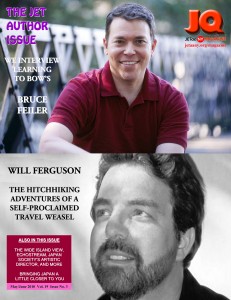
Click image for JQ magazine’s 2010 feature story on Will Ferguson
From the Associated Press via the New York Times:
On Oct. 30, celebrated JET alum author Will Ferguson (Nagasaki-ken, 1991-94) won the Scotiabank Giller Prize, a $50,000 Canadian fiction award, for a his novel 419, about a family’s entanglement in a Nigerian email scam.
A kilt-wearing Ferguson pulled out a flask during his acceptance speech and raised a toast to the written word. Presenters included Sex and the City actress Kim Cattrall.
The Giller, which honors the best in Canadian fiction, was created in 1994 by businessman Jack Rabinovitch in memory of his late wife, literary journalist Doris Giller.
Tuesday’s ceremony was broadcast by the Canadian Broadcasting Corp. For a CBC video of Ferguson on writing 419 and being a Giller finalist, click here.
JQ Magazine: JQ&A with Jenn Doane of the Hiroshima Ange Violet
Article/Journalism, Interview/Profile, JQ Magazine Comments Off on JQ Magazine: JQ&A with Jenn Doane of the Hiroshima Ange Violet
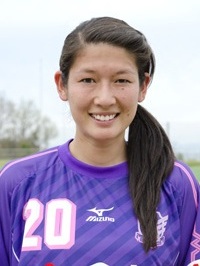
“On JET I was deeply involved in both my town and my prefecture, and in turn developed close relationships with both foreigners and Japanese people. Seattle is a diverse place, but I don’t think I would ever have had such a dynamic and interesting life outside of my day job!”
Seattle native Jenn Doane (Shimane-ken, 2010-12) has played soccer since she was eight years old. Having been a four-year starter on her high school varsity team, a three-year starter in college, and selected to play for the Olympic Development Program, she is now the first American to play professional soccer on a Japanese team, the Hiroshima Ange Violet. JQ learned all about her path to the team in this exclusive interview.
How did you become interested in Japan and the JET Program?
I have known about the JET Program since I was young, actually—my parents were both very involved in the Japanese community in Seattle: My mother was the executive director of the Japan America Society and the Japanese American Chamber of Commerce, and my dad served as president of the Society as well, and I think they have even been asked to be interviewers for prospective JET candidates. However, as any teenager would, I wasn’t interested in anything my parents were! I am three-fourths Japanese and one-fourth Caucasian (my mom is full, my dad is half, and both were born and raised in America).
I wasn’t necessarily ashamed of being Japanese, but I grew up in a mostly Caucasian suburb–and while I don’t think I was ever really picked on or anything, being Japanese wasn’t something I was overly proud of! You should have seen the reactions of my friends when I sometimes brought onigiri and kamaboko in my school lunch!
I was planning to be a Spanish major in college until my junior year when I decided to switch my focus to Japanese and study abroad in Osaka. I think I finally came around and got more curious about my heritage and the Japanese language. Many students from my college (Whitman) do the JET Program, and after a wonderful study abroad experience and hearing from all the raving alums, I thought it would be the perfect thing to do after graduating. So, here I am (or rather, there I was…).
I noticed you were a violinist for the Whitman Women’s Symphony. Any plans to continue with the violin in Japan?
Unfortunately, I have not touched a violin in a long time—however, I really have a passion for music and have found other ways to realize the musician in me! I joined a singing group in the countryside (we sing all the Glee hits) and have also been learning guitar. If I had easier access to a violin, I would definitely love to get back into it!
If you don’t mind sharing, what was it like to be on JET and teach at schools during the time of the disasters last year?
Compared to the JETs and teachers actually living in Tohoku, I can’t say that things were dramatically different. However, there was a kind of solemnness in the air after what happened— lots of moments of silence, and donations boxes all around school and town. One of my college friends is a JET in Miyagi Prefecture and we couldn’t get a hold of him for two weeks after the earthquake…it was terrifying. Thankfully, he had been at a relief shelter without Internet or phone access.
I also had the opportunity to volunteer in one of the hardest hit towns of Tohoku (Kesennuma) about six months after the tsunami, just helping sort debris and cleaning ruined houses, and it was such a moving experience—I met some incredibly strong and inspiring people, people who lost loves ones, everything they owned, or both.
JQ Magazine Seeks Writers for Winter 2012!
Article/Journalism, JQ Magazine Comments Off on JQ Magazine Seeks Writers for Winter 2012!

Visit JQ magazine online at http://jetaany.org/magazine
As winter approaches, JETAA New York’s JQ magazine continues to provide content with an ever-expanding array of articles, interviews and features (see our recent stories here). We’re now looking for new writers, including recent returnees and JET vets, from all JETAA chapters worldwide for posting stories via our host at the global JET alumni resource site JETwit.com. (Scribes are also encouraged to join the JET Alumni Writers group on LinkedIn.)
Below are story ideas grouped by JET participants and alumni (JET World) and those more on Japanese culture (Japan World). And if you’re a JET or JETWit contributor from anywhere in the world with a story idea of your own, let us know!
Click “Read More” below for our winter 2012 ideas pitch package, and contact JQ editor Justin Tedaldi (magazine [at] jetaany [dot] org) to sign up for stories.
JQ Magazine: Book Review – ‘The Buddha in the Attic’
Article/Journalism, Books, JQ Magazine, Reviews Comments Off on JQ Magazine: Book Review – ‘The Buddha in the Attic’
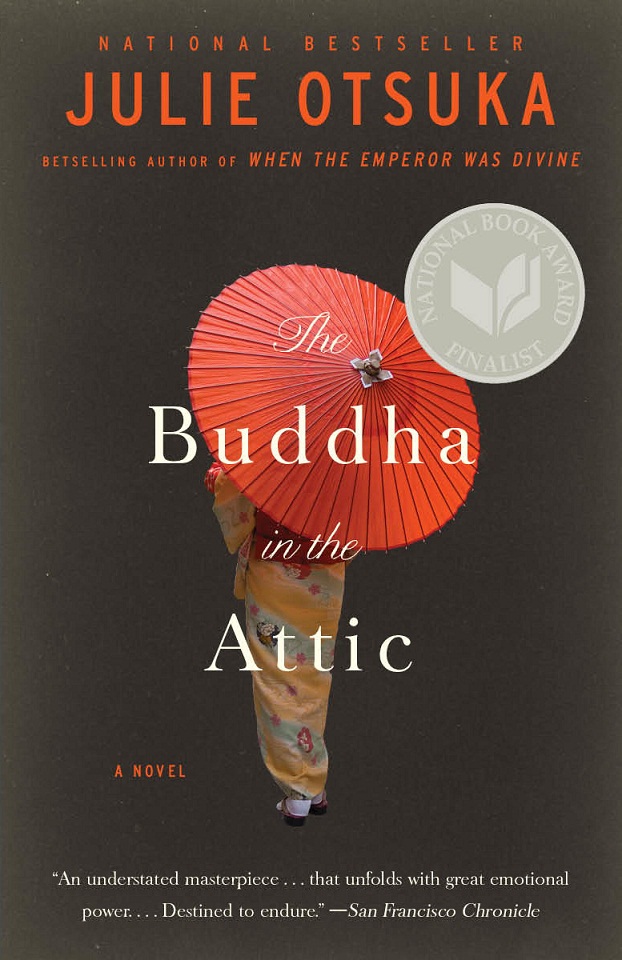
“Just the right length, the perfect amount of general and specific, and no solid story but yet the story that so many people in the United States—and elsewhere—can tell about hope, and heartbreak, and the ways in which lives change that most of us never intend or imagine.” (Knopf)
By Liz Mathews (Hiroshima-ken, 2005-06) for JQ magazine. Liz is the JETAA New York Book Club wrangler.
I would like to start by saying that the JETAANY Book Club discussed reading Julie Otsuka’s The Buddha in the Attic for at least five months before choosing it for our fall meeting. This is notable because 1) we were right in our primary reason for putting it off; and 2) we were even more right in finally selecting it to read. It’s easy to explain the first note: Over the summer we thought it best to opt for a lighter, more beachy read, and not a novel about Japanese “picture brides” and their distressing existences in the United States of the early 20th century.
As for the second point, autumn and its colder, shorter, darker days did turn out to be a much more appropriate setting to read Otsuka’s carefully composed novel. Otsuka wrote her book in eight sections, writing mostly from the perspective of the women—the women as a united “we”—who came across the ocean to a new life of false promises, how they endured meeting their husbands the first time, how they got along (or didn’t) with their employers and new fellow countrymen, and what happened as a new, Japanese American generation grew.
For all the suffering in those first five sections, there is hope written between the lines. Hope for a new life with a wonderful husband, hope that hard work will pay off in acceptance, and hope for their children in that, as one of the paragraphs ends, “Whatever you do, don’t end up like me.” But then, as one club member put it, “You come to this country, you work your ass off, you think you’re getting somewhere…and then you don’t” (referring to the war’s outbreak).
When we got together to discuss The Buddha in the Attic, we spent a fair amount of time talking about the perspective the story was written from—first person plural—and how initially we didn’t like it, but then either grew accustomed to it or could at least appreciate it as a tool. One attendee stated, “Everyone’s situation is different. You can’t even generalize the Japanese experience.” Another pointed out, “[Otsuka] has a new story in every sentence.” We laughed a little at this realization, probably as all our thoughts turned back to our own departure orientations, when we were constantly told those very same things.

“From the very beginning I saw Gordon Hirabayashi’s story as a unique and quintessentially American story, and although he was Japanese American himself, I hoped that the play would have a broad appeal, not just for that community, or just the Asian American community, but for people of all ages, ethnicities, and walks of life.” (Lia Chang)
By Ann Chow (Hyogo-ken, 2007-09) for JQ magazine. Ann is a native New Yorker who gets scared of the big, scary world, but ventures out into it anyway. She coined the term “stealth gaijin” (or thinks she did because she hadn’t heard of it before writing a bunch of articles under that moniker during her time on JET). When not portraying 14-year-olds on Gossip Girl, she can sometimes be found playing a (much older) law clerk on Law and Order: SVU.
Jeanne Sakata is an award-winning stage actress who has performed with many well-known companies on the country’s biggest stages, including the Lincoln Center Theater and the John F. Kennedy Center. She made her playwriting debut in 2007 with Hold These Truths (formerly Dawn’s Light: The Journey of Gordon Hirabayashi), the story of the Japanese American activist and Presidential Medal of Freedom winner, who passed away earlier this year at age 93.
Hold These Truths first premiered in 2007, and has been performed multiple times around the country since then. It is now a part of the Library of Congress Playwrights Archive in the Asian American Pacific Islander Collection in Washington, D.C., and is now having its Epic Theatre Ensemble New York premiere run (starring Joel de la Fuente and directed by Lisa Rothe) through Nov. 18 at the Theater at the 14th Street Y in repertory with Dispatches from (A)mended America.
JQ recently spoke with Sakata about her profound fascination with Hirabayashi’s life, the meticulous research that went into writing Hold These Truths, and what she hopes the play will accomplish.
What are the goals you are trying to achieve with Hold These Truths?
I hope, first, that Hold These Truths will spread awareness of Gordon Hirabayashi, whose story is still virtually unknown to so many Americans. As a young college student during World War II, Gordon stood up for the principles of the Constitution when the United States government failed miserably to do so, persecuting and imprisoning him for his actions. Earlier this year, Gordon passed away in January at the age of 93, and, amazingly, a few months later in April, President Obama posthumously awarded him the Presidential Medal of Freedom, the nation’s highest civilian honor, for the courageous stand he took so many decades ago. So I feel, this year especially, that Gordon’s story is a vitally important one to anyone who cares about our country, and the principles of the Constitution. Second, I hope the play will spread awareness on the East Coast of the mass incarceration of all people of Japanese ancestry during World War II on the West Coast, as knowledge of this tragedy seems to be much less prevalent here than out west.
In general, people on the West Coast know more about this time in American history. What reactions do you expect now that it’s playing here in New York?
As I said earlier, one common reaction we’ve had is that of shock that something so horrible happened during the World War II years in America. Many of our East Coast audience members who lived through those years have said that they were aware that “something bad” happened to the Japanese on the West Coast during that time, but they did not know just how bad it was. For example, they did not know that anyone in Seattle who was one-sixteenth Japanese, or babies from orphanages who had any Japanese blood, were ordered to be penned up behind barbed wire. They don’t know that so many children and young American citizens were torn out of their schools and imprisoned, and for so many years. But I also hope the reaction to Gordon’s story we’ve had here so far will continue—that people will be delighted, as well as profoundly moved and inspired, to learn about him.
How did you choose the subject matter for the play? Did you have family that lived in the internment camps?
I myself am a third-generation Japanese American, and in the 1990s I happened to see a documentary video about Gordon titled A Personal Matter: Gordon Hirabayashi vs. the United States. I was shocked that I had never heard his story before, and I started to find out everything I could about him. The more I read, the more fascinated and intrigued I became. The story just grasped me and wouldn’t let me go, becoming an obsession, and I knew I couldn’t rest until I tried to write a play about Gordon.
My mother’s side of the family was living in Colorado during World War II, and so did not have to go to the camps, although they experienced plenty of hostility and racism in the town where they lived. My father’s family, however, all lived in Watsonville on California’s West Coast, so all of them were rounded up and imprisoned in the camp in Poston, Arizona. As I was growing up, my father and aunts and uncles never spoke of the experience, I believe, because it was so traumatic for them, as it was for so many others.
JQ Magazine: Autumn in Nagasaki
Article/Journalism, JQ Magazine, Travel/Tourism Comments Off on JQ Magazine: Autumn in Nagasaki

Hashima, aka “Gunship Harbor,” as seen from a tour boat in Nagasaki.
By Mohan Nadig (Hyogo-ken, 1998-99) for JQ magazine. Mohan currently lives in Tokyo.
A word of advice: If you haven’t been to Nagasaki, go.
Since my time as a JET in Hyogo Prefecture in 1998, I’ve been on something of a mission to visit every prefecture in Japan at least once. Last year, one of the remaining spots high on my list was Nagasaki.
I’d planned to visit on several occasions in the past but never made it–I was finally inspired to book a ticket after reading David Mitchell’s fascinating novel The Thousand Autumns of Jacob de Zoet, which is set in the region at the turn of the 19th century.
The timing of my visit last October turned out to be very fortuitous. A friend from Nagasaki told me that I would be there during the Okunchi Festival and that a friend of hers would be able to show me around town.
Upon arriving in Nagasaki by train from Fukuoka, the first thing that struck me about the city center was its amazing ugliness, which is of the “what could they possibly be thinking?” variety. I was hard pressed to find a corner not marred by some rusting hulk, dilapidated structure or tacky signage left over from the 1970s. For a city with such a significant history, the lack of beautification and preservation efforts is stunning.
Fortunately, I very quickly found a wealth of redeeming features: hospitable people, nuggets of history waiting to be discovered around every corner, and fantastic views of the sea–and of course, the festive atmosphere of Okunchi.
JQ Magazine: Book Review – ‘Salvation of a Saint’
Article/Journalism, Books, JQ Magazine Comments Off on JQ Magazine: Book Review – ‘Salvation of a Saint’
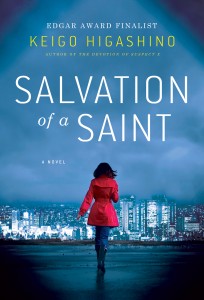
“The detectives in ‘Salvation’ are in constant motion, interrogating suspects, racking their brains for a break in the case. Insomniacs, they observe, question and theorize with an obsessive resolve, as good fictional crime detectives are apt to do.” (St. Martin’s Press)
By Sharona Moskowitz (Fukuoka-ken, 2000-01) for JQ magazine. Sharona is interested in fresh, new voices in fiction and creative nonfiction.
(Click image for an exclusive sample from the audiobook)
With more twists and turns than a mountain route through the Japanese Alps, Keigo Higashino’s latest murder mystery Salvation of a Saint is a seamless, well-constructed suspense novel with all the elements of a classic murder mystery, though he adds considerable fizz to the formula with a few unconventional characters and a very unlikely murder technique.
Yoshitaka is the unfortunate victim, poisoned early on in the story by arsenic laced coffee which he drinks with tepid oblivion. Despite being offed so soon, throughout the novel we learn quite a bit about him as his character is constructed in fragments that piece together to tell the story of his life.
And what an unsavory fellow indeed.
Narcissistic, duplicitous and with a chauvinistic tendency to view women solely in terms of their reproductive potential, Yoshitaka is not terribly likeable, to put it mildly. During the time of his murder he was in the process of leaving his wife Ayane because of her inability to bear him a child, a fact which he states openly with unabashed grandiosity. He was also, conveniently for the plot, in the midst of an affair with Ayane’s trusted confidant and apprentice Hiromi.
So whodunit? Was it a crime of passion committed by one of Yoshitaka’s jilted lovers past or present? Perhaps a jealous colleague? Or were Ayane and Hiromi secretly in cahoots?
