




Justin’s Japan: Interview with Filmmaker Amy Guggenheim on ‘When Night Turns to Day’
 Film, Interview/Profile, Justin's Japan
  Comments Off on Justin’s Japan: Interview with Filmmaker Amy Guggenheim on ‘When Night Turns to Day’

- ‘When Night Turns to Day’ director Amy Guggenheim. (Courtesy of A. Guggenheim)

By JQ magazine’s Justin Tedaldi (CIR Kobe-shi, 2001-02) for Examiner.com. Visit his NY Japanese Culture page here to subscribe for free alerts on newly published stories.
New York-based writer/director/producer Amy Guggenheim is currently hard at work on When Night Turns to Day, a dramatic feature that will be shot in New York and Tokyo. A present-day romantic thriller with martial arts, sword choreography and tattoos, the film follows May, a young American female writer who gets drawn into both Japanese sword fighting (kendo) and a passionate relationship with Toshi, a young Japanese martial artist. Beyond anything she’d ever imagined, both must face secrets from their past, barely escaping with their lives.
Guggenheim herself is a third dan (degree) kendo practitioner who has competed in Tokyo, a grant recipient from the New York State Council on the Arts and the Mellon Fund, and the director of her own production company. I caught up with her to learn more about When Night Turns to Day, which begins shooting in Japan next year.
What made you interested in making a movie about kendo from an American perspective?
I got interested in making a film involving kendo after making a multimedia theater piece called Monsters and Marvels with video projection and 14 actors. It’s about the unconscious influence we have on each other from various cultures, Japanese being one of them. It’s also a way to express my vision of kendo as an American woman in 2010, interested in the “art” aspect of the “martial art.”
What is your personal history with Japan?
I’ve been involved with Japan in one way or another since the 7th grade. I was first interested in the design culture and the values of simplicity and essence, then later in kabuki, noh and butoh. In my background in theater, I was trained by Zen-influenced artists including Elaine Summers— an early intermedia artist from Judson Church (John Cage, Merce Cunningham, etc.), and then Eiko and Koma—butoh artists based in New York. When I was doing my own solo theater performance work, I started practicing kendo. For a few years I toured in Europe, Latin America and the U.S. performing my work and then practicing kendo with local dojos.
With the honor of having an Asian Cultural Council Grant in 2008, I was able to travel again to Japan (the first two trips were kendo-related—2006 participating in the first International Women’s Kendo Tournament in Tokyo), and in these last two years I’ve gone back several times and have been working with Masaru Koibuichi of Koi Pictures (our co-producer there), Setsu Asakura (art director) and others.
The dark, erotic tension of Japanese culture is my own language as well, and also the intuitive intelligence at the heart of kendo is my subject, too.
How did you get into kendo originally? Are there any films that cover the subject that inspired you with the idea or development of your film?
Bobby Troka, a kendo player and voice coach, worked with me on a solo piece of mine, suggesting I try it. I thought it was “too formal,” but once I did it, I fell in love with it and couldn’t stop! That was in 1990. There’s surprisingly few films that adequately deal with kendo, and I must say the idea developed out of my own experience and imagination and was inspired by people I met in the kendo world along the way. The way Kwaidan, directed by Masaki Kobayashi, deals with the uncertain spaces of the psyche, is evocative. Kurosawa’s Ran, Dreams and The Seven Samurai, Shindo’s Onibaba, Masumura’s Irezumi and Hong Kong martial arts films also have great inspirational material.
What are your current goals regarding the next steps in getting the film made?
We are assembling a terrific, experienced, creative team here and in Japan, and launched a mini-fundraising campaign going with Kickstarter.com that ran through November. We will next move on to preliminary test shooting and start working with sword choreographer Kataoka Noboru and actors in New York City. We are working hard to complete financing for the feature to shoot next fall, which will include investors, pre-sales and sponsors. If people are interested in donating to the project to help get us to principal photography next year, please go to our website at www.whennightturnstoday.com. You can also contact me by e-mail about donations, the project, or interest in getting involved with creative skills or production.
Click here for the rest of the interview.
JETAA DC Film Festival: How was it?
Events, Film, JETAA Chapters, Reviews, Uncategorized Comments Off on JETAA DC Film Festival: How was it?
 On December 3 and December 5, JETAADC held its first ever JETAA DC Film Festival. And they did it in style at the Freer Gallery of the Smithsonian Institute. Here’s a write-up of the event courtesy of JETAADC.
In an attempt to increase awareness of the Japan Exchange and Teaching (JET) Program and to showcase Japanese or Japan-related films to American audiences, the Japan Exchange and Teaching Alumni Association of Washington, DC (JETAADC) partnered with the Freer Gallery of the Smithsonian Institution to screen two films from December 3-5, Linda Linda Linda and The Harimaya Bridge.
On Friday, December 3, JETAADC showed Linda Linda Linda, a quirky comedy about a band of four girls and their rehearsals leading up to their talent show performance during school festival. Prior to the film, JETAADC Vice President Nick Harling provided some opening remarks, discussing the JET Program, JETAADC, and adding a bit of context to the film. Approximately 130 people attended the show on December 3, and after the film, about 40 audience members congregated at a local bar to continue discussing the film and Japanese culture.
On Sunday, December 5, JETAADC and the Freer Gallery screened The Harimaya Bridge, written and directed by Aaron Woolfolk, a JET alum from Kochi-ken. The film follows an American man who must travel to rural Japan to claim some important items belonging to his late son, from whom he was estranged. While there, he learns several secrets his son left behind. Mr. Woolfolk attended the screening, which drew over 200 people from the greater DC metro area, including representatives from local media. After the film, Mr. Woolfolk responded to questions from the audience regarding his inspiration for the film, the process of making the film, and what it was like working in Japan, both as a teacher and a filmmaker. About 50% stayed for the Q & A.
Afterwards, Mr. Woolfolk said, “It was a special honor to have the film shown at the Smithsonian Institution, and I am especially grateful to JETAADC for playing a pivotal role in making that happen. Moreover, spending time with the DC alumni before and after the screening reminded me how very fortunate and proud I am to be a part of the JET community.”
JETAADC President Maurice Maloney added, “JETAADC was honored to have Aaron Woolfolk and The Harimaya Bridge as part of our film series. In two and a half hours at the Freer Gallery, the film, along with Aaron’s discussion, conveyed the JET experience to a broader audience than we could have reached in months.”
Maloney added, “In light of discussed budget cuts to the JET Programme and JET Alumni Associations across the globe, it is more important than ever for JET Alumni Associations to showcase the breadth of their alumni and the positive effects they have on their communities.”
Click “Read More” to see photos from the event, courtesy of JETAADC.
WIT Life #139: 60′s Japan film festival
Events, Film, Translating/Interpreting, WIT Life, Writers Comments Off on WIT Life #139: 60′s Japan film festival
WITLife is a periodic series written by professional Writer/Interpreter/Translator Stacy Smith (Kumamoto-ken CIR, 2000-03). She starts her day by watching Fujisankei’s newscast in Japanese, and here she shares some of the interesting tidbits and trends together with her own observations.
On Friday night I attended a free screening of the movie Yearning, which was being shown as part of the Japanese Cinema 1960’s film series at Asia Society. This organization is co-sponsoring the event along with Japan Foundation, and they have been offering complimentary tickets to the five films that were being shown over a span of a little over a month. You had to sign up ahead of time by indicating which film you wanted tickets for and officially you could only pick one, but when I went there was a stand-by line so if you go early on the day of the show you are likely to get in even without tickets.
Although Yearning was the English title of the movie, it came from the Japanese title of 乱れる (midareru), literally meaning Read More
Justin’s Japan: ‘Summer Wars’ Anime Aims for Oscar (Film Review)
Article/Journalism, Film, Justin's Japan Comments Off on Justin’s Japan: ‘Summer Wars’ Anime Aims for Oscar (Film Review)
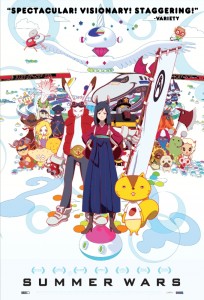
- ‘Summer Wars’ comes to New York’s IFC Center Dec. 29.

By JQ magazine’s Justin Tedaldi (CIR Kobe-shi, 2001-02) for Examiner.com. Visit his NY Japanese Culture page here to subscribe for free alerts on newly published stories.
The opening scene of Mamoru Hosoda’s animated film Summer Wars transports us to the virtual world of OZ, a place where hundreds of millions of users chat, shop and play via customized avatars in a breathtakingly trippy space that owes much to contemporary Japanese pop artist Takashi Murakami and Mamoru Oshii’s Ghost in the Shell movies. But it’s in rural Nagano where most of Summer Wars occurs, and this setting gives it a heart in a world that’s becoming increasingly addicted to online social networks and mobile devices.
The film enjoyed a sold-out reception of its English language premiere at Asia Society yesterday as part of distributor GKIDS’ annual New York International Children’s Film Festival. Fueled by Internet buzz and rapturous word of mouth upon its initial release in Japan last year, the film won a clutch of awards and is an official entry for Best Animated Feature at the 2011 Academy Awards.
The plot: teenage OZ moderator Kenji (voiced by Michael Sinterniklaas) agrees to a “job” escorting his popular schoolmate Natsuki (Brina Palencia) to her great-grandmother’s upcoming 90th birthday celebration at the family’s enormous estate in Ueda. The catch: he’s asked by his secret crush to pose as her fiancé, which hits complications as her crazed extended family enters the picture. To make matters worse, Kenji unwittingly triggers a malicious AI program called Love Machine that threatens not just the existence of OZ, but the rest of the real world with its interdependence on technology. It’s up to the boy—a girl-phobic math prodigy—to gain new confidence in himself in order to right OZ and win his dream girl’s heart.
Click here for the rest of the review.
JETAA DC Film Festival – Dec 3 and 5
Events, Film, JETAA Chapters, Uncategorized Comments Off on JETAA DC Film Festival – Dec 3 and 5
Via Mack Maloney, President of JETAA DC:
JETAA DC will be holding a film festival at the Freer Gallery of the Smithsonian Institute the weekend of December 3-5.
1. Friday, December 3 @ 7pm is “Linda Linda Linda.”
The film follows four girls as they prepare their band for their final school festival. Accompanied by a great soundtrack, this film is funny, poignant, and will certainly have you longing for your school festival (and a karaoke box).
2. Sunday, December 5 @ 2pm is “The Harimaya Bridge,” written and directed by JET alum Aaron Woolfolk (Kochi-ken) who will be in attendance.
Filmed in Kochi Prefecture, “The Harimaya Bridge” is a drama about an American man who must travel to rural Japan to claim some important items belonging to his late son, from whom he was estranged. While there, he learns several secrets his son left behind. Mr. Woolfolk will be in attendance during the screening and will stay to answer questions about his craft and his experiences. Come see a film the Los Angeles Times calls “a unique, complex, consciousness-raising accomplishment,” and Derek Kester of the San Francisco Examiner labels one of the best films of the year.

WIT Life #132: Kwaidan
Events, Film, Translating/Interpreting, Uncategorized, WIT Life, Writers Comments Off on WIT Life #132: Kwaidan
WITLife is a periodic series written by professional Writer/Interpreter/Translator Stacy Smith (Kumamoto-ken CIR, 2000-03). She starts her day by watching Fujisankei’s newscast in Japanese, and here she shares some of the interesting tidbits and trends together with her own observations.
Last night kicked off Japan Society’s current “Zen and Its Opposite” Monthly Classic Film Series, which features films from the late ’50s to ’60s that showcase the paradoxical unity of zen and violence. It began with the 1965 film 怪談 (Kwaidan or Kaidan), said to be the most expensive production of its time. It clocks in at a whopping 161 minutes and although the pacing is slow at certain points, the suspense draws you in and keeps you on the edge of your seat for most of it. Kwaidan is comprised of four separate stories, each haunting in its own way. My favorite was Read More
Dipika Soni (Ishikawa-ken, 2003-06) is an in-house translator for PFU (a Fujitsu company) in Kahoku-shi, Ishikawa-ken. She is also the vocalist for the Japanese hardcore punk band DEGRADE. “Chi-Town Rising” takes a look at the connections between Japan and Chicago, where Dipika will be moving in the coming year.
———————————————————————————————————————–
 The 46th Chicago International Film Festival is currently under way, screening 150 films from 50 countries. First held in 1964, the festival founded by Michael Kutza is one of the oldest of its kind in North America. This year the following Japanese films are being showcased, with cultural support provided by The Japan Foundation.
ABACUS AND SWORD / BUSHI NO KAKEIBO
Director: Yoshimitsu Morita
Reimagining the classic samurai picture, this quiet, elegant drama follows the Inoyama family as they serve their lord not with the sword but with the abacus. With a sense of honor as exacting as any warrior’s and a rigorous ethic of honesty even in the midst of dire poverty, Naoyuki Inoyama (nicknamed “the Mad Abacus” by his rivals) distinguishes himself as a hero for the approaching modern age.
BIG TITS ZOMBIE / KYONYŪ DRAGON
Director: Takao Nakano
A campy, raucous crowd-pleaser that is definitely not for the whole family, this 3-D spectacle pits brassy strippers against a horde of the undead, which the ladies unwittingly revive by reading aloud from an ancient tome. They must battle one of their own in addition to the brain eaters when goth stripper Maria hatches her own ambitious plans to become Queen of the Dead.
CATERPILLAR / KYATAPIRÂ
Director: Kôji Wakamatsu
Horribly maimed while fighting on the Japanese front in China during WWII, a Japanese lieutenant returns home a war hero. But his loss of limbs has not made him any less of a brute, especially to his wife. Required to satisfy his every need, she feels her anger quietly boiling over. Based on a short story that was banned for its extreme subject matter, Caterpillar is a howl of rage against blindness to the atrocities of war.
GOLDEN SLUMBER / GÔRUDEN SURAMBÂ
Director: Yoshihiro Nakamura
In this seriocomic conspiracy thriller, affable deliveryman Aoyagi unwittingly becomes the prime suspect in a hunt for the assassin of the prime minister. As he runs from the authorities and the news media eats up every scrap of incriminating evidence, Aoyagi finds a little help from his friends, including his college sweetheart and a crazy but cheerful youth who’s wanted for serial murder. Together, this motley crew will help Aoyagi navigate the strangest, scariest 24 hours of his life.
SWORD OF DESPERATION / HISSHIKEN TORISASHI
Director: Hideyuki Hirayama
The expert swordsman Kanemi Sanzaemon is a man of principle, first and foremost. His decisive, violent handling of high-level corruption in the court of the local feudal lord landed him in solitary confinement for two years. He has now been released, with one caveat he cannot comprehend: He must serve as bodyguard to the lord he betrayed. This thrilling, masterfully stylized tale of honor combines classic samurai action with a taut story of intrigue and betrayal.
The festival runs from October 7th till the 21st. For a complete schedule and more info visit http://chicagofilmfestival.com/ or call 312-332-FILM.
WIT Life #123: International acclaim and disdain
Anecdote Article, Film, Japan Trends, Translating/Interpreting, WIT Life Comments Off on WIT Life #123: International acclaim and disdain
WITLife is a periodic series written by professional Writer/Interpreter/Translator Stacy Smith (Kumamoto-ken CIR, 2000-03). She starts her day by watching Fujisankei’s newscast in Japanese, and here she shares some of the interesting tidbits and trends together with her own observations.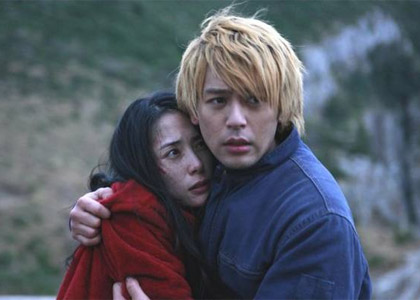
I was really happy to hear that Eri Fukatsu (37) won the best actress award at the 2010 Montreal World Film Festival for her performance in the Japanese film Akunin (Villain). It also features Satoshi Tsumabuki (29) who stars in the title role and is pictured with Fukatsu on the right. Akunin is a tragic love story based on the novel of the same title, and Fukatsu plays the part of a young woman who runs away with a construction worker (Tsumabuki) who inadvertently killed someone. It was directed by Lee Sang Il (36), and all three were in attendance at the festival. Fukatsu is the first Japanese actress to take home the trophy since 1983.
I have liked Fukatsu ever since seeing her in the 2005 drama Slow Dance, which also stars Tsumabuki who is one of my favorites. In this drama you wonder if Read More
Notable JET Alums: Aaron Woolfolk’s “The Harimaya Bridge” wins at Pan African Film Festival
Celebrity, Film, Notable JET Alums, Writers Comments Off on Notable JET Alums: Aaron Woolfolk’s “The Harimaya Bridge” wins at Pan African Film Festival

Aaron Woolfolk (Kochi-ken, 1991-93)
Aaron Woolfolk (Kochi-ken, 1991-93), director and writer of the Kochi-based film, “The Harimaya Bridge,” recently won a director’s award at the 2010 Pan African Film Festival.
Click the link below to read the article and learn more about Aaron and his acclaimed film.
http://www.indybay.org/newsitems/2010/08/12/18655970.php

Tom Baker interviews “Airbender” cast
Article/Journalism, Cartoon/Illustration, Celebrity, Film, Reviews, Writers Comments Off on Tom Baker interviews “Airbender” cast
Tom Baker (Chiba-ken, 1989-91) is a staff writer for The Daily Yomiuri. As another example of JET ROI, he is one of at least four former JETS to have been on the newspaper’s staff in recent years. He usually writes for DYWeekend, the arts and leisure section. You can follow Tom’s blog at tokyotombaker.wordpress.com.
Recently he interviewed two members of the cast of “The Last Airbender” movie during their promotional visit to Tokyo, asking them for their views on the “racebending” controversy surrounding their film. He also covered an insect show now running at a Tokyo museum, reviewed the manga “Otomen,” and weighed in on a couple of other movies now playing in Japan. Here are some excerpts:
“Last Airbender”
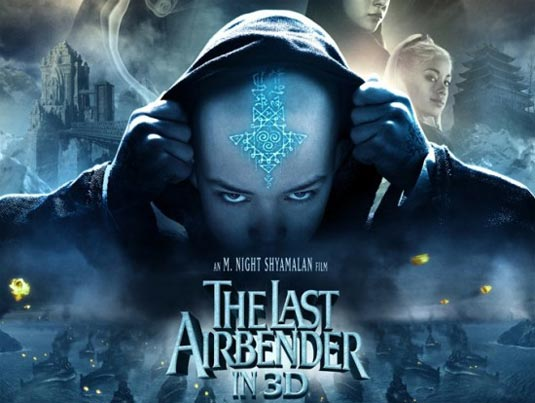 In the United States, some fans of the anime-style cartoon on which the movie is based have protested against the casting of Jackson Rathbone and Nicola Peltz, who are white, in roles the fans saw as Asian.
Asked to comment on that, Rathbone said: “I originally was a finalist for Prince Zuko [a Fire Nation role that went to Slumdog Millionaire star Dev Patel]. Almost a year later, I was brought back in for the character of Sokka…I think what they were really looking for was the qualities that people represent, not so much focusing on race…All these characters [in the cartoon] have so many different features, you can’t really say that they are one race…It’s a shame that people really focus on the race thing and they don’t understand that it’s a story for everyone.”
“And there are over 120 different types of people in the film,” Peltz added.
“In terms of a big-budget film, it’s the most ethnically diverse cast there’s ever been,” Rathbone agreed.
Read the rest of the interview here.
“Insects festival”
Open your window on a hot summer day and you may hear a sound that caught the ear of haiku poet Matsuo Basho in the 17th century: the voices of cicadas, seeping into the rocks. Of course, Japan today is a lot more urbanized than it was in Basho’s time, and cicadas are more likely to sing against a background of asphalt and cement. Yet year after year, the buzzing bugs never fail to show up, even in the heart of Tokyo.
 Visitors to Insects Festival, an exhibition now running at the Edo-Tokyo Museum in Ryogoku, Tokyo, are reminded of such persistence right away with a display of six-legged critters that live in three different Tokyo zones: mountains, fields and downtown areas.
While city-dwellers often resent sharing space with the likes of cockroaches and ants, the emphasis of this show is on seasonal outdoor insects whose diverse shapes, bright colors and occasional songs actually enhance city life…
Read the rest of the article here, or visit the exhibition’s site here.
“Otomen”
 Anyone writing a graduate thesis on the presentation of gender in Japanese pop culture will find abundant material in the manga series Otomen. Readers looking for laughs will also find what they seek in Otomen, but rather less abundantly.
The main characters are a trio of high school students, with the focus on Asuka (a boy who has a name more common for girls), who is in love with Ryo (a girl who has a name more common for boys). Their would-be romance is complicated by the constant presence of their friend Juta, who tries to play cupid, but is more often a third wheel.
Asuka is the captain of the school kendo team, and is admired by everyone as a “real man.” But he is secretly an “otomen,” a boy who is into girly things, such as cute stuffed animals and delicate pastries. He is at least as skilled at cooking and sewing as he is at sports, but he keeps that side of himself hidden. Ryo is Asuka’s mirror image in that she has been raised by her socially inept father to follow in his footsteps as a martial arts champion, but she strives to put up a feminine front at school. Juta has a secret, too, as he is actually a best-selling manga artist who is using the couple as a model for his stories…
Also playing…
You can read Tom’s review of “Inception” here, and his review of “Zombieland” here.
WIT Life #110: Japan Cuts comes to a close
Anecdote Article, Film, Translating/Interpreting, Uncategorized, WIT Life Comments Off on WIT Life #110: Japan Cuts comes to a close
WITLife is a periodic series written by professional Writer/Interpreter/Translator Stacy Smith (Kumamoto-ken CIR, 2000-03). She starts her day by watching Fujisankei’s newscast in Japanese, and here she shares some of the interesting tidbits and trends together with her own observations.
Last Friday wrapped up Japan Cuts, the two-week, 25-film festival at Japan Society. Thanks to JS’s wonderful volunteering system I was able to see nine of the films at the festival itself, and another two in the comfort of my home. The final night wrapped up the event with the two movies About Her Brother and Sweet Little Lies. I was really looking forward to the latter, but I found the pacing slow and the movie’s story less stimulating than I thought it would be.
About Her Brother is one of those ubiquitous sentimental Japanese movies, but it wasn’t too heavy on the sappiness. Tsurube Shofukutei plays Read More
WIT Life #109: Parade
Anecdote Article, Events, Film, Translating/Interpreting, WIT Life Comments Off on WIT Life #109: Parade
WITLife is a periodic series written by professional Writer/Interpreter/Translator Stacy Smith (Kumamoto-ken CIR, 2000-03). She starts her day by watching Fujisankei’s newscast in Japanese, and here she shares some of the interesting tidbits and trends together with her own observations.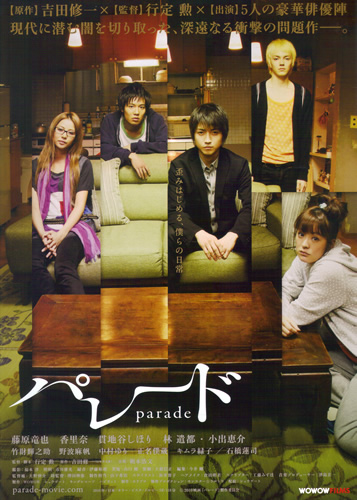
At Japan Society on Friday night I saw what has been my favorite movie of the Japan Cuts festival so far, Parade. A special treat was the attendance of the director, Isao Yukisada, to introduce the movie and take questions after. He presented the movie as a “slice of the dark side of Tokyo,” and expressed his nervousness and excitement at having his work screened here in New York for the first time. The movie explores the relationships between four young people sharing an apartment in Tokyo, as they deal with their respective troubles as well as the danger of an assailant who has been attacking women in the area. The title refers to Read More
WIT Life #108: On the Road
Anecdote Article, Film, Translating/Interpreting, WIT Life Comments Off on WIT Life #108: On the Road
WITLife is a periodic series written by professional Writer/Interpreter/Translator Stacy Smith (Kumamoto-ken CIR, 2000-03). She starts her day by watching Fujisankei’s newscast in Japanese, and here she shares some of the interesting tidbits and trends together with her own observations.
Both films screened last night at Japan Society’s Japan Cuts festival were road movies. The first, Accidental Kidnapper, is reminiscent of Clint Eastwood’s A Perfect World, but I found the second one, One Million Yen Girl, to be more distinctly Japanese. Both feature well-known leads who are easy on the eyes (Katsunori Takahashi and Aoi Yu, respectively) and are backed by strong supporting casts, including Takashi Sasano who makes an appearance in both as an advocate for the main character.
In Accidental Kidnapper he plays a convict who advises Takahashi how to carry out his kidnapping, and in the latter he is a coffee shop proprietor in a small mountain village. In my previous double header, the actor Eita also appeared in both movies; he shows great versatility as one of the main characters in The Foreign Duck, The Native Duck and God in a Coin Locker and has a bit part in Hanging Garden. Both he and Sasano are also in Read More
WIT Life #107: Japan Cuts continued
Anecdote Article, Film, Translating/Interpreting, WIT Life Comments Off on WIT Life #107: Japan Cuts continued
WITLife is a periodic series written by professional Writer/Interpreter/Translator Stacy Smith (Kumamoto-ken CIR, 2000-03). She starts her day by watching Fujisankei’s newscast in Japanese, and here she shares some of the interesting tidbits and trends together with her own observations.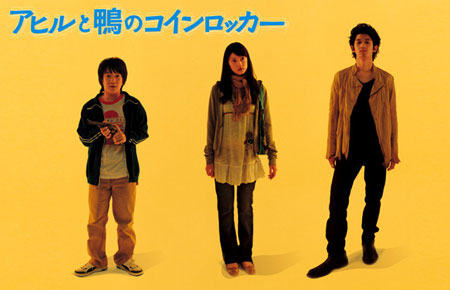
At the Japan Cuts film festival last night, I was able to attend both movies which were screened. The first was The Foreign Duck, The Native Duck and God in a Coin Locker and the one that followed was Hanging Garden. As a special treat, the director of the latter, Toshiaki Toyoda (who also directed Blood of Rebirth which was screened twice at the festival last week) was on hand to offer an introduction to his film and a Q&A session after. The director of the former, Yoshihiro Nakamura, also did Golden Slumber so it was interesting to be able to compare the two.
Director Nakamura clearly places great importance on music in his movies, to the point where is almost a secondary character. This is true in Golden Slumber which focuses on the title’s Beatles song, and in Foreign Duck it is Bob Dylan’s Blowin’ in the Wind. In both cases, the songs and their lyrics are Read More
WITLife is a periodic series written by professional Writer/Interpreter/Translator Stacy Smith (Kumamoto-ken CIR, 2000-03). She starts her day by watching Fujisankei’s newscast in Japanese, and here she shares some of the interesting tidbits and trends together with her own observations.
Last week was the start of the Japan Cuts film festival at Japan Society, where this year 24 films will be featured. This is the largest lineup ever and includes a wide variety of films. The Japan Society allows those who offer to volunteer at the festival the chance to stay and view the movie for free! I have decided to take advantage of this opportunity, and plan to help out during a couple of days of the festival. Stay tuned for reviews of the many movies I will have the chance to sample!
However, my first time at the festival was as a customer last Friday for the screening of the conspiracy theory comedy Golden Slumber. The plot of Read More
