




NYTimes column: “Dominating the Man Cave” by JET alum Bruce Feiler
 Article/Journalism, Books, Celebrity, Notable JET Alums, Writers
  Comments Off on NYTimes column: “Dominating the Man Cave” by JET alum Bruce Feiler
 A thoughtful column in today’s New York Times on the topic of ESPN and man culture by JET alum Bruce Feiler, author of Learning to Bow, Walking the Bible and several other best-sellers including his recent book The Council of Dads:
http://www.nytimes.com/2011/02/06/fashion/06ThisLife.html?_r=1&src=twrhp
Justin’s Japan: Interview with stylist Haruo Noro on NYC’s Lunar New Year Celebration
Article/Journalism, Events, Justin's Japan Comments Off on Justin’s Japan: Interview with stylist Haruo Noro on NYC’s Lunar New Year Celebration

Haruo Noro brings his unique stylings to NYC's Lunar New Year Celebration Saturday, Feb. 5. (Courtesy of Julia Dubrovich)
By JQ magazine’s Justin Tedaldi (CIR Kobe-shi, 2001-02) for Examiner.com. Visit his NY Japanese Culture page here to subscribe for free alerts on newly published stories.
Haruo Noro came to the U.S. to open his own salon after finding success as a stylist in Japan and London. Last year, he worked with the networking site AsianInNY on their “Lucullen” Lunar New Year Fashion Show for designer Joyce Huang. Today (Feb. 3) marks the beginning of the Lunar New Year, and to ring in the Year of the Rabbit AsianInNY has teamed up with the Greater Chinatown Community Association to present their Lunar New Year Celebration this Saturday in Manhattan. I caught up with Noro, who is again working with his stylists and make-up artists for this distinguished cultural event.
Please tell us about your journey to New York from Japan.
I was born and raised in Aomori, Japan, within a family of stylists. My initial training, cutting technique, discipline and inspiration was born here as well. As my experience grew, so did my thirst for new adventures. I wanted to see the world of fashion and beauty. I wanted to expand my knowledge and creativity.
The salon sponsored me to continue my education in London at the Vidal Sassoon Academy, which is where I first experienced a full variety of hair types and textures. London opened my mind through its culture and fashion, giving me the confidence with my skills and the possibilities in the styling industry.
I have been lucky to have had an offer as an assistant to a top stylist in New York City, Oscar Blandi, through which my learning experience continued. I fully blossomed into a complete stylist during my time there. I continued on to Rita Hazan and then my path became clear. I opened my very own salon, which is in the vision as I have always imagined. Fashion, beauty, diversity and creativity here is endless.
How did you first get involved with AsianInNY? What events have you worked on with them before and what was the reaction from the public?
I first got involved with AsianInNY in 2010. When I heard about this opportunity, I was very excited to be part of the Lucullen Fashion Show at the Lunar New Year Celebration. I was especially enthusiastic about having the support of the Asian community in New York, which I am a part of. The designer loved our work, a sophisticated braided bun, which complimented the garments and added a stylish flair. We have received many positive reviews and are happy to be back this year as a sponsor for AsianInNY’s biggest Lunar New Year Celebration in New York City, this time doing both hair and make-up for two designers, as well as singers participating in the show.
What kind of styling are you doing for the upcoming Lunar New Year Celebration and who are you working with?
We will be styling for two designers Way Zen and Janet Zheng. I will be working with my salon team. Haruo Noro Salon will be doing both hair and make-up. The hair for Way Zan collection will be simple yet romantic, loose updos. The hair for Janet Zheng menswear will be natural yet edgy. The make-up lead artist Wenya Chang describes the look as a beautiful look that simply emphasizes the natural beauty of the woman. Light shimmery brown on the eyes, with a rosy flush on the cheeks and a glossy natural lip color. Most importantly, a sexy, dewy complexion.
How would you describe your own style in determining the perfect cut? Did you find yourself adapting your creativity in order to match the image of the Lunar New Year Celebration?
I am always inspired by the artistry in the designs and intuitively create what I see as a companion piece of art. I strive to create a masterpiece each and every time.
Click here for the complete interview.
There’s a nice piece today by Dan Moeller on The Wide Island View (a really high-quality JET-produced webzine for Hiroshima-ken) looking into the similarities between the Philly Phanatic and Slyly, the Hiroshima Carp’s mascot. In the process, Dan comes to grips with the overlap and digs below the costume to reveal some interesting things about the two mascots:
http://www.wideislandview.com/2011/02/the-hiroshima-carp-and-slyly-their-mascot/
Correction: The Wide Island View is independent and not an official AJET publication, as previously stated. Thanks to Dan for pointing that out and apologies for the confusion.
Justin’s Japan: Interview with Ary Warnaar of Anamanaguchi
Article/Journalism, Justin's Japan, Music Comments Off on Justin’s Japan: Interview with Ary Warnaar of Anamanaguchi
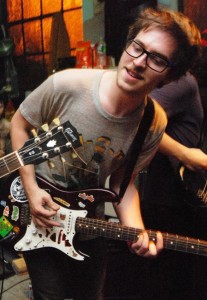
- See Ary Warnarr with Anamanaguchi at New York’s Silent Barn Saturday, Feb. 5. (Leia Jospe/leiajospe.carbonmade.com)

By JQ magazine’s Justin Tedaldi (CIR Kobe-shi, 2001-02) for Examiner.com. Visit his NY Japanese Culture page here to subscribe for free alerts on newly published stories.
The music of Anamanaguchi is part hacked Nintendo Entertainment System, part crowd surfing rave. The Brooklyn-based foursome and chiptune vanguards are on an artistic roll after releasing an acclaimed video game soundtrack based on the film Scott Pilgrim vs. the World, and earlier this month the band played packed houses at both The Studio at Webster Hall as a headliner and Irving Plaza with Super Mash Bros.
If you missed them, fear not: Anamanaguchi returns this Saturday at Silent Barn. I caught up with their co-guitarist and songwriter Ary Warnaar for this exclusive interview.
How did Anamanaguchi form, and what made you decide to specialize in playing chiptune music?
Pete [Berkman, the band’s lead songwriter] started writing chip music in 2003 and was releasing it online under the name Anamanaguchi. Once there was a demand for the music in a live setting, Pete decided to form a band. Over the years the lineup changed quite a bit, but solidified in 2007-08 with Pete on guitar, James [DeVito] on bass, Luke [Silas] on drums and me on guitar as well. I started messing around with chip music when I met Pete and James at New York University in the music technology program. I had been writing electronic music for most of my teen years and had become quite bored with most software by the time I entered college. Modern music software gives you unlimited options in terms of creation, and often lets you skip most steps of creation with presets and loops…software for limited sound chips (such as the 2A03 in the Nintendo Entertainment System) does the exact opposite. You’re extremely limited and are forced to make every note and every sound count. I found that the primitive software and extreme limitations actually made me write more complex music, and helped me focus on expressing myself. The harsh sound palette of simple squarewaves and white noise was also a breath of fresh air to me…overproduced lush sounding electronic music drenched in reverb and pads with hundreds of channels can get kinda boring. Chiptune music is a nice way of going back to basics.
What does the band’s name mean?
Before studying music technology, we were all fashion majors at the Parsons School of Design. Pete and James both interned for Armani, I was a secretary at Prada, and Luke worked at the Gucci store in SoHo. Whenever we showed up at fashion parties, people would always call us as the “Armani-Prada-Gucci” boys. After a couple bottles of Veuve Clicquot, people just started slurring the nickname into “Anamanaguchi.” We quickly realized the fashion world wasn’t for us, but that name just stuck when we made the shift to being a band.
Tell us about your history with Japan. How did it pop up on your radar, what made you want to go there, and how do you keep up your connection with it back home?
Hmm…I’m sure we all have different answers for this. I’ll start with answering for the band, and then get more personal:
As a band, we have never been to Japan.
As a band, we are DYING to go to Japan.
Touring in Japan is kinda our number one dream. Japanese culture, and more specifically, its music scene, is totally awesome. Even the chip-scene in Japan is amazing with artists like quarta330, USK, Maru, Aonami, Cow’P, BSK, YMCK, etc., etc…..
Personally, I have been to Japan twice. I went to Tokyo a couple summers ago and loved it so much that a week after I got back home, I bought another ticket right back to Japan to go to the Fuji Rock Festival. BEST TIME EVER. I’m always keeping up with what’s coming out of Japan, whether it’s reading blogs online searching for new Japanese artists, or asking my girlfriend to buy me clothes when she goes back to Tokyo to visit her family.
What’s your fanbase in Japan like? What things would you like to see and do there on tour?
I don’t really know what our fanbase is like in Japan…I know we have fans there, but we have yet to meet any of them! Hopefully we’ll be out there sooner than later. I love Tokyo, but haven’t really gotten a chance to see any other cities in Japan. Touring would be an awesome excuse to see all of Japan.
Click here for the complete interview.
Justin’s Japan: X Japan Signs North American Deal with EMI
Article/Journalism, Justin's Japan, Music Comments Off on Justin’s Japan: X Japan Signs North American Deal with EMI

X Japan will release its first album in 15 years especially for North America. (Nishioka)
By JQ magazine’s Justin Tedaldi (CIR Kobe-shi, 2001-02) for Examiner.com. Visit his NY Japanese Culture page here to subscribe for free alerts on newly published stories.
Hot on the heels of a rapturous North American tour last fall that climaxed with a sold out gig at New York’s Roseland Ballroom, X Japan is one step closer to cracking America.
The supergroup, which began recording in the mid-’80s and went on to become one of the most successful in Japanese history, has inked an exclusive three-year North American manufacturing and distribution agreement with EMI Music. The first release will be the track “Jade” on March 15, followed by the band¹s as yet untitled American debut set for a summer 2011 release.
“We are so honored to have X Japan as part of the EMI Label Services/Caroline family,” commented EMI Label Services executive VP Mike Harris in a press release issued Thursday. “After the highly successful North American tour last fall, the timing is perfect for the upcoming X Japan release.”
Led by the charismatic drummer/pianist Yoshiki (whom this reporter conducted an exclusive interview with in October), X Japan is currently putting the finishing touches on the disc, the band¹s first new studio album since 1996 and fifth overall. Half of the songs will be culled from some of the band’s gold and platinum Japanese singles, while the other half are brand new songs. An estimated 95% of the lyrics are being sung in English by vocalist Toshi.
Click here for the rest of the story.
Justin’s Japan: NY’s Japan Society Fires Up Sabu Film Retrospective
Article/Journalism, Film, Justin's Japan Comments Off on Justin’s Japan: NY’s Japan Society Fires Up Sabu Film Retrospective

Japan Society's six-film Sabu retrospective begins Wednesday, Jan. 26. (Courtesy of Sabu)
By JQ magazine’s Justin Tedaldi (CIR Kobe-shi, 2001-02) for Examiner.com. Visit his NY Japanese Culture page here to subscribe for free alerts on newly published stories.
This week, New York’s Japan Society presents Run, Salaryman, Run! A Retrospective of Sabu’s Film Works, six slices of cinema packed with high speed, high style, hard luck, and the quirky lusts and lunacies of post-Bubble Japan.
Born Hiroyuki Tanaka in 1964, Sabu is the cult auteur of “punk n’ roll,” alternative comedies, often imitated, never equaled, and far too rarely shown in the U.S. since his 1996 feature debut, Non-Stop a.k.a DANGAN Runner (a film praised by The A.V. Onion Club as “effortlessly clever” and included in this line-up).
In a world of hazards and happenstance, Sabu zeroes in on blue and white collar everymen tossed into dangerously absurd situations from which they desperately try to run. As things speed along, Sabu brings a fresh and frantic twist to traditional film genres (the yakuza film, the thriller, etc.), giving their lean and clean-cropped premises the electroshock treatment and über edgy music scores.
The salute kicks off Wednesday, Jan. 26 with Monster, winner of the FIPRESCI Prize at the 2000 Berlin Film Festival “for its austere, dark wit and keen eye for human foibles.” Other highlights include The Blessing Bell (Netpac Award, 2003 Berlin International Film Festival, Grand Jury Prize, 2003 Cinemanila International Film Festival), and the international premiere of the Japanese auteur’s latest work, the HD-lensed Troubleman.
Sabu has drawn comparisons with Buster Keaton, Johnnie To and Doug Liman, but his satirical jamborees, more than just friendly black comedies, are truly unlike anything else on the silver screen: they are stamina tests, survival riffs, victory rolls.
Click here for the complete story.
Justin’s Japan: Nintendo 3DS Comes to America March 27
Article/Journalism, Japan Trends, Justin's Japan Comments Off on Justin’s Japan: Nintendo 3DS Comes to America March 27

3D gaming becomes reality when the Nintendo 3DS hits stores March 27. (Nintendo Co., Ltd.)
By JQ magazine’s Justin Tedaldi (CIR Kobe-shi, 2001-02) for Examiner.com. Visit his NY Japanese Culture page here to subscribe for free alerts on newly published stories.
Nintendo announced at a press event today (Jan. 19) that its newest handheld video game console, the Nintendo 3DS, will be available in North America on March 27 for $249.99, hitting stores less than a month after its Japanese debut.
The 3DS is the latest incarnation of Nintendo’s portable DS series, which have sold more than 135 million units worldwide since 2004, making it second to Sony’s PlayStation 2 in total sales. Nintendo’s hook this time that should push them over the top employs a method called autostereoscopy, which provides gaming on a special screen without the need for 3D glasses.
Other features include special augmented reality games, backward compatibility with other DS titles, a Virtual Console service for users to purchase Game Boy and Game Boy Color favorites, 3D movie support, StreetPass and SpotPass mode for wireless and Internet gaming, and a Mii Maker that creates a Mii avatar based off a photo taken with the 3DS’ built-in camera. Other interactive functions, like a pedometer and a 3D camera on the back of the device, are expected to increase the console’s appeal to non-gamers as well, according to Nintendo of America’s president Reggie Fils-Aime.
Click here for the complete story.
Justin’s Japan: Anime Smash ‘Evangelion 2.0’ Invades North America
Article/Journalism, Film, Justin's Japan Comments Off on Justin’s Japan: Anime Smash ‘Evangelion 2.0’ Invades North America

Asuka Langley returns in 'Evangelion 2.0,' opening in New York Jan. 21. (Eleven Arts/FUNimation)
By JQ magazine’s Justin Tedaldi (CIR Kobe-shi, 2001-02) for Examiner.com. Visit his NY Japanese Culture page here to subscribe for free alerts on newly published stories.
This Friday (Jan. 21), Cinema Asia Releasing, Eleven Arts and FUNimation Entertainment are set to launch the second installment of the Evangelion film series, as Evangelion 2.0: You Can (Not) Advance premieres in New York and nearly 80 other locations in North America.
Presented in English, 2.0 is the second film in a four part series that re-imagines the sci-fi animated blockbuster TV series Neon Genesis Evangelion (1995-1996). Written and directed by series mastermind Hideaki Anno, the film was one of the top five highest grossing Japanese films of 2009 with box office in excess of $40 million. The franchise itself has grossed over a billion dollars to date, and has become a staple of cosplayers worldwide.
Prior to this week’s debut, the film—which blends apocalyptic mecha action and adolescent angst with thought-provoking religious iconography—bowed at festivals around the world including France, Germany, Finland and Australia. The preceding installment, Evangelion 1.0: You Are (Not) Alone (2007), will also screen in New York for two nights starting today (Jan. 19).
Click here for the complete story.
Any JETs or JET alums with Georgia connections in Japan?
Article/Journalism Comments Off on Any JETs or JET alums with Georgia connections in Japan?
Via JET alum Jessica Cork who works at the Consulate General of Japan in Atlanta:
Trevor Williams, the editor of Global Atlanta, will be visiting Japan at the end of this month and would like to interview some young professionals or entrepreneurs in Japan, preferably those who have Georgia connections. If you are interested, please contact him directly:
Trevor Williams
Editor, www.globalatlanta.com
twilliams@globalatlanta.com
Office: (404) 377-7710
Mobile: (706) 615-4599
Justin’s Japan: Interview with Jazz Pianist Marcus Roberts
Article/Journalism, Interview/Profile, Justin's Japan Comments Off on Justin’s Japan: Interview with Jazz Pianist Marcus Roberts
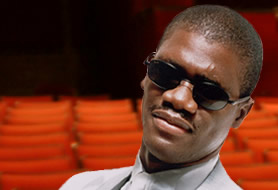
The Marcus Roberts Trio performs in NYC Jan. 18-23. (Courtesy of Florida State University)
By JQ magazine’s Justin Tedaldi (CIR Kobe-shi, 2001-02) for Examiner.com. Visit his NY Japanese Culture page here to subscribe for free alerts on newly published stories.
Blind since the age of four, at 21 years old Marcus Roberts was invited by trumpeter Wynton Marsalis to join his band in the mid-’80s, playing on such Grammy Award-winning albums as J Mood and Marsalis Standard Time, Vol. 1. Six years of touring with Marsalis followed, establishing Roberts as one of the vanguards of young American jazz pianists. Roberts formed his own trio in 1993, and since then he’s been indefatigably presenting his interpretive style around the world as a musician, recording artist and assistant professor of jazz studies at Florida State University.
This week finds the Marcus Roberts Trio, with Rodney Jordan on bass and NEA Jazz Master/Wynton’s little brother Jason Marsalis on drums, in a weeklong residency at New York’s Jazz at Lincoln Center. I spoke with Roberts about his discovery of jazz, the role of technology in his life as a musician, and his thoughts on working with legends like Marsalis and Seiji Ozawa.
What can fans expect from your upcoming shows in New York?
They can expect sort of a wide range of what we like to choose from our repertoire—we have a pretty broad repertoire. We play standard tunes of [George] Gershwin and Cole Porter; we play blues by [Thelonious] Monk and [Duke] Ellington; we play [John] Coltrane’s music; we have a lot of original music that we play; and Jelly Roll Morton. It’s going to be a little bit freer this week, you know. We’re just going to look through the book and pick kind of a historical tour of jazz, if you will.
What was your introduction to jazz?
I grew up in Jacksonville, Florida, and I first started playing piano in church. I was self taught for four years, from eight to 12, and then at 12 I was listening to the radio and I happened to hear Duke Ellington. And I just remember being really enamored with his touch; his style; the chords he was playing. And it went from there; I went from Duke to Louis Armstrong and then I ventured to Miles Davis and Coltrane and Monk, and one by one as the years went on, I got more deep in being interested in how these guys were playing all this stuff that they were coming up with, and how I could emulate that.
Who was your first love in music?
Probably Duke Ellington; I think my real first interest was him. And also [jazz pianists] Teddy Wilson and Mary Lou Williams—I remember hearing Mary Lou Williams with Benny Goodman, and that always struck me. I guess when I’m listening to a great jazz artist, what I’m really always looking for is something that can be taken even outside of the context that they put it in, and I’m able to personalize it and identify my own personality and identity within it. So, honestly, there are many great artists that I love.
Growing up, how did you come to learn about Japan?
I don’t know—I think the first time I went to Japan was with Wynton in 1987, and then I believe went again with a quartet in ’89. But my most memorable experiences of going to Japan have always been with the great conductor Seiji Ozawa. He invited me there a couple of times, and we’ve done Gershwin’s Concerto in F there a few times. It’s probably one of the highlights of my career, going there, doing that with him, because he’s such an innovator, such a great man, and he’s always been very interested in the relationship between how jazz and classical music can be collaborated together, and we always enjoyed working with him there in Japan.
What was it like performing with the maestro?
Oh, my God, absolutely incredible—he is just amazing. He knows that score inside and out, and his dedication to just greatness in general, he’s very infectious. And my band and the other musicians always knew that it was going to be a great performance, because he just wasn’t going to have it any other way. If he had the schedule for rehearsals, I’d talk to him, and by the time we got going, he’d been up since four o’clock in the morning studying scores, making sure that everything was going to be all right. So, he taught me a lot about how you put things on the stage and how you continue to push yourself to reach a real level of expertise and communication with an audience.
Do you enjoy traveling? Where are some of your favorite places around the world?
I enjoy traveling; it’s always fun. It’s always a blessing to be able to play to people and hopefully inspire them through the music you play to have a better day or just something they might be going through. For me, I pretty much will go anywhere, but I love Italy because of the food there, you know? I like going to New Orleans because of the food—I like a lot of places, but I can’t single out a whole bunch of them. I think it’s more about just the variety of the different cultures and the places you can go, because all those different localities have different things that they bring to you, and I guess, from my perspective, since every year we’re going to different places, I guess I’m more intrigued with the act of traveling itself, wherever it is. I also like France for the desserts, and Japan for the sushi. [Laughs]
Click here for the rest of the interview.
Justin’s Japan: All-time Anime Classic ‘Dragon Ball Z’ Comes to Hulu
Article/Journalism, Japan Fix, Justin's Japan Comments Off on Justin’s Japan: All-time Anime Classic ‘Dragon Ball Z’ Comes to Hulu

Goku and the DBZ gang are now streaming online. (Courtesy of FUNimation/Toei Animation Co., Ltd.)
By JQ magazine’s Justin Tedaldi (CIR Kobe-shi, 2001-02) for Examiner.com. Visit his NY Japanese Culture page here to subscribe for free alerts on newly published stories.
U.S.-based FUNimation Entertainment and Toei Animation Co., Ltd. have teamed up to present Japan’s evergreen animated series Dragon Ball Z at Hulu.com, North America’s online leader for streaming TV shows and film in North America.
Yesterday (Jan. 15), FUNimation began streaming the series’ first 15 episodes via Hulu, the official Dragon Ball Z website (www.dragonballz.com) in addition to www.dragonballzkai.com, www.funimation.com.
FUNimation will offer its professionally-produced, uncut, English-tracked and English-subtitled adaptations of the massively successful series beginning with the first episode as well as other chapters of the Dragon Ball franchise: Dragon Ball, Dragon Ball GT and Dragon Ball Z Kai.
Click here for the rest of the story.
Justin’s Japan: Anamanaguchi, Peelander-Z, Starscream to Rock NYC
Article/Journalism, Justin's Japan, Music Comments Off on Justin’s Japan: Anamanaguchi, Peelander-Z, Starscream to Rock NYC

Anamanaguchi headlines New York's The Sudio at Webster Hall Friday, Jan. 14 (Ethan Saks)
By JQ magazine’s Justin Tedaldi (CIR Kobe-shi, 2001-02) for Examiner.com. Visit his NY Japanese Culture page here to subscribe for free alerts on newly published stories.
If you’re looking for new music from New York bands to kick off the new year, your search ends here. This Friday (Jan. 14), The Studio at Webster Hall will host a concert headlined by Anamanaguchi with support by Peelander-Z and Starscream.
If Anamanaguchi’s name is unfamiliar, their sound will whisk you back to the 1980s glory days of the Nintendo Entertainment System. As perhaps the biggest artists of the chiptune genre, the Brooklyn-based foursome tosses punk-flavored electric guitar, bass and drums on top of pop bloops and beeps from a hacked NES and Game Boy that yields retro-futuristic results on disc and onstage. Last year, the group composed the songs for the video game soundtrack based on the film Scott Pilgrim vs. the World, and in November they held a free concert in Union Square to support the controversial alcoholic energy drink Four Loko.
Click here for the rest of the article.
Justin’s Japan: Interview with NEA Jazz Master Hubert Laws
Article/Journalism, Interview/Profile, Justin's Japan Comments Off on Justin’s Japan: Interview with NEA Jazz Master Hubert Laws

2011 NEA Jazz Master Hubert Laws. (Courtesy of Spirit Productions)
By JQ magazine’s Justin Tedaldi (CIR Kobe-shi, 2001-02) for Examiner.com. Visit his NY Japanese Culture page here to subscribe for free alerts on newly published stories.
With a career in music that began in the 1960s, Grammy-nominated flautist Hubert Laws’ latest honor is the NEA Jazz Master Award, which since 1982 is the highest prize the U.S. bestows upon living jazz musicians.
Laws will appear at a free panel discussion with the other 2011 NEA Jazz Masters at New York’s Jazz at Lincoln Center on Jan. 10. (Doors open at 12:45 p.m., and a live video stream can be seen here.) The following night, he will perform at the annual NEA Jazz Masters Awards Ceremony and Concert. For those who can’t attend the sold out show, there will be a live video stream on the NEA website along with a simulcast on the Newark-based WBGO Jazz 88.3 FM and their site, and Sirius/XM Satellite Radio’s Real Jazz Channel 70.
This year also marks the artist’s 40th anniversary of his first trip to Japan. I spoke with him about his time there along with some of his other personal highlights as a musician.
Congratulations on your NEA Jazz Master award. How does it feel to receive this honor?
After learning of its significance, it is a humbling experience to be named among other respected artists of special accomplishment.
How did you find out that you won his award? Did you or anyone else campaign for it?
I happened to be on a tennis court playing doubles when my cell phone rang during a changeover. The gentleman asked if I had a moment—I said, “About 90 seconds.” When he announced the award, I said, “I think my partners will wait a little while longer.” I was not aware of this award, so could not “campaign” for it.
Tell us about your history playing in Japan and working with Japanese artists as a musician.
My first tour in Japan began in Tokyo in 1971 with the “CTI All-Stars” [Freddie Hubbard, Stanley Turrentine, George Benson, Grover Washington, Ron Carter, Bob James, Ester Philips, Hank Crawford and others].
We were greeted at Narita Airport by fans with banners and fanfare as though we were rock stars. That tour included several cities for about two weeks. Since then, 15 other trips there included my own group at the Blue Note Club, another with Ron Carter and his group, Chick Corea and his group, and Sonny Rollins with the Yomiuri Symphony Orchestra, where I premiered the Concertino for Flute and Orchestra by Harold Blanchard. This performance can be seen on the 30 Year Retrospective DVD; and excerpts can be seen on my website. The Laws family [Ronnie, Debra, Eloise and Hubert] appeared at the Cotton Club there in 2007. A JVC Jazz Festival was held there. where Eloise and I appeared there along with Nancy Wilson and others.
My most recent CD features Japanese child prodigy and pianist/keyboardist Yayoi Yoshida in flute adaptations of classical compositions: Rachmaninov’s Piano Concerto #2 and Samuel Barbers’ Adagio for Strings. Excerpts also can be heard on my site.
Why do you think the Japanese enjoy jazz so much?
As a culture, it appears that the Japanese gravitate heavily toward education. This value seemingly leads to appreciation of substance. There is great “substance” in the art of improvised music commonly known as “Jazz.” As in any culture, the “foreign mystique” may also play a part. “A prophet is not unhonored except in his home territory and in his own house.” –Matthew 13:57, New World Translation of Holy Bible.
Click here for the rest of the interview.
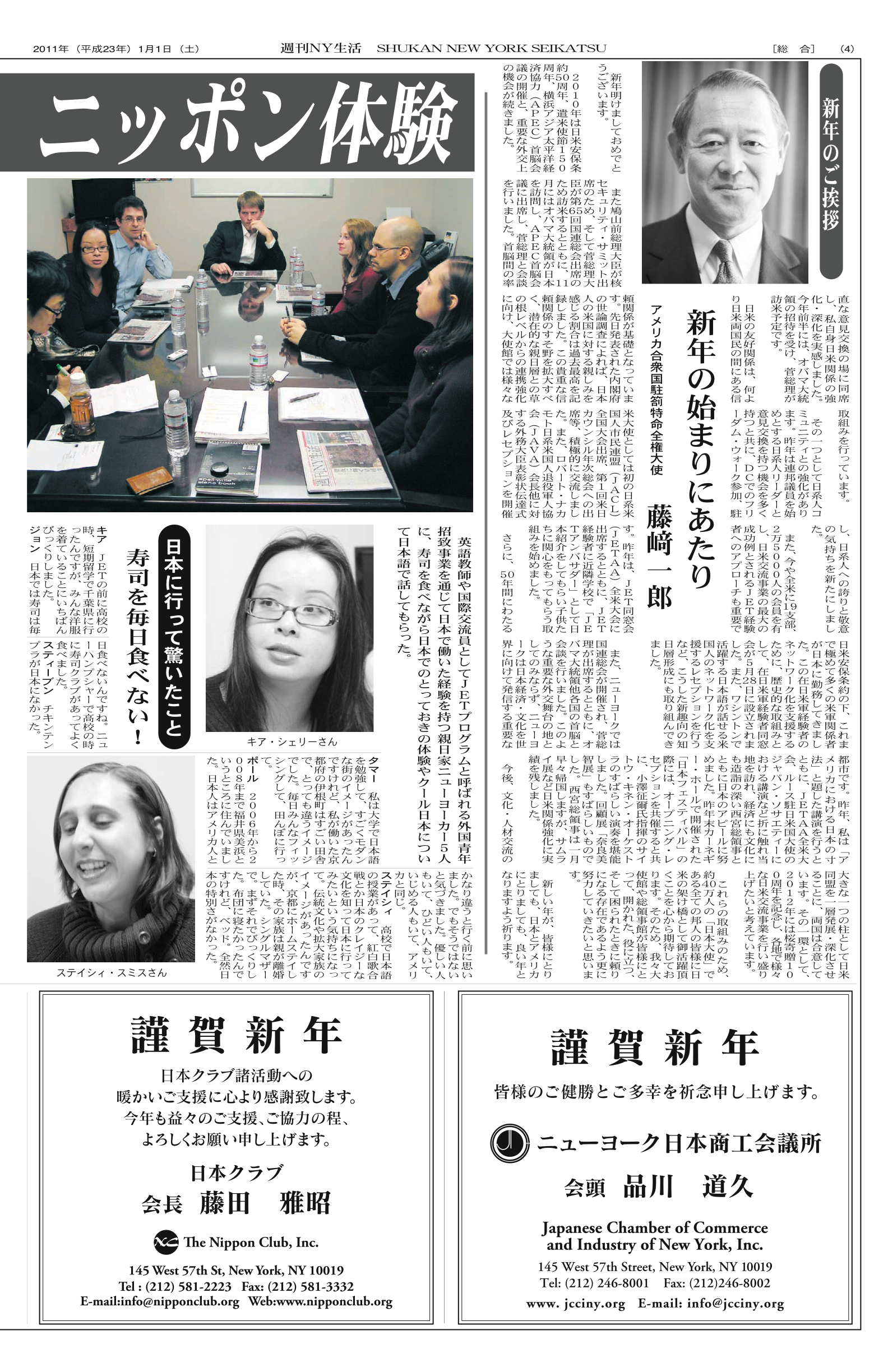
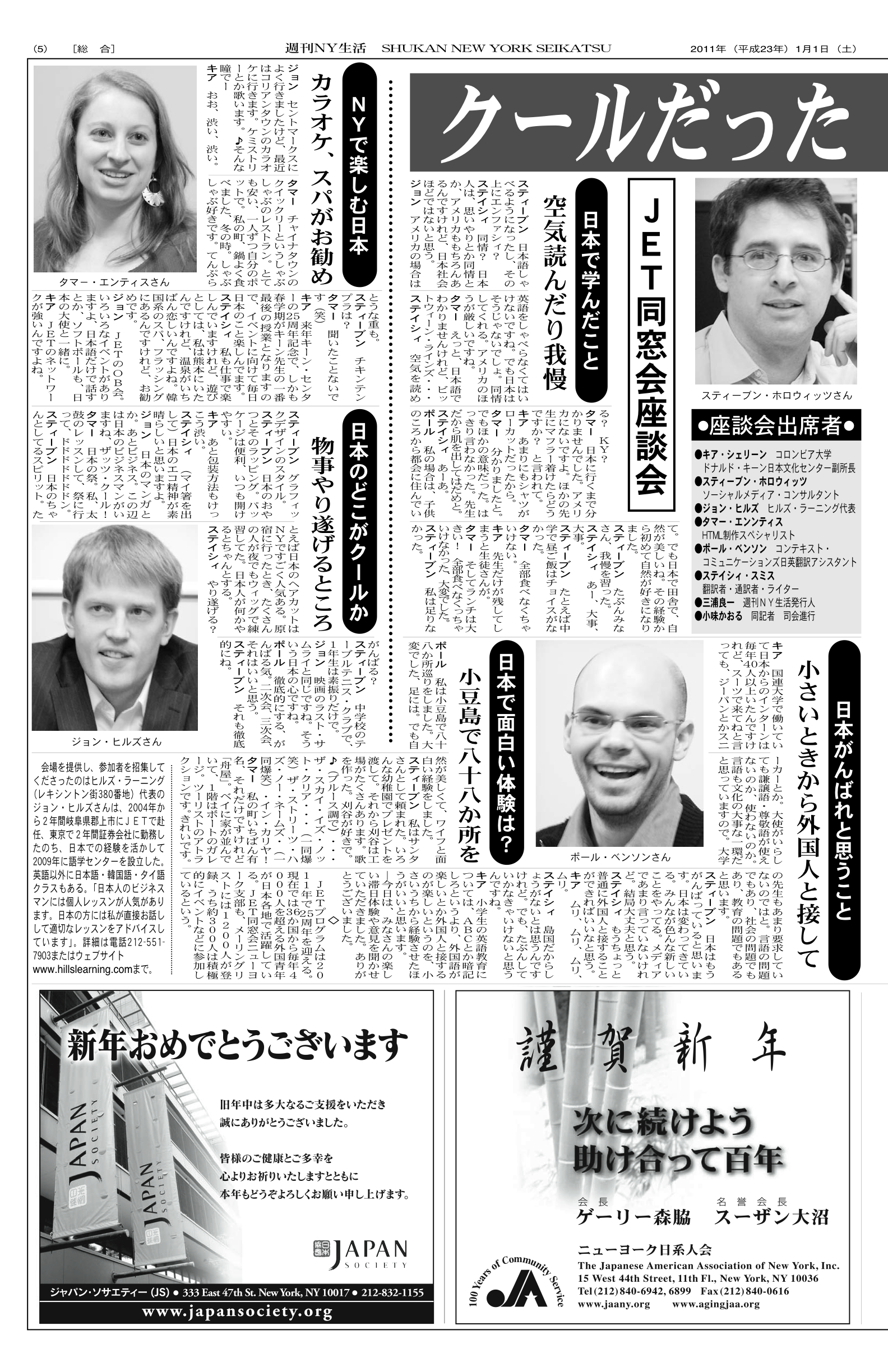
See some familiar JET faces (including that of JetWit founder Steven Horowitz) in the latest issue of Shukan NY Seikatsu, a free, weekly Japanese newspaper available in New York. Along with Steven, JET alums Stacy Smith, Kia Cheleen, Tamar Entis, and Paul Benson sat down with the paper to talk about their experiences for a special New Year’s issue. The even was organized by Jon Hills, founder of Hills Learning (and husband of JET alum Kendall Murano).
The group was asked about what they learned from Japan, what they loved about their areas, what they thought was cool about Japan, and what their reactions were to some of the criticisms Japanese teachers have of JETs. The resulting “NY Cool” feature is front page news, with the full length article inside.
Read the full issue online here (the JET profiles are on page 4 and 5):
http://viewer.nyseikatsu.com/viewer/index.html?editionID=331&directory=../editions&page=1
For more background on the write-up, see this previous JetWit post.
Happy reading!
-Gail Meadows
Associate Editor, JetWit
JET alum manga artist featured in New York Times
Article/Journalism Comments Off on JET alum manga artist featured in New York Times
 Kudos to JET alum Zach Wood (ALT Niigata 2007-09), who was recently featured in a New York Times article about the increase in the number of Japanese universities offering degrees in manga and animation. Zach is a graduate of Stanford University in California and is studying manga at Kyoto Seika University, which established Japan’s first manga program. Universities offering these kind of programs say they are hoping to significantly increase the number of international students enrolled. See the article here:
Japanese Universities Draw Foreign Students With Manga
