




By Justin Tedaldi (CIR Kobe-shi, 2001-02) and Vlad Baranenko (Saitama-ken, 2000-02) for JQ magazine.
Presented by The Playwrights Realm, the drama Crane Story stars Angela Lin (a veteran of JET alum Randall David Cook’s Sake with the Haiku Geisha) as Cassis, a young Japanese American on an odyssey to rescue her brother’s soul from the land of the dead.
Written by Jen Silverman and directed by Katherine Kovner, Crane Story runs through Oct. 1 at the Cherry Lane Theatre in New York’s Greenwich Village. Here’s what JQ‘s critics had to say at a Midtown diner after a recent performance.
Justin Tedaldi: What were your thoughts about the production?
Vlad Baranenko: Given the limited resources that they have being Off-Broadway, they did a very good job with the imagery and the special effects.
JT: I really liked the way the creative team put everything together with the scenery and the costumes, especially the sound effects. There’s a raised wooden stage where most of the action happens, and at the very beginning they describe rain, but you see the rest of the cast drumming their fingers on the stage, which creates the illusion of falling rain. Very creative ways of getting around the limitations that come with being an Off-Broadway production.
VB: I agree on that. The cast obviously remembered their lines really well. It didn’t seem forced, actually; very natural. In that regard, I give them high marks.
JT: I’m reading here that the actor who plays Ishida, Louis Ozawa Changchien, appeared with Adrien Brody, Topher Grace and Laurence Fishburne in the movie Predators.
VB: He looks like someone who’s got some pretty good experience under his belt. He comes off as very authentic in the way he acts, and that’s one of the first things that I noticed.
Justin’s Japan: Hiroshima lends its divine sound to NYC Japan benefit concert
 Article/Journalism, Justin's Japan, Music
  Comments Off on Justin’s Japan: Hiroshima lends its divine sound to NYC Japan benefit concert

Hiroshima brings its soothing sound to New York City Sept. 21.
By JQ magazine editor Justin Tedaldi (CIR Kobe-shi, 2001-02) for Examiner.com. Visit his page here for related stories.
A staple of the Los Angeles jazz scene since 1974, Hiroshima returns for an East Coast engagement tonight (Sept. 21) to headline a Japan relief benefit concert with special guest stars at New York’s B.B. King Blues Club & Grill.
The only Asian American band to have been nominated for a Grammy, the group’s most recent album, 2009’s Legacy, celebrates Hiroshima’s 30th anniversary of recording and serves as a re-visitation of songs (like the easy listening favorite “Roomful of Mirrors” and ’80s hit single “One Wish”) from the band’s first decade.
Led by original members Dan and June Kuramoto, the group proved itself a musical chimera from the start with its self-titled debut, mixing elements of jazz, pop, and R&B with traditional Japanese instruments. Dan has remarked that at the time in America, music was the only outlet of cultural diversity available, and the resulting disc was a pioneering voice in the world music movement that followed.
For the complete story, click here.
Justin’s Japan: Japan Society Remixes a Greek Masterpiece with ‘Medea’
Article/Journalism, Events, Justin's Japan Comments Off on Justin’s Japan: Japan Society Remixes a Greek Masterpiece with ‘Medea’

Micari stars in Satoshi Miyagi's production of 'Medea,' running Sept. 23-25 at New York's Japan Society.
By JQ magazine editor Justin Tedaldi (CIR Kobe-shi, 2001-02) for Examiner.com. Visit his page here for related stories.
Looking for an Eastern take on a Western classic? Japan Society kicks off its fall 2011/spring 2012 performing arts season with the Shizuoka Performing Arts Center (SPAC)’s production of Medea with a three-performance engagement from Sept. 23-25.
Directed by SPAC artistic director Satoshi Miyagi, the performance makes its North American premiere as a visual feast on the scale of a kabuki play. Set in 19th century Japan among the nation’s imperialist, gender-divided late Meiji era, this bold reinterpretation of Euripides’ evergreen features a company of 19 presented in Miyagi’s distinct bunraku puppet theater-inspired style accompanied on stage by live music.
Performed in Japanese with English subtitles, this stunning and internationally acclaimed production has traveled to 20 cities and 11 countries since its premiere in 1999. It also marks the return of SPAC to Japan Society, where the troupe mounted productions of Electra and Oedipus Rex during national tours for both.
For the complete story, click here.
JQ Magazine: Art Review – ‘Fiber Futures: Japan’s Textile Pioneers’ at Japan Society
Art, Article/Journalism, JQ Magazine Comments Off on JQ Magazine: Art Review – ‘Fiber Futures: Japan’s Textile Pioneers’ at Japan Society

From left to right: 'Feel the Wind' (2010), by Fuminori Ono; 'Birth' (2011) by Hitomi Nagai; 'Su no hana' (Nest Flowers) (2011) by Takaaki Tanaka. (Vlad Baranenko)
By Vlad Baranenko (Saitama-ken, 2000-02) for JQ magazine. Vlad is an avid photographer.
Opening this week at New York’s Japan Society is the exhibit Fiber Futures: Japan’s Textile Pioneers, which showcases the works of Japanese textile masters and explores the ever evolving relationship between traditional fabric manufacturing and the uses of unconventional technology and materials to create awe-inspiring works of art. To commemorate the opening of the gallery and the designation of the Japan Society building as a city landmark, a special preview event was held on Sept. 14 with many of the artists in attendance along with an exhibition walkthrough from gallery director Joe Earle.
Originally conceived in 2007, the project received approval following this year’s devastation in Japan, and is jointly presented by Japan Society and the International Textile Network Japan in collaboration with Tama University. According to Japan Society, the collection of 35 works on display was thoroughly selected by a special committee to showcase the work of 30 contemporary masters of a movement originally envisioned in the 1950s to “reflect the fecundity of the Japanese artistic tradition and ingenuity.” Since many of the pieces had to make a long journey from Japan to New York, unique containers had to be meticulously designed for each piece to preserve the artist’s intended presentation and allow the viewer to fully appreciate each work.
To simply describe the collection as a stunning example of creativity and the profound Japanese insight into the coexistence of nature and man would not be enough to credit the artists on display. The exhibition explores such themes as the passage of time and seasons just to name a few. While many of the works are composed of traditional materials such as silk and washi paper, modern materials such as stainless steel, vacuum deposited aluminum, and complex chemical dyes are also added to create three-dimensional enchanting expressions.
JQ Magazine: Photos from the 2011 JETAANY Softball Tournament
Article/Journalism, JETAA Chapters, JQ Magazine Comments Off on JQ Magazine: Photos from the 2011 JETAANY Softball Tournament

Team JETAANY, ready for some softball. (Photos courtesy of Monica Yuki)
By Monica Yuki (Saitama-ken, 2002-04) and Pam Kavalam (Shiga-ken, 2007-09), the JET Alumni Association of New York (JETAANY)’s President and Secretary, for JQ magazine.
On Saturday, Sept. 10, The JET Alumni Association of New York (JETAANY) hosted its Annual Softball Tournament in Red Hook, Brooklyn. Joining the JETs for some friendly competition were Amnet, Docomo, Kintetsu, Mitsubishi, TV Japan, Quick USA, and Yusen. Despite some ominous looking clouds, the 175+ players and spectators enjoyed beautiful, rain-free weather. The daylong tournament was filled with many spectacular plays and great hits, and the event finished with an award ceremony and BBQ at a local bar to celebrate this year’s champion, Yusen. A big thank you to all the teams for coming out and for the tournament’s organizer (and JETAANY President) Monica Yuki!
View the tournament’s Picasa album here.
JQ Magazine: DVD Review — ‘Live from Tokyo’ Explores Music’s Japanification
Article/Journalism, JQ Magazine, Music Comments Off on JQ Magazine: DVD Review — ‘Live from Tokyo’ Explores Music’s Japanification

"What makes this film so unique is how the visuals compliment the subject matter. The music becomes more visceral when scenes from Tokyo’s fluorescent nightlife are flashing on the screen." (Good Charamel Records)
By Sam Frank, an ALT who taught English in Hiraizumi-Cho, Iwate-ken, from 2002-04 and worked in Shirahama-cho, Wakayama-ken as a JET from 2004-06, for JQ magazine. He currently manages the New York division of UnRated magazine and works as a project manager/Web producer at Arrow Root Media.
When it comes to cultural diversity, Japan has always been a borrower. Their entire writing system, known as kanji, is made up of Chinese characters; the country’s most popular sport is baseball, America’s pastime; and South Korean television dramas get all the top ratings. Japan’s music scene is no different. In Live from Tokyo, American director Lewis Rapkin takes us on a kaleidoscopic journey through Tokyo’s bustling underground music scene. Set within the backdrop of the modern Japanese megalopolis, the film explores Tokyo’s eccentric music culture, and how a combination of global information, media-saturated urban areas, and cutting edge innovation has impacted it.
“Since the 2000s, when the Internet became widely used, the number of people listening to underground music has been growing,” explains Murata, lead singer of the band Kuruucrew, during one of the film’s many fascinating interviews. There are many facets to Japan’s underground music scene, and Rapkin captures them beautifully. Early on in the film we learn how MP3s and digital downloads have altered Japan’s musical landscape. TokyoGigGuide.com’s Craig Eaton describes how you can now “get albums online, whereas in the past you’d have to wait until it came to your country or order it, and wait for it to come in the mail.” With a simple click, you can now access Japanese underground artists such as Shugo Tokumaru, Sexy-Synthesizer, and Sajjanu.
When we’re not learning about the underground scene through band interviews, Rapkin gives us an all-access pass to the bands as they perform on stage. Juxtaposed with time lapses of Shibuya’s nightlife, first person views from train lines, and kaitenzushi conveyor belts, we hear punk rock, J-pop, heavy metal, traditional Japanese music, and various synthesizer-based experiments.
For the complete story, click here.
JQ Magazine: JQ&A with JET Alum Mike Maher-King of Smile Kids Japan
Earthquake Tsunami, Interview/Profile, JQ Magazine, Notable JET Alums, Return on JET-vestment, Volunteer, Writers Comments Off on JQ Magazine: JQ&A with JET Alum Mike Maher-King of Smile Kids Japan

"We are already talking to some universities and some private companies about Smile Kids Japan and soon I hope to have more volunteers than there are JETs in Japan! The JET network and support of AJET is at the very core of what we do."
By Renay Loper (Iwate-ken, 2006-07) for JQ magazine. Renay is a freelance writer and Associate Program Officer at the Japan Foundation Center for Global Partnership. Visit her blog at Atlas in Her Hand.
Mike Maher-King (Fukui-ken, 2006-11), originally from Shoreham-by-Sea, UK (near Brighton) and founder of Smile Kids Japan, which was created with the mission to have every orphanage in Japan visited regularly by a volunteer team in an effort to provide children with mentoring, cultural exchange and a newfound sense of trust.
Having making several Japanese friends while attending Royal Holloway, University of London, Mike eventually traveled to Japan and while there, fell in love with the people, the language, the culture, and most of all…the food! After working for a couple years in the UK, Mike returned to Japan as an ALT and eventually went on to create an organization that would touch the lives of thousands of Japanese children.
Recently, Mike took a few moments away from his hectic schedule to share with us a little about his organization, the emergence of volunteerism in Japan, and the impact the 3/11 earthquake and tsunami have had on his work.
When you first began Smile Kids Japan, did you realize you were introducing the concept of mentoring to the Japanese you were working with?
I didn’t actually realize that there are not as many opportunities for people to volunteer here in Japan as there are in the UK, USA, Canada. etc. until I started looking for a way to volunteer. I think with the cultural senpai-kohai (seniority based relationships) system here in Japan, the idea of mentoring isn’t at all new. However, this application of it is relatively new.
What challenges did you encounter doing volunteer work in Japan, where volunteerism isn’t as popular as it is in countries such as the UK or U.S.?
Setting up the very first meeting took a few months and lots of Japanese bureaucracy skills. But it was definitely worth the prodding! That and the initial 10 minutes of shyness, and walking into a room 1/4 of the size I expected with 10 more kids than we thought would choose to come meant all our planning wasn’t quite right! Further, it was also a little tricky to explain to some of the children’s homes what we wanted to do.
What do you think Smile Kids Japan has done for volunteerism in Japan?
There are so many people who do not realize the need for volunteers until they see it with their own eyes. I think that we are [now] approaching the tipping point. However, it is still a work in progress. We have provided an outlet for many people that want to help but didn’t have a channel for their energy. The [recent] earthquake initially transformed things with a huge amount of people volunteering. It will be interesting to see if this is carried back to people’s towns all around Japan.

Happy time in a happi coat. (Rashaad Jorden)
By Rashaad Jorden (Yamagata-ken, 2008-2010) for JQ magazine. Rashaad worked at four elementary schools and three junior high schools on JET, and taught a weekly conversion class in Haguro (his village) to adults. He completed the Tokyo Marathon in 2010, and was also a member of a taiko group in Haguro.
It was the best of times. It was the worst of times.
Those two sentences are a lot more than the beginning of A Tale of Two Cities. The former could best describe my time in the JET Program (with a couple of exceptions), while the latter is an accurate description of my post-JET time.
I was disappointed and sad to leave Yamagata Prefecture last year, but the old saying “when one door closes, another one opens” came to my mind. As much as I enjoyed Japan, I was eager to launch my new life in the U.S.
Since I had talked myself out of grad school for the time being, I figured I ought to put something worthwhile on my resume before commencing the serious job hunt. As my resume included mostly teaching English abroad (France and Japan), I figured I might as well do something related to what I eventually want to do: something editorial related.
Currently, I am seeking an editorial assistant/copy editor/proofreading position. But I would also open to working for cultural exchange programs and in positions that utilize French ability (I am fluent in the language due to having and worked in France).

All Hands volunteers and 3M workers take a break from tearing down drywall to enjoy a delicious bento lunch. All Hands executive director and founder David Campbell, center, T.R., second row, far right. (Eric Zdenek)
By T.R. Pearson (Shiga-ken, 2004-06) for JQ magazine. T.R. currently works in the Admission Office at Riverdale Country School in the Bronx, New York. This was his third deployment with All Hands after volunteering in Indonesia in 2006 and Bangladesh in 2008. If you’d like more information on All Hands, he can be reached at theodoreroyce[at]gmail.com.
I’m sure most JETs remember the influx of e-mails after every typhoon or earthquake in Japan. It didn’t matter if you lived hundreds of miles away on a different island, family members and friends wanted to know you were safe. With the exception of a couple rumbles and some violent windstorms, my time as an ALT in Nagahama, Shiga-ken was relatively peaceful. While earthquakes in Japan are always a concern, the scale of devastation that occurred on March 11, 2011 was unimaginable and unpredictable. Watching coverage from my home in New York, I was now the worried person sending e-mails to friends and researching ways I could help. I found my answer on March 14 when I received a message from the international disaster relief organization All Hands entitled “Japan Tsunami Assessment.”
Three days after the quake, executive director David Campbell and international operations director Marc Young, were on the ground surveying the damage and meeting with local governments to discuss possible response projects. As Marc said in his e-mail, “the best way to really understand the situation is to be there on the ground, and make important decisions from that perspective.” After encountering some refusal for assistance in certain areas, the mayors of Ofunato and Rikuzentakata in Iwate-ken graciously opened their arms and their cities to All Hands to coordinate relief efforts, recruit volunteers, and distribute fresh food through a partnership with Second Harvest Japan. A month after All Hands launched Project Tohoku, they received over 4,000 applications from eager volunteers. Initially, the organization requested people with Japanese language skills and cultural knowledge to expedite the work that needed to be done. This made JET alums and current expats living in Japan perfect candidates to get involved.
Much like the JET Program, All Hands attracts people from all over the world at different stages in their lives. To date, All Hands has brought in over 539 volunteers from 28 countries. When I was there in June, I worked alongside college students on summer break, backpackers who rearranged their travel schedules, mid-career professionals who quit unfulfilling jobs, nurses with extensive international experience, and of course, JET alumni. Certain aspects of the JET Program mirrored this experience as we navigated an unfamiliar landscape, discussed Japanese culture, talked about our hometowns, sang our hearts out in karaoke booths, shopped at the grocery store, and lived in a community as if it were our own.
The official trailer for Naoko Ogigami’s Toilet, screened at Japan Society July 2011.
By Stacy Smith (Kumamoto-ken CIR, 2000-03) for JQ magazine. Stacy is a professional writer/interpreter/translator. She starts her day by watching Fujisankei’s newscast in Japanese, and shares some of the interesting tidbits and trends together with her own observation in the periodic series WITLife.
I was able to catch Naoko Ogigami’s Megane (Glasses) when it was shown in March 2009 as part of the ContemporAsian film exhibition at New York’s Museum of Modern Art, so I was glad to see her newest film Toilet was being screened at Japan Society’s recent JAPAN CUTS film festival. I appreciated the simplicity and quirkiness of this first feature, but I liked the second one even better for its humor.
Both star Ogigami staple Masako Motai, an actress whose presence always greatly enhances whatever work she is in. Because Toilet is almost entirely in English, it is palatable for those who want to see a foreign movie without dealing with those pesky subtitles. It is supposedly set in the U.S., but it was actually produced in Toronto (Ogigami studied film at USC and in Canada).
Toilet opens with the death of the matriarch of a family of three adult siblings, Ray, Maury and Lisa. The movie’s center is Ray, an emotionless engineer with a fondness for plastic models. A fire in his apartment forces him (toy collection in tow) to move home with Maury and Lisa, who live in the house they grew up in. The audience finds out that shortly before she passed away, their mother went to Japan to bring her mother back with her. Their grandmother Baa-chan doesn’t speak any English and leads a silent existence, despite them all living together. Initially the family member with whom she seems to get along best is the household cat, Sensei.
JQ Magazine: Book Review – ‘The Beautiful One Has Come,’ short stories by JET alum author Suzanne Kamata
Article/Journalism, Books, JQ Magazine, Reviews Comments Off on JQ Magazine: Book Review – ‘The Beautiful One Has Come,’ short stories by JET alum author Suzanne Kamata

“The stories in The Beautiful One Has Come have a universal appeal but will strike a familiar note in particular with those who have spent considerable time outside their comfort zones.” (Wyatt-MacKenzie Publishing)
By Sharona Moskowitz (Fukuoka-ken, 2000-01) for JQ magazine. Sharona works at a literary agency in New York City. She is interested in fresh, new voices in fiction and creative nonfiction.
I began reading Suzanne Kamata (Tokushima-ken, 1988-1990)’s new collection of short stories with no idea what to expect and a sense of up-for-anything enthusiasm. Luckily, that feeling stayed with me throughout the collection and renewed itself automatically as I approached each new story.
There’s an enjoyably uncomfortable tension contained within the pages of The Beautiful One Has Come and it’s precisely that tension, paired with Kamata’s ability to glide between narrative points of view, that makes this collection so strong. The characters who inhabit the pages feel so true I could practically hear their pulses.
The physical settings of the stories vary from Cuba to Egypt to France to Japan among other countries, but the characters seem to inhabit spaces all their own: their minds are the true sites of conflict. The stories deal mostly with women in various states of transition; feeling like outsiders while negotiating their own identities, striving for something just out of reach, or trying to come to terms with loss. There is the foreign housewife who longs for the comforts of her native land, the elderly artist whose husband wrongfully gets the credit for the paintings she has created and the Japanese girl who is obsessed with studying abroad in Egypt.
Though these profiles might sound familiar, each story is buoyed by unique and unexpected details which keep the characters from sinking into stereotypes.
Justin’s Japan: Interview with Billy Sheehan of Mr. Big on Touring Tohoku
Article/Journalism, Interview/Profile, Justin's Japan Comments Off on Justin’s Japan: Interview with Billy Sheehan of Mr. Big on Touring Tohoku

Billy Sheehan, right, with Mr. Big: "We had raised about $100,000 for the earthquake relief, and there’s still more to be raised, too. In the end, we raised a bunch of money, and we got a special letter from the Japanese Embassy in Washington, D.C. thanking us for being there." (William Hames)
By JQ magazine editor Justin Tedaldi (CIR Kobe-shi, 2001-02) for Examiner.com. Visit his page here for related stories.
One of the most respected bassists and gentlemen in the music world, Billy Sheehan is back with Mr. Big, the Los Angeles-based rock band he formed in 1988 best known for the hit ballad “To Be with You,” which shot to number one in 15 countries, including the U.S., in 1992. After splitting a decade later, in 2009 the original lineup reformed, followed by the release of What If…, the first album in 15 years from the original lineup.
Now, American fans are finally going to get a chance to see Billy, Paul Gilbert, Eric Martin and Pat Torpey together on stage since their ’90s heyday for a month-long American tour beginning Saturday (July 30) at San Diego’s 4th & B. In this exclusive interview, I spoke with Billy on Mr. Big’s current jaunt around the world, their triumphant return to Japan (where the band is revered), and the possibility of another album from the guys.
So far this year Mr. Big has played all over Europe, Asia and South America. What have your highlights been?
Japan is always amazing. The most difficult thing about touring is getting to and from the gigs…once we’re onstage, there’s no trouble at all, and in Japan, it’s just a breeze. We don’t fly in much, and take a lot of bullet trains, which are super convenient and easy and clean and safe and fast and everything. So Japan is always easy. The rest of Southeast Asia was actually pretty cool, too. We were supposed to do two shows in China, but the Shanghai show got cancelled because the promoters had the wrong visa for us. The shows in Korea, Taiwan and the Philippines were unbelievable, and in Taiwan we actually had to speed away from the venue in a van with literally crowds of people chasing after us (laughs). It was hilarious.
Mr. Big toured Japan less than one month after the earthquake and tsunami, and even did gigs in Iwate and Miyagi Prefectures, the areas most affected by the devastation. What was that experience like?
Really touching. There was a [camera] crew meeting us at the airport and then following us around, and we didn’t know, but they went out in the crowd and interviewed a lot of people, so later on we saw that they had interviewed a guy…I think he was from Sendai. They interviewed him for television, and we didn’t see it until we saw the show. He’d lost everything, and a couple of friends and family, and he’d lost his entire Mr. Big collection, so he actually came to the show to start his collection over again. And I’m telling you, it was so touching, this poor guy, that in his life, the important thing was to come and get his music back together again, really amazing. We had raised about $100,000 for the earthquake relief, and there’s still more to be raised, too—I just saw another $22,000, and I have to see what the figures are for the downloads of the special song we did [“The World Is on the Way”], also, so there’s a bunch more, too.
In the end, we raised a bunch of money, and we got a special letter from the Japanese Embassy in Washington, D.C. [signed by Ambassador Ichiro Fujisaki] thanking us for being there. We didn’t know how it would go when we went there, was it too soon or not, but [remember] after 9/11, where after the dust cleared, all the playhouses and restaurants were going out of business because nobody was going to New York City, so what helped was that going to see a show and having dinner to help the economy rolling again, so we were hoping to get that idea happening. We heard from saké dealers that were going out of business because nobody was drinking because they were all in mourning, you know? It’s a shame that so many lives were lost, but one of the most important things after anything like that is to get back up on your feet again. So I think we helped a bit—I’m cautiously optimistic to say I think we helped a bit. And from the tone of the e-mails and speaking with people after the show, we’re very pleased. So it all ended good.
Was there any hesitation at all about playing those gigs because of the radiation?
For me, no. A couple of the guys in the band were a little concerned about it. I fly transoceanic all the time [across] the Pacific, and you get a dose of radiation every time you do that. I think it’s equivalent to—I forget the figure—one, two or three chest X-rays just by flying over the ocean. And I do know that radiation, to incite fear in people, is almost second to none, you know? It’s invisible, and you don’t know it’s there and the next thing you know, you’ve got a problem. So I knew that there was probably some elevated degree of danger, but I also know that most things of that nature are over-exaggerated, in my experience with my own personal catastrophes of earthquakes and whatever else. They really do overblow it.
So I wasn’t worried personally, but we were more concerned for the fans, and I know that the Japanese government is very conscientious with their safety and rules. I remember I was in Tokyo one time, and there was a typhoon warning for everyone to stay inside. This was years ago, and I was out with a friend of mine, we were walking around, and the streets were deserted; there was nobody anywhere…the people in Japan are really in tune with the warnings and such. And I found out the government wouldn’t have allowed [us] to go on if we were to put a crowd of people in danger, so there was that factor, as well. So a couple of the guys in the band were a little worried about it, but I was okay with it, and in the end, all of us are glad we did it.
For the complete interview, click here.
For Justin’s February 2011 interview with Billy, click here.
JQ Magazine: Four Cups of Sake, ‘Three☆Points,’ Two Beers, and One Night with Sora Aoi
Article/Journalism, Film, JQ Magazine Comments Off on JQ Magazine: Four Cups of Sake, ‘Three☆Points,’ Two Beers, and One Night with Sora Aoi

Sora Aoi at New York's Japan Society for the ‘Three☆Points’ premiere, July 15, 2011. (Justin Tedaldi)
By Rick Ambrosio (Ibaraki-ken, 2006-08) for JQ magazine. Rick manages the JET Alumni Association of New York (JETAANY)’s Twitter page and is the creator of the JETwit column Tadaima!
So I’m here to give you my Three☆Points review. I’m sure you’ll find it somewhere down there. I mean I could just write you about the movie. but that would be unfair, it would be out of context, it would be devoid of what makes this process fun. You see, New York’s Japan Society once again pulled out all the stops for their JAPAN CUTS film festival, and tonight was its apex; the American Premiere of Three☆Points, with a Q&A from actress Sora Aoi and director Blah Blah something Japanese. Not to mention an after party with a DJ, food, and all the beer you can drink. Reviewing things has its perks. If for some reason you don’t know who Sora Aoi is, please, by all means, look her up, Google her. Try doing it at work, under unfiltered pictures. Have your boss and co-workers gather around. It’ll be totally appropriate.
But anyways, there I am at Megu, the uber-fancy restaurant in the Trump World Tower next door to Japan Society. It was Restaurant Week in NYC, so two friends of mine and my girlfriend accompanied me there for a pre-show meal. Little did I know the dinner would be so light on “meal” and heavy on sake-tasting. It was supposed to only be three sakes but they messed up and gave us four. Not so much a problem, but at a place where a single person can easily drop $200 on a meal, going for Restaurant Week and only paying $35 a person results in a curtailed dining experience, no matter how delicious.
So after demolishing a breaded asparagus, a smattering of fresh sushi and a fantastic green tea crepe, I stumbled over to Japan Society ready for my date with destiny. Of course, that would need a moment, since four sakes meant I needed to use the men’s room. The line was out the door, though. People had come out en masse to see Ms. Aoi. I waved to a couple of the volunteers I knew as I jogged down the stairs towards the bathroom. My girlfriend was along for the fun as well, and she darted into the women’s room.
On exiting I lingered, waiting for my girlfriend. I watched where the serpentine line ended; at the opening to the 300-plus seat, meticulously clean theater in Japan Society. I knew both the ticket takers. I debated in my head as to if I should attempt to cut all the eager people in line with a high five to score good seats and impress my girlfriend. My “don’t be a douche” motto rendered this plan a bad idea, and instead just patiently, drunkenly waited for the poor girl who got stuck dating me.
JQ Magazine: Theatre Review – Amon Miyamoto’s ‘The Temple of the Golden Pavilion’
Article/Journalism, JQ Magazine, Reviews Comments Off on JQ Magazine: Theatre Review – Amon Miyamoto’s ‘The Temple of the Golden Pavilion’

Go Morita in a scene from 'The Temple of the Golden Pavilion' at New York's Lincoln Center Festival. (Stephanie Berger)
By Lyle Sylvander (Yokohama-shi, 2001-02) for JQ magazine. Lyle is entering a master’s program at the School of International and Public Affairs at Columbia University (MIA 2013) and has been writing for the JET Alumni Association since 2004. He is also the goalkeeper for FC Japan, a NYC-based soccer team.
In 1950, a young Buddhist monk committed a notorious act of arson and destroyed the ancient Kinkakuji Temple in Kyoto, Japan. Yukio Mishima, Japan’s preeminent novelist at the time, fictionalized the events in Kinkakuji, published in 1956 and translated into English as The Temple of the Golden Pavilion in 1959. While the actual arsonist was diagnosed with paranoid schizophrenia, Mishima presented an elaborately detailed psychological study of a disturbed man, incorporating elements of Buddhist and ancient Greek philosophical reflections on the impermanence of beauty and the conflicts between idealism and reality. The novel helped cement Mishima’s worldwide literary reputation and inspired numerous adaptations, including an opera, a modern dance ballet and two film versions.
Now, the director Amon Miyamoto, previously represented in New York by his production of Stephen Sondheim’s Pacific Overtures, has adapted the story into a full-fledged theatrical production. Having premiered last year at Miyamoto’s Kanagawa Arts Theatre (KAAT) in Yokohama, the production was presented intact by the annual Lincoln Center Festival in New York from July 21-24 with its original cast, led by J-pop star Go Morita of the boy band V6.
In presenting his version of the story, Miyamoto (who co-wrote the script with Chihiro Ito) relies on an arsenal of visual conventions, from multimedia projections to Western theatrical blocking to Japanese austerity. Most of the play is presented on a wooden stage suggestive of an old classroom, a fitting visual component of the temple grounds’ claustrophobic enclave. Mizoguchi, the monk’s name in Mishima’s version, is played by Morita as an awkward stutterer who creates a vibrant interior world at odds with his disappointing reality.
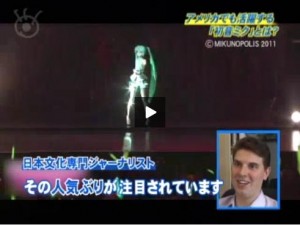
JQ magazine editor Justin Tedaldi talks Hatsune Miku on FCI's "Today's Eye" segment. (Courtesy Fujisankei Communications International)
JQ magazine editor/Japanese Culture Examiner Justin Tedaldi (CIR Kobe-shi, 2001-02) was recently interviewed by Fujisankei (FCI) News on Japan’s virtual pop idol Hatsune Miku for their “Today’s Eye” segment broadcast this week on Japanese TV!
Miku is the star of Toyota’s summer Corolla ad campaign in the U.S., and earlier this month performed to massive crowds at L.A.’s Nokia Theatre and the San Diego Comic-Con! Check out the video here or click on the image for Justin’s comments.
Direct link: www.fujisankei.com/video_library/event/hatsunemiku.html
