




Justin’s Japan: Film Review – ‘Hatsune Miku Live Party 2011 39’s Live in Sapporo’
 Article/Journalism, Film, Justin's Japan, Reviews
  Comments Off on Justin’s Japan: Film Review – ‘Hatsune Miku Live Party 2011 39’s Live in Sapporo’

"With New York going bananas in between numbers and the room itself mimicking the Sapporo show with timed strobe and lighting effects—the theater’s management really went the extra mile—it truly felt like being at a concert." (Courtesy of Live Viewing Japan)
By JQ magazine editor Justin Tedaldi (CIR Kobe-shi, 2001-02) for Examiner.com. Visit his page here for related stories.
On Nov. 10 a one-time theatrical screening was held for a new concert film from virtual pop phenom Hatsune Miku. Entitled Hatsune Miku Live Party 2011 39’s Live in Sapporo, the film—captured in August at the 2,000 capacity Zepp Sapporo—is Miku’s latest appearance in America following a Toyota ad campaign and live gigs at L.A.’s Nokia Theatre and the San Diego Comic-Con earlier this year. (In fact, this reporter was interviewed for Japanese TV about that; click here for the news clip.)
Hatsune Miku, whose name means “first sound of the future,” is a Vocaloid (meaning machine-made vocals) digital female avatar and the most popular of Crypton Future Media characters that employ Yamaha technology to create synthesized vocal tracks, similar to Auto-Tune. In Japan, Miku is massively successful and has appeared in numerous popular video games and music videos, and her Sailor Moon-meets-Avril Lavigne image (she is a teen idol, after all) is equally fanboy and fangirl friendly.
Presented by Live Viewing Japan and simulcast in nine U.S. cities, this screening was shown to a capacity Times Square crowd. From the moment Miku’s name flashed up on the dark screen five seconds in, the audience was hooked. Wild applause, shrieks and excitement from the mostly American teens and twentysomethings in the crowd took the older folks by surprise. “This is like Paul McCartney to us,” remarked one lady several seats away. (She and her companion left about an hour in.)
For those unfamiliar with J-pop, the genre’s credo is style over substance (Katy Perry and Lady Gaga are our closest counterparts), but just like with our pop tarts, a catchy hook is a catchy hook. With a black, completely bare stage flanked by a five-piece band (yes, the music seems to be performed live), the only thing besides Miku noticeable throughout are the hundreds of lime green glow sticks pumped energetically by the fans throughout. Again, this was mirrored by the Times Square audience as one enterprising otaku passed out five blue ones (not to be outdone, he carried a massive Darth Maul-ish staff that lit up a chunk of the theater.)
For the rest of the article, click here.
A (Culturally) Stimulating Interview with the Insatiable Asa Akira
Article/Journalism, Celebrity, Interview/Profile, Justin's Japan Comments Off on A (Culturally) Stimulating Interview with the Insatiable Asa Akira

“I think I have a lot of Japanese culture ingrained in me. Just from being from a Japanese family, living in Japan. The whole ‘respect your elders,’ that, to me, is the main thing that’s different between America and Japan.”
Porn porn
By Michael Karns (CIR Kobe-shi, 2001-02) for JQ magazine. Michael is an avid photographer.
The winner of five AVN Awards (like the Oscars, but without Cuba Gooding, Jr.), Asa Akira returned to the East Coast last weekend for a rare promotional trip. In the spirit of intensifying relations between our nation and Japan, we spoke with the scintillating 25-year-old superstar/native New Yorker about her Japanese roots, her favorite anime films, and the deeper cultural points that America and Japan can swap with each other.
Regarding your Japanese heritage, where is your family originally from?
My mother’s side of the family is from Osaka and my father’s side is from Tokyo, but they live in Yokohama.
You went to an American school growing up.
I did, a very prestigious American private school. It was nice.
When Japanese students relocate to America, it can be difficult adjusting. How was it for you relearning the way of life here?
I was born in New York City and I moved to Japan when I was six, so I already had a little America experience, but it was definitely a huge culture shock. Kids in Japan are really good, even American ones. So coming to New York was like, “Oh my God, these kids are 12 years old and they’re doing drugs!” It was definitely a huge culture shock, and I totally bought into it for a little bit (laughs).
You’ve got an incredible personality…
Thank you.
What do you attribute this to?
I grew up around boys; I think that has a lot to do with my sense of humor. Me and this other girl were always the only two girls in this group of boys, so I think we grew up with a really good sense of humor, you know?
So are you kind of like an otemba (tomboy)?
Yeah (laughs).
That’s my type, by the way.
Oh, good (laughs).
Regarding Japanese culture, what things do you like the most about it? Are there any films or other things that you point to as an inspiration?
I think I have a lot of Japanese culture ingrained in me. Just from being from a Japanese family, living in Japan. The whole “respect your elders,” that, to me, is the main thing that’s different between America and Japan. People in America treat old people like [expletive].
I love my grandmother, but I know what you’re talking about.
(Laughs) And they just don’t listen to older people. I think that’s weird. So that would be the main thing.

Kirsten Phillips strikes a Yosakoi pose.
By Sierra Soleil (Fukushima-ken, 2000-02) for JQ magazine. Sierra works at an ESL school in Manhattan. He enjoys teaching, writing, and riding his bike.
The first weekend of November marked the ninth annual Japan Arts Matsuri (JAM) in New York, this year at the Theater for the New City in the East Village. With about 30 volunteers and a handful of business sponsors, JAM put on an excellent show for roughly a thousand people over the three exciting days.
The entryway and lobby of the theater was crammed with tables selling everything from okashi and yakisoba to clothes and handicrafts, though most people in the know went directly for the Sendai miso cream puffs, and for good reason. There were even two carnival games: a simple one involving throwing a plastic katana at prizes, and an incomprehensible one where people poked little cookies with needles for some reason. Nearly every table was also raising money for earthquake/tsunami relief.
Every day of the three-day matsuri had music and dance performances, but Saturday was Talent Night, where performers could compete for a special invitation to perform at next year’s JAM. I wasn’t sure what to expect from Talent Night, which was good, because it was as wildly erratic as any cross-section of modern Japanese music and dance should be. The first act I caught was Robin’s Egg Blue, a cheerful acoustic pop group. They were followed by a band called Firesign, which was meant to be metal, though any spell they cast dissipated immediately when, as they left the stage, one of the emcees decided to reassure us that they were all very polite in person. After that there were modern and traditional dances, a gospel singer, a karaoke cover of Cee Lo Green’s smash hit (the “Forget You” version, of course), and a fascinating collaboration between a belly dancer and a beatboxer.
The show was billed as being like Amateur Night at the Apollo, and there was some resemblance. The acts were short, and before each intermission the audience chose their favorite via applause. Looking at the lineup, it occurred to me that JAM’s offering was a lot more diverse than anything I’ve seen at Amateur Night. One of the matsuri’s goals is to share Japanese culture with Americans, and the lesson to take from Talent Night is that culturally, the Japanese really are into everything. It also occurred to me that the power to vote by cheering for a performer we liked meant a lot less without the power to impeach them by booing.
I came to Talent Night specifically to meet with JET alumna Kirsten Phillips (Niigata-ken, 2005-08), a member of the Yosakoi Dance Project 10tecomai. The first impression she makes is everything a JET is supposed to be: energetic, cheerful, with a kind of wide-eyed enunciation that makes everything sound exciting. She went directly from teaching in Japan to teaching special education in New York, and it immediately seems like she would be good at it.
JQ Magazine: Film Review – Sion Sono’s ‘Cold Fish’ an Antisocially Acquired Taste
Article/Journalism, Film, JQ Magazine, Reviews Comments Off on JQ Magazine: Film Review – Sion Sono’s ‘Cold Fish’ an Antisocially Acquired Taste

“In the end, Sono really does ask us about our humanity, and what life is about. Sure, he takes the bloody, abusive, rape-filled path, but he does touch on some solid stuff. It’s a lot of big questions wrapped in a gory, misogynistic, boob-exposing gift box.” (Courtesy Salient Media)
By Rick Ambrosio (Ibaraki-ken, 2006-08) for JQ magazine. Rick manages the JET Alumni Association of New York (JETAANY)’s Twitter page and is the creator of the JETwit column Tadaima!
I was hungry, real hungry after work and was about 20 minutes early to the New York Museum of Art and Design near Columbus Circle to see the movie Cold Fish 「冷たい熱帯魚」, so I walked a block to Good Burger and grabbed an overpriced hamburger. As I arrived back to the museum, I sat next to Shree (name changed to protect the innocent) who was midway through a burrito. With minutes left before the movie started, we headed into the museum and down some wooden steps to the theater. Walking in I was pretty surprised; we were only accompanied by seven or eight other patrons. Little did I know that it was a blessing in disguise…fewer people to feel awkward around after the movie.
Oh yes, the movie. How do I write about Cold Fish? It’s a little difficult. I suppose I can do it like this:
Cold Fish is a film directed by the controversial Sion Sono (whose month-long, eight-film retrospective wraps this week at MAD) and stars Denden and Mitsuru Fukikoshi. The film is based on real murders that took place in Fukushima. The story begins well enough: A timid man named Nobuyuki (Mitsuru Fukikoshi) with a rebellious daughter (Hiraki Kajiwara) and a hot trophy wife (gravure idol Megumi Kagurazaka) is feeling disconnected and regretful. They own a tropical fish shop. Through an awkward circumstance they meet Mr. Murata (Denden) and his attractive wife (Asuka Kurosawa), both of whom also own a tropical fish shop.
From there, shit just gets weird. That’s the only way I can explain it, folks. And it wasn’t just because the film cut out four times while we watched it. (Apparently, there were Blu-ray issues…through most of the movie. The museum might want to buy a new player before they hold another festival.) Anyway, Mr. Murata decides to bring Nobuyuki on as a partner, but not before hiring his daughter at his shop and sleeping with his wife (who apparently enjoys rough treatment, to put it mildly).
As Nobuyuki is introduced as the new partner, the old partner finds himself exiting the business via a poisonous death. This is where things kick into the next gear, and Murata forces Nobuyuki to assist with the disposal of the body. The whole body disposal process is presented with great detail. I’m serious about this part—after watching this movie, I am fairly confident that anyone could make a dead body disappear.
The plot then dives deeper and deeper into the dark comedy that is Murata’s utter disregard for human life and the director’s utter disregard for your stomach. By the way, did I mention that this film is very graphically violent? If you aren’t into that kind of thing, find another show; this movie revels in its ability to test what you can deal with gore-wise. If you enjoy severed heads and genitalia being tossed around a bathroom, you’ve found your dream movie.
Justin’s Japan: Japan Arts Matsuri 2011 presents amateur night, guest stars, charity showcase
Article/Journalism, Events, Music Comments Off on Justin’s Japan: Japan Arts Matsuri 2011 presents amateur night, guest stars, charity showcase

Japan Arts Matsuri 2011 runs Nov. 4-6 at Manhattan's Theater for the New City. (Kenji Mori)
By JQ magazine editor Justin Tedaldi (CIR Kobe-shi, 2001-02) for Examiner.com. Visit his page here for related stories.
For every Japanese artist and entertainer in New York with a dream to make it big, the ninth annual Japan Art Matsuri (JAM) is the place for their star to shine. Held this year from Nov. 4-6 at the Theater for the New Cityin Manhattan’s East Village, this year JAM 2011 offers its biggest and most diverse lineup to date.
Hosted by Yoshi Amao and Saori Goda and presented by JaNet in association with Faune Dance Troupe, JAM 2011 has established itself as one of America’s largest Japanese art and music festivals, presenting Japan and its unique culture with performances by Japanese artists, musicians and entertainers in a true matsuri (festival)-style atmosphere, and to enhance friendship and communication among New York City’s cultural communities.
More than 1,000 people are expected to attend the three-day event that features, in addition to live entertainment, a variety of street stall-style shops in the theater lobby that sell everything from Japanese food and drinks to artworks and traditional goods. There will also be charity booths to help those in Japan devastated by the 3/11 Tohoku earthquake and tsunami disaster.
For the complete story, click here.
JQ Magazine: Concert Review – DREAMS COME TRUE in New York City
Article/Journalism, JQ Magazine, Music, Reviews Comments Off on JQ Magazine: Concert Review – DREAMS COME TRUE in New York City
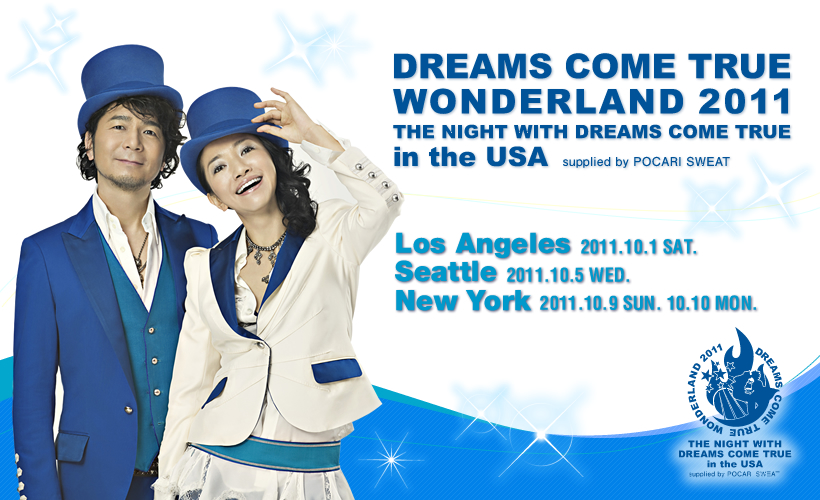
(Courtesy Chimera R. Productions)
By David A. in Virginia, special to JQ magazine.
Japanese mega-band DREAMS COME TRUE (ドリームズ・カム・トゥルー a.k.a. ドリカム) made a very rare U.S. appearance at the Highline Ballroom in New York City on October 9, the first of two shows that sold out within days of their announcement in July. Many thanks to fanpage DCT Joy for notifying its members of this wonderful event. For those of us not in New York, Los Angeles, or Seattle, we otherwise might not have known about it.
At dusk, around 6:30, the line already was down the block for admission to the inconspicuous Highline Ballroom in Chelsea. On this unseasonably warm October Sunday evening, the anticipation was palpable, the “DCT Joy” bringing alive the night. One walks upstairs to the ballroom, spare and easy to navigate. The management asks those seated on the floor of the “pit” to stand so that the crowd can fill the room.
First of all, a big shout-out to Justin Tedaldi (Kobe-Shi CIR, 2001-02) at JQ magazine. This reviewer cannot thank you enough. Also, thanks to Reiko from the DCT organization for her kind words.
Prior to the show, the house PA played a recording of some of DCT’s most well-known melodies, such as “Ano Natsu no Hanabi” and “Ureshii! Tanoshii! Daisuki!”, performed on soft bells.
Promptly at 8:00, introductions were made first by a woman in Japanese, to great enthusiasm from the audience; then a man said, “New York City! Are you ready for DREAMS COME TRUE?!” “A theme of the WONDERLAND” played as the fifteen-piece band-and-dance ensemble walked on stage, followed by Masato Nakamura (中村 正人). Although the Highline Ballroom has a standing capacity of 700, with a few dozen dinner tables on the balcony, the roar from the crowd was as if they were in an arena. With the theme concluded, Miwa Yoshida (吉田 美和) arrived, with her hair tied back and wearing a loose-fitting, light pink outfit; and, with her familiar exclamation “DREAMS COME TRUE in WONDERLAND….!!!”, the band launched into a heavy version of “Nando Demo,” as the crowd danced, waved, and cheered, encouraged by Miwa in all of her boundless energy.
JQ Magazine Is Looking for Writers for Fall 2011!
Article/Journalism, JQ Magazine Comments Off on JQ Magazine Is Looking for Writers for Fall 2011!

As the year winds down, JETAA New York’s JQ magazine continues to provide weekly content with an ever-expanding array of articles, interviews and features (for our recent stories, click here). Following our quarterly meeting in Manhattan this week, we’re now looking for new writers from all JETAA chapters worldwide to write and share more material that we can post online to the widest JET readership on the web through our hosts at the global JET alumni resource site JETwit.com.
Below are story ideas grouped by JET participants and alumni (JET World) and those more on Japanese culture (Japan World). If you’re a JET or JETWit contributor from anywhere in the world, we welcome your interest or extra story ideas! Contact JQ’s editor Justin Tedaldi (magazine [at] jetaany [dot] org) to sign up.
***JET WORLD***
JETAANY CAREER FORUM/WELCOME BACK RECEPTION (11/12)
We would like coverage of upcoming events in New York for any writers planning to attend.
JETs ‘RETURN TO TOHOKU’ SERIES
The Ministry of Foreign Affairs and the Japan Tourism Agency jointly organized an Invitation Program for JET Alums who worked as a JET in Iwate, Miyagi, Fukushima or Sendai-shi for 2 or more years to return to Japan as an ambassador. The goal of the program is to help promote the affected areas and do PR work on their behalf. From around the world, 14 JET alums were selected to return to Japan. Of those, eight were US JET alums. Visit the provided link to see their stories if you would be interested in doing a Q&A with one of them. Also, if you or other JETs are planning to return to help out in the wake of the devastation, we’d love to run an article so you can share your thoughts with other JETs around the world. www.jetaausa.com/tohoku-recovery/jet-alums-return-to-tohoku
‘ALONE IN THE KITCHEN WITH A RICE COOKER’ SERIES
We are running a new series on JETwit about solo cooking experiences while on JET (check out “Nattode,” the first piece in the series). Did you discover a new favorite comfort food in Japan, learn to cook a mouthwatering meal that you still serve today or accidentally buy something really weird only to discover (and reluctantly) eat it in your mansion? We want to hear about it!
HOLIDAYS IN JAPAN ANECDOTES WANTED!
This year, we’re bringing back seasonal holiday (from November through New Year’s) anecdotes from JET alumni around the world! If you have a strange, delightful (or both—we all do) short story to share about your holiday seasons past in Japan, we’d love to publish it.
Job: Bilingual Japanese Client Relations Associate (Bergen County, New Jersey)
Jobs Comments Off on Job: Bilingual Japanese Client Relations Associate (Bergen County, New Jersey)
Via Salem Executive Search. Please make sure to mention JETwit if you apply for this position:
—————————————————————————————————————————————–
Custody Administration Supervisor (translation involved) salary depending on experience. Candidate should have Custody experience and experience with translating the Business digest.
Business Planning & Promotion officer (bilingual Japanese) Salary depending on experience. Candidate should have business and banking knowledge to support the VP of BPP, ability to work on projects and have planning, promotional, analytical, operational and relational aspects of custody (including and not limited to its related FX services) experience and securities lending business experience.
There is also an FX administrator position open, also bilingual Japanese. Candidates must have Foreign Exchange back office experience. (Salary depends on experience.)
TO APPLY, CONTACT:
Lisa Miceli at lmiceli@salemsearch.com
JQ Magazine: Concert Review — Japan Society Hosts J-Pop Showcase with Yu Sakai and Cibo Matto
Article/Journalism, JQ Magazine, Music Comments Off on JQ Magazine: Concert Review — Japan Society Hosts J-Pop Showcase with Yu Sakai and Cibo Matto

Musician Yu Sakai brought his ecclectic talent to Japan Society Oct. 20. (Vlad Baranenko)
By Vlad Baranenko (Saitama-ken, 2000-02) for JQ magazine. Vlad is an avid photographer.
On Oct. 20, New York’s Japan Society held a sold out co-headlining performance by hometown heroes Cibo Matto and the Japanese singing sensation Yu Sakai in his international debut. Whether an aficionado of jazz, hip-hop, R&B or pop, the catchy synth beats of the girl duo and Yu Sakai’s melodic voice left an indelible impression on everyone in attendance.
Billed as J-Music Ride, the show opened with a set of fantastic vocal performances by Sakai. The breakout singer, whose professional music career kicked off in 2009 when his single titled “Story” became a radio hit, has quickly become one of Japan’s most admired artists, earning him the iTunes “J-Pop Best Album of 2010.” In June of this year, Sakai released his long-awaited album Yes!!, and those lucky enough to have attended the show (Yu Sakai’s only performance in the U.S.) were given an opportunity to sample many of the new tracks like “Train.”
Departing from the standard band format, the majority of instrumental sounds in Sakai’s pieces were recorded by the artist himself. At Japan Society, the artist would beatbox into the microphone to create a looping background rhythm, simulating a multi-layered chorus-like effect by sampling his own voice. He would then insert a fast paced piano tune, and the resulting melody astounded the audience, prompting whistles and applause during the song. To appease the American audience, Sakai-san surprised the concert attendees with his beautiful rendition of Michael Jackson’s “Rock with You.” In between pieces, Sakai would talk to the sold out crowd in a very nonchalant manner (he previously lived in Los Angeles), often making fun of himself and telling people to not be afraid to visit Japan. The obvious raw talent of Yu Sakai made this rare appearance a true gem, and the standing ovation from the audience at the end of his performance proved that this young artist can look forward to a bright future ahead.
Justin’s Japan: Interview with the English Dub Cast of ‘Dragon Ball Z’ at New York Comic Con
Events, Interview/Profile, Justin's Japan Comments Off on Justin’s Japan: Interview with the English Dub Cast of ‘Dragon Ball Z’ at New York Comic Con

One down, six to go: Voice actors Christopher Sabat, Justin Cook, and Sean Schemmel of 'Dragon Ball Z.' (Justin Tedaldi)
By JQ magazine editor Justin Tedaldi (CIR Kobe-shi, 2001-02) for Examiner.com. Visit his page here for related stories.
To celebrate the 15th anniversary of its English-language debut, Dragon Ball Z is coming to Blu-ray for the first time in America. The November release of Dragon Ball Z Level 1.1 contains the first 17 episodes of the anime series that dominated Japan’s pop culture scene in the 1990s and later, the rest of the world. This newly remastered collection restores the original, director-approved color scheme and 4:3 aspect ratio in stunning 1080p HD, and each volume will include rare never-before-seen special features.
In this exclusive interview conducted at New York Comic Con/Anime Festival (where I also talked with Stan Lee), I spoke with three of the English dub cast members: Christopher Sabat (Vegeta/Piccolo/Yamcha/voice director), Justin Cook (Raditz/Super Buu/ADR engineer), and Sean Schemmel (Goku/King Kai/Nail) about the release, their favorite Dragon Ball memories, and the proper context for discussing one’s favorite cartoon crush.
Regarding your approach to the characters’ voices, how much of the original Japanese voice work did you watch? For the voices you replaced, how much of that did you take into consideration?
Chris: At the start, a lot of consideration was taken to the original voices, and when I say original voices, I mean the Canadian cast [whose English dub work aired from 1996-98], because at the time [Dragon Ball’s North American producers] FUNimation had decided for a multitude of reasons that it was just physically impossible for them to record in Canada any longer. It was difficult to keep the actors consistent on the roles, because a lot of the Canadian actors were cast in other things, and sometimes it would make their job difficult. In fact, they had to recast Goku several times in Canada; they didn’t want to do that anymore. And it also made more sense to be closer to the parent company, so they moved it all down to Fort Worth.
We tried to take a lot of care at the beginning to match the Canadian cast, only because we didn’t want it to be too much of a shock, and when I say “we” I guess I mean the people who hired me—they didn’t want it to be too much of a shock to the American culture when they changed out these voices. And to be honest, when we first started recording this, we didn’t really have access to the Japanese versions of the show; we were dubbing off the Spanish version of Dragon Ball Z. So if we ever listened to the original language on the tape, it was like (speaks in a rapid mock Spanish): “Goku! Dragon Ball Zeta!” [Goku’s wife] Chi-Chi’s name was Milk.
We were just trying to keep it consistent to the first 68 episodes, and it wasn’t until later that we were redubbing the show that we actually started getting in the real Japanese versions of the show and had the technology to be able to quickly preview the Japanese files. We didn’t even have digital files yet, and sometimes we didn’t even get all the original materials that had the Japanese track on it; sometimes we were lucky if it had any sound on the tape at all…the [original] Japanese wasn’t an option.
Have you been to Japan before? If not, what would you want to do there?
Sean: I have plenty ideas about what I want to do in Japan. I have not been to Japan; I really want to go. My goal is to become a background character in an anime, so I can say this (with mock surprise): “Nani?!” (what) and that’s it. I want it to be one line, to be a Japanese seiyū [voice actor]. Give me something longer than that (in a gruff voice): “Ware ware…” (we) something, but just one line; that’s my goal. And, to meet Masako Nozawa [the original voice of Goku] and maybe, if I were lucky, [Dragon Ball creator] Akira Toriyama, but that’s probably never going to happen.
If you met Toriyama-sensei, what would you ask him?
Sean: I would just thank him, because when you think about it, here’s this guy that draws this comic book, there’s this massive explosion—that I’m on the periphery of, if you think about it—[that] radically changed my life forever. So I’d be extraordinarily grateful to that guy.
Read the complete story here.
JQ Magazine: JQ&A with Peelander-Yellow of Alien Punk Band Peelander-Z
Anecdote Article, JQ Magazine, Music Comments Off on JQ Magazine: JQ&A with Peelander-Yellow of Alien Punk Band Peelander-Z

Peelander-Yellow, center: "I don't care about Band!!!!! We never 'play' music!!!!! We just want to 'play' with youuuuuu!!!!! Come to see our show then check it yourself!!!!!!!!" (Whitney Lee)
By Justin Tedaldi (CIR Kobe-shi, 2001-02) and Vlad Baranenko (Saitama-ken, 2000-02) for JQ magazine.
Psychedelic, seizure inducing, and fantastically successful in their ability to cause absolute sensory overload during their intergalactic performances, Peelander-Z is back. The colorful Japanese punk group hailing from the Z area of Planet Peelander returns to New York City (where it formed in 1998) for their latest tour behind their new album Super DX Hitz.
Those yearning for their Peelander-Z fix will have the opportunity to experience all the colorful mayhem at the Bowery Poetry Club on Oct. 22. In this exclusive interview, we interrogate Peelander-Yellow to reveal the deepest secrets of their cosmic travel, their mastery of the chaos theory, and what the future holds for the ongoing kaiju saga.
Tell us about Peelander-Z’s Super DX Hitz album.
You can hear our all Hitz songs and understand Peelander-Z world!!!!!!!
28 happy songs and 5 Karaoke DVD!!!!
Get it for your Mom, because your Mom wants dance with youuuuuuuuuu and Peelander-Z!!!
How do you come up with the themes for your songs?
All ideas come from my sweet yellow brain when I eat medium rare S.T.E.A.K., Tacos, Ice Cream~~~~~!!!!!
What inspired you to form the band?
I don’t care about Band!!!!!
We never “play” music!!!!!
We just want to “play” with youuuuuu!!!!!
Come to see our show then check it yourself!!!!!!!!
Who is Peelander-Yellow and what’s his story?
I’m not Peelander-Red!
I’m not Peelander-Green!
I’m not Peelander-Pink!
I’m not Peelander-Black!
Yes, I’m Peelander-Yellow for youuuuuuuu!!!!!!
I was born from Banana on Planet Peelander!!!!!
That’s why I love it!!!!!
Please bring it for meeeeeee!!!!!
Justin’s Japan: Interview with cartoonist Adam Pasion on ‘Aftershock’ and ‘Sundogs’
Article/Journalism, Interview/Profile, Justin's Japan Comments Off on Justin’s Japan: Interview with cartoonist Adam Pasion on ‘Aftershock’ and ‘Sundogs’

"'Aftershock' is supposed to communicate how far-reaching the influence of Japan has been on cartoonists all over the world, and how we feel in a moment like this. I guess more than an open letter, it's a get well card." (Courtesy of Adam Pasion)
By JQ magazine editor Justin Tedaldi (CIR Kobe-shi, 2001-02) for Examiner.com. Visit his page here for related stories.
For the past several years Adam Pasion has been living in Nagoya, which he calls “Japan’s best kept secret.” An editor and illustrator for RAN magazine, he is also a co-owner and English teacher of SpeakEasy Language School. As the creator of his own comic diary series Sundogs, the San Jose native was profiled in The Japan Times earlier this year, and the strip has since been collected into three books, providing a daily document of Pasion’s life in Nippon with his growing family from 2008 through 2010.
His latest project is Aftershock: Artists Respond to Disaster in Japan, a global response to the combined disasters of this year’s Tohoku earthquake, tsunami and nuclear meltdown. Edited and complied by Pasion and representing over 35 contributors from five continents, including Jeffrey Brown, Ben Snakepit, and JET alum Lars Martinson (Fukuoka-ken, 2003-06), the book shares their thoughts and feelings about a freshly devastated Japan in manga form. In this exclusive interview, Pasion reveals the inspiration for this unique project, his favorite Sundogs moments, and what’s next on his plate.
Tell us about your history with Japan. How did it cross your radar growing up?
My hometown had a pretty big and vibrant Japantown, and we would often go there and eat or go window shopping as a kid, but beyond that Japan was just a point on a map for me. In college I worked with a Japanese girl who tried to get me to go to some club for Japanese exchange students. I reluctantly went and was surprised by how much I enjoyed it—tons of delicious Japanese food and lots of cute girls. I started going regularly, and that is where I met my wife. I started taking a Japanese class, and through that class I got offered a position working in Japan for a summer. After spending a summer working here, I fell in love with the place. Several years later, my wife and I found out that we were going to be having a baby, and we decided to come have the baby close to my wife’s family here in Nagoya. Four years, two kids and a couple belt sizes later, and we are still here.
How did Aftershock come together following the earthquake and tsunami of March 2011?
Like most people out there who have any sort of connection to Japan, I felt paralyzed by the whole thing. Here were all these terrible events unfolding just a few hundred miles up the coast and there was nothing I could do about it. I had a sort of “survivor’s guilt” by proxy. When the medical teams and disaster relief groups started to come in I felt even more uneasy, realizing that it was in fact possible to help, just impossible for me to help. Every place I looked told me “just donate money for now.” I felt like I was sitting in the waiting room, waiting for the doctors to do their job. All I could do was wait, and offer to help with the hospital bills.
Then one night my brain was racing as I was trying to go to sleep, and the idea occurred to me to find a way to help out within my own skill set, which is where the idea for this book came about. I jumped out of bed and immediately fired off about 10 e-mails to the cartoonists I knew personally, and the response was 100 percent positive. I contacted Top Shelf Productions after that on a whim and they were into the idea right away. I still felt like any moment it would vanish in smoke until out of the blue I started getting tons of requests to join the project and submissions from people I had never met. The word had gotten out and was spreading quickly, and at that point I knew we were on to something. When things with Top Shelf didn’t pan out, the project already had way too much momentum to give up, which is why I decided to self-publish it. When the book was funding on Kickstarter, I actually had people thanking me for the chance to pledge money to the project. I still can’t wrap my head around that.
What are your goals with releasing Aftershock?
This has been a major point of misunderstanding from a lot of people. The main goal of this project is not fundraising for a charity. That is certainly a big part of it, but the distinction is that even if it fails to make a lot of money, I think it is incredibly meaningful in its own right. From the beginning I have described this book as a kind of “open letter” to the nation of Japan from the international comics community. It is supposed to communicate how far-reaching the influence of Japan has been on cartoonists all over the world, and how we feel in a moment like this. I guess more than an open letter, it’s a get well card. It is also a timepiece that encapsulates the popular sentiment of the world at one moment. I want all the contributors to look back on this book and remember exactly where we were and how we felt while we were still in the thick of it. I think we have succeeded in this goal. We have created a lasting piece of art that captures an important moment in time and the zeitgeist that goes along with it.
Some people have misunderstood the purpose of the project as a way to donate to the disaster. It certainly is [all proceeds from Aftershock will be donated to relief efforts in northeast Japan—Ed.], but if your main purpose is to make a donation, then there are much more direct ways to do it than to buy this book. I want the book to be successful in its aim to raise as much money as possible to help in the rebuilding process, but I also want people to actively become involved. Read the stories and see why we care so much. I want it to motivate people to join the process of rebuilding and I want it to help people feel like we are all in this thing together.
For the complete story, click here.
JQ Magazine: Book Review – ‘Aftershock: Artists Respond to Disaster in Japan’
Article/Journalism, Books, JQ Magazine Comments Off on JQ Magazine: Book Review – ‘Aftershock: Artists Respond to Disaster in Japan’

“I assumed a response to the earthquake would be grim. I was, however, relieved to see that there is a nice dose of playfulness alongside the serious, an homage to resilience and the inimitable Japanese sense of humor.” (Big Ugly Robot Press)
By Sharona Moskowitz (Fukuoka-ken, 2000-01) for JQ magazine. Sharona works at a literary agency in New York City. She is interested in fresh, new voices in fiction and creative nonfiction.
Composed in the wake of the catastrophic events of 3/11, Aftershock is something of a series of love letters to Japan written in the object of affection’s own familiar dialect: manga. Edited and compiled by American-born and Nagoya-based cartoonist Adam Pasion (Sundogs), the range of over 35 artists/admirers runs the gamut from the seasoned foreign resident to the casual Japanophile, each with an individual style and tone. The pieces are as eclectic as the artists’ experiences and personal ties to Japan, and all proceeds from Aftershock will be donated to relief efforts in northeast Japan.
When I first approached the anthology I wasn’t sure what to expect though I braced myself for gravity. Even in the form of manga, I assumed a response to the earthquake would be grim. I was, however, relieved to see that there is a nice dose of playfulness alongside the serious, an homage to resilience and the inimitable Japanese sense of humor.
For example, “I Was a Teenage Otaku” by JET alum and Tohonharu cartoonist Lars Martinson (Fukuoka-ken, 2003-06) traces the trajectory of the author’s interest in manga and anime, a hobby which “provided the spark that made [him] want to get out there and really explore” and eventually led to his move to Japan as an exchange student. Though his passion for the art form eventually waned, it gave way to a much broader appreciation of the Japanese arts in general.
JQ Magazine: Japan Society Launches Beer Revolution
Article/Journalism, Events, JQ Magazine Comments Off on JQ Magazine: Japan Society Launches Beer Revolution

Green Tea IPA, one of over 20 beers ready for tasting at Japan Society's Beer Revolution event Oct. 5. (Courtesy Baird Brewery)
By Vlad Baranenko (Saitama-ken, 2000-02) for JQ magazine. Vlad is an avid photographer.
With an exploding market for craft beer here in the U.S., Japan’s contribution to the industry, known domestically as ji bīru (地ビール), has seen tremendous growth over the past 17 years.
On Oct. 5, beer buffs and those who simply enjoy an occasional cold pint alike will get an opportunity to sample from at least 20 kinds of beer at New York’s Japan Society‘s “Japan’s Beer Revolution: The Birth, Death, and Resurrection of Japanese Craft Brewing.”
While previously held back by government regulation, Japan’s microbreweries took off in 1994, and have since been experimenting with a variety of traditional ingredients such as ginger and oysters to create rich and complex flavors to replace the standard lagers in order to satisfy local taste palettes. Since many of the beers are produced in age old sake breweries, the Japanese had no trouble adapting Western methods to manufacture a product whose quality would no doubt impress even the pickiest connoisseurs of Belgian brew.
JQ Magazine: JQ&A with Author/JET Alum James Kennedy on the 90-Second Newbery Film Festival
Article/Journalism, Books, JQ Magazine Comments Off on JQ Magazine: JQ&A with Author/JET Alum James Kennedy on the 90-Second Newbery Film Festival

"As for how being on JET has influenced my writing—definitely, a lot of the fantastical world in my book 'The Order of Odd-Fish' is inspired by what I saw and experienced in Japan." (Courtesy of James Kennedy)
By Renay Loper (Iwate-ken, 2006-07) for JQ magazine. Renay is a freelance writer and Associate Program Officer at the Japan Foundation Center for Global Partnership. Visit her blog at Atlas in Her Hand.
James Kennedy (Nara-ken, 2004-06), author of the acclaimed young adult novel The Order of Odd-Fish, will be curating the 90-Second Newbery Film Festival at the New York Public Library on Nov. 5 and with the Harold Washington Library in Chicago on Nov. 16.
Named after John Newbery (thought to be the founding father of children’s literature), the Newbery Award is considered the highest regarded honor given to the author of the most distinguished contribution to American children’s literature, and the American Library Association has awarded it every year since 1922. James took a moment to tell us a little about the festival, curating, and his path as an author.
What is the premise of the festival?
[It is a contest, or challenge of sorts] open to anyone, to make a video that compresses the story of a Newbery Medal (or Honor)-winning book into 90 seconds or less. No book trailers! It has to be the entire story. For it turns out that any book, no matter how worthy and somber, becomes pleasingly ludicrous when compressed into 90 seconds. The goal is comedy.
In a previous JETwit posting, you mentioned three award winners who wrote about Japan and the Japanese that no one has tackled yet. Why do you think that is?
Only because the books aren’t as famous—people are naturally inspired to make movies of books they’ve already read and loved. Everyone has heard of Newbery Medal winners like A Wrinkle in Time by Madeleine L’Engle, The Graveyard Book by Neil Gaiman, or Bridge to Terabithia by Katherine Paterson.
The three Japan-related books that won Newbery Medals or Honors—Kira-Kira by Cynthia Kadohata, Heart of a Samurai by Margi Preus, and Commodore Perry in the Land of the Shogun by Rhoda Blumberg—are just not as well-known, and so it’s less likely someone would be moved to make a video. Their oversight is your opportunity! (To make it more interesting, you could even do it in Japanese and add subtitles!)
If you had to give one word of advice to entrants, what would it be?
Don’t merely recap the book. Transform the story! Either in style or substance. Some great examples of successful 90-Second Newbery entries are this full-scale musical version of The 21 Balloons, or this shadow puppet version of Where the Mountain Meets the Moon.
As I mention in the contest rules, it’s fun to switch up the genre style, like doing Charlotte’s Web in the nightmarish style of David Lynch’s Eraserhead. Or even cross two Newbery books: how about the rodents of Mrs. Frisby and the Rats of Nimh fight their counterparts in The Tale of Despereaux? Rat fights make for gripping cinema! Basically, make it funny. The deadline for entries is Oct. 17.
