




JQ Magazine: JQ&A with Jim Breen of Monash University on WWWJDIC
 Article/Journalism, Interview/Profile, JQ Magazine, Language Study
  Comments Off on JQ Magazine: JQ&A with Jim Breen of Monash University on WWWJDIC

“I just spent several weeks in Finland and Sweden, where the level of English speaking is extremely good. No JET Programmes there. You can’t even argue that they are related languages—Finnish is just as foreign as Japanese, and probably has fewer gairaigo (borrowed words). How do they do it? By teaching it properly in the first place, with trained and qualified teachers.” (Courtesy of Jim Breen)
By Tim Martin (Fukui-ken, 2006-08) for JQ magazine. Tim is a neuroscience researcher and swing dancer based in New York City. He runs a blog called The Floating Lantern, where he writes about humanism and other things that matter. Lately he is trying to learn more about effective altruism and the science of applied rationality.
Jim Breen is the man behind a resource that probably every English speaker trying to learn Japanese has used: the massive WWWJDIC online dictionary. In the 1980s, Breen developed an interest in Japanese that led to him programming a Japanese dictionary for DOS as a hobby. While a professor of digital and data communications at Monash University in Melbourne, Australia, Breen continued working on the dictionary, until eventually it bloomed into an interface that connects and cross-references hundreds of thousands of entries for words, names, and kanji.
Now a recognized authority on lexicography and the Japanese language, Breen continues to work on his “hobby,” and is pursuing a Ph.D. in computational linguistics. In this exclusive interview, JQ spoke with Breen to find out how it all began, his thoughts on language teaching and the JET Programme, and how he thinks technology will affect our experiences with foreign language in the future.
How did you develop your interest in, as you say on your website, “things Japanese”? Is there a specific part of Japanese culture or media that got you hooked?
I guess my interest in Japan over other foreign countries began around 1977 when my eldest daughter, then six years old, began to study the violin using the Suzuki Method. My wife, a musician and music teacher, had heard about the Suzuki Method from a lecture and demonstration, had been extremely impressed, and had expressed an interest in our children studying in the method. From that point on Suzuki began to play an increasingly bigger part of our lives as our second and third children began to study within that method. Also, my wife began to explore teaching in the Suzuki Flute Method.
None of this interest was particularly focussed on Japan itself. In 1980, I took most of the year off work to complete my MBA (I was a budding junior executive in Telecom Australia in those days). A fellow student in our classes had studied Japanese, and impressed me by translating some of the titles of pieces in the Suzuki books. Also among the visiting lecturers was a former trade commissioner in Japan, who spoke eloquently about the importance of Japan and the need for people trained in Japanese. I recall going home that night and saying to my wife: “I think I’d like to study Japanese eventually.” She didn’t think much of the idea, and I concentrated on other things like finishing my MBA and completing a music performance diploma.
In mid-1981, my wife said one day that she thought she really should go to Japan to study teaching Suzuki flute with Toshio Takahashi at the Suzuki headquarters in Matsumoto, as there was no one in Australia teaching Suzuki flute. I liked the idea, and we agreed to go the following December and January, which is Australia’s summer period when schools are closed. Our kids, then aged ten, seven and three, could easily miss a couple of weeks school in December. I arranged two months’ Long Service Leave from Telecom (LSL is a employee right in Australia after you have worked more than 10 years with an employer), and after struggling for a short while with Teach Yourself Japanese (all Kunrei-shiki romaji), I also arranged to have weekly Japanese lessons with Brian Drover, who trained as a Japanese linguist in the Australian army during WWII.
So, in late November 1981, five Breens arrived at Narita, made our way into Tokyo, were popped on a Chuo-sen train to Matsumoto by people from the Suzuki organization, and later that day found ourselves being greeted by a welcoming party from the Nagano Girl Scouts(!). (My eldest daughter was a Brownie, so we had set the international tom-toms working.)
We spent two months in Matsumoto living in two tiny six-mat apartments rented to us by the mother of some local Girl Scouts. My wife had piano and flute pedagogy classes, my kids had lessons in violin and piano (the former with Shinichi Suzuki himself), and I did the housework, shopped, minded kids, tried to study Japanese, etc.
I guess I don’t have any particular parts of Japanese “culture” I concentrate on—my tastes are rather catholic in this regard.
JQ Magazine: Staying On—JETs in Fukushima Share Their Stories
Article/Journalism, Earthquake Tsunami, JQ Magazine, Return on JET-vestment, Volunteer Comments Off on JQ Magazine: Staying On—JETs in Fukushima Share Their Stories

Sunrise over Iwaki: A local pre-dawn commemorative service took place on March 8, 2014, which included taiko performances and ended with the sunrise over the beach near Shinmaikohama Park. (Alexandrea “Xan” Wetherall)
By Eden Law (Fukushima-ken, 2010-11) for JQ magazine. Eden lived and worked in the core city of Iwaki on JET, and he is a current committee member of JETAA NSW, based in Sydney, Australia.
Introduction
It’s been three years since the Great East Japan Earthquake of 2011. While the rest of the world, and arguably, the rest of Japan, has moved on, communities all along the east and north coast continue to endure and deal with the continuing legacy and consequences of that event, especially those displaced from the exclusion zone around TEPCO’s Daiichi plant.
The JET Programme continues to operate, with the government previously announcing plans to double the number of participants over three years. JETs continue to live and work in Tohoku, including JETs who were there before the earthquake, joined later by those placed after 2011. This article will examine the experiences and viewpoints of JETs who continue to work and live in Tohoku, in particular, those living in Iwaki, Fukushima, a city just past the the southern edge of the nuclear exclusion zone. Three years on, they will relate what they’ve seen and observed in their neighbourhood and the city. In addition, the viewpoints of two local Japanese residents will also be included, one from a retired member of a suburb in which evacuees have been housed; and a Japanese English teacher and mother of two.
Before the earthquake, Iwaki was one of the biggest rural cities in Fukushima, with a thriving fishing and farming industry, popular with tourists who come for its natural beauty and well-known beaches. A region rich in history from the Nara period (and prehistory, with its own dinosaur and fossil museums), it also has a famous theme park called the Spa Resort Hawaiians (made famous by the 2006 award-winning film Hula Girls) as well as the Aquamarine Fukushima aquarium. A mere 2.5 hours away from Tokyo by express train, it also supports a large JET community, ideal for those wanting to experience a rural pace with easy access to the bright lights of Tokyo. As a JET placement, it was arguably one of the best places to be.
JQ Magazine: JQ&A with Cade Mosley on His Return to Japan with Rotary International
Article/Journalism, Cultural Outreach, Interview/Profile, JQ Magazine Comments Off on JQ Magazine: JQ&A with Cade Mosley on His Return to Japan with Rotary International

“In my experience, Japan is going through an interesting evolution these days. It’s starting to take a more assertive role in international affairs and taking more of a stand for human rights, development, and peaceful relations. This also makes it a very interesting time for Westerners to be engaged in Japan more than ever before.” (Courtesy of Cade Mosley)
By Mark Flanigan (Nagasaki-ken, 2000-04) for JQ magazine. Mark is a program director at the Japan ICU Foundation in New York City and was also a Rotary Peace Fellow at ICU from 2010-12, during which time he volunteered for a tsunami relief mission in Ishinomaki after the terrible 3/11 tragedy. In addition to his JET and Rotary service, Mark has also been a U.S. Army officer, Presidential Management Fellow, Pacific Forum CSIS Young Leader, Eisaku Sato Memorial Essay Contest prize winner, and Aspen Institute Socrates Program Seminar scholar. His interests lie in international education, disaster response, and post-conflict peacebuilding. He can be contacted at mflanigan[at]jicuf.org.
Christopher Cade Mosley (Nagasaki-ken, 2000-01) is a current Rotary Peace Fellow at International Christian University (ICU) in Tokyo and previously served as a JET for one year. Born in Texas and raised mostly in Fort Worth, Mosley attended the University of Texas at Austin, majoring in government and philosophy. He also spent a semester abroad in Haifa, Israel and interned for Congressional House Majority Leader Dick Armey in Washington, D.C. He was also on student government for their department (Liberal Arts), chairing the committee on study abroad. In this exclusive interview, JQ caught up with Mosley to discuss his lifelong interest in politics and international affairs.
Thanks for your time and for answering our questions, Cade! Would you please tell everyone about your time on JET?
I was a JET in 2000-01 on a long, thin island called Tsushima in Nagasaki, but physically closer to the city of Fukuoka, nestled in the strait between the cities of Pusan and Fukuoka. Tsushima is famous for a decisive sea battle Japan won against Russia in 1905 that first put Japan on the map as a world power and set its course into the 20th century. There’s a massive Russian battleship sunk just off the coast from my apartment there! (Too deep to see, though.) I taught for the second largest district, called Mitsushima, on the south end of the island.
What was your JET role?
I was an ALT at four schools in my district, spending a week in each so that I would rotate through all four in a month. I spent Monday through Thursday assisting the teacher with the lesson, usually coming up with some creative activity or role play to complement the lesson, and Fridays at our BOE.
Did you have any previous background in Asian languages and cultures?
I actually was accepted to JET while I was teaching English in Seoul, South Korea, and my friends there insisted I take the opportunity. Before Seoul, I didn’t have any experience. My whole reason for going to Seoul and applying to JET were because I had zero experience with Asia and thought it would be a good chance to get to know the region, since I was already interested in international affairs at that time.
Justin’s Japan: Nippon in New York—Japan Week at Grand Central, Mayday debut, Jake Shimabukuro
Article/Journalism, Events, Fundraising, Justin's Japan, Music Comments Off on Justin’s Japan: Nippon in New York—Japan Week at Grand Central, Mayday debut, Jake Shimabukuro

Ukulele hero Jake Shimabukuro returns to Highline Ballroom March 27. (Courtesy of Highline Ballroom)
By JQ magazine editor Justin Tedaldi (CIR Kobe-shi, 2001-02) for Examiner.com. Visit his Japanese culture page here for related stories.
Tucked between Oscar and cherry blossom season, March offers an unmissable array of concerts, performances and exhibitions, along with a special gathering to mark the three-year anniversary of the Tohoku earthquake and tsunami.
This month’s highlights include:
March 1-2, 2:00 p.m.
Kaleidoscoping Tohoku: Three Years After the Disaster in 2011
J-LABO Brooklyn, 300-302 Seventh Street, Park Slope
Free
Three years have now passed since the tsunami, earthquake and nuclear accident in 2011 rocked Eastern Japan, yet those who have visited since have been enchanted by the rich culture and history of Tohoku, forging relationships with local residents across generations and geographies. Now, various new projects, art works, crafts, and business from the traditional and the contemporary have emerged. Contents of the two-day event include regional progress reports; a silent auction and charity sale; an exhibition featuring a display of local crafts and a documentary film of Fukushima residents; and of course, food and sake!
Monday, March 2, 11:00 a.m./2:00 p.m./4:30 p.m.
Engleman Recital Hall at Baruch Performing Arts Center, 55 Lexington Avenue
$25 advance/$31 day of event at box office
A show for all ages, this celebration of otaku culture displays how total devotion to one’s artistry creates a truly unique and unforgettable performance. With 15 years of experience, Syan is considered one of the top balloon artists of Japan, becoming the first person ever to win the triple crown of Japanese balloon competition the year he turned pro. A graduate of Japan’s only circus school, Saito is an accomplished juggler, acrobat, balloon twister, and award winner best known for his ninja performance, where he showcases his artistry while clad in black.
March 6-8
Vanderbilt Hall at Grand Central Terminal, 89 East 42nd Street
Free
Japan Week’s annual program highlights unique features of Japanese culture from the last 100 years to the present. Delectable regional foods, technology exhibits, and traditional arts and performances will aim to inspire greater understanding of Japan and travel to the country. There’s something for everyone, from the fresh aroma of Kyoto green tea; a new NTT DOCOMO smartphone app that translates spoken Japanese and English; an introduction to Japanese artistry including hand-blown glass house wares, wooden keyboards and USB’s, gold lacquered iPhone cases; and more. Those planning an international trip can head to the Visit Japan booth for in-person info about travel and various regions.
For the complete story, click here.
JQ Magazine: Book Review — ‘Public Properties: Museums in Imperial Japan’
Article/Journalism, Books, Reviews Comments Off on JQ Magazine: Book Review — ‘Public Properties: Museums in Imperial Japan’

“Aso’s study is an intriguing, and refreshingly straightforward, examination of the shaping of the Japanese public in an era of increasing speed, change and modernization in the realm of how objects can promote, or even create, a national identity.” (Duke University Press)
By Jessica Sattell (Fukuoka-ken, 2007-08) for JQ magazine. Jessica is a freelance writer and a graduate student in arts journalism. Her favorite museum in all of Japan is the Fukuoka Asian Art Museum, but the Mori Art Museum is a close second.
Artist Barbara Kruger poses the pinnacle of questions in an untitled 1991 photograph and type-on-paper piece featuring a sunglasses-clad man whose mouth is twisted into a howl of wonder: “Why are you here?” She provides a few suggestions: “To kill time? To get ‘cultured’? To widen your world? To think good thoughts? To improve your social life?” When this piece is encountered within the walls of a gallery or art museum, these prompts can stir the viewer to question their place as a member of a larger conversation, rather than a simple viewer or consumer. This provokes further rumination: what do we feel when we go to museums, anywhere in the world? What connections do we have, or are we “supposed” to have, to an assortment of collected and cataloged objects arranged for public access? How are we shaped by social and political entities that can (and do) organize exhibitions around certain agendas? Design, of any kind, is never without direction.
Dr. Noriko Aso, Associate Professor of History at the University of California, Santa Cruz, addresses these, and several other powerful veins of inquiry, in her recently published book Public Properties: Museums in Imperial Japan (Duke University Press). She posits that the forerunner to the Japanese museum audience of today was shaped by governing bodies in a shift that brought state-safeguarded treasures out of storage houses and into public view. In this sense, museums in Imperial Japan (1868-1945) played a part far beyond that of the cultural repository and actually took on an active role in cultivating a Japanese national identity. Artworks, ancient artifacts and other cultural treasures helped to shape the self-representation of a self-actualized Japanese public.

“I didn’t have any idea what I was getting into when I arrived as a JET, or if I would even be here longer than a couple of years. However, working for the future of these children, and trying to give them more opportunities in their future, has become my greatest personal accomplishment and given my life new meaning.” (Courtesy of Matthew Cook)
By Eden Law (Fukushima-ken, 2010-11) for JQ Magazine. Eden is a member of JETAA NSW, based in Sydney, Australia, which is part of the thriving JETAA Oceania community that covers Australia and New Zealand.
As a JET Programme success story, that of Matthew Cook (Osaka-fu, 2007-12)’s must surely rank as being one of the most extraordinary and inspiring. Hailing from Blacksburg, Virginia in the U.S., Matthew’s interest in Japanese martial arts led to his participation on JET. Beginning a five-year tenure as an in Osaka ALT, he also served as AJET national council chair, working with the Japanese government as well as JET alumni associations, international corporations, and news media about the value of the programme and internationalization. In 2012, after his JET tenure ended, he was hired by the Osaka Prefectural Board of Education as their Native English Teacher (NET) Program Coordinator, and in the following year, became a senior staff member appointed to the revolutionary English Education Reform Project—and as far as anyone knows, a first for a foreign-born, former JET to be appointed to a senior government role in education.
Now almost a year after his historic appointment, Matthew generously took some time out of his packed schedule to talk with JQ about his role, and most interestingly of all, provide some frank opinions about the JET Programme and the state and future of English education in Japan.
First of all, let me just say, congratulations on your achievement. In a nutshell, how did you go from being an ALT to a senior staff position at the Osaka Prefectural Board of Education? Is that something you could have imagined doing when you first arrived as a JET in 2007?
Thank you very much. It’s been a whirlwind, these past few years, and the congratulations are appreciated. However, we believe the real work is just beginning now.
During my time as a JET, I had the unique opportunity to develop my own curriculum and methodology, teaching junior high and elementary school students. I taught phonics part of a methodology, with the goal of extensive reading. I also had the honor being the AJET national council chair my final year on JET. That experience opened a lot of doors, allowing me to meet some influential people that I may not have been able to meet otherwise.
One of those people was Toru Nakahara, who was named the superintendent of the Osaka Prefectural Board of Education on April 1 of last year. He holds the strong belief that English education has been a failure in Japan, and wants to reform the system altogether. He was one of the first people to take my opinions and experiences seriously, and believed that I could use them to play a key role in the reformation of English education in Osaka. Because of that, I got the chance to interview for a position on his special “English Reform Project Team,” fondly referred to as the “Seven Samurai.”
It’s something I never would have dreamed of in 2007. In fact, I didn’t have any idea what I was getting into when I arrived as a JET, or if I would even be here longer than a couple of years. However, working for the future of these children, and trying to give them more opportunities in their future, has become my greatest personal accomplishment and given my life new meaning.
“Seven Samurai” is a wonderfully evocative name. Who are the other members on the English Reform Project Team?
I was hired from outside the board of education along with Kiyoshi Takeda, who was a high school English teacher in Shiga prefecture. He took a couple years off, and a few years ago he graduated from Harvard with a master’s in educational leadership.
Colleagues who already worked for the board education were teamed with us, because they should have a good understanding of the internal processes of the board of education. Two members from the high school division, two members from the prefectural education center, and one member from the elementary and junior high school division.
I know it’s early days yet, but what kind of impact does the appointment of a non-Japanese (and a former JET!) to a government position have on English education and the perception of JETs in particular?
That’s a tough question for me to answer. It’s a huge leap forward, and very encouraging from my viewpoint. I hope that it opens the door for other government entities in Japan to see what’s possible and search out capable employees with broader experience and different perspectives to add to their workplace. If there’s anything that I’ve learned, it’s that diversity should be celebrated and encouraged.
JQ Magazine: JETAA UK Launches Careers and Networking Programme
Article/Journalism, JETAA Chapters, JQ Magazine, Networking Comments Off on JQ Magazine: JETAA UK Launches Careers and Networking Programme

JETAA UK members Sarah Parsons (second from right) and Rob Gorton of Toyota (second from left) attend the inaugural Careers and Networking Programme reception with guests in the fields of business and academia, Nottingham, Oct. 3, 2013. (University of Nottingham)
By Sarah Parsons (Gunma-ken, 1995-97) for JQ magazine. Sarah is the careers and networking coordinator for JETAA UK and chair of the Midlands Chapter. She also runs her own business called Japan In Perspective, where she facilitates business links between the UK and Japan.
There are a variety of ex-JETs: those who have just returned looking for jobs and hoping to make sense of and use their JET experience, and those who are still interested in keeping in touch with Japan who have been very successful using their JET experience professionally—whether it be directly Japan-related or using it as a catalyst for a new career—but who have not been engaged with JETAA for a long time, if ever. Several things became evident.
First, JET can be a life-changing experience that offers so many potential professional opportunities, but the professional needs of our members are not being formally facilitated within JETAA UK. Secondly, the job environment in the UK is getting more and more competitive and it is very challenging for ex-JETs to stand out, gain more business skills and use their experiences professionally, so there is a demand for helping JETs with their post-Japan careers; and thirdly, in order to achieve any of this, JETAA needs to raise its profile professionally and engage with local business communities.
In this vein, we decided to map out a multifaceted programme within JETAA UK to facilitate these needs and to engage and utilise the expertise of some of our more experienced members. We wanted to organise networking events for local ex-JETs to meet the local business communities (UK companies that are interested in Japan as well as local Japanese companies) so as to offer great opportunities for JETs to develop important contacts and give attendees a chance to keep up to date on what is happening in the Japan-related business world.
JQ Magazine: JQ&A with Photographer Wei Yuet Wong on ‘The Fukushima Project’
Article/Journalism, Cultural Outreach, Earthquake Tsunami, Events, Interview/Profile, JQ Magazine Comments Off on JQ Magazine: JQ&A with Photographer Wei Yuet Wong on ‘The Fukushima Project’

“Though people have told me no one wants to see disaster photos anymore, I think it’s a good reminder because it’s barely three years, and already people are forgetting. Not only outside Japan, but within Japan itself, people are forgetting. It’s true that people need to move on and rebuild their lives, but there’s still so much more work to be done in Tohoku.” (Courtesy of Wei Yuet Wong)
By Nathalie Ng (Shizuoka-ken, 2010-11) For JQ magazine. A member of JETAA Singapore, Nathalie was an inaka JET and her time in Japan has taught her to appreciate the flowers by the roadside and how to snowboard.
Wei Yuet Wong (Nagano-ken, 2008-10) left his home in Singapore to join JET following a summer homestay in Hiroshima. He went there because of the history as he’d learnt about the devastation during World War II, and he was particularly interested in seeing how the city had progressed since then. The relationship formed with his homestay family inspired him to join JET.
Assigned to three different schools in Ueda City, during his first few months he was often left feeling clueless and dependent on his supervisor due to the language barrier and the office hierarchy, but he soon got better at it by keeping an open mind and adapting. He is particularly proud that he was able to inspire in his students that they didn’t have to speak English with an American accent to be understood, and this has helped them to be more confident, speaking out during and outside of classes. (In fact, one of Wong’s former students even visited him and his family during the Chinese New Year.)
Since returning from Japan Wong has been working as a corporate warrior, but since last year he has finally taken the leap to pursue his photography interests. His work is now on display in a new exhibition called The Fukushima Project, which runs through 14th February at Select Books in Singapore on 51 Armenian Street. Through special postcards available for sale, visitors can write messages to the people of Hisanohama in Iwaki, which will then be collected and sent to them to let them know that their story has not been forgotten.
In this exclusive interview, JQ spoke with Wong about his visits to Fukushima before and after the 2011 Tohoku earthquake and tsunami, and the relationships he’s made with the locals through his numerous community activities.
You were posted to Nagano-ken and you lived there before the quake happened. What was your motivation for this exhibition?
I felt awed and hopeless when I first looked at the videos of the earthquake, perhaps like so many people around the world. Then why Fukushima? I think there may be three explanations. One, I first visited Fukushima in 2009 to visit friends, so I got to see Fukushima before the disaster. It was quite a different place.
Two, I have friends in Fukushima, and they live in Koriyama city, about 45 km away from the Fukushima No. 1 nuclear power plant. I was concerned about them. I was curious to know how they felt on the day of the earthquake, and then during the subsequent confusion about the nuclear power plant. I also wanted to see how they are doing when most other parts of the world, and Japan, starts forgetting about them.
Lastly, I wanted to experience how it would be like to venture into the disaster zone. I have a need to see things for myself. To touch the soil. Walk on the sand. Smell the salty air on the Japanese east coast, and try to imagine how people felt that day.
Why did you choose this particular town of Hisanohama?
It was by chance that I discovered this town. It’s quite a story, one thing leading to another, with some fortunate chance encounters. But, the best summary is: I met a friend at Koriyama Station to listen to her account, and her experiences. After that I wanted to visit the coast, so she told me that Iwaki is where I should go. With my ticket bought, I hopped on the bus for the 1.5 hour journey to Iwaki. Once at Iwaki, I went to the local tourist office, and asked for directions to the coast. The person at the office looked quite surprised, and she pulled out a map, studied it for a moment, and said, “Maybe you shouldn’t go. We used to have nice beaches, shrines, and attractions. But now, nani mo nai (there’s nothing).” I was not put off, and she finally realised that I would still go no matter what, and she suggested why don’t I go to Hisanohama, where I can have a nice walk, and just look around. So, there I went.
In the international media, most people know about Kesennuma, Rikuzentakata and Minamisoma, but Hisanohama remains unknown. So, I think it’s nice that I visited Hisanohama. It’s a town just 31 km south of the Fukushima No. 1 nuclear power plant, along the Pacific Coast, and has suffered great damage in the tsunami.
Justin’s Japan: Nippon in New York — ‘Dragon Ball’ in Color, Lolita Fashions, ONE OK ROCK’s Debut
Article/Journalism, Books, Events, Film, Justin's Japan, Music, Networking Comments Off on Justin’s Japan: Nippon in New York — ‘Dragon Ball’ in Color, Lolita Fashions, ONE OK ROCK’s Debut

Dragon Ball Full Color makes its English-language debut in print and digital Feb. 4. (VIZ Media LLC)
By JQ magazine editor Justin Tedaldi (CIR Kobe-shi, 2001-02) for Examiner.com. Visit his Japanese culture page here for related stories.
Stay warm this winter with some hot local events, from the debut performance of one of Japan’s most successful live acts, another performance from one of the country’s biggest crossover stars, and an annual showcase that brings the sights (and tastes) of Japan to vivid life.
This month’s highlights include:
Saturday, Feb. 1, 6:00 p.m.
Asia Society, 725 Park Avenue
Free
The final entry of the film series Vengeance Is Shohei Imamura! Yasuko was exposed to black rain, the radioactive fallout from the atomic bomb dropped on Hiroshima. Years later, she and her townsmen continue to rebuild their life and endure the aftermath. At an age ripe for marriage, Yosuko has been rejected by man after man for fear of radiation, even though she has shown no signs of any illness. The film juxtaposes present-day struggles with flashbacks to scenes of wartime devastation. A departure from Imamura’s usual interest in bawdy human behavior, this film brings him closer to his early mentor Ozu, who is known for his restrained and subdued study of quiet dignity and for whom Imamura acted as assistant director.
Tuesday, Feb. 4
Dragon Ball Full Color, Volume 1
$19.99 MSRP
Akira Toriyama’s epic manga series—one of the most popular of all time—makes its English-langage debut in full color, graphic novel-size in print and digital editions! Son Goku is the greatest hero on Earth. Five years after defeating the demon king Piccolo, he’s grown up and has a family. But what is the real reason for Goku’s incredible strength? A visitor from outer space arrives bearing terrible news—Goku is an alien, and the visitor, Raditz, is Goku’s brother! When Raditz turns out to be a ruthless killer, Goku must fight his incredibly strong brother to save his family and the entire human race. A surprising alliance may be Earth’s last hope: Goku will team up with his old enemy Piccolo to save the world!
Tuesday, Feb. 4, 7:30 p.m.
Joe’s Pub, 425 Lafayette Street
$30 reserved, $35 premium
Akiko Yano returns to Joe’s Pub with her longtime New York friends/virtuoso musicians Will Lee and Chris Parker, answering overwhelming demand from the fans who caught their previous go-round in November 2012. See the pop and jazz chanteuse whom Jon Pareles of the New York Times calls “a world class songwriter with a clear, gentle, wide-ranging voice. She is also an accomplished, endearing performer who might be a Japanese Carole King, Joni Mitchell or Meredeith Monk…”
For the complete story, click here.
JQ Magazine: MIT Professor Ian Condry Explores ‘The Soul of Anime’
Article/Journalism, Books, JQ Magazine, Notable JET Alums Comments Off on JQ Magazine: MIT Professor Ian Condry Explores ‘The Soul of Anime’

“I think it’s a challenge coming back from JET. But the times and experiences we had will really pay off in the long run even if in the short term it’s hard to see how they will apply.” (Courtesy of Web.mit.edu)
By Sheila Burt (Toyama-ken, 2010-12) for JQ magazine. Sheila is a Chicago-based journalist who blogs at www.sheilaburt.com.
Anime can easily be called a global phenomenon. In the past few decades, several anime TV series and movies have grown so successful that even people with little knowledge of Japanese culture can probably name at least one anime show or character. But how is something that is so labor intensive, costly and culturally quirky able to transcend oceans and inspire rabid fan bases?
A participant in the JETAA Regional Conference held at Harvard University earlier this month, cultural anthropologist Ian Condry (Miyagi-ken, 1988-89) explores this question in his new book, The Soul of Anime. An associate professor of comparative media studies at MIT since 2002, Condry researches cultural movements that go global, looking at how and why certain local phenomenon spread. The Soul of Anime is his second book, followed by Hip-Hop Japan: Rap and the Paths of Cultural Globalization (2006), about the inner world of Japanese hip-hop.
Although initially interested in the business model of anime, Condry changed the focus of his research after learning, rather surprisingly, that “No one gets rich making anime. And in fact, it’s a terrible business model.” Rather than looking at how anime sustains itself business-wise, Condry looks at the power of anime as a platform where, oftentimes, fans and other forms of “collaborative creativity” are at the heart of anime’s success. In order to illustrate this argument, Condry tells the story of Gundam, an anime series about giant robots that first aired in 1979. It was initially a ratings failure, but after fans created everything from encyclopedias to timelines about the show, it became a cult sensation, eventually becoming the longest-running anime series in Japanese history.
“If you look at media only in terms of the genius of the creators or the kind of business model that it fits into, then you miss the power of fans and the importance of the value they add to the products,” Condry explains. “That’s sort of what the book is about. I think now we’re starting to see that all over the place with Facebook, Wikipedia, and Twitter, all these kind of media platforms where the content is made by the users but then there’s this interaction between the users and the platform producers that make all the difference.”
Justin’s Japan: Japan Goes to the Oscars
Article/Journalism, Film, Justin's Japan Comments Off on Justin’s Japan: Japan Goes to the Oscars
Click image to read story
By JQ magazine editor Justin Tedaldi (CIR Kobe-shi, 2001-02) for Shukan NY Seikatsu. Visit his Examiner.com Japanese culture page here for related stories.
Fans of Japan-themed cinema were delighted when candidates for this year’s Academy Awards were announced Jan. 16, as Cutie and the Boxer was nominated for Best Documentary Feature and The Wind Rises received the nod for Best Animated Feature Film.
A 2013 Sundance Film Festival entry (and award winner for director Zachary Heinzerling), Cutie and the Boxer captures the stormy 40-year marriage of painter Ushio Shinohara and his wife Noriko, a budding artist in her own right. Shot over five years in New York, the film is a raw and sometimes unpleasant look at how egotism and the desire to create can bend personal relationships to the breaking point. It will be released on Blu-ray and DVD Feb. 4.
On the animated front is The Wind Rises, the latest work from Hayao Miyazaki of Studio Ghibli fame. Based on the life of wartime aeronautical engineer Jiro Horikoshi, it was the top-grossing film in Japan last year and is the third Oscar nominee for Miyazaki (he previously won for 2001’s Spirited Away). It could also be his last, as he announced his retirement in September. The film receives a domestic theatrical release Feb. 21, and marks a bold new thematic direction for the maestro.
The 86th annual Academy Awards will be broadcast live on March 2. For more information on the nominees, visit www.oscar.go.com.
JQ Magazine: North American Alumni Regional Conference Advances JETAA Initiative
Article/Journalism, Events, JETAA Chapters, JQ Magazine Comments Off on JQ Magazine: North American Alumni Regional Conference Advances JETAA Initiative

Delegates to the 2014 JETAA Regional Conference at the Edwin O. Reischauer Institute of Japanese Studies at Harvard University, Jan. 2014. (Courtesy of Tim Ogino)
By Tim Ogino (Akita-ken, 2011-13) for JQ magazine. Tim returned from Japan last summer and immediately became involved in NEJETAA as communications coordinator/webmaster. After spending two wonderful years in Tohoku, he returned to Boston to attend graduate school and is excited to remain involved with the Japanese community, looking forward to the day he can return to the land of festivals, kiritampo, and karaoke.
With New Year’s goals and resolutions firmly prepared, 34 JETAA delegates from 15 chapters across North America gathered for the 2014 JETAA Regional Conference at the Edwin O. Reischauer Institute of Japanese Studies at Harvard University in Cambridge, MA from Jan. 10-12 to discuss ways to improve their JETAA chapters. The New England JETAA chapter played host to this year’s conference and organized a series of discussions, workshops, and seminars under the theme of “Membership Management.”
The week preceding the conference was filled with anticipation about not only the content of the seminars and workshops, but also the weather in Boston. Stories about the week’s now infamous “polar-vortex” surely were intimidating to JET Alumni from warmer climates. Luckily, the temperatures recovered just in time for a comfortable and productive weekend for all in attendance.
The conference began on Friday night with a welcome reception graciously hosted by the Consul General of Japan in Boston, Akira Muto, which featured special guests Museum of Fine Arts Curator Dr. Anne Nishimura Morse and founding JETAA member Professor Ian Condry (Miyagi-ken, 1988-89) of MIT. Their kind remarks emphasized the importance of membership in JETAA as well as the presence of Japanese culture and art in America, setting an ambitious tone for the rest of the weekend.
JQ Magazine: Film Review—Hirokazu Kore-eda’s ‘Like Father, Like Son’
Article/Journalism, Film, JQ Magazine, Reviews Comments Off on JQ Magazine: Film Review—Hirokazu Kore-eda’s ‘Like Father, Like Son’

“As in his other films, Kore-eda’s action unfolds in minute detail and slowly evolving scenes. His static camera and well-balanced visual frame reference Ozu, another director concerned with Japan’s modernization and the traditional family.” (© 2013 FUJI TELEVISION NETWORK, INC.AMUSE INC.GAGA CORPORATION. All rights reserved.)
By Lyle Sylvander (Yokohama-shi, 2001-02) for JQ magazine. Lyle has completed a master’s program at the School of International and Public Affairs at Columbia University and has been writing for the JET Alumni Association of New York since 2004. He is also the goalkeeper for FC Japan, a New York City-based soccer team.
The winner of the Jury Prize at the 2013 Cannes Film Festival, Hirokazu Kore-eda’s newest film, Like Father, Like Son, features a stronger narrative arc and story than his previous films, which include the metaphysically philosophical After Life and the naturalistic Ozu-like Nobody Knows. In fact, the film’s plot reads like a Hollywood high-concept pitch: two families discover that their children are not their own due to a switch at birth. Developing a “nature vs. nurture”-type approach to the subject, Kore-eda gives the families different socioeconomic backgrounds.
Ryota Nonomiya (Masaharu Fukuyama) is a high-achieving architect who lives in a modern Tokyo high-rise apartment with his wife Midori and their six-year-old son Keita (Keita Ninomiya). The other father, Yudai Saiki (Lily Franky), is a working class shopkeeper who lives on the outskirts of the city in a nondescript housing block with his wife Yukari (Yoko Maki) and the young Ryusei (Hwang Sho-gen). By presenting these two disparate backgrounds, Kore-eda examines the nature of father-son relationships and familial influence in modern Japan.
Much of the film’s action concerns the responses to the shocking new information. Do the families try and “switch” the children again so that the original wrong can be corrected? Now that they are inseparably involved in each others’ lives, do they try and raise the children together? Or do they simply carry on as before, complicit in their knowledge that neither child is living with his biological parents? Kore-eda examines each of these scenarios as the characters try to confront a situation that life has not prepared them for.
Justin’s Japan: ‘Evangelion: 3.0,’ Stanley Clarke Trio, K-pop Concert Debuts
Art, Article/Journalism, Events, Film, Justin's Japan Comments Off on Justin’s Japan: ‘Evangelion: 3.0,’ Stanley Clarke Trio, K-pop Concert Debuts

Evangelion: 3.0 You Can (Not) Redo makes its New York theatrical debut at Big Cinemas Manhattan Jan. 10. (© khara. Licensed by FUNimation® Productions, Ltd. All Rights Reserved.)
By JQ magazine editor Justin Tedaldi (CIR Kobe-shi, 2001-02) for Examiner.com. Visit his Japanese culture page here for related stories.
Start 2014 off right by heading down to your local concert hall, cinema or arts center for some fantastic new year’s fare. Whether you enjoy cutting edge anime, a performance from Grammy-winning and pop sensations, or a classic film favorite of the legendary Donald Richie, treat yourself and catch a break from the cold.
This month’s highlights include:
Sunday, Jan. 5, 7:00 p.m.
MIKA Samba Jazz Trio
Somethin’ Jazz Club, 212 East 52nd Street, 3rd Floor
$12
Presented by Mar Creation, New York-based samba jazz pianist and recording artist MIKA will have her first concert in 2014 at midtown’s venerable Somethin’ Jazz Club, supported by Rafael Barata (drums) and Eduardo Belo (bass). A native of Rio de Janeiro, Barata brings the bossa nova, Belo brings the bottom, and MIKA knits it all together, evoking the warm, soothing sounds of Ipanema and beyond to kick off the new year in style.
Jan. 8-12
Niwa Gekidan Penino—The Room Nobody Knows
Japan Society, 333 East 47th Street
$28/$22 Japan Society members
North American debut! Two brothers inhabit a mysterious, dreamlike apartment. On the day of the elder’s birthday, the younger, who is supposed to be studying for college entrance exams, is preoccupied with creating unusual objects for the celebration. Meanwhile, in the upper room, the younger brother’s alter egos—derived from his wild imagination and taking the form of two creatures, one with a sheep’s head and another with pig features—help with the party preparations. Written and directed by psychiatrist turned most-talked-about theater artist Kuro Tanino and performed by his company Niwa Gekidan Penino, The Room Nobody Knows lures you into a weird yet funny world hidden deep within the Tokyo metropolis. Performed in Japanese with English subtitles. A MetLife Meet the Artists Reception follows the Jan. 8 performance.
Thursday, Jan. 9, 7:30 p.m.
Best Buy Theater, 1515 Broadway
$50-$180
Forming in their native South Korea in 2008 and big in Japan (where they have toured and released albums since 2011), boy band U-KISS is finally touring America for the very first time! U-KISS (an acronym for Ubiquitous Korean International Super Star) consists of members Kevin, Eli, AJ, Soohyun, Kiseop, and Hoon. The band will kick off a new series of concerts titled “THE HEADLINERS,” which promises to bring spectacular 360-degree content of these rising pop princes.
For the complete story, click here.
JQ Magazine: Tohoku Projects—The TOMODACHI Initiative
Article/Journalism, Earthquake Tsunami, JQ Magazine, Local Government Comments Off on JQ Magazine: Tohoku Projects—The TOMODACHI Initiative
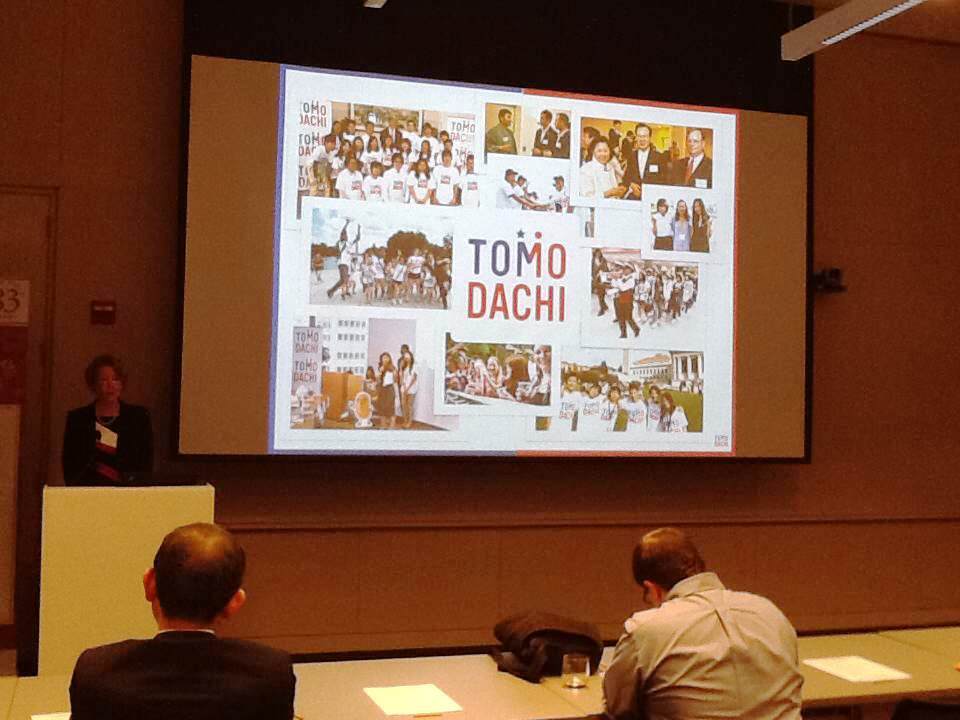
Suzanne Basalla, left, presents The TOMODACHI Generation: Investing in the NEXT Generation of U.S – Japan Relations, Chicago, Oct. 11, 2013. (Sheila Burt)
By Sheila Burt (Toyama-ken, 2010-12) for JQ magazine. As part of an occasional series, Sheila is profiling individuals who are or were in some way involved with rebuilding efforts in the Tohoku region. Her first post was on the writing project 3,000 Letters to Japan. After JET, Burt spent an additional year in Japan working at a private school and translation company. She recently returned to the Chicago area. Read more of her reporting at her blog, Stories from the Inaka.
Having been posted in Tokyo during the disastrous March 11 earthquake and tsunami of 2011, diplomat Suzanne Basalla saw firsthand how quickly Japan changed in a matter of seconds.
As senior advisor to former Ambassador John V. Roos in the Embassy of the United States in Tokyo, Basalla had been living in Japan since March 2010, advising Roos on several economic and foreign policy matters. A few months after 3/11, Basalla visited Tohoku and started thinking of ways to encourage redevelopment in the stricken area, “trying to do what we [could] to create hope and support,” she recalled. Although her post with the embassy ended in March 2012, she realized she wasn’t ready to go back to the Pentagon.
Instead, Basalla and a team of others pooled their efforts to create the TOMODACHI Initiative, a public-private partnership established in the wake of 3/11 with the U.S.-Japan Council in Washington. TOMODACHI helps coordinate educational, business and cultural exchange programs for Japanese youth, particularly students in Tohoku, where development opportunities are still few and far between. Presenting at a Japan American Society of Chicago event last October, Basalla referred to TOMODACHI as “an incredibly important initiative…with a path-breaking paradigm.”
“Part of leadership is getting to know yourself,” said Basalla, who now serves as executive vice president of the U.S.-Japan Council. “TOMODACHI’s initiative is to inspire and empower young Japanese and Americans by giving them experience, skills and confidence to achieve their dreams and contribute to a better world.”
