




Justin’s Japan: ‘You Look Yummy!’
 Article/Journalism, Books, Justin's Japan, Reviews
  Comments Off on Justin’s Japan: ‘You Look Yummy!’
Click image to read story
By JQ magazine editor Justin Tedaldi (CIR Kobe-shi, 2001-02) for Shukan NY Seikatsu. Visit his Examiner.com Japanese culture page here for related stories.
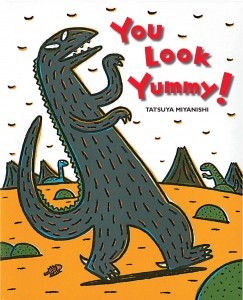
For parents of little ones not quite ready for Jurassic World comes You Look Yummy!, a children’s book by Tatsuya Miyanishi and newly published in English by Museyon.
The story of a fearsome Tyrannosaurus (the star of 11 other bestselling titles written by the author) and the baby Ankylosaurus he grows attached to (the tot believes his “daddy” names him “Yummy” after he’s hatched), You Look Yummy!, teaches valuable lessons about the bonds between a parent and child, and how those bonds can remain strong despite mistaken identity.
Museyon
As “father” and “son” grow close, the Ankylosaurus mimics the T-Rex in ramming mountains, cutting down trees and roaring (complete with his own muted sound effects). When the day comes for them to part, readers will be touched by what unfolds.
Children will be instantly attracted to Miyanishi’s illustrations. Throughout its pages, there are artistic touches like a white sky, coloring outside the edges to make the images pop, and hash marks for the dinos that serve as texture 101. Especially effective are scenes of a night sky jam-packed with stars and dotted with some exaggeratedly large ones (think Christmas tree). The result is something that feels like it could have been drawn by a child, but is secretly the work of a seasoned artist—after all, the Tyrannosaurus is a dead ringer for Godzilla.
For more information, visit www.museyon.com.
JQ Magazine: Manga Review — ‘Showa 1953-1989: A History of Japan’
Article/Journalism, Books, JQ Magazine, Reviews Comments Off on JQ Magazine: Manga Review — ‘Showa 1953-1989: A History of Japan’

“Shigeru Mizuki has led a full life of hardship and wonder. At the time of this book’s publication, he is 93 and still bringing laughter to many through his enormous body of award-winning work, which is thankfully becoming more available in English.” (Drawn and Quarterly)
By Julio Perez Jr. (Kyoto-shi, 2011-13) for JQ magazine. A bibliophile, writer, translator, and graduate from Columbia University, Julio currently keeps the lights on by working at JTB USA while writing freelance in New York. Follow his enthusiasm for Japan, literature, and comic books on his blog and Twitter @brittlejules.
Showa 1953-1989: A History of Japan is the fourth and final volume of the English translation of Shigeru Mizuki’s manga history of the Showa period. Translated for the first time into English by JET alum (and JQ interviewee) Zack Davisson (Nara-ken, 2001-04; Osaka-shi, 2004-06), the release of this book marks the end of a long journey for us readers. Mizuki took great pains to detail significant events of the Showa period and Japan’s role in World War II in order to preserve a comprehensive look at the time from the perspective of someone who had lived it. He intended this manga history to be a gift for all the generations born in a time of peace. As a reader born in the first year of the Heisei period, I was not even alive for any single event I read about, but nevertheless was moved by the power of Mizuki’s personal and historical storytelling and art to think about world history in new ways. The best part of reading something by Mizuki is you’re in for plenty of laughs along the way as well.
As a refresher for those of you who have been with us from the start, and an intro for those just tuning in, the first volume of this illustrated history of the Showa period in Japan covered the years 1926-1939 and highlighted a modernizing Japan and Mizuki as a child fascinated by spirits called yokai, and almost as importantly, a child obsessed with food. The book chronicled a number of incidents in Japan and Asia that took Japan down the road to World War II that come to a head in the second book which featured the years 1939-1944. This volume devotes itself to capturing the massive scale and harrowing death tolls of air-, sea-, and land-based conflicts in the war, and as time passes Mizuki’s own autobiographical narrative weaves in as he serves in the army. The third volume covers 1944-1953 and sees the darkest parts of Japanese history in World War II, and Mizuki’s own experiences are spotlighted, but it is not without the hope and admiration for humanity inspired from Mizuki’s encounter with the natives of Rabaul. This book also covers the Allied occupation of Japan and the beginning of what historians call “Postwar Japan” in which Mizuki starts down the path that will lead him to manga success and Japan becomes a booming economic power.
Interestingly, the last volume covers 1953-1989, which is 36 years of history and among the other volumes is the one that tackles the longest period of time. It’s also the most varied in its content. The same historical approach to events from a variety of perspectives narrated by either Nezumi Otoko or Mizuki himself persists through this volume, but as TV, movies, and popular culture take on an increasingly larger significance in society, so do strange events take on a more significant coloring in history. Mizuki devotes many pages to portraying abnormal events both comical and criminal that preoccupy the public mind by way of showing how times have changed since before the war. For this reason, the fourth volume at times can sometimes feel like a series of short historical episodes told in manga form, but of course presented in a chronological and unified way.
Justin’s Japan: ‘Ghost in the Shell’ returns, ‘Allegiance,’ Jake Shimabukuro
Article/Journalism, Events, Film, Justin's Japan, Music Comments Off on Justin’s Japan: ‘Ghost in the Shell’ returns, ‘Allegiance,’ Jake Shimabukuro

“Allegiance,” a new Broadway musical starring Tony Award winner Lea Salonga (left) and George Takei (second from right) premieres at the Longacre Theatre Nov. 8. (Henry DiRocco)
By JQ magazine editor Justin Tedaldi (CIR Kobe-shi, 2001-02) for Examiner.com. Visit his Japanese culture page here for related stories.
From Broadway to anime to J-pop, November is just as colorful as the leaves gliding through the air. Add to that a cutting-edge Noh-inspired stage spectacle, a classical collegium performance and the return of the undisputed ukulele master, and you’ve got an irresistibly epic rundown.
This month’s highlights include:
Oct. 31-Nov. 1, 12:00 p.m.
We Are Perfume: World Tour 3rd Document
Anthology Film Archives, 32 Second Avenue
$18
This new documentary follows the veteran all-girl pop trio on a two-month international live tour (which made a stop at New York’s Hammerstein Ballroom last November). While traveling around the globe to cities across Asia, Europe, and the United States, audiences will see Perfume’s powerful live performances and catch never before seen behind-the-scenes footage. Witness the group’s single-minded approach to their performances – the joy, anguish, and struggles, not only in the music, but also in fashion and pop culture.
Nov. 2 & 8
Village East Cinema, 181-189 Second Avenue
$14
From the creative team behind Anohana, The Anthem of the Heart tells the story of Jun, once a happy young lady with a tenacious personality. Jun has torn her family apart by saying something hurtful, and her ability to speak has been sealed away by the Egg Fairy in order to stop her from hurting others. Now, Jun lives in the shadows and avoids the limelight. But when she is nominated to become the executive member of the Community Outreach Council and appointed as the main lead in the council’s musical, Jun will have to find her voice and the wisdom to temper her words. Presented in Japanese with English subtitles.
Nov. 3, 5-8
BAM Harvey Theater, 651 Fulton Street (Brooklyn)
$25-$70
An angel’s garment, possessed of mysterious powers, falls to a remote island on Earth, where it is found by a poor fisherman. To get it back, the angel offers up her greatest celestial gift: a dance of incomparable beauty. Dance icons and former New York City Ballet principals Wendy Whelan and Jock Soto, contralto Katalin Károlyi and tenor Peter Tantsits, and puppets by Chris Green come together in this inspired reimagining of a Japanese Noh theater classic. With choreography by David Neumann, costumes by Belgian fashion icon Dries Van Noten, and an original score by Nathan Davis—performed live by the International Contemporary Ensemble and Brooklyn Youth Chorus—Hagoromo merges genres to send a stranded spirit back to heaven.
For the complete story, click here.
Justin’s Japan: LuckyRice New York Slurpfest Serves up Ramen Heaven on Earth
Events, Food & Drink, Justin's Japan Comments Off on Justin’s Japan: LuckyRice New York Slurpfest Serves up Ramen Heaven on Earth

Gator Shio Ramen from Crane Ramen of Gainesville, presented at LuckyRice New York Slurpfest 2015. (Justin Tedaldi)
By JQ magazine editor Justin Tedaldi (CIR Kobe-shi, 2001-02) for Examiner.com. Visit his Japanese culture page here for related stories.
Imagine a place where a variety of regional ramen from around the world is served all in one night. Enter New York Slurpfest 2015, which was held Oct. 22 at Astor Center in Manhattan, featuring dishes from places as diverse as Florida, Fukuoka, Hawaii and Rhode Island—a ramen lover’s dream event.
Slurpfest, which is organized by New York-based Asian culinary event producers LuckyRice, was first held in 2013 and is expected to continue from the looks of last week’s participants, all slurping ramen with smiling faces.
“LuckyRice was founded seven years ago to bring awareness to [Asian] culture, and food is the most universal medium,” said LuckyRice founder Danielle Chang, who rhapsodized about ramen with guests throughout the evening.
“This simple staple has become this glorified chef cuisine,” she added, noting that the amount of ramen restaurants in Japan alone outnumbers every McDonald’s location on the planet.
My evening began with an intriguing dish originating from Crane Ramen in Gainesville called Gator Shio Ramen, which was made with a surprisingly refreshing salt broth topped with corn, greens, quail egg, and alligator tail chashu.
For the complete story, click here.

“Here Comes the Sun conveys how with persistence, perseverance and patience, seemingly impossible hurdles in Japan can be overcome.” (Stone Bridge Press)
By Rashaad Jorden (Yamagata-ken, 2008-10) for JQ magazine. A former head of the JETAA Philadelphia Sub-Chapter, Rashaad is a graduate of Leeds Beckett University with a master’s degree in responsible tourism management. For more on his life abroad and enthusiasm for taiko drumming, visit his blog at www.gettingpounded.wordpress.com.
“Sometimes, you have to travel a very great distance to find a home within yourself.”
That saying could certainly describe the journey of Leza Lowitz, a Californian who has worked extensively in Japan. She chronicles her path through several eventful periods—such as adolescence during the tumultuous early 1970s, her romance with a Japanese man named Shogo (whom she eventually weds), and her attempts to adopt in Japan in Here Comes the Sun: A Journey to Adoption in 8 Chakras, an autobiographical story that captures the ups and downs of Lowitz’s efforts to carve a niche in Japanese society.
As indicated by the subtitle of the book, Lowitz utilizes the influence of another culture to best integrate herself into Japanese society. But first, you might be asking… what’s a chakra? Derived from the Sanskrit root car (“to move”), a chakra represents a major wheel of energy in the human body, and each chakra contains a particular function. Chakras regulate, distribute and balance the energy and nerve functions of their locations.
Lowitz calls the chapters in Here Comes the Sun “chakras” and each one contains a certain theme. For example, the first chapter in the book is titled Muladhara, derived from the Sanskrit word for “root” or “support.” Some chapters in Here Comes the Sun deal directly with the yoga practices that balance a chakra—Lowitz tells us when the aforementioned primary chakra is balanced, you’ll feel stable and secure while being in a better position to succeed.
Justin’s Japan: ‘Naruto’ takes Comic Con, ‘Legend of Zelda,’ L’Arc~en~Ciel
Article/Journalism, Celebrity, Events, Film, Justin's Japan, Music Comments Off on Justin’s Japan: ‘Naruto’ takes Comic Con, ‘Legend of Zelda,’ L’Arc~en~Ciel

Naruto creator Masashi Kishimoto makes his first-ever appearances outside of Japan in New York Oct. 7-10. (Courtesy of ForeverWorld)
By JQ magazine editor Justin Tedaldi (CIR Kobe-shi, 2001-02) for Examiner.com. Visit his Japanese culture page here for related stories.
The Japan-centric events of the month ahead promise to be as rich and full as autumn itself—brisk and colorful, with a dash of unpredictability.
This month’s highlights include:
Oct. 8-11
Jacob K. Javits Convention Center, 655 West 34th Street
Limited tickets available
The East Coast’s biggest gathering for fans of comics, film, anime and manga, New York Comic Con returns with its biggest roster of Hollywood talent to date, including the first-ever appearance outside of Japan of Naruto creator Masashi Kishimoto, on hand for an exclusive Q&A panel (Oct. 8, 5:30 p.m.) as well as the North American theatrical debut (Oct. 10, 11:30 a.m. at Hammerstein Ballroom) of Boruto: Naruto the Movie! In addition, Kishimoto will also make live appearances at Apple Store SoHo (Oct. 7, 7:00 p.m.), Kinokuniya Book Store (Oct. 9, 8:30 p.m.) and Barnes and Noble Tribeca (Oct. 10, 3:30 p.m.). Don’t miss this chance to meet one of Japan’s most popular contemporary manga artists!
Oct. 9-Jan. 10
For a New World to Come: Experiments in Japanese Art and Photography, 1968-1979 Japan Society Gallery, 333 East 47th Street
$12 students and seniors, $10, Japan Society members. Free on Friday nights, 6:00-9:00 p.m.
In the wake of the social and political upheaval of the late 1960s, Japanese artists and photographers began crafting a new visual language for an age of uncertainty. Their embrace of camera-based experiments would alter the cultural landscape and lay the foundations for contemporary art in Japan. For a New World to Come is the first comprehensive exhibition to spotlight this radical break with the past. With some 200 works by such luminaries as Ishiuchi Miyako, Daidō Moriyama, Jirō Takamatsu, and Shōmei Tōmatsu, the exhibition charts the stunning diversity of photographic practices during this pivotal era, from conceptual series situated squarely within global artistic currents, to visually arresting meditations on time, place, and self.
Oct. 10, 12, 13, 17, 19, 21
Village East Cinema, 181-189 2nd Ave.
$15
See the next generation of Naruto on the big screen! With Naruto as the Seventh Hokage, Hidden Leaf Village is planning to host the Chunin Exams to train new shinobi. Among the entrants are Sasuke’s daughter, Sarada, who adores Naruto, Mitsuki, an exceptionally talented yet mysterious shinobi, and Boruto, Naruto’s son who shows great potential, but despises his father. Sasuke, who’s been on a mission in another dimension, appears before Naruto to warn of a strange impending danger he has sensed. An inconceivable foe lies in wait as Sasuke, the Five Kage, and Boruto charge into another dimension!Presented in Japanese with English subtitles.
For the complete story, click here.
JQ Magazine: Book Review — ‘Kendo: Culture of the Sword’
Books, JQ Magazine, Reviews Comments Off on JQ Magazine: Book Review — ‘Kendo: Culture of the Sword’

“Truly grasping Kendo might feel like learning Japanese—it’s a never-ending journey that feels overwhelming. But with persistence, the content will become easier to understand and quite enjoyable.” (University of California Press)
By Rashaad Jorden (Yamagata-ken, 2008-10) for JQ magazine. A former head of the JETAA Philadelphia Sub-Chapter, Rashaad is a graduate of Leeds Beckett University with a master’s degree in responsible tourism management. For more on his life abroad and enthusiasm for taiko drumming, visit his blog at www.gettingpounded.wordpress.com.
At pep rallies for my school’s sports clubs during my time on JET, I occasionally saw students decked in armor and masks while gripping swords. They were obviously members of the kendo club, but I had no idea what they actually did (other than participate in a martial art I knew nothing about). I was excited to start reading Kendo: Culture of the Sword so I could be properly introduced to the sport.
Written by Alexander C. Bennett, a New Zealander who has served as a professor at Kansai University and the coach of his country’s national kendo team, the book illustrates how kendo has evolved throughout the years from, among other things, a form of military training to a sport in which world championships are conducted every three years. More importantly, Kendo would teach me what happens in the sport.
Indeed, my initial expectations for the book were satisfied early when Bennett explained the “complex” rules and methods of kendo (even before mentioning the rules, he does us a gigantic favor by presenting the various names for Japanese swordmanship throughout the years—kenjutsu was actually the term long used to refer to the martial art). He also shines when he includes images of the sport’s equipment as well as a table detailing how you score a point. Bennett also provides fascinating information about the state of women in kendo: although there are references to women doing kendo that date back to early modern Japan, women only largely started practicing the sport after World War II (girls were traditionally taught naginata or kyūdō instead of kendo). In addition, even though women compete nationally and internationally in championship competitions, very few women hold positions of power in kendo education at a regional or national level.
Nippon in New York: ‘Attack on Titan,’ Taylor Anderson Memorial, Luckyrice Fest
Article/Journalism, Earthquake Tsunami, Events, Film, JETs in the News, Justin's Japan, Music Comments Off on Nippon in New York: ‘Attack on Titan,’ Taylor Anderson Memorial, Luckyrice Fest

The live-action film debut of Attack on Titan premieres at Village East Cinema Sept. 30. (Courtesy of FUNimation)
By JQ magazine editor Justin Tedaldi (CIR Kobe-shi, 2001-02) for Examiner.com. Visit his Japanese culture page here for related stories.
As the summer winds fade into fall colors, the weeks ahead are shaping up with these exciting events, ready to be enjoyed after Labor Day.
This month’s highlights include:
Tuesday, Sept. 8, 6:30 p.m.
Japanese Design Today: Unique, Evolving, Borderless
UL105, University Center, The New School, 63 Fifth Ave.
Free (click here to register)
Japanese design has been proven capable of transcending language barriers and fostering communication and understanding between cultures, enthusiastically embracing elements of other cultures while developing and retaining its own unique sense of design aesthetic, which today is recognized and appreciated throughout the world. But as Japanese society has transformed socially, geopolitically, and economically, so has Japanese design transformed to accommodate these changes which has given way to a new era. Hiroshi Kashiwagi, professor at Musashino Art University, and architect/ furniture designer Yoshifumi Nakamura will each discuss the evolution, distinguishing characteristics, and current state of Japanese design today. A Q&A session will follow the presentations.
Friday, Sept. 11, 7:00 p.m.
The Concert Hall — New York Society for Ethical Culture, 2 West 64th Street
$20
Celebrating its eighth annual concert, this year Circle Wind will give tribute to Taylor Anderson, an American victim of the the Great East Japan Earthquake/Tsunami on March 11, 2011. Anderson was dispatched to Ishinomaki under The Japan Exchange and Teaching (JET) Program in 2008 and was teaching English to schoolchildren there. The newly formed “Never Give Up Taylor’s Choir” from the Ishinomaki/Higashi-Matsushima area will perform an original piece symbolizing their appreciation for the American people’s support to recover from the devastation in 2011. Maestro Gregory Singer and his Manhattan Symphonie Orchestra also returns to perform some tribute songs for Taylor together with koto soloist Masayo Ishigure and other prominent artists. Hosted by New York’s choral harmony group Tomo.
Saturday, Sept. 12
Double feature: Live Your Dream and Dream Beyond 400 Years
Nippon Club of New York, Rose Room, 145 West 57th Street
$10 per film (at 5:00 p.m. and 6:45 p.m.)
Live Your Dream is a story about the courage and sacrifice of Taylor Anderson and for all the young people who travel the world trying to make a difference. Taylor was an extraordinary American who on the JET Program dedicated herself to teaching Japanese children, living her dream right up to the disaster of March 11, 2011. In the New York premiere of Dream Beyond 400 Years, local choir Tomo took a journey to Coria Del Rio in Spain, representing a journey going beyond 400 years. In this town, they met “Japón-san,” the descendants of Japanese travelers to Spain 400 years ago. The members of Tomo and Japón-san form a lifelong friendship in this touching real-life story. An after-screening reception featuring Circle Wind Concert participants and members of Taylor Anderson’s family will be held at 7:30 p.m. ($40).
For the complete story, click here.
Justin’s Japan: ‘Attack on Titan’ Storms U.S. Theaters
Article/Journalism, Events, Film, Justin's Japan Comments Off on Justin’s Japan: ‘Attack on Titan’ Storms U.S. Theaters
Click image to read story
By JQ magazine editor Justin Tedaldi (CIR Kobe-shi, 2001-02) for Shukan NY Seikatsu. Visit his Examiner.com Japanese culture page here for related stories.
Attack on Titan is the upcoming live-action feature film from Studio Toho and director Shinji Higuchi, which will be released in two parts in the U.S. by FUNimation Entertainment this fall. Part One hits select theaters for three days beginning Sept. 30, with Part Two following Oct. 20.
Originally created by manga artist Hajime Isayama in 2009 and currently published by Kodansha Comics in the U.S., Attack on Titan has over 50 million copies in print, as well a 25-episode anime series, also produced by FUNimation for American audiences. The series is so popular that a special Titan-themed attraction opened at Universal Studios Japan earlier this year.
The film’s official U.S. release comes swiftly after Part One’s world premiere at the Egyptian Theater in Los Angeles on July 14 and its Japanese release on Aug. 1. Written by Yusuke Watanabe, the films star Haruma Miura and Kiko Mizuhara as two young soldiers living in a deadly post-apocalyptic land where humans fight man-eating Titans for their very survival.
“FUNimation is honored to host the world premiere of Attack on Titan here in the United States with Toho,” said FUNimation president and CEO Gen Fukunaga in a press release. “Attack on Titan is truly a worldwide phenomenon and we are excited to bring the live-action movie to theaters.”
For more information, visit http://attackontitanthemovie.com.
JQ Magazine: Book Review — ‘Yurei: The Japanese Ghost’
Books, JQ Magazine, Reviews Comments Off on JQ Magazine: Book Review — ‘Yurei: The Japanese Ghost’

“If you like reading about mythology and supernatural horror around the world, or if you enjoy Japan’s unique brand of horror from such films as The Ring and The Grudge, then Yurei: The Japanese Ghost is a must-read.” (Chin Music Press)
By Julio Perez Jr. (Kyoto-shi, 2011-13) for JQ magazine. A bibliophile, writer, translator, and graduate from Columbia University, Julio is currently working at JTB’s New Jersey office while seeking opportunities with publications in New York. Follow his enthusiasm for Japan, literature, and board gaming on his blog and Twitter @brittlejules.
Do not read this review.
If you are foolish enough to read this review to the end…after seven days, you will be followed by a lingering spirit which will slowly, but unrelentingly, press more and more of its weight upon your shoulders. The weight will build to an unbearable breaking point, leaving you weak and overwhelmed by the scent of rotting flesh, driving your mind to unknowable depths of madness and despair. You can avoid this terrible fate by sharing this book review via the social media outlet of your choice or by purchasing Yurei: the Japanese Ghost, a new and excellent nonfiction effort by JET alum Zack Davisson (Nara-ken, 2001-04; Osaka-shi, 2004-06).
No doubt you’ve seen or heard of such films as The Ring and The Grudge, which have served as ambassadors of Japan’s very rich ghost culture (not to mention Halloween staples), but it is likely that there are aspects of these Japanese movies that you may have not been able to appreciate on some level. This book’s purpose is to fill in those gaps and fascinate you with an expertly catalogued evolution of ghost stories in Japan, and how pervasive they remain in pop culture to this day.
What exactly is a yūrei and why is it different from a Western ghost? What’s with the white face and long black hair? Why water? What drives the yūrei to do what it does? These questions and more are answered in this book. In the author’s words, “The goal of this book: to provide this understanding, to allow a clearer insight not only into the popular products of Japan but also the history and culture from which they sprang.” Yurei: The Japanese Ghost is a guided tour of the yūrei, from their appearance, to the rules they obey, to the traditions behind these characteristics. Davisson achieves this goal through the use of highly enjoyable primary choices and sharing the fruits of much academic research.
JQ Magazine: Book Review — ‘Mashi’
Article/Journalism, Books, JQ Magazine, Reviews Comments Off on JQ Magazine: Book Review — ‘Mashi’

“JETs reading Mashi will relate to the story because just as many of us had support systems of friendly faces outside of the workplace, Murakami was fortunate that members of the Japanese American community in both Fresno and San Francisco provided a helping hand when he needed it.” (University of Nebraska Press)
By Rashaad Jorden (Yamagata-ken, 2008-10) for JQ magazine. A former head of the JETAA Philadelphia Sub-Chapter, Rashaad is a graduate of Leeds Beckett University with a master’s degree in responsible tourism management. For more on his life abroad and enthusiasm for taiko drumming, visit his blog at www.gettingpounded.wordpress.com.
During your JET experience, you probably heard about Japanese baseball icons such as Ichiro, Daisuke Matsuzaka, Hideki Matsui and Yu Darvish excelling in Major League Baseball. However, well before all of them were instilling pride in their countrymen through their feats on American diamonds, one southpaw from rural Yamanashi Prefecture was setting the big leagues on fire.
Baseball historian Robert K. Fitts introduces fans of the sport to Masanori Murakami in Mashi: The Unfulfilled Baseball Dreams of Masanori Murakami, the First Japanese Major Leaguer. The biography documents how Murakami went from a run-of-the mill relief pitcher for the Nankai Hawks to a major contributor to the San Francisco Giants in the mid-1960s that nearly punched a ticket to the World Series—all while being the subject of a fierce tug-of-war between the two organizations.
Piercing together information he obtained from interviews with Murakami, the pitcher’s close friends and experts on Japanese baseball, Kitts explores Murakami’s improbable journey to baseball stardom. Murakami was actually uninterested in baseball as a child and when he did develop a deep love for the sport, his father Kiyoshi objected to his son’s new passion. But Kiyoshi relented when he realized his son could earn a scholarship to an elite Tokyo-area high school.
Despite being a high school starter, a pro career was really not on the cards for Murakami, as his main focus was on attending college (and possibly pitching at that level). However, his success at Hosei II High School made him an attractive pro prospect and representatives from several NPB (Nippon Professional Baseball) teams offered him contracts. One of those teams was the Nankai Hawks, and they offered him something more than solely the opportunity to make a lot of money: the possibility of going to the United States to improve his craft, an idea that intrigued him.
Justin’s Japan: Nippon in New York—‘Dragon Ball Z,’ Liberty City Anime Con, Waku Waku NYC
Article/Journalism, Events, Film, Justin's Japan, Music Comments Off on Justin’s Japan: Nippon in New York—‘Dragon Ball Z,’ Liberty City Anime Con, Waku Waku NYC

Dragon Ball Z: Resurrection ‘F’ premieres the week of Aug. 3 at three Manhattan-area locations. (FUNimation)
By JQ magazine editor Justin Tedaldi (CIR Kobe-shi, 2001-02) for Examiner.com. Visit his Japanese culture page here for related stories.
In the dog days of summer, it’s best to escape the heat in a place that’s cozy and cool. For those into Japanese cultural events, this month offers a diverse selection of film premieres and live music—all in the comfort of indoor air conditioning.
This month’s highlights include:
Aug. 4, 5, 7, 8 & 11
Dragon Ball Z: Resurrection ‘F’
AMC Empire 25, 234 West 42nd Street
Chelsea Cinemas, 260 West 23rd Street
Village East Cinema 7, 181-189 2nd Avenue
$15
Hot on the heels of last year’s summer blockbuster, Battle of Gods, Resurrection ‘F’ is the second film personally supervised byDBZ creator himself, Akira Toriyama. The new movie showcases the return of Frieza, the galaxy’s most evil overlord. After years in spiritual purgatory, Frieza has been resurrected and plans to take his revenge on the Z-Fighters of Earth. Facing off against Frieza’s powerful new form and his army of 1,000 soldiers, Goku and Vegeta must reach new levels of strength in order to protect Earth from their vengeful nemesis. English dub version.
Friday, Aug. 28, 6:00 p.m.
Always: Sunset on Third Street 3
Japan Information Center Gallery, Consulate General of Japan in New York
299 Park Avenue, 18th floor
Free (email RSVP to kanako_shirasaki[at]jfny.org; photo ID required upon entry)
A special screening of the third film in the wildly popular series! In 1964, novelist Ryunosuke Chagawa (Hidetaka Yoshioka) has married Hiromi (Koyuki), and the two now share a happy life with Junnosuke (Kenta Suga), the young boy he had taken in during the first film, who is now in high school. Hiromi is also pregnant, and the family prepares to welcome a new addition to their household. One day, Hiromi discovers a telegram that Chagawa had hidden. Who sent this telegram? What is the surprising identity of this new, rival writer? And what future awaits the people of Third Street? Presented in Japanese with English subtitles.
Aug. 28-30
Crowne Plaza White Plains, 66 Hale Avenue
$50 for weekend pass
The best three-day anime convention (just north of) New York City, the inaugural Liberty City Anime Con features over 100 events and panels, a dozen guests and entertainers, three days of cosplay, game tournaments and anime screenings, and concerts, balls and dances. Guest performers include idol singer Reni Mimura, female J-pop group Starberry, and New Jersey-based anime, video game and J-pop cover band Moshi Moshi.
For the complete story, click here.
Justin’s Japan: Nippon in New York—JAPAN CUTS, Kishi Bashi, ‘Kafka on the Shore,’ Keiko Matsui
Article/Journalism, Events, Film, Music Comments Off on Justin’s Japan: Nippon in New York—JAPAN CUTS, Kishi Bashi, ‘Kafka on the Shore,’ Keiko Matsui

HIBI ROCK: Puke Afro and the Pop Star kicks off this year’s JAPAN CUTS film festival at Japan Society July 9. (© 2014 HIBI ROCK Film Partners)
By JQ magazine editor Justin Tedaldi (CIR Kobe-shi, 2001-02) for Examiner.com. Visit his Japanese culture page here for related stories.
After you’ve seen the outdoor fireworks, enjoy some summer events in the cool indoors, whether it’s catching one of 28 films premiering at Japan Society’s annual festival, enjoying the new sounds of electronic and jazz veterans, or witnessing an all-new retelling of the work of contemporary Japan’s most influential novelist.
This month’s highlights include:
July 9-19
Japan Society, 333 East 47th Street
$13, $10 Japan Society members, seniors and students (most screenings)
North America’s largest festival of new Japanese film, the ninth annual edition of JAPAN CUTS is proud to present actress Sakura Ando with the CUT ABOVE Award for Outstanding Performance in Film, presenting her latest great performances in two new films for the festival’s Centerpiece Presentation. Shingo Wakagi’s elegant Banana Yoshimoto adaptation Asleep makes its North American premiere, and Masaharu Take’s fantastic slacker-to-boxer pathos-drenched comedy 100 Yen Love is presented in its North American premiere, followed by the PUNCH LOVE Party. The festival’s Closing Film is perhaps one of the most memorable Japanese titles of the decade: Juichiro Yamasaki’s Sanchu Uprising: Voices at Dawn, being shown for the first time outside of Japan. Director Yamasaki appears at the festival to present this remarkable independent period film, which offers a valuable fable for the political consciousness of the contemporary moment.
Monday, July 20, 7:00 p.m.
$40
Having collaborated and toured with of Montreal, Regina Spektor, and now Guster, singer, violinist, and composer K Ishibashi (aka Kishi Bashi) embarks on an epic orchestral solo project. His solo live show is a dazzling array of looping and vocal/violin gymnastics. Bright and soaring avant-pop songs are prevalent, as are Eastern-tinged arrangements, gentle ballads, Philip Glass-inspired improvisations, and more than a few moments that flirt with ‘70s prog (in the tradition of ELO or Yes). Jarringly kaleidoscopic, but it works.
July 21-23
High Line at the Rail Yards, West 30th Street and Eleventh Avenue
Free
Aki Sasamoto presents Food Rental, a new performance for which she will bring a custom-built food cart to the High Line’s newest section. From her perch inside the cart, the artist will offer visitors an à la carte selection of micro performances and playful narrative demonstrations. Like an off-kilter life hacking workshop, Food Rental will continue Sasamoto’s history of performances that engage visitors with sneakily shifting stage sets and unruly props.
For the complete story, click here.
Justin’s Japan: Wismettac Wows at Japanese Food Fest
Article/Journalism, Events, Food & Drink, Justin's Japan Comments Off on Justin’s Japan: Wismettac Wows at Japanese Food Fest
Click image to read story
By JQ magazine editor Justin Tedaldi (CIR Kobe-shi, 2001-02) for Shukan NY Seikatsu. Visit his Examiner.com Japanese culture page here for related stories.
Lovers of Japanese food and drink gathered at 230 Fifth in Midtown Manhattan on June 20 for the Wismettac Asian Foods 2015 NY Premium Sake and Shochu Tasting Event, an annual business-to-business gathering that served up a foodie’s paradise.
Formerly known as Nishimoto Trading Co., Ltd. USA, Wismettac Asian Foods, Inc. was established in Kobe in 1912, and is one of the oldest importers, wholesalers and distributors of Asian food products in North America. It is well known in the U.S. for its Shirakiku brand food products, which include rice, noodles, and seafood.
Now in its eighth year, the event featured around 25 different Japanese sake and shochu companies and 15 different food manufacturers. It’s a place where one can enjoy piping hot savory katsudon curry rice followed by chocolate mochi ice cream with freshly sliced strawberries, finishing with a crisp, refreshing selection of daiginjo sake.
“Participating in this event is a great opportunity, because I can introduce Japanese culture and it’s a great way to introduce how to use Japanese ingredients properly to make a delicious dish,” said Hideko Lilley, a sales associate for Wismettac attending the New York event for her third year.
For more on Wismettac, visit www.ntcltdusa.com.
JQ Magazine: Book Review — ‘Marathon Japan’
Article/Journalism, Books, JQ Magazine, Reviews Comments Off on JQ Magazine: Book Review — ‘Marathon Japan’

“The running boom in Japan shows no signs of slowing. Marathon Japan explains why as it marvelously highlights a growing and evolving sport.” (University of Hawai’i Press)
By Rashaad Jorden (Yamagata-ken, 2008-10) for JQ magazine. A former head of the JETAA Philadelphia Sub-Chapter, Rashaad graduated from Leeds Beckett University with a Master’s degree in Responsible Tourism Management (for more on his life in the U.K., visit his blog at www.gettingpounded.wordpress.com). While in Japan, Rashaad completed the 2010 Tokyo Marathon, ran two half marathons in Yamagata Prefecture, was a part of an ekiden club, and finished fourth in the 2009 Ishidan Marathon (a race up the steps of Mount Haguro).
Hopefully, your JET experience included you busting out your running shoes and joining your prefecture (or village) in a road race. It did for me on several occasions. But if you never got around to working up a sweat over 10 kilometers (or maybe even 21), you might remember your school being enthralled by its annual ekiden, or frequently seeing races televised on Sunday mornings.
So why have such events become an integral part of Japanese sporting culture? Thomas R.H. Havens examines why in Marathon Japan, the first comprehensive English-language book about the history of marathons and ekiden in the country.
Long before Kenya emerged as the world’s elite marathon nation, Japan could make a serious claim to producing the world’s best at 42.195 km. Marathon Japan illustrates the periods when Japanese marathoners dished out most of the world’s fastest times—such as the 1930s (In 1934, nine of the world’s ten fastest times were run by Japanese), the 1960s (1965 alone saw the Japanese record fifteen of the world’s top twenty marathon times), and the 1980s (during which Toshihiko Seko won ten of the fifteen marathons he completed in). And to top it off on the women’s side, in 2004, three Japanese finished among the world’s top eight marathoners.
