




Minamisanriku photo blog
 Earthquake Tsunami
  Comments Off on Minamisanriku photo blog
http://msf.ca/blogs/photos/2011/04/05/japan/
Fundraising event: JETAA Music City to co-host Top Chef Tsunami Relief Sake Dinner – 4/21
Earthquake Tsunami, Events, Food & Drink, Fundraising, JETAA Chapters, Networking Comments Off on Fundraising event: JETAA Music City to co-host Top Chef Tsunami Relief Sake Dinner – 4/21
Via JETAA Music City:
JETAA Music City and the Japan-America Society of Tennessee (JAST) will co-host the Top Chef Tsunami Relief Sake Dinner on Thursday, April 21st at Cha Chah in Nashville, TN. Top Chef DC’s Arnold Myint and Top Chef All Star’s Tiffany Derry will be preparing a 5-course meal with sake pairings with proceeds going to the JETAA USA Fund and the Tennessee Tomodachi Fund. The event will also include a Silent Auction.
We are so excited to share that no more reservations are being taken for the event! We are going to have a packed house on this evening for Japan. If you have additional questions, contact Terry Vo at president@mcjetaa.org.

Foreign correspondents start “No. 1 Shimbun” to cover Tohoku disaster
Article/Journalism, Earthquake Tsunami, Japan Trends Comments Off on Foreign correspondents start “No. 1 Shimbun” to cover Tohoku disaster
Thanks to JET alum Emily Metzgar, Assistant Professor at Indiana University’s School of Journalism, for sharing the link to the new publication No. 1 Shimbun, published by leading foreign correspondents in Japan.
CLICK HERE for the April 2011 Special Issue.
JETAA Hanami Update 04.11.11
Cultural Outreach, JETAA Chapters, Notable JET Alums Comments Off on JETAA Hanami Update 04.11.11
A couple updates from hanami celebrations around the JET alumni community:
- JETAA DC participated in Washington, D.C.’s Cherry Blossom Festival. Click here for NHK written and video coverage, which includes an interview at the end with JETAADC Board Member Sarah Lyons (Kagoshima 2007-2009).
- JETAA Music City President Terry Vo, returned to her home state of Arkansas as a Cherry Blossom Princess for their cherry blossom festival and won Miss Congeniality! More to come on that.
Japan Volunteers
Earthquake Tsunami, Volunteer Comments Off on Japan Volunteers
Via the Japan Earthquake Disaster Relief Idea Exchange Facebook page, which I believe was originally set up by JET alum Emily Duncan:
Here’s a link to a blog/website called Japan Volunteers (japanvolunteers.wordpress.com) that seems to have good info and perspectives on volunteering in various ways in connection with everything going on in Japan. Here’s an excerpt:
Your services are needed
I have put out a call to several disaster relief NGOs I know to see what their needs are. Many groups are asking for volunteers in limited numbers.
I know many of you want to volunteer but money (see donation pages) and daily use items (see the materials page) are still needed. Please do not just get in a car and drive north.
I have recently heard that in some places in Tohoku there are too many people showing up clogging roads and using up limited resourced. We all can do something to help but we do not all need to go up there to make a difference.
I have many emails every day from people who want to do something – people from all over the world who want to come to Japan. I am sorry but you will not find that answer here on this site. Right now is not the time to just hop on a plane and come to help with the relief efforts. When the rebuilding starts 1000s of volunteers will be needed. that should take anywhere from 3 to 10 years.
JETwit goes to London!
Cultural Outreach, Events, JETAA Chapters Comments Off on JETwit goes to London!
 I’ll be visiting London this week (with daughter Helen in tow) Wednesday through the following Tuesday, staying with a good friend I originally met studying at Waseda. And while in London I plan to:
- Attend a talk by Roland Kelts (Osaka-shi, 1998-99), author of Japanamerica, at The Daiwa Anglo-Japanese Foundation in London on Thursday, April 14, 4pm on “Pop culture from a Multipolar Japan.”
- Meet up with JETAA International Chair and former JETAA NY Vice-President Shree Kurlekar who now lives in London as well as JapaneseLondon.com‘s Vanessa Villalobos (who is also a JETAA UK officer).
- Jointhe Japanese Conversation Group’s Hanami Picnicon Saturday, April 16 (which I believe will include a number of JET alums).
If you’d like to meet in person just come to one of the events, or feel free to get in touch at jetwit [at] jetwit.com.
There’s a very thoughtful article titled “This is what public diplomacy looks like“ by JET alum Emily Metzgar, Assistant Professor at Indiana University’s School of Journalism, on the Center for Public Diplomacy blog (which is part of the University of Southern California’s Annenberg School of Communications). (This is the same Emily Metzgar conducting the Survey of American Alumni of the JET Program.)
Here’s an excerpt that captures the gist of the piece, namely that JET is providing Japan with a significant “return on JET-vestment“:
“But in the aftermath of Japan’s devastating earthquake and tsunami, the value of having a large, worldwide network of college-educated foreigners who understand, respect and appreciate Japanese society and culture continues to emerge. A look at a JET alumni networking website, JETwit.com, provides ample evidence of the many ways in which current and former JETs are responding in whatever ways they can to the disaster hitting a country that all of them, at one time or another, have called home.”
CLICK HERE to read the full article.
AJET Cares: Care packages for JETs in affected areas
Earthquake Tsunami, Fundraising, Local Government, Volunteer Comments Off on AJET Cares: Care packages for JETs in affected areas
Via AJET.net:
AJET is trying to coordinate sending care packages to JETs in areas affected by the earthquake. If you, a group of friends, or your prefectural AJET chapter would like to send a care package to a JET who needs it, please see this form for more information and to sign-up: http://tinyurl.com/3v9o25o.
Questions? Contact us at care@ajet.net. Show another JET that you care~
Here’s the full post from the AJET website:
Dear JET Participants,
As you know, many JETs live in areas that were heavily affected by the earthquake and tsunami. Though relief agencies have been making headway, some regions are still without regular access to power, heat, or supplies. NAJET has provided information on volunteering and donating through some of these organizations, but now we’d like to focus on helping out within our own community, JET to JET.
If you have been looking for a way to get involved, whether as a local AJET chapter, as a group, or as an individual, here is an opportunity to help on a very personal level. We will be putting together a database of request for assistance and offer to help from across the nation. JETs in affected areas will be paired with JETs from areas that are able to provide support. Our hope is that this will strengthen the bonds within our community, while providing personal, timely aid.
We will try to arrange recipients and senders based on the specific requests and information provided by both sides. JETs who are able to send supplies should click on the link at the bottom of the page and fill out the “Application to Send Assistance” form. JETs who live in areas affected by disaster should fill out and submit the “Application to Receive Assistance” form at the corresponding link below. JETs living in affected areas may also include requests for items in need at a specific evacuation shelter.
Once NAJET pairs up applicants and contact is established on both sides, we hope that the support relationship will grow from there, and that JETs will be able to communicate between one another. However, if you need any advice or support, please don’t hesitate to contact us. The list of respondents will be continuously updated, and the more people can help out, the better. We strongly encourage senders to work together with their prefecture’s AJET chapter!
Guidelines for what to include, box size limits, etc. are included on the application forms.
We will be matching up JETs as we get more information, so it may take some time before you have a contact. We ask for your patience, and in the meantime, encourage you to get involved in your local communities by raising money or gathering donations. For a list of ways that you can help out, please browse our website.
Click here to SEND a care package
Click here to REQUEST a care package
For questions, comments, feedback, please contact: care@ajet.net
I was extremely honored (and also surprised) to receive this Certificate of Appreciation from the Council of Local Authorities for International Relations (CLAIR). There are many, many JETs and JET alumni helping out in so many ways both in Japan and from other parts of the world–with volunteering, fundraising, translating, reporting, organizing, communicating, etc. JETwit is simply a reflection of the JET and JET alumni communities, and so appreciation extends to all of you as well. And for those who don’t know, the folks at CLAIR have been working around the clock through all of this to help JETs and families of JETs in myriad ways for which my words do not suffice.
Issho ni isshokenmei ganbarimasu.

Japan Times article on evolving needs of Tohoku residents
Earthquake Tsunami, Fundraising Comments Off on Japan Times article on evolving needs of Tohoku residents
Relief workers must adjust quickly
Individuals, groups face challenge identifying constantly changing needs of survivors
http://search.japantimes.co.jp/cgi-bin/nn20110406f1.html
Something to keep in mind as everyone tries to think about the best places to donate. Basically, it’s a moving target to some extent.
7.4 earthquake off the coast of Miyagi
Earthquake Tsunami Comments Off on 7.4 earthquake off the coast of Miyagi
7.4 earthquake off the coast of Miyagi just now. Tsunami warning for wave of 1 meter.
From KMOV.com in St Louis (via Associated Press):
TOKYO (AP) — Japan’s northeastern coast has been rattled by a strong aftershock. The Japan meteorological agency has issued a tsunami warning for a wave of up to one meter. The warning was issued for a coastal area already ravaged by last month’s tsunami.
Officials say the quake was a 7.4-magnitude and hit 25 miles (40 kilometers) under the water and off the coast of Miyagi prefecture. The quake that preceded last month’s tsunami was a 9.0-magnitude.
Buildings as far away as Tokyo shook for about a minute.
(Copyright 2011 by The Associated Press. All Rights Reserved.)
*************
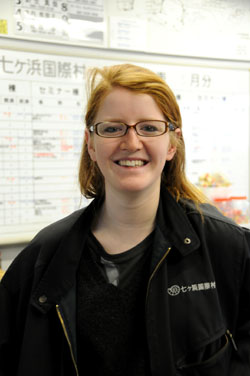
Here’s an April 7 Japan Times article about Marti McElreath (CIR Miyagi-ken, Shichigahama-shi).
JET post best, not ‘pityfest’
American helps, refuses to leave beloved, battered beach locale
Thursday, April 7, 2011
SHICHIGAHAMA, Miyagi Pref. — There is a picture folder in Marti McElreath’s Facebook account that chronicles her time in Shichigahama, a town located on a small peninsula in Miyagi Prefecture less than an hour’s drive from Sendai and where she has been working since last summer under the Japan Exchange and Teaching Program.
Her comment on the folder reads: “I have the best JET placement in Japan,” a view McElreath hasn’t changed despite the massive earthquake and tsunami that brutally transformed the once peaceful beach community she has come to love.
“I mean, it’s heartbreaking and hard to see what happened, but people are laughing and kids are playing and life is going on. Even after all that’s happened, I still believe it, I believe that I have the best JET placement in Japan,” she said.
While radiation fears from the Fukushima No. 1 nuclear power plant have led many foreigners in the region to flee, McElreath, who said the town lies on the cusp of the 80-km evacuation zone recommended by the U.S. government, has remained firm in her conviction to stay and do what she can to help the community.
“I’ve only been here for seven or eight months, but I really do love Shichigahama. The people here have been really amazing to me, and they’ve done so much to help me — I couldn’t imagine just leaving,” said McElreath, 23, from Westborough, Mass.
The earthquake and tsunami that hit the small town of 20,000 claimed 56 lives, and 18 people remain missing. Nearly 1,000 people were still living in the town’s six evacuation centers as of Tuesday, and many houses in the coastal area were swept away or damaged.
The facility McElreath works for, Kokusaimura, or International Village, is being used as a temporary shelter, providing food and a place to sleep for around 300 people, and McElreath spends her days helping out evacuees as the only foreigner among the staff.
According to the International Affairs Division of the Miyagi Prefectural Government, out of the 70 JETs in Miyagi — excluding those in Sendai — 36 have either returned to their homeland or evacuated from the prefecture following the earthquake and subsequent nuclear disaster.
A municipal representative from Sendai said out of the 70 JET assistant-language teachers working in the city, 50 remained, and the rest planned to return before schools reopen Monday.
When the magnitude 9.0 earthquake hit at 2:46 p.m. on March 11, McElreath was at her office at Kokusaimura, going about her usual business.
As a coordinator for international relations, McElreath, fluent in Japanese after studying as an exchange student in Kobe during high school and then at Tohoku University during her senior year in college, was responsible for organizing various community events the facility hosted, as well as giving English-language and culture classes to local residents.
Without warning, the earthquake cut off the lifelines at the facility, and while sirens blared out tsunami warnings, people began evacuating to Kokusaimura, which sits on a hill.
McElreath said no one at the facility at that point was aware of the scale of the tsunami that was about to crash into the peninsula. By the time emergency electric generators were able to re-connect television sets, evacuees were confronted with horrific images of the disaster.
“I think it was around that point that we realized that we were going to be here for a while,” she recalled.
Then at around 6 or 7 p.m. a huge explosion shook the facility and its residents as the JX Nippon Oil & Energy Corp.’s Sendai oil refinery, located a few kilometers from Shichigahama, went up in flames.
“The entire sky went red, and everyone gathered around the windows and looked outside and it was, like, an inferno,” McElreath said, adding the smoke from the refinery lasted two or three days.
While McElreath was able to notify a prefectural adviser of the JET program of her safety immediately after the earthquake, cell phone reception quickly died.
It was not until the third day after the earthquake that she rode her bicycle 6 or 7 km toward Sendai and her cell phone finally re-connected, allowing her to contact family and friends to let them know she was safe.
McElreath said that as the Fukushima nuclear disaster unfolded, many foreigners she knew in the region, including non-JETs and those from other nations, were contacted by their respective embassies and advised to evacuate.
“There are noticeably less foreigners, there is almost no one left that you can tell by just walking around,” McElreath said, adding she did not feel threatened by the radioactivity leaking in Fukushima.
“I decided that I would rather stay here as long as possible and keep on monitoring the situation,” she said, adding that while her parents are concerned for her safety, they understand her desire to remain and help the community.
While electricity returned about a week after the earthquake, and propane could be used, water remained undrinkable and was only restored Tuesday in some areas of town. McElreath said that while Kokusaimura was well stocked with food and drinking water, evacuees missed taking baths.
Meanwhile, McElreath said Plymouth, Mass., Shichigahama’s sister city, has been making fundraising efforts, already gathering $80,000 to be used in the town’s rebuilding. Teams from as far afield as Turkey have arrived on search and rescue missions, and various volunteers, including many celebrities, make the rounds to Kokusaimura to drop off goods and cheer up the evacuees.
McElreath has recontracted with JET until July 2012, and she is determined to stay and work — if the situation allows her to — for the entire duration.
“I’d like to let everyone know that the people here are positive and we don’t want this to become a pityfest.
“We are doing our best.”
Toronto Fukushima JET alum fundraising
Blogs, Earthquake Tsunami, Events, Fundraising, JETAA Chapters, Writers Comments Off on Toronto Fukushima JET alum fundraising
Just noticed on Brent Stirling’s (Fukushima) blog ForYourBrentertainment an item about some Toronto JET alums (Jason Ishida and Eric Chan) who worked in Fukushima who have organized a Japan fundraising event for this coming Saturday, April 9 at Orville’s Pub as well as an additional fundraiser on Sunday, April 10 at the Toronto Buddhist Church Social Hall.
Asahi article about JETAA NY Fundraiser
Article/Journalism, Earthquake Tsunami, Events, JETAA Chapters, JETs in the News, Return on JET-vestment, Translating/Interpreting Comments Off on Asahi article about JETAA NY Fundraiser
**************
Thanks to Kyushu-based professional translator Joel Dechant for alerting JEtwit to this article in Japanese on Asahi.com about Tuesday night’s JETAA NY Japan Fundraiser. My Japanese reading ability has weakened over the years, but it looks like I’m quoted at the end of the article. I think the other JET alum quoted is Ayelet Fogel (Sendai City, Miyagi-ken) who is in the photo. (And yes, that’s me in the background of the photo wearing my “JETAANY Nihongo wakaru yo!” t-shirt.)
If anyone would like to translate or summarize in English, please post as a comment or e-mail it to jetwit [at] jetwit.com.
English translation below by Lee-Sean Huang, webmaster of JETAANY and JETwit.
〈世界から被災地へ〉第二の故郷「ガンバ!」 元英語教師奔走
2011年4月7日10時25分
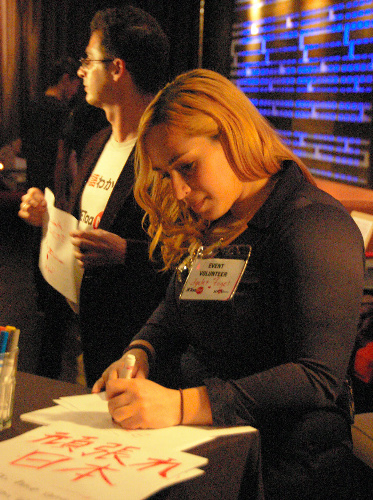 日本の高校や中学に派遣された米国の元英語教師が東日本大震災の被災者支援に奔走している。ニューヨークでは5日夜、義援金集めのパーティーがあり、多くの参加者が「第二の故郷」に思いを寄せた。
ニューヨーク州ロングアイランド出身のアイェレット・フォーゲルさん(31)は「3・11」の当日、仙台市の自宅にいた。家具が崩れ落ち外に飛び出した。
日本政府が英語指導の助手として招くJETプログラムで2003年8月から宮城県に滞在。3年の任期が終わっても宮城に残り、8年間で県内の七つの学校で教えた。現在は仙台育英学園の講師として働く。
最初の2年を過ごした南三陸町や気仙沼市では津波で家を流された友人も少なくない。釣りやサーフィンをし、親友と何度も通った美しい海岸は、がれきの山になった。宮城県石巻市では、JETのテイラー・アンダーソンさん(24)が犠牲になった。
仲間が大変なときに宮城を離れたくはなかったが、家族の懇願もあり先月18日に帰国。「米国でも出来ることがあるはず」と、義援金集めに走り回る。4月20日に学校が始まるのに合わせ、仙台に戻る予定だ。
1987年に始まったJETプログラムは、経験者が5万人を超える。
ニューヨークのパーティーには約300人が駆けつけ、約90万円が集まった。90年代に愛知県刈谷市に滞在したスティーブン・ホロウィッツさんによる と、米国各地で同様の動きがある。「私たちはどこにいても心の中では日本人。日本で過ごした日々への恩返しをしたいのです」(ニューヨーク=田中光)
<International responses to the Tohoku Earthquake>
Former English Teachers support their 2nd hometowns
April 12, 2011, 10:25
Former American English teachers who worked in Japanese junior high and high schools are organizing to support the victims of the recent eastern Japan earthquake. There was a fundraiser party in New York on the evening of April 5, where many participants came out in support of their “second hometowns.”
Ayelet Fogel (31 yrs/old), from New York’s Long Island, was at her home in Sendai City on the day of the “3/11” quake. She ran outside to safety as items in her home came crashing down.
Fogel has lived in Miyagi Prefecture since August 2003 when she was invited by the Japanese government to serve as an ALT (Assistant Language Teacher) on the JET Programme. After finishing her 3 year term, she remained in Miyagi and taught for 8 years at 7 schools in the prefecture. She is currently employed as an instructor at the Sendai Ikuei Gakuen.
In Minamisanriku Village and Kesennuma City, where Fogel spent her first 2 years in Japan, she has many friends whose houses were washed away by the tsunami. The beautiful coastline where she went fishing and surfing many times in the past with her friends has been turned into a mountain of rubble. JET participant Taylor Anderson, who was based in Miyagi Prefecture’s Ishinomaki City, died in the disaster.
Fogel did not want to leave her friends in Miyagi in a time of distress, but upon the request of her family, she returned to the US on March 18th. “I should be able to do something to help from the US as well,” she thought, and so began to collect donations for the disaster relief effort. She plans to return to Sendai in time for the beginning of the new school year on April 20th.
Founded in 1987, the JET Programme now has over 50,000 alumni.
The fundraiser party in New York attracted about 300 guests and raised over 10,000 dollars (~90,000 yen). According to Steven Horowitz, who lived in Aichi Prefecture’s Kariya City in the 1990s, similar fundraising events are taking place across the United States. “Wherever we are, we are all Japanese in our hearts. We want to do something to give back for the time we spent in Japan,” Horowitz said.
Tanaka Akira, New York
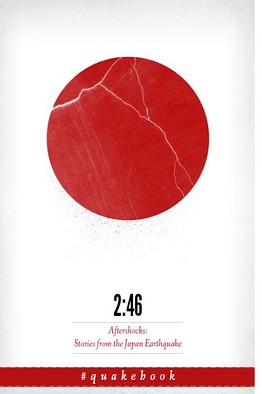 Fukushima City JET Brent Stirling recently put out word to JETAA chapters about Quakebook, “a book of stories, art and photographs that reflected first person accounts of the disaster” which will soon be available on Amazon.com with all proceeds going to benefit the Japan Red Cross. Brent contributed his own story and has also offered to help with marketing and spreading the word. Below Brent provides some insight into the unique process that led to the creation of of the project as well as his own involvement.
I lived in Fukushima City from August 2006 to August 2010 and worked as an ALT there. The recent earthquake, tsunami and nuclear crisis in Tohoku has had me glued to my computer since it began, as has probably been the case with all JET Alumni. Keeping in contact with my friends in Fukushima-ken through Facebook and Twitter, I felt helpless as far as how to help and what to do.
With limited access to news in the first days after the quake, I compiled information from friend’s Facebook status updates, Twitter and a variety of news sources. I sent these updates via Facebook to my friends who didn’t have the time to comb through the news in order to get an accurate picture of what was going on. Updates included news about transportation, gas, areas with running water, wind directions, reactor conditions and radiation levels. Facebook became a source of news for everyone in the prefecture. The current and former Fukushima JET community along with Japanese people worked together in order to get a clear picture of what was going on in Fukushima.
A week after the earthquake, I was sent a link to a blog asking for contributions about the earthquake. The blogger, OurManInAbiko, hoped to create a book of stories, art and photographs that reflected first person accounts of the disaster. He vowed to edit all the submissions and donate all of the proceeds to the Japanese Red Cross. Looking to help anyway I could, I put in a submission about my experience in Canada throughout the ordeal and how proud the JETs and Japanese community had made me throughout the crisis. My submission discusses sensationalism in the media and how the JET community worked together using social media to overcome adversity and share accurate news on the situation as it unfolded. I didn’t know that within 15 hours, OurManInAbiko had received 74 eyewitness submissions from all over Japan, as well as reactions from elsewhere in Asia, Europe and North America.
Through Twitter, the idea of #Quakebook grew. Just as the Fukushima-ken JETs had used social networks in order to keep in contact, #Quakebook was using the networks in order to promote and create a book. People joined in to spread the word and help with the logistics of publishing a book of this magnitude in such a short span of time. Soon after, writer, William Gibson wrote a piece for the book, then Jake Adelstein contributed, Yoko Ono has recently come on board, offering her own piece in Japanese and English Through the work of so many on Twitter from all over the world, #Quakebook began to take off. Articles appeared on the BBC website, the Wall Street Journal and CNN Go to name a few. Amazon has agreed to publish the book, waiving all of their fees with 100% of the money going to the Japanese Red Cross. The all-volunteer team of #Quakebook is now working at getting translations of the book into different languages so that it can be a truly worldwide phenomenon.
The group that comprises the Quakebook team is continually growing. Every person involved is using their skills and their own contacts in order to get the word out to every corner of the globe. The team, while working closely is completely anonymous as everyone is referred to by their Twitter names. My role has been very small throughout the Quakebook marketing process, but I believe in the book and I think it has the potential to bring people who are otherwise removed from the situation in Japan closer to it. In buying the book, not only are people making a donation to the Japanese Red Cross, but they’re also getting the stories of the people involved, the people that this disaster has affected.
I know that all JET Alumni are tied to Japan the same way that I am. Everyone’s time in Japan had a profound affect on where they are now and what they’ve done with their lives. I’m hoping that this connection to Japan will get JET Alumni Associations worldwide to support and promote this book as best they can. By putting a link to the Quakebook website on your blog, printing Quakebook posters for around your neighbourhood or your local library or getting it into the media wherever you are, everyone can make a difference in this project and help with the relief efforts in Japan.
- Pre-order the book at www.quakebook.org
- Excerpts from Quakebook
- Brent’s re-work of his submission
