




JQ Magazine Seeks Writers for Spring 2012!
 Article/Journalism, JQ Magazine
  Comments Off on JQ Magazine Seeks Writers for Spring 2012!

Visit JQ's homepage at http://jetaany.org/magazine
As we march into spring, JETAA New York’s JQ magazine continues to provide content with an ever-expanding array of articles, interviews and features (see our recent stories here). We’re now looking for new writers, including recent returnees and JET vets, from all JETAA chapters worldwide for posting stories via our host at the global JET alumni resource site JETwit.com. (Scribes are also encouraged to join the JET Alumni Writers group on LinkedIn.)
Below are story ideas grouped by JET participants and alumni (JET World) and those more on Japanese culture (Japan World). If you’re a JET or JETWit contributor from anywhere in the world, we welcome your interest or additional story ideas! Contact JQ’s editor Justin Tedaldi (magazine [at] jetaany [dot] org) to sign up for stories, and click here to see the story ideas online.
Click “Read More” below for our spring 2012 ideas pitch package.
Justin’s Japan: March Movies at Japan Society, New York International Children’s Film Festival
Article/Journalism, Film, Justin's Japan Comments Off on Justin’s Japan: March Movies at Japan Society, New York International Children’s Film Festival

Makoto Shinkai’s ‘Children Who Chase Lost Voices from Deep Below’ is a modern-day Orpheus tale with a sci-fi twist that pays tribute to the great works of Hayao Miyazaki. (Courtesy of GKids)
By JQ magazine editor Justin Tedaldi (CIR Kobe-shi, 2001-02). Visit his Japanese culture page on Examiner.com here for related stories.
Oscar season may be over, but this month offers a score of cinematic delights from Japan Society and the New York International Children’s Film Festival.
As part of its Love Will Tear Us Apart Globus Film Series, Japan Society presents outré love stories from Japan and Korea, including the U.S. premiere of Shinya Tsukamoto’s KOTOKO (March 2) and the world premiere of Koji Wakamatsu’s Petrel Hotel Blue (March 7) among 23 seminal films from the genre.
Other highlights include Hirokazu Kore’eda’s Air Doll (March 3), Nagisa Oshima’s arch-classic In the Realm of the Senses (March 16), Yukio Ninagawa’s Snakes and Earrings (March 16), Lee Sang-il’s Villain, (March 9) Lee Chang-dong’s Oasis, (March 18) and Kim Ki-duk’s Bad Guy, (March 10), among other twisted tales of star-crossed lovers on the rocks and on the run. (Click here for a complete list of films and showtimes).
For younger cineastes, the critically acclaimed New York International Children’s Film Festival kicks off its 15th anniversary event from March 2-25 at New York’s DGA Theater, Walter Reade Theater, IFC Center, Peter Norton Symphony Space, Asia Society, Scholastic Theater, and Cantor Film Center.
The nation’s largest festival for kids and teens will present four weeks of ground-breaking and thought-provoking new works for ages 3-18, with 100 new films, opening and closing galas, new feature premieres, six short film programs, filmmaker Q&As, filmmaking workshops, and the NYICFF Awards Ceremony. This year’s edition features three Japanese films from 2011.
For the complete story, click here.
Job: Translator for Fukushima Panel Event (NYC)
Article/Journalism, Film, Jobs Comments Off on Job: Translator for Fukushima Panel Event (NYC)

The New York Peace Film Festival will be held March 10-11 in New York City.
By JQ magazine editor Justin Tedaldi (CIR Kobe-shi, 2001-02). Visit his Japanese culture page on Examiner.com here for related stories.
The producers of this year’s New York Peace Film Festival are seeking a translator for Sunday, March 4 and Monday, March 5 to assist with events leading up to the actual festival the following week at the Unitarian Church of All Souls.
The producers are now coordinating with local activists and guests from Japan for an entire week of events relating to Fukushima. There will be an energy expert, professors, and a worker from the crippled Fukushima Daiichi and Daini nuclear plant, who will speak to the public on March 5 at Riverside Church, and for emergency workers and first responders including doctors and others at Manhattanville College on March 6.
Due to the nature of panelists and audience on March 6, an able translator and interpreter is needed. This will be paid work. For more information, please e-mail NYPFF executive producer Yumi Tanaka at yumicomic [at] gmail [dot] com.
To read an interview with Yumi on last year’s New York Peace Film Festival, click here.
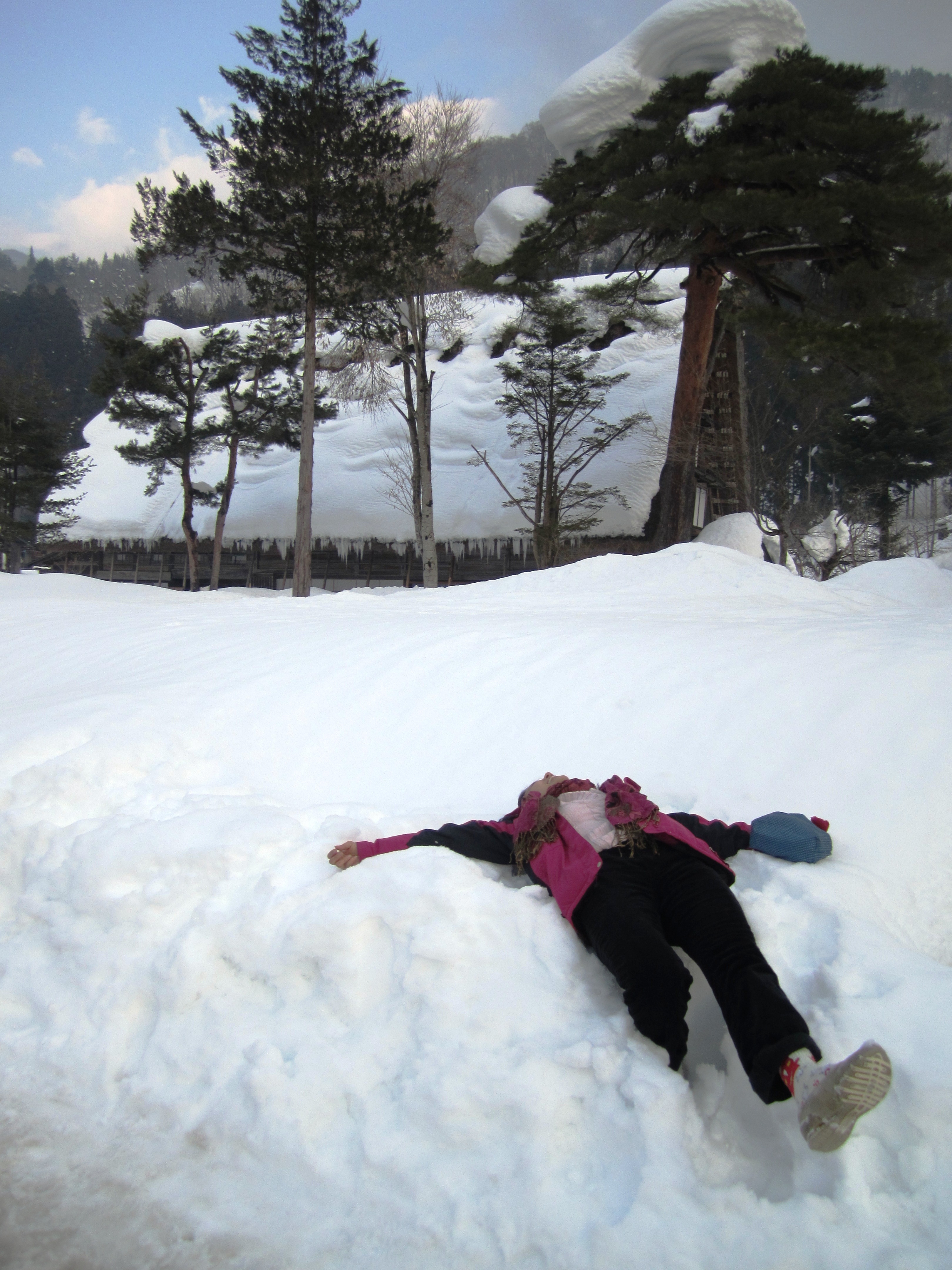
Wendy enjoying the snow (safely) at World Heritage Site Shirakawa-go, Gifu.
By Wendy Ikemoto (Ehime-ken, 2006-2011). Wendy taught at six crazy but lovable high schools and served as a Prefectural Advisor on JET. Now based in the equally crazy New York City, she is looking for her next challenging career opportunity. Wendy is a fan of reading, writing, and cooking as a form of socialization. Visit her LinkedIn profile here.
I learned the hard way that bicycles and snow don’t mix.
It wasn’t that I didn’t have my suspicions about this, but I: a) Needed to get to the train station, and b) was inexperienced with the fluffy stuff (it was only the second time in years that snow in my country town hadn’t immediately melted away, and as a Hawaii girl, the snow seemed more novelty than threat).
So on a January morning in Ehime, I left my apartment to catch a train into town. I followed the same route to the station that I used hundreds of times. I rode past a small temple on the hill. I enjoyed watching the animals in the river along the road. I took the turn by the bridge and in slow motion, my tire slipped out from under me and I crashed. SMACK–I fell on the back of my head.
I couldn’t move for a moment.
Before I could regain composure, I started to get dragged off. A kind Japanese couple had seen the whole thing and sensibly moved me out of the road. I was very grateful, but hugely mortified. After about a minute, I thanked them profusely, assuring them that I was OK, and managed to get back on my bicycle. Slowly and wobbly, I made it to the station.
I met my friend, we bought our train tickets, and through the gate we went to wait for our train. This was my first moment to relax since the accident. Although I felt fine, I decided to inspect the back on my head. Lightly, my fingers caressed where I crashed until they came upon a bump. Not the hard kind that happens when you knock your head against a shelf, but the soft kind that happens when you have a blister. Crap. Well, maybe I can go to the doctor tomorrow, I thought.
When I brought my hand down into my lap, however, I noticed that it looked funny…there was blood all over it.
Justin’s Japan: Interview with DJ Krush on His 20th Anniversary Tour
Article/Journalism, Justin's Japan, Music Comments Off on Justin’s Japan: Interview with DJ Krush on His 20th Anniversary Tour

"Everyone’s using computers these days, but when I was young analog was king. Today everyone’s using the same software, so it can sound a bit dull. On the other hand, there’s plenty of surprising music you can create, so that’s what I’m aiming to do." (Justin Tedaldi)
By JQ magazine editor Justin Tedaldi (CIR Kobe-shi, 2001-02) for Examiner.com. Visit his Japanese culture page here for related stories.
Born Hideaki Ishi in Tokyo, DJ Krush is one of the world’s most acclaimed electronic music artists and producers. He first made his name in hip-hop in the 1980s as the founder of Krush Posse, and his style now transcends category much like his idol Miles Davis, who dropped the “jazz” label for “music” in the late 1960s.
Continuing his world tour, DJ Krush plays at The MID in Chicago tonight (Feb 21). In this exclusive interview conducted Sunday backstage at the Music Hall of Williamsburg in Brooklyn (his first New York City gig in four years), I spoke with the artist during sound check about his two decades as a solo artist, his shocking yakuza past, and this thoughts on the future of music.
Last year you celebrated your 20th anniversary as a solo artist. What did it mean to you?
It’s endless—I didn’t expect it would last this long, so when I realized that it was now 20 years I was surprised. My history as a DJ is 25 years, but I’ve been a solo artist for 20 years.
Before you began your career you became involved with the yakuza. Did having this reputation make it difficult to enter or be successful in the music business at first?
I didn’t want to mimic American style hip-hop; I wanted to create a style unique from everyone else. At first, I didn’t have a good reputation and they wanted to attack me, so it was really tough.
What are the central differences between Japanese and American hip-hop?
The style is the same, but the culture, lifestyle and background is different. It’s tricky to explain, but the differences are there.
For the complete story, click here.

Amy at Soma, Fukushima, with Mr. Tanji, August 2011.
By Amy Cameron (Fukushima-ken, 1998-2000) for JQ magazine. Amy was one of eight American JET alums selected for the Tohoku Invitational Program sponsored by the Ministry of Foreign Affairs and the Japan Tourism Agency.
I will always remember the day back in 1998 that I received my JET ALT assignment. I immediately rushed to a map to see where I would be living. I hadn’t studied Japanese before, so it was hard to pronounce the words: Nihonmatsu-shi, Fukushima-ken. My tongue tripped on the syllables and I laughed. I found the spot on a map, about halfway between Tokyo and Aomori, 35 miles or so from the coast, between some mountains. I tried to imagine what it would be like to live there. As my departure approached, friends and family asked where in Japan I was heading, but no one had ever heard of Fukushima.
Fast forward to the days following March 11, 2011, and suddenly the whole world had heard of Fukushima. Amidst the media overload of earthquake, tsunami, and radiation disaster images, friends and family called and e-mailed me, “Was that where you used to live?” I scrambled to contact friends and coworkers in the region. My former supervisor cried when he heard that I was thinking of him. People in Nihonmatsu were okay, he assured me. The earthquake had not done as much damage as in some other areas, and Nihonmatsu was far enough from the coast that it had not been hit by the tsunami. Radiation, on the other hand, was a growing concern.
At this time, my heart ached to return to Fukushima to visit the people and land I loved so dearly. I had spent two amazing years there as an ALT, and it had been hard to leave. Even as news of the disasters began to fade from the headlines, I felt distracted from my life in Boston, part of me emotionally back in Fukushima. When I heard about the Tohoku Invitational Program for JET alums a few months later, I was so excited that I had a hard time sleeping. This was it: a real opportunity to return to my Japanese hometown, much sooner than I had thought would be possible.
Justin’s Japan: L’Arc~en~Ciel Rocks Madison Square Garden March 25
Article/Journalism, Justin's Japan, Music Comments Off on Justin’s Japan: L’Arc~en~Ciel Rocks Madison Square Garden March 25

Courtesy of BAM!
By JQ magazine editor Justin Tedaldi (CIR Kobe-shi, 2001-02). Visit his Japanese culture page on Examiner.com here for related stories.
After 20 years, 13 million albums and 16 million singles sold, famed rock group L’Arc~en~Ciel is gearing up for a historic performance as the very first Japanese act to headline New York¹s legendary Madison Square Garden.
Formed in Osaka in 1991, L’Arc~en~Ciel (the name means “rainbow” in French) gained acclaim for their glam-influenced stage fashions, frenetic live shows, and punk/new wave inspired music. The group has achieved legendary status at home and abroad, and its new album BUTTERFLY will be released on iTunes in much of the world outside of Japan in March.
The album also includes the hit song “Good Luck My Way” as featured in the movie version of the iconic and highly popular anime full-length feature film, Fullmetal Alchemist: The Star of Milos. This band¹s hit single “Ready Steady Go” was used in the soundtrack of the original Fullmetal Alchemist television series featured on Cartoon Network’s Adult Swim.
L¹Arc-en-Ciel¹s lead singer and occasional guitarist hyde has called BUTTERFLY “a monumental album, it’s great that we can release the album just at the right time.”
For more details and tickets, click the banner image or visit www.larc-en-ciel.com.
Justin’s Japan: Robert Whiting Brings ‘Tokyo Underworld’ to Japan Society
Events, Japan Society Round-up, Justin's Japan Comments Off on Justin’s Japan: Robert Whiting Brings ‘Tokyo Underworld’ to Japan Society

Tokyo Underworld 2012: An Evening with Robert Whiting will be held Feb. 16 at Japan Society. Continue reading on Examiner.com Robert Whiting brings ‘Tokyo Underworld’ to Japan Society. (Courtesy of Japan Society)
By JQ magazine editor Justin Tedaldi (CIR Kobe-shi, 2001-02) for Examiner.com. Visit his Japanese culture page here for related stories.
Japan Society of New York becomes your gateway to the seamy side of Japan on Feb. 16 with Tokyo Underworld 2012: An Evening with Robert Whiting. At this special appearance, the celebrated author will discuss the intractable role of yakuza in virtually all areas of modern day society in Japan. (It also echoes a 2011 Japan Society lecture by crime expert and Tokyo Vice author Jake Adelstein.)
Whiting first came to Japan with U.S. Air Force intelligence in 1962, where he was assigned to work for the National Security Agency in the U-2 program. He graduated from Tokyo’s Sophia University in 1969 with a degree in Japanese politics. His research into the ties binding Japan’s leading politicians to Yakuza bosses gained him entrée into the Higashi Nakano wing of Tokyo’s largest criminal gang, the Sumiyoshi-kai, where he became an “informal advisor.” He worked for Encyclopedia Britannica Japan as an editor until 1972, whereupon he moved to New York City and wrote his first book, The Chrysanthemum and the Bat. He later worked for Time-Life in Tokyo for a year before becoming a professional author.

Preston busts a move onstage with cosplay idol Reni Mimura. (Justin Tedaldi)
By Preston Hatfield (Yamanashi-ken, 2009-10) for JQ magazine. Preston moved from San Francisco to New York City in January 2012 and is now accepting submissions from people who want to be his friend. Abduct him from his house in the middle of the night, or find him on Facebook and ask about his JET blog in which he details his exploits and misadventures in that crazy Land of the Rising Sun we all love.
The Bennett Media Studio in New York’s West Village was filled to capacity on Feb. 11 for Saturday’s Lunar New Year Celebration and Fashion Show. This event, hosted by the ASIANinNY networking organization, treated guests to a night of Asian-oriented exhibitions, highlighted by two fashion shows and an energetic performance by cosplay singer and Japanese idol Reni Mimura.
The boys took the stage first, modeling clothes by designer Ninh Nguyen and eliciting a number of lascivious hoots and catcalls from an appreciative crowd, and the girls, wearing Meiling Chen’s new line, came out to a barrage of camera flashes. Fitting with the Year of the Dragon, the models’ hair, stylized by a team from Haruo Noro Salon, exhibited a quiet ferocity and mystique.
“For [the girls] the look is a simple and romantic boho style, center part, with a low ponytail and a braid. For [the boys] the look is a ’60s mod, edgy/punk, with a modern and clean feel,” lead stylist Noro said of his artistic intent. Having worked and studied in salons in Japan and London before coming to New Jersey and establishing his own business, Noro explained that for this event he drew mostly from his Japanese training, though having additional training and work with other cultures and participating in various fashion shows has enhanced his creative vision.
“I love that ASIANinNY is able to feature and promote various Asian designers, and my team and I are very happy to be part of it,” he said.
Justin’s Japan: Cosplay Idol Reni Mimura, Haruo Noro Salon Headline NY Lunar New Year Fest Feb. 11
Article/Journalism, Events, Justin's Japan Comments Off on Justin’s Japan: Cosplay Idol Reni Mimura, Haruo Noro Salon Headline NY Lunar New Year Fest Feb. 11

Courtesy of AsianInNY.com
By JQ magazine editor Justin Tedaldi (CIR Kobe-shi, 2001-02) for Examiner.com. Visit his Japanese culture page here for related stories.
Cosplay singer Reni Mimura and Japanese stylists from Haruo Noro Salon will appear at AsianInNY‘s annual Lunar New Year Celebration and Fashion Show on Feb. 11 at Bennett Media Studio, 723 Washington Street in Manhattan’s West Village at 7 p.m.
New York’s premier online destination for multicultural networking and entertainment, AsianInNY’s Year of the Dragon celebration is in time with the New York Fashion Week. Many outstanding Asian designers will present their new collections with runway fashion shows along with an exciting line-up of comedy, music, dance, and martial arts. Models will rock tresses and looks with amazing hair and make-up provided by Haruo Noro Salon.
Reni Mimura specializes in Moe style performances, a genre that emphasizes the cute look of Japanese pop-culture with the hip appeal of Japanese animation. She released her first Japanese CD in 2006 and relocated to New York in 2008. In 2009, she was invited as a guest performer to Japan Society, Otakon, New York Anime Festival and Anime Boston, and is quickly winning over the hearts of many new local fans, thanks to her pretty stage costumes, upbeat personality, and her unique singing talent.
For the complete story, click here.
Justin’s Japan: ‘Tokio Confidential,’ ‘Our Planet’ Premiere Next Week
Article/Journalism, Events, Justin's Japan Comments Off on Justin’s Japan: ‘Tokio Confidential,’ ‘Our Planet’ Premiere Next Week

Mel Maghuyop and Manna Nichols in rehearsals for ‘Tokio Confidential,’ playing Feb. 5-19 at the Atlantic Theater Stage 2. (Philip Smith)
By JQ magazine editor Justin Tedaldi (CIR Kobe-shi, 2001-02) for Examiner.com. Visit his Japanese culture page here for related stories.
Words, music and the history of the world collide next week with the new theatrical presentation of Tokio Confidential at Atlantic Theater Stage 2 from Feb. 5-19 and Our Planet at Japan Society for one night only on Feb. 6.
A new musical penned entirely by Eric Schorr and helmed by Joanna McKeon (the associate director of the Broadway and national tour editions of Green Day’s American Idiot), Tokio Confidential (a Richard Rogers Award finalist) is set in 1879 the hidden pleasure quarters of Meiji era Japan.
Isabella Archer, a young American war widow, crosses an ocean in search of a lost love—and is about to cross a line from which she can never return. When Isabella falls in love with a renowned Japanese tattoo artist, she enters a world of extreme beauty, becoming an object of unexpected desire—in a realm of unspeakable danger. It’s a journey across the boundaries between pleasure and pain, art and artifice, the secrets of the flesh and the sins of the heart.

Tsurugajo Castle in Aizuwakamatsu City.
By Kris Gravender (Fukushima-ken, 2002-06) for JQ magazine. Kris was one of eight American JET alums selected for the Tohoku Invitational Program sponsored by the Ministry of Foreign Affairs and the Japan Tourism Agency. This article was originally printed in the Oct. 21, 2011 issue of Chicago’s bilingual newspaper Chicago Shimpo.
What could I do? What could I really do? I was fighting the urge to return to Aizu simply because I knew the possibility for contracting some kind of cancer, but I felt I just had to do something. When the earthquake hit we knew it was bad, but the tsunami made everything worse. Then, to top it all off, Fukushima was becoming a “nuclear wasteland,” according to the news reports we were getting, and there was nothing we could do for the place we love.
My wife, being from Aizu, was distraught for weeks. She called her family, friends she hadn’t talked to in years, and even the local International Association, to get as much news as possible. Her aunt and uncle live in Sendai, and there was no communication from them, not to mention that her brother is a police officer and was being sent into the radiation zone to assist with evacuations. Eventually we were told everyone was safe and healthy, and yet this didn’t do much to make us feel better. We donated money, clothes, and food to the Red Cross, but it just didn’t seem to be enough to make us feel like we were helping.
Then I heard from a friend about a program the Ministry of Foreign Affairs was sponsoring for JET alums to return to their hometowns and tour, as long as they communicated with the outside world about what they saw, felt, and experienced. It was almost as if God was trying to tell me, “Here’s your chance.” My wife and I talked about it for days: If I go, what kinds of problems would I face; what would I do while I was there; could I go into the zone for just a couple of hours to see for myself what was happening; and a whole list of questions and ideas. No matter what the answers became, I knew I had to go.
JQ Magazine: Film Review – ‘Norwegian Wood’
Article/Journalism, Film, JQ Magazine, Reviews Comments Off on JQ Magazine: Film Review – ‘Norwegian Wood’

“The wintertime beauty of the Tonomine highlands in Hyogo prefecture is a sadly haunting visual expression of Naoko’s isolation and loss of life. One only wishes the characters were as compelling as the landscape in which they find themselves.”
By Lyle Sylvander (Yokohama-shi, 2001-02) for JQ magazine. Lyle is entering a master’s program at the School of International and Public Affairs at Columbia University (MIA 2013) and has been writing for the JET Alumni Association since 2004. He is also the goalkeeper for FC Japan, a New York City-based soccer team.
Haruki Murakami’s novel Norwegian Wood 「ノルウェイの森」 was published in Japan in 1987 and propelled the author to superstar status, especially among the nation’s youth. The novel was also an international success and the first English translation (there were eventually two) introduced Murakami to the U.S.
Unlike his other well-known works, such as Hard Boiled Wonderland and the End of the World and The Wind-Up Bird Chronicle, Norwegian Wood eschews surreal and Kafkaesque sensibilities in favor of a more nostalgically sentimental narrative. It tells the story of love and loss from the vantage point of its 37-year-old protagonist, Toru Watanabe, looking back on his youth as a student during the 1960s.
As in Europe and the U.S., Japan at that time was a society in flux and the establishment was being challenged by idealistic student movements. Against this backdrop, Toru falls in love with the emotionally troubled and fragile Naoko, who sinks into a deep depression after the suicide of their mutual friend Kizuki. She leaves the university for a mountainous sanitarium and during her absence, Toru has a love affair with Midori. Eventually, Naoko succumbs to the darker nature of her illness and commits suicide, sending Toru into an emotional period of bereavement, after which he can commit emotionally to Midori and continue on with his life.
Justin’s Japan: Roland Kelts Joins Famed Musicians, Writers for The Global Salon
Article/Journalism, Events, Justin's Japan, Roland Kelts Comments Off on Justin’s Japan: Roland Kelts Joins Famed Musicians, Writers for The Global Salon

Author Roland Kelts and musician Keiko Matsui join Akiko Yano and Ian Buruma for The Global Salon: Cities in Japan at The Greene Space on Jan. 19. (Kaz, Bobby Quillard)
By JQ magazine editor Justin Tedaldi (CIR Kobe-shi, 2001-02) for Examiner.com. Visit his Japanese culture page here for related stories.
JET alum and half Japanese American writer, editor and lecturer Roland Kelts (Osaka-shi, 1998-99) will appear with acclaimed musicians and writers connected to Japan for an intimate talk and performance called The Global Salon: Cities in Japan at The Greene Space in New York on Jan. 19.
Kelts, who lives half of each year in Tokyo and New York, is the author of Japanamerica: How Japanese Pop Culture has Invaded the U.S. and writes about contemporary Japan for several publications in the U.S. and Japan. He is a frequent commentator on Japan for National Public Radio and the BBC.
Hosted by WNYC News host Eddie Robinson and presented in cooperation with the Consulate General of Japan, The Global Salon: Cities in Japan presents compelling stories of courage and resiliency, while the country continues to face unprecedented hardships of increased suicidal rates and unemployment, before and after the 2011 earthquake and tsunami. Robinson will engage the audience and esteemed guests through captivating dialogue and enchanting musical themes about the country’s economic future, advances in technology, and the preservation of its remarkable culture.
For the complete story, click here.
Justin’s Japan: New York Hosts Sneak Preview of Studio Ghibli’s ‘The Secret World of Arrietty’
Article/Journalism, Film, Justin's Japan Comments Off on Justin’s Japan: New York Hosts Sneak Preview of Studio Ghibli’s ‘The Secret World of Arrietty’

Studio Ghibli's 'The Secret World of Arrietty' premieres in New York Jan. 21. (GNDHDDTW)
By JQ magazine editor Justin Tedaldi (CIR Kobe-shi, 2001-02) for Examiner.com. Visit his page here for related stories.
Co-written by anime legend Hayao Miyazaki and directed by Miyazaki protégé Hiromasa Yonebayashi, the New York International Children’s Film Festival will present a special one-time advance screening of Studio Ghibli’s new film The Secret World of Arrietty on Jan. 21 at Symphony Space, nearly a whole month ahead of its wide release on Feb. 17. The news comes just as the massive 15-film Studio Ghibli Festival (which broke box office records by grossing over $150,000 to date at the IFC Center) wraps up Jan. 12.
Originally released in Japan in July 2010 and based on Mary Norton’s classic children’s book The Borrowers, the film is a beautiful story about friendship, family and love, sumptuously animated with all the loving detail, warmth and humanity expected from Studio Ghibli’s finest works.
Arrietty (voice of Bridgit Mendler), a tiny but tenacious 14-year-old, lives with her parents (voices of Will Arnett and Amy Poehler) in the recesses of a suburban garden home, unbeknownst to the homeowner and her housekeeper (voice of Carol Burnett). Like all little people, Arrietty remains hidden from view, except during occasional covert ventures beyond the floorboards to “borrow” scrap supplies like sugar cubes from her human hosts.
For the complete story, click here.
