




Justin’s Japan: Nippon in New York — Japan Day @ Central Park and a ‘Deadly She-Wolf’
 Article/Journalism, Events, Japan Local, Justin's Japan
  Comments Off on Justin’s Japan: Nippon in New York — Japan Day @ Central Park and a ‘Deadly She-Wolf’

CNN national correspondent Sandra Endo hosts Japan Day @ Central Park May 12. (Courtesy of @sandraendotv)
By JQ magazine editor Justin Tedaldi (CIR Kobe-shi, 2001-02) for Examiner.com. Visit his Japanese culture page here for related stories.
This month’s highlights include:
Sunday, May 12, 10:30 a.m.
Free
Now in its seventh year, Japan Day has won acclaim from New Yorkers from every walk of life, with Mayor Michael Bloomberg calling it an eagerly anticipated cultural event on the city’s calendar. For this year’s event, organizers are planning once again to have both the Japan Run (beginning at 8:00 a.m.) and the Japan Day Festival, emphasizing enjoyable activities for all ages that will deepen participants’ understanding and appreciation of Japanese culture—not to mention the food, drinks and snacks! Hosted by CNN national correspondent Sandra Endo, this year’s guest performers include Taiko Masala, Kylee, Yosakoi Dance Project 10tecomai, Chris Hart, and the Glory Gospel Singers.
May 16-June 2
Deadly She-Wolf Assassin at Armageddon!
La MaMa Experimental Theatre, 74 East 4th Street
$30 adults, $25 students/seniors
Deadly She-Wolf Assassin at Armageddon! is the latest music/theater and martial arts tour de force from collaborators Fred Ho and Ruth Margraff. A daring and imaginative homage to the 1970s Japanese raging cult manga and theatrical hit Lone Wolf and Cub (Kozure Ookami)—which has inspired many other adaptations and works in comic books and film over the past decades—Deadly She-Wolf explodes with a ferocious stylistic mix of Japanese Noh theater and modern-day anime and manga influences with unique multi-martial arts and sword fighting choreography and a glorious score fusing traditional Japanese music and soul-jazz. Raised as a weapon by a brutal conspirator, a young female assassin discovers that her target has spun the empire of Japan into crisis and ruin–and–is none other than her father. Torn between loyalty to her mission, her nation and her soul, she must face the unimaginable at the twilight of an imperial epoch.
For the complete story, click here.
JQ Magazine: Cultural Heritage Soars in San Francisco’s Japantown
Article/Journalism, Events, Japan Local, JQ Magazine Comments Off on JQ Magazine: Cultural Heritage Soars in San Francisco’s Japantown

Under the Peace Pagoda at the Northern California Cherry Blossom Festival, San Francisco, April 2013. (Preston Hatfield)
By Preston Hatfield (Yamanashi-ken, 2009-10) for JQ magazine. Preston received a B.A. in English literature with an emphasis in creative writing and a minor in Japanese at the University of California, Davis. After spending an amazing year on JET in Yamanashi, he spent a year writing and interning with book publishing companies in New York. He currently lives in Marin County, where he continues to cover local Japan-related stories for JQ, and teaches English as a second language at an international school in San Francisco.
This April marks the forty-sixth time that San Francisco has hosted the Northern California Cherry Blossom Festival. As one of the world’s top annual festivals of its kind and one of the largest Japanese American events in the country, the festival has made quite a reputation for itself, and each year it’s bigger and better. Whether you’ve been to Japan before and need a fix of your favorite street food, or you’re a newbie interested in exploring the culture, the NCCBF offers a comprehensive and top-notch Japan experience that includes traditional and modern elements.
If you’ve been to other festivals, you already know to expect tea ceremony demonstrations, doll exhibits, taiko performances, and cosplay competitions, but pay attention and you’ll also notice a powerful sense of community in every act and exhibit. Excepting a handful of wonderful guests from Japan (including this year’s Grand Marshal, renowned singer and actor Teruhiko Saigo), the NCCBF is put on wholly by the Bay Area’s Japanese American community, including some 300 volunteers, 50 organizations, schools, and groups, and is sponsored by a number of local businesses. In some respects, it’s their way of making a statement, as Allen Okamoto, co-chairman of the NCCBF, explains:
“One of the reasons I continue to volunteer with the festival is that Japantown is rapidly changing. The demographics of the community are changing with the intermarriage and lack of migration from Japan. I consider the festival as an institution the same as the Japanese language schools, the churches and other community organizations like the Japanese Community Youth Council, Kimochi, Inc. and the Japanese Cultural & Community Center. We are all continuing the culture and heritage of things Japanese.”
The festival has become something of a culture treasure here, and it’s no wonder. San Francisco, with a formidable but recently declining Japanese American population, is home to one of the last “true” Japantowns in the U.S., but some locals think that’s debatable. “I saw [at the festival] a hardworking community [bringing] culture and fun to Japantown, which for the rest of the year is slowly being eaten by non-Japanese businesses. Koreatown sometimes feels more appropriate,” said Bay Area resident and JET alum Mikeal Gibson.
Justin’s Japan: Nippon in New York – Kyary Pamyu Pamyu, Sakura Matsuri and More
Article/Journalism, Events, Justin's Japan Comments Off on Justin’s Japan: Nippon in New York – Kyary Pamyu Pamyu, Sakura Matsuri and More

J-pop star Kyary Pamyu Pamyu makes her Big Apple debut at the Best Buy Theater April 14.
By JQ magazine editor Justin Tedaldi (CIR Kobe-shi, 2001-02) for Examiner.com. Visit his Japanese culture page here for related stories.
Spring has sprung in the Big Apple, and that means one thing: a new season of sounds, colors, and spectacular performing arts to match the blossoming sakura trees throughout the city.
This month’s highlights include:
April 5-6
BMCC Tribeca Performing Arts Center Theatre 2, 199 Chambers Street
$50 general admission, $15 students (use discount code STU at Smarttix page)
A story of courage and personnel sacrifice of an American doctor and the Japanese medical staff who risked their lives following the devastating earthquake, tsunami and nuclear disasters that struck Japan on March 11, 2011, Hikobae is a fictionalized story based on recorded interviews with physicians and nurses from Soma City Hospital, a medical center in the Fukushima evacuation zone. Supported by the Tribute WTC Visitor Center, proceeds from the production will benefit the Momo-Kaki Orphan Fund, which supports children who lost their parents in the disaster. The theater piece will be performed in English and Japanese, with subtitles projected behind the actors.
April 5-14
BAM Rose Cinemas, 30 Lafayette Avenue
$13 adults, $9 children and matinees, $8 members
Part of BAMcinématek. For nearly three decades, the films of Hayao Miyazaki and the company he founded, Studio Ghibli, have revolutionized the art of animation. Miyazaki’s indelible style—which weds the uncanniness of Lewis Carroll and the epic grandeur of Akira Kurosawa—stands as a testament to the beauty and imaginative power of hand-drawn animation, conjuring richly realized worlds replete with mystical spirits and shot through with an abiding concern for the relationship between humans and nature. All films directed by Hayao Miyazaki and in 35mm.
Sunday, April 14, 7:00 p.m.
Best Buy Theater, 1515 Broadway
$25, $100 VIP meet and greet
Born in 1993 in Tokyo, Kyary Pamyu Pamyu attracted attention with her individual blog, and has been active as a model in Japan. A charismatic personality that represents the youth fashion of Harajuku, her smash single “PONPONPON“—released on her debut album shortly after she finished high school—became a big hit around the world, racking up over 46 million views on YouTube to date. Receiving plenty of attention as the symbol of kawaii (or “cuteness” in Japanese), Kyary Pamyu Pamyu makes her New York concert debut as part of her ambitious 10-country “100%KPP” tour.
For the complete story, click here.
Justin’s Japan: Studio Ghibli’s Latest Comes to New York
Article/Journalism, Film, Justin's Japan Comments Off on Justin’s Japan: Studio Ghibli’s Latest Comes to New York
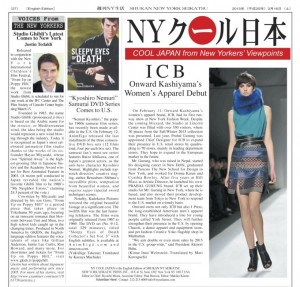
Click image to read story
By JQ magazine editor Justin Tedaldi (CIR Kobe-shi, 2001-02) for Shukan NY Seikatsu. Visit his Examiner.com Japanese culture page here for related stories.
Released in conjunction with the New York International Children’s Film Festival March 15, From Up on Poppy Hill, the newest work from Studio Ghibli, is now playing at four locations in New York City.
Founded in 1985, the name Studio Ghibli (pronounced ji-blee) is based on the Arabic name for the sirocco, or Mediterranean wind, the idea being the studio would represent a new wind blowing through the industry. Today it is recognized as Japan’s most celebrated animation film studio thanks to the works of its co-founder Hayao Miyazaki, whose own Spirited Away is the highest-grossing film in Japanese history and the Academy Award winner for Best Animated Feature in 2003. (A recent poll conducted in Japan revealed the nation’s favorite Ghibli film to be 1988’s My Neighbor Totoro, claiming 24.3 percent of the vote.)
Co-written by Miyazaki and directed by his son Goro, From Up on Poppy Hill is a period piece that takes place in Yokohama 50 years ago, focusing on an innocent romance that blossoms between Umi and Shun, two high school kids caught up in the changing times. Produced in North America by GKIDS, the English-language edition features the voice talents of stars like Gillian Anderson, Jamie Lee Curtis, Ron Howard, and many more.
For showtimes and tickets for From Up on Poppy Hill, visit www.gkids.tv/poppyhill.
JQ Magazine: Film Review – ‘Live Your Dream: The Taylor Anderson Story’
Article/Journalism, Earthquake Tsunami, Film, JQ Magazine Comments Off on JQ Magazine: Film Review – ‘Live Your Dream: The Taylor Anderson Story’

“Laced with emotional reflections, vivid photos and jovial home movies, the film walks the viewer through Taylor’s 24 years on earth and untimely end caused by the Great East Japan Earthquake and Tsunami of 2011.” (Global Film Network Inc.)
By Renay Loper (Iwate-ken, 2006-07) for JQ magazine. Renay is a freelance writer and associate program officer at the Japan Foundation Center for Global Partnership. Visit her blog at Atlas in Her Hand.
Directed by renowned filmmaker and founder of Global Film Network Regge Life, Live Your Dream: The Taylor Anderson Story is Life’s first documentary about a loss.
Best known for his features like Doubles (about Japan and America’s intercultural children), After America…After Japan (about the migration of Americans to Japan and Japanese to America) and Struggle and Success: The African American Experience in Japan, Life opens the window for the viewer to glimpse the life of Taylor Anderson (Miyagi-ken, 2008-11) through personal accounts from her loved ones. Laced with emotional reflections, vivid photos and jovial home movies, the film walks the viewer through Taylor’s 24 years on earth and untimely end caused by the Great East Japan Earthquake and Tsunami of 2011. In light of the tragedy, the film sends a message of hope, optimism and encouragement for all to follow their hearts.
The film is divided into chapters, beginning with the first, “She Took Her Time.” Jean Anderson, Taylor’s mother, reveals how in everything Taylor did, she did it at her own pace, including her birth: she was 11 days late. According to her father, Andy Anderson, Taylor grew up inquisitive, interested and easygoing, never letting anyone influence her decisions. Julia Anderson-Kerr and Jeffrey Anderson (Taylor’s sister and brother, respectively) shared what it was like to grow up with such a peaceful and patient sibling.
From as early as they could remember, Taylor was into reading, exploring and having fun. Growing up near Richmond, VA, she was first introduced to Japanese at Millwood Elementary School. Her teacher exposed her to the language, artifacts and clothing of Japan at an early age, and from that point on she was hooked. Unfortunately, when she moved on to St. Catherine’s High School, Japanese was not an option, so she continued to study on her own.
It wasn’t until her college years at Randolph-Macon College in nearby Ashland that Taylor had the opportunity to visit Japan. She traveled to Tokyo for a January course designed to expose students to the history of the city. Later that summer, Taylor taught at a Japanese language academy, where she was adored by all. It was because of Taylor’s contagious zeal for Japan that her childhood friends and classmates became interested in the country and culture as well. She exposed them to anime, manga and the films of Hayao Miyazaki, inspiring some of them to travel to Japan and explore it for themselves.
Justin’s Japan: Nippon in New York – From ‘Edo Pop’ to ‘Poppy Hill’
Article/Journalism, Events, Film, Justin's Japan, Music Comments Off on Justin’s Japan: Nippon in New York – From ‘Edo Pop’ to ‘Poppy Hill’

“From Up on Poppy Hill,” the latest film from Studio Ghibli, premieres in New York March 16. (©2011 Chizuru Takahashi/Tetsuro Sayama/GNDHDDT)
By JQ magazine editor Justin Tedaldi (CIR Kobe-shi, 2001-02) for Examiner.com. Visit his Japanese culture page here for related stories.
Tucked between Oscar and cherry blossom season, March offers an unmissable array of concerts, performances and film premieres, along with a special gathering to mark the two-year anniversary of the Tohoku earthquake and tsunami.
This month’s highlights include:
Sunday, March 3, 6:45 p.m.
Exploring the Road of Shamisen – Koto Workshop and Concert
Still Mind Zendo, 37 West 17th Street
$15 advance, $18 at the door
For reservations, email contact[at]marcreation.com or call 917-400-9362
In the latest workshop of the Spring Traditional Japanese Musical Instrument Series, shamisen specialist Yoko Reikano Kimura will demonstrate the vast 400 years of shamisen repertoire and explore the infinite possibilities of the instrument. Shamisen was brought to Japan through the Silk Road and since then it was popularized among samurai to ordinary citizens. But in today’s cosmopolitan age, new shamisen music continues to thrive.
March 6-9
The Bach Variations: Bach and Mendelssohn
Avery Fisher Hall, 10 Lincoln Center Plaza
$41-$123
In its first-ever Bach Festival, a kaleidoscopic three-week celebration of the depth and breadth the man the New York Times named the greatest composer of all time, Kobe-born conductor and harpsichordist Masaaki Suzuki leads five vocalists along with his own Bach Colleguim Japan and Yale Schola Cantorum with his own unique approach, combining his perspective with the virtuosity of the New York Philharmonic. On the program are Bach’s “Motet No. 1: Singet dem Herrn” and “Magnificat,” along with Mendelssohn’s :Magnificat in D Major” and “Christus.”
March 9-June 9
Edo Pop: The Graphic Impact of Japanese Prints
Japan Society, 333 East 47th Street
$12 general admission, $10 students and seniors, Japan Society members and children under 16 free
Edo Pop playfully juxtaposes classic ukiyo-e prints from such masters as Katsushika Hokusai and Utagawa Hiroshige with contemporary works inspired by these artists and their works. Delve into alluring worlds created by the power of Edo period and contemporary popular culture in which change is the only constant. Organized by the Minneapolis Institute of Arts, with the contemporary art selections curated for the New York presentation by Miwako Tezuka, Ph.D., Director, Japan Society Gallery.
For the complete story, click here.
JQ Magazine: JQ&A with JUSTE Program Participant Saiko Goto
Article/Journalism, Cultural Outreach, Interview/Profile, JQ Magazine Comments Off on JQ Magazine: JQ&A with JUSTE Program Participant Saiko Goto

“In Minamisanriku, the local government wanted to keep the shiyakusho (city hall) as a memorial for the tsunami, but people who lost family there disagreed. Finally, the building was demolished recently. It reminded us of sad stories and memories of people who escaped to city hall during the tsunami.” (Courtesy of Saiko Goto)
By Fernando Rojas (Fukui-ken, 2008-10) for JQ magazine. A resident of Teaneck, New Jersey, Fernando was JHS ALT in Fukui prefecture, home of the echizen-gani, a city named Obama, the Fukuisaurus, and nuclear power plants. While in Japan, he picked up shuji (Japanese calligraphy) as his hobby and continues to practice today. He is currently a fellowships associate for the Social Science Research Council’s Abe Fellowship Program in Brooklyn and co-representative for the JETAA New Jersey subchapter.
Hailing from Tome City in Miyagi Prefecture, Saiko Goto was a recent JUSTE Program participant at Rutgers University in New Jersey. Informally called the “Reverse JET Program,” the Japan–U.S. Training and Exchange Program for Language Teachers allows Japanese Teachers of English (JTEs) from all over Japan to take courses in ESL teaching at U.S. universities.
Goto received her teaching license from Gunma Prefecture Women’s University, where she majored in English. She currently teaches at Sakuma Junior High School and has taught English for eight years. Before returning to Japan in January, Goto spoke with JQ about JUSTE and the ongoing impact of the March 11 earthquake and tsunami on her school.
How are teachers selected to participate in the JUSTE program?
Teachers are selected according to their prefectures. In some prefectures, teachers have to apply for the program. In other prefectures, teachers are picked by the board of education. In my case, I was recommended by my principal to the Tome City Board of Education and selected by the Miyagi Prefecture Board of Education.
Have you found the JUSTE program beneficial? In what ways has the program helped you?
Being on JUSTE has been very beneficial. I have met and talked with many people from different countries, as well as learned a lot from them through English. I have also thought more about my teaching and the importance of learning English. The program has also helped me to create more effective activities. I made many activities with other JUSTE members and we will use them in my classes.
Would you recommend the program to other JTEs in Japan?
Definitely. By participating in the program, you can have many chances for meeting people and learn a lot. I visited a former ALT during the winter vacation and experienced life in Arkansas with her and her family. I also became friends with other JUSTE participants. We will share our list of activities with each other online and keep in touch.
JQ Magazine: Life After JET on YouTube
Article/Journalism, JQ Magazine, LifeAfterJET Comments Off on JQ Magazine: Life After JET on YouTube

JET alum Eliot Honda: “With my year coming to a close, I wanted to create a set of videos that would not only explain what to expect as an ALT, but also what to expect as an Uwajima ALT. I had truly come to love this city, and I wanted to show off some of its beauty and history.”
By Eliot Honda (Ehime-ken, 2009-2012) for JQ magazine. Born and raised in Honolulu, Eliot was an ALT placed in Uwajima City of Ehime Prefecture. Prior to JET, Eliot worked as a freelance video editor mainly in the commercial and corporate world in San Francisco. Following JET, he returned to Honolulu and joined his mother in real estate. He currently has made a JET Introduction video, and has a YouTube series in the works called Sister City Ties, showing the beauty of the friendship between Honolulu and Uwajima.
My father always preached that “everything happens for a reason.” My being placed in Uwajima was no exception. Uwajima, as I would come to find out, had strong ties to my home of Hawaii. King Kalakaua of Hawaii and Date Munenari of Uwajima had met in 1881, becoming Japan’s first contact with a head of state. Uwajima and Hawaii would meet again in 2001 when the Ehime Maru, a high school fishing vessel, would be struck by a U.S. submarine. Nine lives would be tragically lost, including four high school students.
News of the tragedy spread quickly through Hawaii, causing the people to do everything they could to help the Uwajima families. Whole those families could have shown hate and anger toward the people of Hawaii, they instead embraced the people of the Aloha State with open arms. Through this tragedy, a friendship between Honolulu and Uwajima was born, giving way to the creation of a sister city relationship. To help strengthen the ties between the two cities, the mayor of Uwajima requested ALTs who were born in Hawaii. I found myself to be one of the lucky few chosen to represent Hawaii there as my time on the JET Program began.
I came to Uwajima with all these grand ideas of using video in my lessons. A month into my first year as an Uwajima ALT, I came to the realization that utilizing video in the classroom or in school for that matter would be an impossible task. If finding students willing to speak English in front of the class was difficult, finding students to speak English in front of a camera would be like moving the Hawaiian Islands with a fish hook. (I think only Hawaii people will get that reference.)
Feeling a bit defeated, I sat in my apartment and contemplated how I could put everything I’d learned in the multimedia world to good use. As fate would have, it I was asked by one of the Ehime Maru family members to join the Ehime Maru memorial service, and create a documentary not about the tragedy, but about the friendship between Honolulu and Uwajima. The documentary was for the schools in Ehime, and upon completion, DVDs were given to a large number of schools. This single video became the start of several videos for both the sister city exchange and the promotion of Uwajima.
JQ Magazine Seeks Writers for Spring 2013!
Article/Journalism, Events, JQ Magazine Comments Off on JQ Magazine Seeks Writers for Spring 2013!

Visit JQ magazine online at http://jetaany.org/magazine
As we slide into spring, JETAA New York’s JQ magazine continues to provide content with an ever-expanding array of articles, interviews and features (see our recent stories here). We’re now looking for new writers, including recent returnees and JET vets, from all JETAA chapters worldwide for posting stories via our host at the global JET alumni resource site JETwit.com. (Scribes are also encouraged to join the JET Alumni Writers group on LinkedIn.)
Below are story ideas grouped by JET participants and alumni (JET World) and those more on Japanese culture (Japan World). And if you’re a JET or JETWit contributor from anywhere in the world with a story idea of your own, let us know!
Click “Read More” below for our spring 2013 ideas pitch package, and contact JQ editor Justin Tedaldi (magazine [at] jetaany [dot] org) to sign up for stories.
JQ Magazine: Book Review – ‘Yoko Ono: Collector of Skies’
Article/Journalism, Books, JQ Magazine, Reviews Comments Off on JQ Magazine: Book Review – ‘Yoko Ono: Collector of Skies’

“The book’s release is timed to coincide with Ono’s 80th birthday on February 18, and provides readers snippets of info on some tumultuous periods during her lifetime.” (Amulet Books)
By Rashaad Jorden (Yamagata-ken, 2008-2010) for JQ magazine. Rashaad worked at four elementary schools and three junior high schools on JET, and taught a weekly conversion class in Haguro (his village) to adults. He completed the Tokyo Marathon in 2010, and was also a member of a taiko group in Haguro.
“Everybody knows her name, but nobody knows what she does.”
That line—uttered by the most famous of her three husbands—could accurately sum up Yoko Ono for a long time. But that shouldn’t be the case. Fortunately, thanks to a new book co-written by Nell Beram and Carolyn Boriss-Krimsky, readers have insight into this remarkable woman’s life.
Yoko Ono: Collector of Skies—so titled because Ono has always looked to the sky for inspiration—delves into the life of the famous avant-garde artist and musician, from her childhood in Japan and the U.S. to her chart-topping success in her seventies. The book’s release is timed to coincide with Ono’s 80th birthday on February 18, and provides readers snippets of info on some tumultuous periods during her lifetime.
Ono’s journey is presented in an easy-to-read format geared toward young adults. Unlike many other biographies, where all the photographs tend to be lumped together in a couple of sections, the photos in Collector of Skies are spread throughout the book, and they range from one in which Ono is wearing a kimono at the age of two to another taken at the inaugural lighting of the Imagine Peace Tower in Reykjavik in 2007. The authors also use quotes from Ono to expound upon certain periods and moments of her life.
Of course, any story about Yoko Ono has to make heavy mention of her relationship with John Lennon, and the middle of the book is largely devoted to her life with the former Beatle. While Collector of Skies might not reveal anything earth shattering for hardcore Lennon and Beatles fans, younger readers (or those unfamiliar with the Beatles) will learn not just the real story of the group’s breakup, but more importantly, the duo’s activism.
JQ Magazine: JQ&A with Bruce Feiler on ‘The Secrets of Happy Families’
Article/Journalism, Books, Celebrity, Events, Interview/Profile, JQ Magazine Comments Off on JQ Magazine: JQ&A with Bruce Feiler on ‘The Secrets of Happy Families’

“One big idea in my book is that families should adapt all the time. The single best thing we’ve done is to add a weekly family meeting. We ask three questions, based on a popular program called ‘agile families.’ And no surprise: that idea was born in Japan in the culture of real-time change.” (Courtesy of HarperCollins Publishers)
By Sharona Moskowitz (Fukuoka-ken, 2000-01) for JQ magazine. Sharona is interested in fresh, new voices in fiction and creative nonfiction.
New York Times bestselling author and columnist Bruce Feiler (Tochigi-ken, 1987-88) has written a range of books dealing with topics as varied as life in Japan (depicted in 1991’s Learning to Bow), religion, and his own diagnosis with cancer.
His latest book, The Secrets of Happy Families, is a playbook for today’s family with tips and advice for increasing overall happiness and strengthening the family unit. Unlike other family-related books, Feiler does not advocate one particular method or philosophy over another; rather, he has done a thorough investigation of what happy families have in common and offers readers a slice of the pie.
In this exclusive interview, Feiler shares how his experience in Japan has given him insight into family life across cultures, as well as his take on the modern family’s trials and tribulations.
It seems the book market is already glutted with all sorts of self-help books about families. What sets your book apart and why do you feel that it is particularly timely?
In many ways, I was motivated by the deluge of self-help books. They’re boring, tried, and out of fresh ideas. As a parent, I was completely frustrated and had tons of questions about how to make my family function more effectively, and the only books out there were from “family experts.” Meanwhile, in every other arena of contemporary life—from Silicon Valley to elite peace negotiators, from championship sports teams to the Green Berets—there are proven new ways to make teams and groups run more smoothly. I wanted to know what those people were doing with their own families, then test their ideas with mine. Not every idea worked. That’s why I put over 200 new ones in the book, because what clicks with your family may be different from what clicked with mine. But my hope is that if you take three ideas, you’ll have a happier family in a week.
In the chapter about the agile manifesto, you talk about the importance of “being part of the family team.” In writing about the importance of teamwork within the family, were you inspired at all by your experience in Japan, a culture which valorizes the group above all else?
I think it may be more the other way around, in that I was attracted to Japan because I’ve always been interested in tight groups and well-run teams. At the time I lived in Japan, in the late 1980s, Americans still believed that the individual mattered above all else. But one thing we’ve learned from the Internet is that we all have a natural inclination toward groups, social networks, and other gatherings of people. The first generation of happiness research has shown us that relationships matter above all else. Happiness is other people. And the people who matter most to us are our family. Yet there have been almost no books that tell us how to do that.
Are there other cultural practices you observed in your time in Japan which you believe could benefit American families?
One I learned while in Japan is that being part of a group doesn’t just happen. Japanese schools, in particular, work on it. I remember a school trip I went on where classes were divided into small groups. The number one rule was, don’t be late. The number two rule was, only one person in each group was allowed to have a watch. Guess what! You better stick together. Having a close family doesn’t just happen, either—you have to work on it. Fortunately, there are lots of new ideas out there to do that, which I’ve tried to gather.
JQ Magazine: JQ&A with Takashi Ikezawa of Resobox Japanese Art Gallery
Art, Article/Journalism, JQ Magazine Comments Off on JQ Magazine: JQ&A with Takashi Ikezawa of Resobox Japanese Art Gallery

“We don’t want art to be only for wealthy people, but instead want to target as wide an audience as possible for the purpose of disseminating Japanese culture. This is actually the reason why we chose to be located in Queens, as it is said to be the most diverse part of the city.” (Stacy Smith)
By Stacy Smith (Kumamoto-ken CIR, 2000-03) for JQ magazine. Stacy is a professional Japanese writer/interpreter/translator. She starts her day by watching Fujisankei’s newscast in Japanese, and shares some of the interesting tidbits and trends together with her own observations in the periodic series WITLife.
In recent years, Long Island City has experienced a rapid gentrification, being converted from an abandoned, industrial wasteland to a hotspot of waterfront apartments and art institutions. Of course it has big hitters like the Noguchi Museum that are well known to Japanophiles, but there are also Japan-related galleries flying under the radar just waiting to be discovered. One such place is Resobox, a short walk from the Queensboro Plaza subway stop whose location is marked by only a small, overhanging sign and a signboard that sits on the sidewalk reading: “The place where people who are conversant with, dedicated to and influenced by Japanese art can gather, create innovative arts through the collaborative process and disseminate them to the world.” Interest piqued? So was mine, and I was fortunate to have the opportunity to speak with Resobox co-owner Takashi Ikezawa to learn more about this unique endeavor.
Can you share with JQ readers Resobox’s back story and the origin of your name?
Resobox was a name created from the words “resonate” and “box,” and it refers to a space where artists can meet and collaborate to create new and innovative art. It initially referred to a project begun by my partner Fumio Tashiro, a jazz musician who became interested in experimental music and music as art performance. He would collaborate with dancers, painters, and musicians to put together performances. I had a business background as I worked at a talent agency representing Japanese artists in NYC, and I knew Fumio casually. However, we started meeting up monthly to brainstorm, and our discussions always focused on the breadth and depth of Japanese culture and arts. In order for a solid collaboration to take place, you need to have a strong foundation. Since we are both Japanese, we found the culture of our native country to be a foundation substantial enough to build on. Our brainstorming sessions yielded the idea of artists, both Japanese and non-Japanese, coming to our box and resonating off each other to create new Japanese art. This is how Resobox was launched in its gallery form in June of 2011.
Can you give an example of some successful collaborations?
One of the artists who was featured until early January, Mary Burton Wheeler, became involved by taking a Japanese ink painting (sumi-e) class at Resobox. It happened to be taught by Ayakoh Furukawa, the artist we currently have on display, and collaboration began in this class environment. Wheeler learned not just about Japanese painting itself but about Japanese sense and ideas, and she incorporated this into the new pottery she produced as a result. On first glance you wouldn’t say that her work is particularly “Japanese,” but on closer look there is definitely a Japanese sensibility that she encountered via her collaboration with Ayakoh.
Justin’s Japan: Nippon in New York – A Lunar New Year Kickoff
Article/Journalism, Events, Justin's Japan Comments Off on Justin’s Japan: Nippon in New York – A Lunar New Year Kickoff

Wakamaru, left, and Hiroshi Ota star in the short play “I, Worker,” part of the Seinendan Theater Company + Osaka University Robot Theater Project at Japan Society Feb. 7-9. (Osaka University & Eager Co. Ltd.)
By JQ magazine editor Justin Tedaldi (CIR Kobe-shi, 2001-02) for Examiner.com. Visit his Japanese culture page here for related stories.Saturday, Feb. 2, 6 p.m.-10 p.m.Stay warm this winter with some hot local events, from retro anime screenings to bilingual robot plays to a J-pop infused Lunar New Year spectacular.
This month’s highlights include:
Feb. 1-15, 9:30 a.m.-4:00 p.m.
NIPPON-JIN Exhibition
Consulate General of Japan, 299 Park Avenue
Free
Presented by J-COLLABO, a unique social network that promotes the Japanese art scene with various collaborating artists, NIPPON-JIN (meaning “Japanese”), will be on view at the gallery of the Consulate General of Japan from Feb. 1-15. Showcasing more than 300 unique portrait photographs taken by Junichi Takahashi, NIPPON-JIN reveals what Takahashi sees as “Japanese people,” opposed to the prototype of stereotypical “Japanese” that others expect and portray. To capture the essence of what makes Japanese “Japanese,” Takahashi decided to approach this project by taking hundreds of samples over a four-year period of Japanese being themselves, letting the accumulation of the subject matter form the answer. The exhibition will go to the gallery of Narita International Airport in Japan this summer.
Sunday, Feb. 3, 3:00 p.m.-4:00 p.m.
Salon Series No. 44. Gestures, Mime and Dance
Tenri Cultural Institute, 43A West 13th Street
$15 general, $10 students/seniors
Now in its fifteenth year, the 45th performance of Sachiyo Ito & Company’s Salon Series is titled “Gestures in Japanese Dance and Mime.” From noh theater to today’s baseball heroes, the Japanese have tended to use more gestures than other peoples, particularly compared to those in the west, and in much subtle manner. Why and how we use them in daily life and see any of those are reflected in dance. Featuring guest Yass Hakoshima (who led Yass Hakoshima Movement Theater for 40 years in the USA and Europe), live demonstrations will illustrate how a mime draws gestures from daily life as a comparison and to gain further insight. Excerpts from kabuki dances choreographed by Ito as well as Hakoshima’s ever-popular comic piece, “Fisherman,” will be performed.
Feb. 7-9, 7:30 p.m.
Seinendan Theater Company + Osaka University Robot Theater Project
Japan Society, 333 East 47th Street
$28, $25 Japan Society members
Imagine a time when “robot maids” are commonly found in family households. That’s the much-anticipated setting of these two heartrending short plays by Oriza Hirata, founder of Japan’s celebrated Seinendan Theater Company. In Sayonara (android and human actors), an android is bought to console a girl suffering from a fatal illness, but when its mechanics go awry, the meaning of life and death to humans and robots comes into question. In I, Worker (robots and human actors), a husband’s struggle to cope with the loss of his child is juxtaposed with the malaise of one of his robots, which has lost all motivation to work. This double bill was developed in collaboration with Dr. Hiroshi Ishiguro, a leading international researcher on robotics and Director of the Intelligent Robotics Laboratory at Osaka University. Sayonara will be performed in English and Japanese with English subtitles. I, Worker will be performed in Japanese with English subtitles.
For the complete story, click here.

“J-Boys is a historical lesson for readers of all ages. Although the story takes place 20 years after World War II, Japan is still very much scarred by the war and Oketani mentions how it affected the mindsets of the country’s people.” (Stone Bridge Press)
By Rashaad Jorden (Yamagata-ken, 2008-2010) for JQ magazine. Rashaad worked at four elementary schools and three junior high schools on JET, and taught a weekly conversion class in Haguro (his village) to adults. He completed the Tokyo Marathon in 2010, and was also a member of a taiko group in Haguro.
The 1960s were a decade of enormous change around the world. Although Japan didn’t experience the upheaval some other countries did during that period, for one teenager, the mid-1960s were shaping up to be a different era.
Shogo Oketani’s novel J-Boys: Kazuo’s World, Tokyo, 1965 takes readers into the lives of young Kazuo Nakamoto and, to a lesser extent, his friends—younger brother Yasuo, his friend Nobuo, Nobuo’s older brother Haruo, and Kazuo’s classmate Minoru. As steeped in tradition as Japan is (and continues to be), Oketani paints a picture of a society beginning to be seriously touched by foreign influences. Inspired by the 1964 Olympics in their hometown, Kazuo and Haruo usually head to an empty lot after school to emulate 100-meter champion Bob Hayes (It was Kazuo’s dream to be an Olympic sprinter). And like many young people across the world, Haruo went crazy for a quartet from Liverpool, often singing “A Hard Day’s Night.”
Essentially, J-Boys (which was based on Oketani’s childhood)serves a journey through the ups-and-downs of adolescence while introducing younger readers to Japanese culture and the changing landscape of the country. Kazuo’s father speaks about the rise in TV’s popularity with an air of sadness, blaming it for the loss of a nearby cinema. Likewise, Kazuo feels the new Tokyo (much of it fueled by Olympic-related construction) he sees during his Saturday afternoon walks is not necessary an improved one. Kazuo develops a crush on a girl he’s known for quite a while, but sees a couple of close friends move just prior to the start of a new school year. So he realizes he’s about to embark on an unpredictable journey.
Justin’s Japan: Japan Society Presents 15th Contemporary Dance Showcase: Japan + East Asia
Art, Article/Journalism, Justin's Japan, Music Comments Off on Justin’s Japan: Japan Society Presents 15th Contemporary Dance Showcase: Japan + East Asia
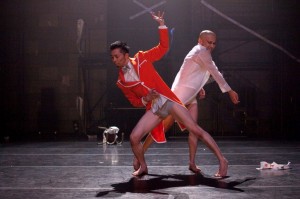
From Tokyo, “Misshitsu: Secret Honey Room,” created and performed collaboratively by Makotocluv founder Makoto Enda (in orange) and former Dairakudakan dancer Kumotaro Mukai (in white), has its North American premiere at Japan Society of New York Jan. 11-12. (Hideto Maezawa)
By JQ magazine editor Justin Tedaldi (CIR Kobe-shi, 2001-02) for Examiner.com. Visit his Japanese culture page here for related stories.
Japan Society swings into the new year with two nights of its upcoming 15th Contemporary Dance Showcase: Japan + East Asia showcase from Jan. 11-12. This year’s program features four North American premieres.
Since the inception of the Performing Arts Program in 1953, Japan Society has introduced more than 600 of Japan’s finest performing arts to an extensive American audience. The program also commissions new works to non-Japanese artists, produces national tours, organizes residency programs for American and Japanese artists and develops and distributes educational programs. Originally America’s leading platform for the introduction of Japanese choreographers and companies, the Dance Showcase has expanded to include artists and works of international acclaim from the broader East Asian region.
From Tokyo comes the U.S. premiere of post-post-post butoh Misshitsu: Secret Honey Room – Duo Version, created and performed collaboratively by Makotocluv founder Makoto Enda and former Dairakudakan dancer Kumotaro Mukai, following a world premiere at Setagaya Public Theatre/Theatre Tram in Tokyo in August 2012. Formed in 2001, Makotocluv appeared at Japan Society in 2008 and was hailed by the New York Times as “wonderfully fluent in the language of the theater.” Misshitsu: Secret Honey Room marks Mukai and Enda’s first collaboration in 15 years.
For the complete story, click here.
