




JQ Magazine: JQ&A with Web Entrepreneur Vanessa Villalobos
 Article/Journalism, Food & Drink, Interview/Profile, JQ Magazine
  Comments Off on JQ Magazine: JQ&A with Web Entrepreneur Vanessa Villalobos

“If you create businesses based on your own experience and enthusiasms, you’ll never tire of them. Be sure to network with JETAA to stay in touch with people who are interested in Japan.” (Courtesy of Vanessa Villalobos)
By Rafael Villadiego (Nagasaki-ken, 2010-13) for JQ magazine. A member of JETAA New South Wales, Rafael is a collector of words on a journey still searching for a destination, who has a tendency to forget, we are all sometimes like the rain…
Like many JET alums, Vanessa Villalobos (Tochigi-ken, 2000-03) thoroughly enjoyed her time in Japan and was seeking a practical means to maintain that connection upon returning home. Seeking to recapture her experiences on the JET Program and maintain her Japanese language skills after returning to the United Kingdom, she founded the travel/lifestyle/culture site JapaneseLondon.com and the language exchange hub, IsshoniLondon.co.uk.
As an independent businesswoman and entrepreneur, she offers some advice to JQ readers seeking to pursue their own ventures and shares some insight into the trials and tribulations of language exchange. She also offers insider tips to discovering the hidden Japan in London along with the colorful contrasts between the two island nations, her thoughts on the recent vote for Scottish independence, and her take on the UK version of nattō.
How long did you spend on the JET Program and in which prefecture were you placed?
I was a “one-shot” ALT in Tochigi-shi for three years. Tochigi-ken is north of Tokyo and is famed for Nikko, strawberries and gyoza.
How did your time on JET influence the overall design and purpose of the websites?
Japan was endlessly fascinating to me, and I loved teaching Japanese learners of English. Thus, I chose to focus my business endeavors on connections between Japan and England.
IsshoniLondon.co.uk connects private tutors of English to Japanese learners of English. Most of the tutors are ex-JETs. In my intro video on the site, I explain how the kindness of friends and teachers in Japan allowed us teachers to develop an understanding and fondness for Japanese language and culture, and how we hope Japanese people will develop the same fondness of the UK. I am always looking for top-quality tutors, so please do get in touch if you’d like to work as a freelance tutor.
JapaneseLondon.com does what it says on the can! It’s a labour of love and is all about discovering Japanese things in London. It promotes and profiles the individuals, events and businesses that together make up “JapaneseLondon”! There is an events calendar, and I’ve just added a job board. Please do sign up to the newsletter on the site! JapaneseLondon.com can also connect you to a tutor of Japanese here in London!
Do you have any advice for JETs looking to setup similar initiatives in their hometowns?
Just get stuck in—and don’t give up. If you create businesses based on your own experience and enthusiasms, you’ll never tire of them. Staying power is important as it is sooo hard to build your own business from scratch. But it is deeply satisfying at the same time! Be sure to network with JETAA to stay in touch with people who are interested in Japan.
JQ Magazine Editor Interviewed by FCI News on X Japan at Madison Square Garden
Celebrity, Events, JQ Magazine, Music Comments Off on JQ Magazine Editor Interviewed by FCI News on X Japan at Madison Square Garden
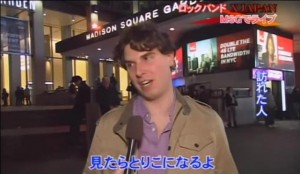
JQ magazine editor Justin Tedaldi talks X Japan outside Madison Square Garden, Oct. 11, 2014. (Courtesy of FCI NY)
JQ magazine editor/Japanese Culture Examiner Justin Tedaldi (CIR Kobe-shi, 2001-02) was recently interviewed by Alex York of Fujisankei (FCI) News for commentary on X Japan’s debut performance at Madison Square Garden on Oct. 11.
The spectacular three-hour show (see JQ‘s review of the concert here) was X Japan’s first and only American concert in four years, and the first to retain the band’s signature full stage production outside of Japan. Check out the video here or click on the image for Justin’s comments, and read his exclusive interview with X Japan’s leader Yoshiki here.
Direct link: http://www.youtube.com/watch?v=yWptyvtYCXM#t=43
JQ Magazine: Film Review — ‘The Tale of the Princess Kaguya’
Article/Journalism, Film, JQ Magazine, Reviews Comments Off on JQ Magazine: Film Review — ‘The Tale of the Princess Kaguya’

“For his finale, Isao Takahata has made a film that encompasses all of human experience.” (GKIDS)
By Lyle Sylvander (Yokohama-shi, 2001-02) for JQ magazine. Lyle has completed a master’s program at the School of International and Public Affairs at Columbia University and has been writing for the JET Alumni Association of New York since 2004. He is also the goalkeeper for FC Japan, a New York City-based soccer team.
When one hears the name “Studio Ghibli,” the director Hayao Miyazaki immediately comes to mind. Starting with Nausicaä of the Valley of the Wind in 1984, Miyazaki has continually delivered hit after hit for the past 30 years, making him the most successful contemporary Japanese filmmaker (animated or otherwise). Moviegoers can be forgiven for not recognizing the name of Miyazaki’s partner and Ghibli co-founder Isao Takahata, who tends to operate behind the spotlight. But Takahata is an accomplished animator and filmmaker in his own right.
In the West, he is best known for the extraordinary Grave of the Fireflies (1988), a powerful anti-war epic about the firebombing of Kobe during the Second World War. Roger Ebert considered Fireflies one of the best war films ever made, and it certainly ranks among Studio Ghibli’s greatest efforts, elevating the standards of anime depicting serious subject matter. Takahata’s other films were successful in Japan but received limited distribution in the West—notably the ecologically minded Pom Poko (1994) and the comic strip-inspired comedy My Neighbors the Yamadas (1999). From this selection of titles, it is clear that Takahata can work in a variety of genres with different animation styles. Unlike Miyazaki, he delegates much of the animation work and does not have an immediately recognizable aesthetic.
Last year, both Miyazaki and Takahata announced their retirements. For his swan song, Miyazaki released the controversial The Wind Rises (read JQ’s review here), which managed to receive criticism from both the political left and the right in its treatment of the war. Takahata decided to end his career with a project that he conceived and abandoned 55 years ago: A feature film version of the tenth century folktale The Tale of the Bamboo Cutter. Both films were to be released simultaneously in a show of solidarity, but production delays resulted in a later distribution for Takahata’s film. The film became a big hit domestically, and is now receiving its U.S. release under the title The Tale of the Princess Kaguya in both subtitled and dubbed versions.

X Japan take a triumphant bow at Madison Square Garden, New York City, Oct. 11, 2014. (Vlad Baranenko)
By Vlad Baranenko (Saitama-ken, 2000-02) for JQ magazine. Vlad is an avid photographer. For his photo gallery of X Japan’s concert at MSG, click here.
On Oct. 11, Madison Square Garden was ignited by the amazing energy of the sensational Japanese rock group X Japan. Realizing a lifelong dream of its founding members—vocalist Toshi and superstar drummer/pianist Yoshiki—X Japan overcame years of behind-the-scenes drama to finally play the World’s Most Famous Arena, as one of the most successful Japanese music groups of all time brought down the house in NYC.
For the first time ever outside of their native Japan, X Japan culminated their dream to perform an all-immersive concert, armed with a full array of fireworks, pyrotechnics, confetti, and incredible light effects. According to Yoshiki in one of many heartfelt messages delivered to the crowd that night, never before their performance at MSG has the group invested so much to awe an overseas audience, which he said was being broadcast live to Japan and other Asian countries.
Playing to a nearly packed arena, the group that started with a dream of two four-year-old boys almost 45 years ago kicked off the show with a pyrotechnic bang, letting the excited audience rock hard to “Jade.” By creating an all-immersive experience for their concert goers, X Japan’s mix of rock and the classical genres appealed to the emotions of young and old attendees alike. For their second appearance in NYC after their legendary show at the now-defunct Roseland Ballroom in 2010, the band’s deep appreciation for their fans’ support rang loud when Yoshiki shared the story of the group’s history and ups and downs. The death of former members Hide and Taiji hit everyone in the group hard, and as Yoshiki spoke about his late friend Hide as still being part of the group, many in the audience shed a tear.
Justin’s Japan: Interview with Yoshiki of X Japan on the Band’s Madison Square Garden Debut
Article/Journalism, Celebrity, Events, Interview/Profile, Justin's Japan, Music Comments Off on Justin’s Japan: Interview with Yoshiki of X Japan on the Band’s Madison Square Garden Debut

“At an X Japan show, we create a show with the audience—it’s not ‘the band is performing and the audience is just watching,’ so we create the show together. We’re going to try to make Madison Square Garden like a huge club.” (Courtesy of ID PR)
By JQ magazine editor Justin Tedaldi (CIR Kobe-shi, 2001-02) for Examiner.com. Visit his Japanese culture page here for related stories.
For Yoshiki Hayashi, this Saturday (Oct. 11) will go down in J-rock history, as one of the biggest bands in Asia makes their debut at Madison Square Garden. Formed over 30 years ago, X Japan first gained notoriety in the mid-’80s by ushering in the visual kei movement, a style that continues to evolve through other Japanese megastars like L’Arc~en~Ciel (who headlined the World’s Most Famous Arena themselves in 2012).
At the center of it all is X Japan’s founding member, Yoshiki. An equally talented songwriter, heavy metal drummer and classical pianist, he is both the heart and soul of X Japan, and, having lived in Los Angeles for two decades, the ideal mouthpiece for the band’s American tours, which started with a bang in 2010 at Lollapalooza and included a sold-out gig at New York’s now-defunct Roseland Ballroom.
In this exclusive, expansive interview, I spoke with Yoshiki about how the group’s original hopes to play the Garden in 2008 were dashed by personal health and management troubles, his favorite, anime, manga and X Japan songs, and his experience working with legends like Stan Lee, KISS, and the Emperor of Japan.
How did this concert for Madison Square Garden come together? I know there were plans to do this in 2008; can you talk about this history?
Our band reunited around the year 2008. We did our reunion concert in Tokyo Dome, three days or so, I think. At that time, we were also thinking of performing [shows] outside of Japan, and Madison Square Garden was one or two of [the ideas]. But for some reason they didn’t happen, so since then, that venue was always in our minds. A few years ago, we decided to try schedule Madison Square Garden. I think we were kind of confirmed last year.
It’s a long road.
Yes. Well, considering that X Japan was not doing anything—I mean, the band broke up around the end of 1997, so when we reunited we had almost 10 years of a break. We started doing a bunch of arena shows, and then we started touring the world when we went to 16 countries or so. Considering this, the [last] six or seven years have been tours [laughs].
Are there plans for X Japan to play any other concerts for the remainder of the year?
Not now. We just announced our shows in Japan, this place called Yokohama Arena, so we [performed] there Sept. 30 and Oct. 1. It’s kind of like a prelude to Madison Square Garden and a kickoff to [that] show, about 10 days before that. As of now, Madison Square Garden is the only American show, but [depending] on how it goes, we may start another world tour. We’re just talking about it right this moment.
For the complete story, click here.

“Samuels draws from historical precedents and a rich and meticulously researched source material, as well as his extensive experience as a long-time observer and commentator on Japan, to produce a compelling and thought-provoking attempt to examine the true impact of the 3.11 disaster.” (Cornell University Press)
By Eden Law (Fukushima-ken, 2010-11) for JQ magazine. Eden currently serves on the JETAA New South Wales committee in Sydney, Australia as the online social media, webmaster and occasional editor. Got feedback? Leave a comment below.
The natural and man-made disaster of the 2011 Tohoku earthquake provoked an intense and visceral response from within and without, which saw an unprecedented level of cooperation between allies and between former enemies, and a united outpouring of human generosity and spirit globally. Little wonder then, that the usual cynical rhetoric was replaced with wholly credulous proclamations of a new age that could be an economic, technological, political and social rebirth of a nation.
“We expect a lot from crises,” author Richard J. Samuels notes in 3.11: Disaster and Change in Japan’s preface, and confesses to have himself been caught up in that same wave of optimism. What would the actual consequences be from the disaster? Would it bring a new era of “revival,” one of a number of slogans touted around Japan in the months following 3.11, or would the goodwill and its accompanying momentum evaporate in the face of reality that brings with it the problems of coping and dealing with a humanitarian disaster?
Samuels draws from historical precedents and a rich and meticulously researched source material, as well as his extensive experience as a long-time observer and commentator on Japan, to produce a compelling and thought-provoking attempt to examine the true impact of the 3.11 disaster. Starting with a description of the state of Japan around the time of the event, he describes a country in the economic doldrums, far from its position that it occupied decades earlier as an economic powerhouse that was the envy (and fear) of the developed world. Politically, Japan’s government had become a circus of ever-changing prime ministers, resulting in low public confidence in its leaders. Little wonder, then, that when the calamity of March 11th struck, the expectation and need for change seemed especially urgent and indeed, possible, more than at other time in recent Japanese history.
Justin’s Japan: Nippon in New York — Studio Ghibli, New York Comic Con, X Japan, Hatsune Miku
Article/Journalism, Events, Film, Justin's Japan, Music Comments Off on Justin’s Japan: Nippon in New York — Studio Ghibli, New York Comic Con, X Japan, Hatsune Miku

Catch the New York premiere of Studio Ghibli’s “The Tale of Princess Kaguya” at IFC Center Oct. 3. (GKIDS)
By JQ magazine editor Justin Tedaldi (CIR Kobe-shi, 2001-02) for Examiner.com. Visit his Japanese culture page here for related stories.
The Japan-centric events of the month ahead promise to be as rich and full as autumn itself—brisk and colorful, with a dash of unpredictability.
This month’s highlights include:
Friday, October 3, 6:30 p.m.
IFC Center, 323 Avenue of the Americas
$14
New York premiere! Legendary Studio Ghibli co-founder Isao Takahata (Grave of the Fireflies, Pom Poko) revisits an ancient Japanese folktale in this gorgeous, hand- drawn masterwork decades in the making. Found inside a shining stalk of bamboo by an old bamboo cutter (James Caan) and his wife (Mary Steenburgen), a tiny girl grows into an exquisite young lady (Chloë Grace Moretz). The beautiful princess enthralls all who encounter her—but ultimately she must confront her fate. The film will have a “sneak preview” screening in Japanese at IFC Center on Thursday, Oct. 16 prior to its regular run Oct. 17. Click here for additional showtimes.
Sunday, Oct. 5, 4:00 p.m.
Best Buy Theater, 1515 Broadway
$42
The 10-member Morning Musume ’14, also known as Momusu, are one of the most successful Japanese all-girl idol groups, produced by the famous rock writer-producer Tsunku. Their music style is poppy and upbeat, matched only by their elaborately choreographed dance performances. Their story began in 1997 after a TV audition and they made their major debut in 1998.The following year, their single “Love Machine” was their first to sell over one million units. Morning Musume ’14 have already performed in China, Taiwan, South Korea, France and the USA (Los Angeles), and are poised to make their New York stage debut.
Sunday, Oct. 5, 7:00 p.m.
Peter Jay Sharp Theatre at Symphony Space, 2537 Broadway
$40/$30 members, students and seniors/$22 children
Experience the thunderous rhyhms of the ancestral Japanese taiko drums and the magical sounds of the bamboo flutes, as Taikoza returns with richly authentic performances and colorful Japanese dances. The international touring taiko group, led by Swiss-born director Marco Lienhard, will present new compositions as well as traditional pieces in this unique concert featuring special guest from Japan Ichiro Jishoya, who was recently featured in the documentary film Drum Out the Drum of Happiness – Inclusion. This concert will celebrate the 150 anniversary of the diplomatic relationship between Switzerland and Japan.
For the complete story, click here.

“Hopefully the lines between my actual experiences and pure fiction are seamless. When readers ask me, ‘Is this part true?’ they seem surprised by the answers. So that makes me happy—the fiction is believable and sometimes the outrageous is the truth.” (Courtesy of William Fraser)
By Rafael Villadiego (Nagasaki-ken, 2010-13) for JQ magazine. A member of JETAA New South Wales, Rafael is a collector of words on a journey still searching for a destination, who has a tendency to forget, we are all sometimes like the rain…
Laurie Fraser (Osaka-fu, 1997-98) is a writer and traveler who married a Kurd in Turkey in the 1990s. The experience inspired The Word Not Spoken, semi-autobiographical debut novel that blurs the line between reality and fiction, casting light on a tumultuous period in history through the eyes of those who experienced it firsthand.
The conflict between the PKK [Kurdistan Workers’ Party] and the Turkish Armed Forces has its roots in the First World War and continues to have repercussions for the region to this day. But beyond these grand struggles are the quiet moments in between: The ordinary challenges and trivial frustrations of everyday life, and the more overarching issues of culture and religion, which Fraser approaches with a genuine curiosity and gentle humor that forms the emotional core of her book.
An extensive traveler to a number of different countries across the globe, Fraser has experienced life in the broadest context before eventually finding her way “home.” Now a teacher and healer in Ottawa, JQ caught up with her to discuss the events of her life that inspired the novel and how they contrasted with her time on the JET Program.
What led you to first write this novel, and why did it take so long for the finished work to see light?
The scene where Ahmet and Leigh meet a group of destitute Kurdish refugees is exactly true, except that it happened in 1996, not 1995. I decided then to write a book and tell their story in a way that wasn’t “bad news.” At that time, my husband believed that the world would never hear about the Kurds if the PKK wasn’t setting off bombs. I recognized that as a Canadian, I had a right that he did not—the right to free speech.
I am a poet at heart, and I found a novel to be unwieldy to say the least. I had the poet’s need to touch every word over and over—so that slowed me down.
The Word Not Spoken was refused by countless publishers—I had a stack of rejection letters collected just in the year I was in Japan. It did well in a Canadian national writing contest in 2000, but only the winner was published. I was incapacitated with illness for a few years, but I eventually did a huge rewrite in 2010-11 with a professional editor. The manuscript did get better and better over the years, but it wasn’t until self-publishing became accessible and respected that I finally decided to go for it on my own.
I promised those refugees and my husband (who was killed in 1997) that I would publish their stories and really, it was a stone in my stomach for 18 years.
Kurdish House in Vancouver flew me out there (from Ottawa) to read to a large Kurdish audience this past spring. Afterwards, men and women came to talk to me: “I lived in one of those tents for four years.” “I was tortured 45 days.”
I have been haunted by the refugees I met living in those tents in 1996. I couldn’t imagine how any of them would have survived. These Vancouverites were an affirmation of life—some of them had made it! Some of them would have been children in 1996…and here they were! All I could say was, “I’m so glad you got here. I prayed for you.” And indeed, I wrote a book for them.
Justin’s Japan: J-Rocktober
Article/Journalism, Events, Justin's Japan, Music Comments Off on Justin’s Japan: J-Rocktober

Click image to read story
By JQ magazine editor Justin Tedaldi (CIR Kobe-shi, 2001-02) for Shukan NY Seikatsu. Visit his Examiner.com Japanese culture page here for related stories.
This October is set to be a landmark month for New York City, as it welcomes to the stage some of the most celebrated Japanese musicians performing today.
Things kick off on Oct. 5 with girl group Morning Musume ’14 at the Best Buy Theater. The forerunner to today’s mega-member pop acts like AKB48, Momusu has been spinning off hits since 1997, launching the career of songwriter-turned-record mogul Tsunku in the process.
On Oct. 11, X Japan, the country’s best-selling rock band of all time, becomes the second Japanese act to headline Madison Square Garden, following L’Arc~en~Ciel’s historic debut there two years ago. Led by the charismatic drummer (and classical pianist) Yoshiki, X Japan has sold out the 55,000 seat Tokyo Dome a record-setting 18 times.
The venerable Tokyo Ska Paradise Orchestra, which has been on the scene since the late 1980s and has collaborated with artists as diverse as Puffy, Shiina Ringo and Shakira, plays Irving Plaza on Oct. 14. If it’s cutting edge you crave, virtual idol superstar Hatsune Miku makes her New York bow at Hammerstein Ballroom on Oct. 17-18 with a special concert featuring 3D projection technology and a live band.
Seeking something heavier? Stadium act Maximum the Hormone, which appeared at Ozzfest Japan last year alongside Black Sabbath, Slipknot and Tool, invades the Best Buy Theater Oct. 27.
JQ Magazine: Book Review — ‘WA: The Essence of Japanese Design’
Art, Books, JQ Magazine, Reviews Comments Off on JQ Magazine: Book Review — ‘WA: The Essence of Japanese Design’

“WA is an excellent reminder that the analysis of everyday objects in our lives can be more insightful than we might first think, examining the roles of myriad mediums in Japanese daily life in ancient times to today including practical uses, religious ones, and political statements.” (Phaidon)
By Julio Perez Jr. (Kyoto-shi, 2011-13) for JQ magazine. A bibliophile, writer, translator and graduate from Columbia University, Julio is currently working at Ishikawa Prefecture’s New York office while seeking opportunities with publications in New York. Follow his enthusiasm for Japan, literature, and board gaming on his blog and Twitter @brittlejules.
Whether you like looking at furniture, crafts, art, and everything in between, in museums, magazines, or even Pinterest, you’re sure to appreciate the awe of a magical table, that from some angles is almost invisible, not to mention the rustic austerity of handmade materials for the Japanese tea ceremony and many other fascinating objects featured in WA: The Essence of Japanese Design. Throughout history, design and craftsmanship have had important roles in everyday life and practical uses, as well as in the arts and even in the political arena. WA explores the changing faces and development of Japanese design through the mediums themselves.
The book is divided into sections that include: Wood, Bamboo and Lacquer, Paper, Metal, Fabric and Textiles, Ceramic, and Synthetic/New Materials. Each section features a few dozen stunning photographs of objects, crafts, or even furniture, and a short essay that highlights pieces made from a particular material that, along with the photos, support its discussion about the development of that medium in Japan in a manner approachable for all readers. The contents of the book are written and selected by Rossella Menegazzo and Stefania Piotti, who are both scholars of East Asian arts and crafts, and they have successfully created a beautiful, approachable book on the subject.
WA explores the Japaneseness of Japanese design that has evolved throughout its history of ancient influences, from continental Asia and the Silk Road, through Japan’s periods of isolation, and continuing through today with its integration and innovation of Western design and cultural needs. WA is a very approachable book; the essays are not heavy with jargon and relate more to the pictures, which provides a very special and immediate connection to Japanese arts that would only be rivaled by holding the items themselves featured in the photos.
JQ Magazine: JQ&A with Mark Deyss of Marist Brothers International School in Kobe
Article/Journalism, Interview/Profile, JQ Magazine Comments Off on JQ Magazine: JQ&A with Mark Deyss of Marist Brothers International School in Kobe

“When students do right, let them know about it and make sure to tell their parents, too. Show students that although you may have high expectations, you are fair and reasonable. Love what you teach and that excitement will transfer to students. These are some things that I found go into successful teaching.” (MBIS, courtesy of Flickr)
By Lyle Sylvander (Yokohama-shi, 2001-02) for JQ magazine. Lyle has completed a master’s program at the School of International and Public Affairs at Columbia University and has been writing for the JET Alumni Association of New York since 2004. He is also the goalkeeper for FC Japan, a New York City-based soccer team.
A native of Delmar, New York, Mark Deyss (Yokohama-shi, 2001-02) is a history and social studies teacher at Marist Brothers International School in Kobe, which has been a historic institution for the Kansai region’s pre-K through 12th children since 1951. Married with two young children, Mark is also a competitive bodybuilder in his spare time.
In this expansive interview, Mark spoke with JQ about how a visit to Iowa landed him his job, the unique benefits and challenges that go with teaching and living long-term in Japan, and some surprising misconceptions about bodybuilding.
What sparked your interest in Japan? Were you always interested growing up, or was it more of a curiosity thing?
I didn’t have a real interest in Japan per se. I was more interested in teaching in Indonesia (Bali, to be specific) or Thailand (Phuket). Both those places seemed pretty cool and exotic to a 22-year-old fresh out of college (SUNY Oswego). But what the hell does a 22-year-old know?! In the end, I backed away from those locations because from what I could tell, you needed to actually go to the place and start knocking on doors at language schools to find a job. That was a little too much adventure for me. A professor at my college mentioned AEON. I looked into it and it turned out that I could interview with them right in New York City. They gave me a contract to look over before I actually went to Japan and they seemed much more legitimate in general. That’s how my interest in Japan developed—as a conservative alternative to Bali.
Can you tell us about the conversation school you taught at in Japan before you joined JET?
I first came to Japan in September 1998 to work with AEON. Like most people who knew nothing about Japan, I requested to be located in Tokyo (in fairness to myself, I did actually know a couple of people in Tokyo, which is part of the reason for the request). AEON said they didn’t have anything in Tokyo open, but put me as close to Tokyo as possible—Hiratsuka City, in Kanagawa-ken. It worked out for the best, as most things in life do. I was with AEON for a year before taking a job (for a lot more money!) with another small eikaiwa outfit named Proto, which was actually run by a car parts manufacturer named Nippon Seiki (amongst other things they make dashboard and instrument panels for the “All-American” Harley Davidson and Chevrolet Corvette). Proto was located in Nagaoka, Niigata, surroundings that were much different than the urban congestion of Kanto. I was with Proto for about a year and a half before I came back to Kanagawa (Yokohama) for JET.
What did you do after JET?
I went to NYC to attend graduate school (education) at Queens College. Those years were indeed the hardest of my life, but my trials weren’t related to Queens College per se, more just being a scared young adult with an uncertain future and a tenuous present! Queens College served its purpose well and gave me the wonderful experience of living in Flushing, New York.
While attending the college, I taught at The Summit School, located in Jamaica, New York. It is a pretty good school for learning disabled and emotionally disturbed kids. I already had some experience working with that population of students before I went to Japan for the first time (summer job), so it was not an unfamiliar thing for me. That job served its purpose and provided me with enough money (barely enough!) to pay rent, eat three meals a day and get out of grad school debt free.
JQ Magazine: Book Review – ‘Colorless Tsukuru Tazaki and His Years of Pilgrimage’ by Haruki Murakami
Books, JQ Magazine, Reviews Comments Off on JQ Magazine: Book Review – ‘Colorless Tsukuru Tazaki and His Years of Pilgrimage’ by Haruki Murakami

“Tsukuru Tazaki is more akin to a collection of related experiential pieces on existentialism rather than a straightforward story, which is why sometimes it can feel incomplete and unexplained. But there is a certain pleasure to be had from reading Murakami’s descriptive text, as he unhurriedly takes his time in building a backdrop by utilizing bits and pieces of asides and ephemera.” (Knopf)
By Eden Law (Fukushima-ken, 2010-11) for JQ magazine. Eden hails from the JETAA New South Wales chapter in Sydney, Australia, aging one hour at a time, his soul still empty, on the slow gentle slide to the eternal sleep of the grave. With the wind in his hair and a song in his heart, of course.
Haruki Murakami is a rare, superstar author who can engender the kind of excitement and anticipation more often seen with pop and movie idols. His latest novel, Colorless Tsukuru Tazaki and His Years of Pilgrimage, sold over a million copies in Japan in the first week, and overseas, the reception has been no less enthusiastic, with its release celebrated by midnight openings of bookstores with breathless fans queuing with anticipation.
Since its debut in English, the novel has topped the New York Times best sellers hardcover fiction list. As befitting such a book, it comes in a handsome dust jacket and cover designed by Chip Kidd, heavy with symbolism in blocked color bars and Japanese train routes peeking through plastic windows. Not all international covers for the book were created equally—check out this Tumblr gallery of all its international permutations, if you’re curious. It would seem that one doesn’t just read a Murakami novel; one experiences it.
I fully intended that last sentence to be facetious, but having finished the book, I’m not so sure I’m too far off the mark. In Tsukuru Tazaki, the author skillfully creates a world where characters are connected to each other by the most tenuous of relationships, gossamer-thin and fragile. For our eponymous protagonist, the most important relationship of his life—that with the only group of friends he has ever had—is suddenly and inexplicably severed, and he finds himself banished without explanation, causing a kind of spiritual trauma.
Justin’s Japan: Interview with James Rolfe of Cinemassacre on ‘Angry Video Game Nerd: The Movie’
Article/Journalism, Film, Interview/Profile, Justin's Japan Comments Off on Justin’s Japan: Interview with James Rolfe of Cinemassacre on ‘Angry Video Game Nerd: The Movie’

James Rolfe, left, on the Angry Video Game Nerd movie with co-writer/co-director Kevin Finn: “To me, it’s the ultimate fan-film. It’s made by fans, for fans. It means dreams can come true, with a lot of hard work and personal sacrifice.” (Justin Tedaldi)
By JQ magazine editor Justin Tedaldi (CIR Kobe-shi, 2001-02) for Examiner.com. Visit his Japanese culture page here for related stories.
An Internet sensation that debuted as the Angry Video Game Nerd ten years ago, filmmaker James Rolfe has taken millions of YouTube visitors back to the past with his hotheaded, foulmouthed alter ego, who gleefully tears down some of the most notorious titles and accessories (the Power Glove, anyone?) from the golden age of retrogaming. (If you’ve ever thrown a controller across the room, you’ll understand.)
As the creative linchpin of his website and production company Cinemassacre, the AVGN legend culminates with this year’s release of Angry Video Game Nerd: The Movie, a feature-length, years-in-the-making collaborative effort between Rolfe and co-writer/co-director Kevin Finn. A satisfyingly silly sci-fi/adventure hybrid in the Troma tradition, the film enjoyed a sold out 16-city North American screening tour earlier this summer, and makes its Vimeo on Demand debut today (Sept. 2), with a DVD/Blu-ray release planned for the holiday season.
In this exclusive, wide-ranging interview, I spoke with Rolfe about everything from the film’s New York premiere last month, the Nerd Renaissance we’re currently living in, and the most “Japanese” (i.e., insane) game he’s ever played.
It feels like we’re living in some kind of Nerd Renaissance—even “Weird Al” Yankovic’s last album went to number one. How do you feel about all this?
Nerds were big in the ’80s. It’s all coming back now. I feel there’s a much broader definition of “nerd” now, and it’s something to be proud of.
What are your thoughts on the live appearances you’ve had promoting the film so far? Which moments have been the most memorable?
Since July 21, we’ve been touring this movie around, city by city. It’s been amazing. The energy from the crowd is fantastic! There’s nothing like watching the movie with live reactions. The best moment is during the opening credits. Everyone cheers. Sometimes they clap along with the music. You can really feel the hype building up to the AVGN title screen. Then it explodes, and everyone goes nuts.
What can you share about the back-to-back screenings held for the New York premiere?
It was a rowdy crowd. Especially the second screening. I loved it, though it was exhausting. Under normal circumstances, I would be sick of looking at this movie, but the fans make it exciting every time. It never gets old.
Mount Fuji and Godzilla movies play a prominent role in the film. If you were to ever visit Japan, what would you most want to see and do there?
I’ve always wanted to go. There isn’t one thing in particular. I’d just like to see all around the major cities like Tokyo. Just normal tourist things.
What are some of your favorite moments of “Japaneseness” in video games that you’d like to give a shout-out to?
Hmmm. Not sure. Probably Ninja Baseball Bat Man! That game is insane.
For the complete story, click here.
Justin’s Japan: Nippon in New York — J-COLLABO Fall Fest, Craft Beer, The Joy of Sake, Akiko Yano
Article/Journalism, Events, Justin's Japan Comments Off on Justin’s Japan: Nippon in New York — J-COLLABO Fall Fest, Craft Beer, The Joy of Sake, Akiko Yano

Osaka-based Geisha Kikuno comes to J-LABO Brooklyn for two performances with multimedia director Kenji Williams Sept. 7. (Courtesy of J-COLLABO)
By JQ magazine editor Justin Tedaldi (CIR Kobe-shi, 2001-02) for Examiner.com. Visit his Japanese culture page here for related stories.
As the summer winds fade into fall colors, the weeks ahead are shaping up with these exciting events, ready to be enjoyed after Labor Day.
Sunday, Sept. 7, 1:00 p.m.
J-COLLABO Fall Festival feat. Geisha Kikuno
J-LABO Brooklyn, 300 Seventh Street
Suggested donation: $20
The history of the geisha spans over 300 years. Their beauty and grace is legendary as is their exceptional skill in music, dance and entertainment. In spite of a near worldwide fascination, the number of geisha is decreasing year by year. Geisha Kikuno is a unique Geisha from Osaka. She is dedicated to finding new approaches to promote this unique history to the next generation, and will come to New York for two performances to demonstrate this ancient art form in collaboration with multimedia director Kenji Williams.
Friday, Sept. 12, 6:30 p.m.
Kampai! The World of Japanese Beer
Japan Society, 333 East 47th Street
$28, $23 Japan Society members/seniors
Pull up a stool to Japan Society’s annual beer lecture and tasting, featuring unique and rare brews from Japan’s emerging craft beer industry. Mark Meli, professor at Kansai University and author of Craft Beer in Japan: The Essential Guide, delves into the culture, history and innovative brews coming out of Japan’s beer scene during the lecture. At the tasting reception, enjoy the opportunity to sample many unique and hard-to-come-by brews. Must be at least 21 years old.
Sept. 12-Oct. 10
Japan — An Island Nation: 1870-1890
Resobox Gallery, 41-26 27th Street, Long Island City
Free
An exhibition of entrepreneurial class culture from the Burns Archive. Japan — An Island Nation showcase the best of Japanese photographs that were made to show the perceived exotic nature of Japan to the West. Photographers, under government supervision, documented the artisans, shopkeepers and workers that made up the bulk of the Japanese middle and working class entrepreneurial society. It was critical for Japanese “public relations” of the era to put a face on Japan’s people and products, and through international fairs and expositions the world was introduced to Japan. A free opening reception will be held Friday, Sept. 12 from 7:00 p.m.-9:00 p.m.
For the complete story, click here.
JQ Magazine: JQ&A with John Gaunter on ‘Sake Confidential’
Article/Journalism, Books, Food & Drink, Interview/Profile, JQ Magazine Comments Off on JQ Magazine: JQ&A with John Gaunter on ‘Sake Confidential’

“Sake is so deep and varied that one could never stop talking about it. Every day is full of surprises. Not major ones, but usually surprises related to the attention to detail that goes into sake and the interesting stories behind it.” (Courtesy of John Gauntner)
By Eden Law (Fukushima-ken, 2010-11) for JQ magazine. Eden is a JETAA New South Wales committee member, who would like it to be known that if it wasn’t for getting involved with JETAA, he wouldn’t know what to do with his spare time after hours. JET: It’s like the Illuminati, except less about the world domination and more about the fun denomination. Got feedback on this article? Leave a comment below.
If ever there was a prize for most unexpected job opportunity spin-off from the JET Program, the career of John Gauntner (Kanagawa-ken, 1988-89) would be hard to beat, especially after a few rounds of nihonshu. A longtime resident of Kamakura and the world’s first (and only) non-Japanese to hold certification as both a Master of Sake Tasting and Sake Expert Assessor, Gauntner has come a long way since a drinking session with a buddy from The Japan Times led him to this series of fortunate events.
Proving that this beverage continues to be an infinite font of inspiration, Gauntner has recently added a new book to his growing stable of literary output, Sake Confidential: A Beyond-the-Basics Guide to Understanding, Tasting, Selection, and Enjoyment. In it, he covers all aspects of the precious drop: from what it is, how it is made, and how it is meant to be enjoyed (spoiler: any way you like it), to the inside story of its politics, marketing, and the industry itself. But this is no textbook: Like a true sake evangelist, Gauntner enlightens beginners and insiders alike, pairing clear and simple language with confidence and unabashed passion.
In this exclusive interview, Gauntner discusses the state of sake’s popularity in its own country and abroad, what it means being a non-Japanese sake evangelist with his unique qualifications, and what the future holds for him.
What was the reason behind writing this book, and who is its audience?
I wanted to show the depth and breadth of the sake world, to show it has as many avenues for exploration as wine does.
How is this book different from the others?
This book goes beyond the basics and more into depth about many interesting side topics of the sake world.
Is this book designed to replace or update your previous books?
No, it is intended to augment them. This one introduces less sake and is light on the basics,
What’s the market like for these books?
So far it is selling well, but ask me in two years!
What’s left to be said about sake? Are there any surprises left in the industry?
It is so deep and varied that one could never stop talking about it. Every day is full of surprises. Not major ones, but usually surprises related to the attention to detail that goes into sake and the interesting stories behind it.
