




Sake World e-Newsletter by John Gauntner (November 2010)
 Celebrity, Cultural Outreach, Food & Drink, Notable JET Alums, Writers
  Comments Off on Sake World e-Newsletter by John Gauntner (November 2010)

John Gauntner: JET alum and leading sake expert
The November 2010 issue of the Sake World E-mail Newsletter by JET alum and leading sake expert John Gauntner (aka “The Sake Guy”) is now available online. In this issue:
1. Greetings
2. “I’m from the Gov’t”
3. The 18 Nihonshu Samurai Tasting
4. Did You Know?
5. Sake Basics
6. Announcements and Events: Sake Professional Course in Japan
7. Sake Education Central
Additional Links:
 Culture Spreaders is a new feature intended to shine a spotlight on JET alums involved in spreading and sharing Japanese culture in their home countries. If you know of a good JET alum for a future post, just e-mail jetwit [at] jetwit.com tell us why you think that alum is a Culture Spreader. (Self-nominations welcome too.)
Seattle-based Bruce Rutledge (MEF Program Chiba-ken, 1985-87) is the Editor-in-Chief of Ibuki, the “Japanese Inspired Food and Lifestyle Magazine” for the Seattle/Bellevue/Portland area. (www.ibukimagazine.com)
I was in Seattle this past weekend and (thanks to JETAA Pacific Northwest President Sandra Sakai) was able to pick up a copy of the “I Love Kawaii” issue, which featured “6%Dokidoki Brings Happy Anarchy,” “Your Slice of Japan on the Eastside,” a recipe for green tea sweets, a travel article titled “Kanpai in Tokyo” and a sake article titled “Food pairing hints.” The magazine also includes an extensive Japan-related business directory for the area, including restaurants, galleries, grocery stores, etc.
In addition to his work with Ibuki, Bruce is also the founder of Chin Music Press, which has put out a number of Japan-related books and takes pride in book design.
For all his work with Ibuki and Chin Music Press, Bruce is undoubtedly a major JET alum “Culture Spreader.”
Message from JETAA International Chair Shree Kurlekar
JETAA Chapters, Uncategorized Comments Off on Message from JETAA International Chair Shree Kurlekar
The following is the text of an e-mail sent out to the JETAA chapter representatives listserve by newly elected JETAA International Chair Shree Kurlekar (Shiga-ken, 2005-07). With Shree’s permission, we’re re-posting a slightly edited version here on JetWit for the benefit of the JET alumni community. For more information about JETAA International, you can visit the website at http://jetalumni.org.
Greetings members of the JET alumni community,
My name is Shree Kurlekar and I was elected Chair of JETAA International at the JETAAI meeting October 1-3 in Edinburgh, Scotland.
Here’s a list of what will be covered below:
1. Introduction to me and the new JETAAI Board
2. The Future of JET and JETAA
3. 2010-11 Action Plan for Country Representatives
*******************
JET ROI: Japan Times readers respond to Debito Arudou’s “Don’t Blame JET for Japan’s Poor English”
Return on JET-vestment, Uncategorized Comments Off on JET ROI: Japan Times readers respond to Debito Arudou’s “Don’t Blame JET for Japan’s Poor English”
Back in September the Japan Times ran a column by Debito Arudou titled “Don’t Blame JET for Japan’s Poor English.” The article defended JET against criticism of non-improving English test scores. But it also waded into some generalizations that prompted some thoughtful responses. (Thanks to CLAIR-NY’s Matt Gillam for the heads up.)
Click here to see all of the responses.
The final word on JET, for now
Arudou misses the mark
Debito Arudou’s recent article on the JET (Japan Exchange and Teaching) Programme (Just Be Cause, Sept. 7) and many of the responses which followed (Have Your Say, Oct. 12):
I do agree that there are some systemic challenges educators must attempt to overcome in order to provide these kids with the English education they deserve. But Mr. Arudou’s arguments are so simultaneously inflammatory and reductive that I cannot believe a reputable publication would venture to publish them.
He is right to have concerns about the very real institutionalized handicaps in the Japanese educational system, but his ideas are so ill-articulated (“Group psychosis?” Are you kidding?) and, frankly, ignorant that I fear the real problems (and solutions) become lost in the muck.
The article itself misses the opportunity to shed light on what is actually happening in Japanese schools. Mr. Arudou is right to worry that cutting the program and withdrawing the significant foreign presence in Japan might be counter- productive, but I do not believe that that is because the Japanese are suffering from “eigo psychosis,” whatever that means. The “problems” are institutionalized at this point — a reflection of the greater cultural conflict Japan faces as it strives to look forward while staying rooted in history and tradition.
The push/pull between The Way Things Have Always Been Done and Read More
JET ROI: Shukan NY Seikatsu article on JETAANY Welcome Back Reception quotes Jim Gannon
JETAA Chapters, Return on JET-vestment Comments Off on JET ROI: Shukan NY Seikatsu article on JETAANY Welcome Back Reception quotes Jim Gannon
Below is a copy of an article from Shukan NY Seikatsu (Weekly NY Life) about the JETAANY Welcome Back Reception held on November 6. The article includes some quotes from James Gannon (Ehime-ken, 1992-94) (Executive Director of the Japan Center for International Exchange (JCIE/USA), author of the July 3 “JET on the Chopping Block,” and one of the newest members of the JETAANY Board of Directors) that appeared in the November 5 op-ed written by James along with Michael Auslin (Director of Japan Studies at the American Enterprise Institute) and Paige Cottingham-Streater (Deputy Executive Director of the Maureen and Mike Mansfield Foundation).
The article is titled, “JET Program as a bridge between the US and Japan: An alumni event held in New York City.” It talks about the JET Program alumni event welcoming 23 new returnees who worked as ALTs or CIRs via the JET Program and who recently returned to the New York area. The article says that approximately 110 guests in total attended the event. And Ambassador Nishimiya encouraged the new returnees in his speech saying, “I hope you will continue to do your part building bridges between the people of Japan and the United States.” The article also introduces Mr. James Gannon as a JET alumnus and quotes from the Asahi Shimbun op-ed: “The JET Program is a ‘triumph of soft power’ in the US-Japan relations in the grassroots level.” (Thanks to Noriko Furuhata of the Consulate General of Japan in New York for help with the translation.)

JET Program mentioned by PM Kan in meeting with President Obama
Return on JET-vestment, Uncategorized Comments Off on JET Program mentioned by PM Kan in meeting with President Obama
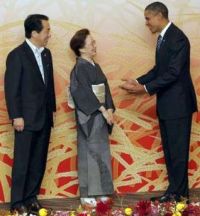 According to some recent article in the Japanese press, Prime Minister Naoto Kan mentioned the JET Programme in his meeting with Obama, reaffirming the program’s importance.
This is of course a significant statement about the importance of the JET Program to Japan.
Here are two articles:
- Japan Today (English): http://www.japantoday.com/category/politics/view/kan-obama-discuss-rare-earths-other-clean-energy
- Chunichi Shinbun (Japanese): http://www.chunichi.co.jp/s/article/2010111301000669.html
Here are some highlights from the Japan Today article:
Kan also told Obama that he aims to enhance bilateral exchanges between the two countries to include a wide range of people in five years.
The initiatives include sending young Japanese teachers and interns to the United States, as well as implementing such programs as promoting collaboration on education and two-way exchanges among universities in Japan and the United States, the officials said.
Kan also expressed concern about the declining number of Japanese students studying in the United States and voiced his intention to work more on this problem.
He also reaffirmed the importance of existing efforts, including the Japan Exchange and Teaching Program, the officials said.
JETAA DC Film Festival – Dec 3 and 5
Events, Film, JETAA Chapters, Uncategorized Comments Off on JETAA DC Film Festival – Dec 3 and 5
Via Mack Maloney, President of JETAA DC:
JETAA DC will be holding a film festival at the Freer Gallery of the Smithsonian Institute the weekend of December 3-5.
1. Friday, December 3 @ 7pm is “Linda Linda Linda.”
The film follows four girls as they prepare their band for their final school festival. Accompanied by a great soundtrack, this film is funny, poignant, and will certainly have you longing for your school festival (and a karaoke box).
2. Sunday, December 5 @ 2pm is “The Harimaya Bridge,” written and directed by JET alum Aaron Woolfolk (Kochi-ken) who will be in attendance.
Filmed in Kochi Prefecture, “The Harimaya Bridge” is a drama about an American man who must travel to rural Japan to claim some important items belonging to his late son, from whom he was estranged. While there, he learns several secrets his son left behind. Mr. Woolfolk will be in attendance during the screening and will stay to answer questions about his craft and his experiences. Come see a film the Los Angeles Times calls “a unique, complex, consciousness-raising accomplishment,” and Derek Kester of the San Francisco Examiner labels one of the best films of the year.

Via Dan Dooher (Akita-ken, 2006-10):
After reading your most recent JetWit Diary post, I wanted to share with you something Akita Prefecture has just recently started:
The Prefecture’s International Affairs Division is trying to reconnect Akita JET alumni and study abroad students with the prefecture via a bi-monthly newsletter called, “Akita Global Network.”
In the International Affairs Division’s own words:
“The project hopes to reach people who have left Akita to both maintain connections to Akita and elevate overseas awareness of our prefecture. We are planning to issue “Akita Global Network Newsletter” bi-monthly. Please enjoy it with your friends and family.”
If there are other former JET alums out there from Akita interested in receiving this pdf newsletter, please contact the International Affairs Division at: kokusaika@pref.akita.lg.jp
The newsletter welcomes submissions from alumni as well.
Dan also wondered if any other prefectures are doing something similar. If you are aware of any similar efforts, please email jetwit@jetwit.com. Yoroshiku!
Gunma-ken JET alum and Florida JETAA Newsletter Editor Bahia Simons-Lane has a good post on her blog–Bahia Portfolio: Posting about Japan, language and education–on the debate concerning benefits derived from the JET Programme.
A little more about Bahia and her background:
Bahia was an Assistant Language Teacher at a girls’ high school in Gunma Prefecture for 2 years, then she worked for the Gunma Prefecture Board of Education as the Assistant Language Teacher’s Advisor. She is currently pursuing a Master’s in International and Intercultural Education.
Don’t believe the hype
Article/Journalism, JETs in the News, Return on JET-vestment Comments Off on Don’t believe the hype
A recent post on InsideJapan News Network titled “Japan Plans US Teacher Training Scheme” cites a Daily Yomiuri article about a new proposed project to send Japanese teachers to the U.S. for two years of training. The Yomiuri article suggests that if this new project were to go forward, it would mean the end of the JET Programme.
However, after checking with several well-versed sources both in and out of the Japanese government, it sounds like the article’s analysis is inaccurate. Apparently, it would most likely be complementary program (if it even happens) and would not mean the end of the JET Programme.
To paraphrase one source, it wouldn’t make sense for President Obama to back a plan that would reduce the number of jobs for Americans.
Lars Martinson’s “Tonoharu: Part Two” reviewed by BoingBoing
Books, Cartoon/Illustration, JETs in the News, Notable JET Alums, Reviews, Writers Comments Off on Lars Martinson’s “Tonoharu: Part Two” reviewed by BoingBoing
JET alum Lars Martinson recently released his follow-up graphic novel Tonoharu: Part 2. Here’s the review by Mark Frauenfelde of BoingBoing:
“Tonoharu Part Two: Excellent graphic novel about an English teacher in Japan”: http://www.boingboing.net/2010/11/10/tonoharu-part-two-ex.html
(Editor’s note: I have a copy of Tonoharu: Part 1, and every time I show it to a fellow JET alum and they start reading it, they end up reading the whole thing (which takes about 15 minutes). It’s really terrific and very unique.)

Return of the Samurai
Article/Journalism Comments Off on Return of the Samurai
Thanks to JET alum Margie Banin (who works as an “Ex-pat Coach”) for sharing a nice NY Times article titled “Return of the Samurai” which comments on the 150th anniversary of the first Samurai delegation to visit the U.S. in 1860.
Among other interesting tidbits, there was apparently almost a scandal when several of members of the Japanese delegation were found naked together in their hotel bathtub.
 JetWit Diary is a new feature by Steven Horowitz (Aichi-ken, 1992-94), founder and publisher of JetWit. Steven is available on a consulting basis to assist organizations with any membership building, social media consulting, creative communications and writing needs.
Early November for JETAA chapters usually means welcome back receptions and career forums. It also means a great opportunity to gather JET-relevant info.
Here in New York, one thing that was clear in Ambassador Nishimiya’s speech at the JETAANY Welcome Back reception is that JETAA has played a significant role in helping to communicate the value of JET to the Japanese public and that JETAA’s efforts have been noticed and appreciated. Those efforts have helped at the central government level to push back against some of the negative and often not-so-well-informed commentary that was getting out there.
That said, I also learned from a recently returned Aichi JET that Aichi will no longer take on prefectural JETs as of the coming year. That news is a bit concerning. Because if budget cuts at the local level take a toll on the JET Programme, and in turn the future number of JET alums, then that means a shift in our priorities.
Going forward, perhaps we need to focus our energy on local governments in Japan and finding ways to help them get a better return on their JET-vestment. It’s worth noting that many JETs are already giving back to their local governments in lots of ways. JETs have set up businesses, have brought tourists, have nurtured sister city relationships and done other things that have provided value. You may not have heard about most of them, but they’re happening. Which means on that level, the challenge is to identify them, gather them and make sure people know about them (e.g., by writing about them on JetWit, on chapter websites, in the media, etc.)
But it also means that the JET alumni community may need to be more innovative and creative (just like that time you were asked to teach a class with 2 minutes’ advance notice and no lesson plan). It would be extremely helpful to our cause if we can figure out more ways to tap the energy of the JET alum community and channel it towards the benefit of local governments in Japan.
The JET-Sister City List Project is one attempt in that direction. But the next step is to figure out what else we can do with it.
Another simple but effective way to lay the groundwork to make things happen is to build up affinity groups such as the JET Alumni Travel & Tourism group, the JETAA Education Professionals group, the JET Alumni Non-Profits group, the JET Alumni Writers group and the JET Alumni Policy & Government group. And if you can think of another group that would be good to have, then go ahead and set it up and we can post it on JetWit.
Whatever we do as a community, it’s clear that now is the time to step up. And keep in mind that every problem is also an opportunity.
************
JetWit Bits
- One recent returnee at the Welcome Back Reception mentioned she found her job in NYC via JetWit and pointed out something I hadn’t really considered: That it’s hard to find jobs back home while you’re in Japan, and JetWit seems to do a good job of filtering through JET-relevant jobs in ways that Monster.com and CareerBuilder don’t. That said, I also realize that JetWit is fairly America-centric. Not by design, but just because that’s where I live and that’s where most job listings come from. If anyone in the UK, Australia, New Zealand or elsewhere wants to start posting JET-relevant jobs on the site, by all means please get in touch.
- “What do people do after JET?” Another recent returnee told me that’s the question that was on her mind as she finished her contract. And she appreciates that JetWit answers it. Her comment reminded me that that’s the same question that drove me back in 2002 when I became the JETAANY Newsletter editor. I had no idea where people went after JET and what they did. As a result, a lot of the articles were driven by my curiosity to figure out the answer to these questions, one JET at a time. We still probably don’t the answer for maybe half the alums out there. (Contrary to popular belief, there is no central or government JET alum list anywhere that tracks where people are and what they’re doing.) But now, at least, we know a great deal more than we used to. And that’s helped strengthen the community and also created a positive feedback loop where the strength of the network draws in more JET alums who were previously off the radar screen.
- Thanks to everyone for spreading the word about the JET-Sister City List Project. I’m enjoying all the responses that come in. And I noticed that JETAA Hawaii and JETAA Pacific Northwest posted the request to their membership which has led to more submissions. Speaking of which, I’ll be in Seattle this weekend to visit some JET alumni friends and am fortunate that my trip happens to coincide with the JETAA PNW Happy Hour at Wann Izakaya! (Also, if anyone in Seattle has an extra pack ‘n play lying around, let me know. :-)
Gambarimashou.
Steven Horowitz (Aichi-ken, 1992-94)
Brooklyn, NY
JET Alumni Translators and Interpreters Group on LinkedIn
Career, Networking, Translating/Interpreting Comments Off on JET Alumni Translators and Interpreters Group on LinkedIn
I just set up a long overdue JET Alumni Translators & Interpreters Group on LinkedIn:
http://www.linkedin.com/groups?mostPopular=&gid=3676490
A great way to connect with other JET alum translators and interpreters and share and collaborate on work opportunities as well.
(FYI, I’ve maxed out the number of groups I can create on LinkedIn. So if you have another idea for a JET alum affinity group, go ahead and set it up and I’ll publicize it. Because I can’t create any more of these.)
Looking for a job in Tokyo (or Japan)? JETAA Tokyo can help
Career, JETAA Chapters, Jobs, Networking Comments Off on Looking for a job in Tokyo (or Japan)? JETAA Tokyo can help
 If you’re looking for work in Tokyo (or even in Japan in general), a good place to start is the JETAA Tokyo website where you can sign up for their monthly digest, including job listings and career support activities.
Here’s the link: www.jetaa-tokyo.org
Have a job listing you want to get out to the JETAA Tokyo community, or a career-related inquiry? Email career@jetaa-tokyo.org.
